
by Daniel Gauss
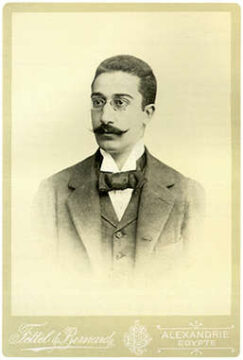
I started playing with the idea that Constantine P. Cavafy might be a type of Faust-like character who beats the devil by making temptation irrelevant. Through a poetry devoted to memory, sensuality and the afterlife of desire, Cavafy undermines the Christian-Faustian assumption that pleasure necessarily decays into guilt, disappointment or damnation.
In Cavafy’s work, ecstatic gay sexual experience is not morally or spiritually ruinous, but can, in fact, be among the highest forms of human physical and emotional intensity, experientially irretrievable as a discrete moment, haunting and provocative as a memory but still incorruptible.
Frankly, it might be more accurate for me to say I wish to use Cavafy as a type of anti-Faust. I see Cavafy as a queer poet who dismantles a foundational Western myth from the inside out. What Cavafy preserves in memory is not shame but a type of radiance (a term he uses in his poetry). The sensual experiences of youth do not become evidence of moral lapse or failure even though he might speak ironically about “dissolution.”
Indeed, when Cavafy explores dissolution, it functions as a positive factor in his development as a poet. By dissolution he means a life lived outside the moral pretenses and hypocritical codes of propriety of Alexandria under British rule in the early 20th century, a social world where queer desire often had to be managed through concealment, subterfuge and obliquity.
Dissolution meant a life of erotic freedom and experience, charged secrecy, bold risk and nonconforming encounters that would have been condemned and caused severe social repercussions. For Cavafy dissolution becomes the wellspring of his creative brilliance, showing that the unconventional, even taboo, experiences of his youth were what shaped his art. Read more »