
Enjoying the content on 3QD? Help keep us going by donating now.
Category: Recommended Reading
The US really is unlike other rich countries when it comes to job insecurity – and AI could make it even more ‘exceptional’
Jeffrey C. Dixon in The Conversation:
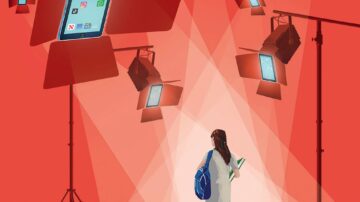
 How will AI affect American workers? There are two major narratives floating around. The “techno-optimist” view is that AI will free humans from boring tasks and create new jobs, while the “techno-pessimist” view is that AI will lead to widespread unemployment.
As a sociologist who studies job insecurity, I’m among the pessimists. And that’s not just because of AI itself. It’s about something deeper – what scholars call “American exceptionalism.” While people commonly use this phrase to refer to anything that makes the U.S. unique, I use it narrowly to refer to the country’s approach to work and social welfare, which is quite different from the systems in other rich countries.
I suspect AI will “turbocharge” American exceptionalism in ways that make workers more afraid of losing their jobs. When fused with organizations’ adoption of new types of AI, workers’ fears may soon become reality, if they haven’t already.
More here.
Enjoying the content on 3QD? Help keep us going by donating now.
Two Years of Doxxing at Harvard
Max Krupnick in Harvard Magazine:
 On Wednesday, October 11, 2023, an unusual truck circled the streets surrounding Harvard Yard, pausing outside the bakery across from Widener Library. Three video screens on its sides showed the faces and names of Harvard students. Accompanying text, in newspaper typeface, labeled them “Harvard’s Leading Antisemites.”
By now, nearly everyone is familiar with how it happened. The day after the October 7, 2023, Hamas terrorist attacks on Israel, Harvard’s Palestine Solidarity Committee circulated a letter holding “the Israeli regime entirely responsible for all unfolding violence.” Representatives of 33 student organizations, from overtly political groups to a South Asian dance troupe, cosigned it. And amid the angry backlash, some prominent voices called out for a particular form of retribution. Investor Bill Ackman ’88, M.B.A. ’92, posted on X that Harvard should release the names of students who belonged to the signing groups “to insure [sic] none of us inadvertently hire any of their members.” If students support the letter, he continued, their views should be “publicly known.”
More here.
Enjoying the content on 3QD? Help keep us going by donating now.
How ageing changes our genes
Chris Simms in Nature:
 The visible effects of ageing on our body are in part linked to invisible changes in gene activity. The epigenetic process of DNA methylation — the addition or removal of tags called methyl groups — becomes less precise as we age. The result is changes to gene expression that are linked to reduced organ function and increased susceptibility to disease as people age. Now, a meta-analysis of epigenetic changes in 17 types of human tissue throughout the entire adult lifespan provides the most comprehensive picture to date of how ageing modifies our genes.
The study assessed DNA methylation patterns in human tissue samples and revealed that some tissues seem to age faster than others. The retina and stomach, for example, accumulate more ageing-related DNA methylation changes than do the cervix or skin. The analysis also found universal epigenetic markers of ageing across different organs. This ‘epigenetic atlas’ might help researchers to study the link between DNA methylation and ageing and could aid the identification of molecular targets for anti-ageing treatments.
More here.
Enjoying the content on 3QD? Help keep us going by donating now.
Dua Lipa in Conversation With Percival Everett
Enjoying the content on 3QD? Help keep us going by donating now.
Salt Statues: Carhué Cemetery, Buenos Aires
Mariana Enríquez at the Paris Review:
The concrete Christ designed by Francisco Salamone, severe like all his works are, emerged some time ago from the ultrasalty waters of the flooded Epecuén Lagoon. Now people leave offerings to it, partly in thanksgiving that the flood didn’t reach the town of Carhué, partly to pray that the town of Villa Epecuén will once again become the successful tourist resort that it was for decades, before it turned into the ruin it is today, a town haunted by trees so dry and salt-coated they look like they’re made of ash. White trees, ghost trees, triffid trees with their roots exposed, trees that look like spiders on an endless march.
I remember photographs of that Christ on the cross. The water had risen to cover his feet, and all around him were dead, half-submerged trees. The trees are still there, but the crucifix was moved a few meters closer to the city; it’s now on a wooden platform that you access by a ladder from the beach in front of the lake.
more here.
Enjoying the content on 3QD? Help keep us going by donating now.
Tuesday Poem
September
September
and autumn creeps
into summer’s room
so many dresses
shade upon shade of green
too many
the young girl
wants something richer
to bring out
the cream of her skin
the sweep
of her dark hair
she fingers an oak leaf
imagining herself dancing
in that shape, but fiery, across the hills
smiles
yes
that will do
Enjoying the content on 3QD? Help keep us going by donating now.
On Felix Shumba
Marissa Moorman at the LRB:
The female cabbage tree emperor moth (Bunaea alcinoe) is the size of a human hand. I saw one in 1992 in Zimbabwe’s Eastern Highlands, where the Vumba mountain range runs along the border with Mozambique; in the 1970s, ZANU guerrillas fighting for independence from white Rhodesia had hidden in the area. I snapped a shaky photo of the giant moth, beneath a dull outdoor light, with a pocket camera. I don’t know whether I still have the print, but it doesn’t matter. The image stayed with me. The moth was alone. Still. Unbothered. She seemed to own the night.
I remembered the moth when I visited the artist Felix Shumba at the International Studio and Curatorial Programme in Williamsburg, Brooklyn in March this year. Shumba, an artist from Zimbabwe, spent three months in the converted industrial space of the ISCP. Charcoal drawings hung on the walls. File folders were arranged on the floor in neat rows. Shumba had drawn oversized bugs on them in charcoal, including a moth. He makes the charcoal himself. It is light in the hand but his images are full of gravity. The human and animal figures sometimes seem to lift from the paper, as if they could step into the room.
more here.
Enjoying the content on 3QD? Help keep us going by donating now.
Monday, September 1, 2025
John Updike was that rarest of things: a writer who wrote much the same in private as he did in public
Peter Tonguette at The American Conservative:
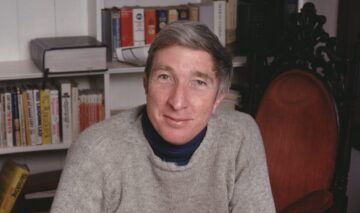 Few American authors of the past century churned out as many words. Even peers who matched or exceeded Updike’s productivity when it came to novels, such as Philip Roth, could not keep pace when factoring in the numerous other modes in which he regularly put pen to paper: short stories, poems, book reviews, essays, a play, a memoir, and even five books for children. Multiple books appeared after his death, including a final volume of short stories, My Father’s Tears.
It should come as no surprise, then, that Updike was as expansive, candid, and prolix in his personal correspondence as he was in his writing for publication and for pay. The superb, revelatory Selected Letters of John Updike gives an indication of the eagerness with which Updike wrote to friends, family members, both his wives, countless editors, and even the occasional critic. By the same token, the stuff and substance of these letters is much like that of his much-honored fiction, including “The Music School”: ordinary life, up to and including churchgoing. “Updike was able to bestow vibrancy and meaning upon that which would otherwise seem ordinary, so that it resonates and hums,” writes James Schiff, the editor of the present volume. “In so doing, he offers us a new way of seeing and knowing our daily lives.” We find here that Updike was that rarest of things: a writer who wrote much the same in private as he did in public.
More here.
Enjoying the content on 3QD? Help keep us going by donating now.
‘Ten Martini’ Proof Uses Number Theory to Explain Quantum Fractals
Lyndie Chiou and Joseph Howlett in Quanta:
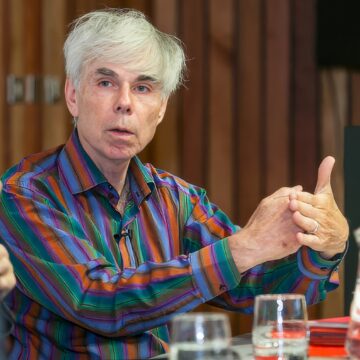 In 1974, five years before he wrote his Pulitzer Prize–winning book Gödel, Escher, Bach: An Eternal Golden Braid, Douglas Hofstadter(opens a new tab) was a graduate student in physics at the University of Oregon. When his doctoral adviser went on sabbatical to Regensburg, Germany, Hofstadter tagged along, hoping to practice his German. The pair joined a group of brilliant theoretical physicists who were agonizing over a particular problem in quantum theory. They wanted to determine the energy levels of an electron in a crystal grid placed near a magnet.
Hofstadter was the odd one out, unable to follow the others’ line of thought. In retrospect, he’s glad. “Part of my luck was that I couldn’t keep up with them,” he said. “They were proving theorems, but they had nothing to do with the essence of the situation.”
Hofstadter instead decided to test out a more down-to-earth approach. Rather than proving theorems, he was going to crunch some numbers using an HP 9820A(opens a new tab) desk calculator — a computerlike machine that weighed nearly 40 pounds and could be programmed to perform complex computations.
Hofstadter needed it to solve a particular formulation of the Schrödinger equation, which lies at the core of quantum mechanics.
More here.
Enjoying the content on 3QD? Help keep us going by donating now.
Sequoia Capital’s view: The $10 Trillion AI Revolution
Enjoying the content on 3QD? Help keep us going by donating now.
Gaza postwar plan envisions ‘voluntary’ relocation of entire population
Karen DeYoung and Cate Brown in The Washington Post:
 A postwar plan for Gaza circulating within the Trump administration, modeled on President Donald Trump’s vow to “take over” the enclave, would turn it into a trusteeship administered by the United States for at least 10 years while it is transformed into a gleaming tourism resort and high-tech manufacturing and technology hub.
The 38-page prospectus seen by The Washington Post envisions at least a temporary relocation of all of Gaza’s more than 2 million population, either through what it calls “voluntary” departures to another country or into restricted, secured zones inside the enclave during reconstruction.
Those who own land would be offered a digital token by the trust in exchange for rights to redevelop their property, to be used to finance a new life elsewhere or eventually redeemed for an apartment in one of six to eight new “AI-powered, smart cities” to be built in Gaza. Each Palestinian who chooses to leave would be given a $5,000 cash payment and subsidies to cover four years of rent elsewhere, as well as a year of food.
More here.
Enjoying the content on 3QD? Help keep us going by donating now.
Drunken Podcasting With Michel Houellebecq
Enjoying the content on 3QD? Help keep us going by donating now.
The Pictures Of Rosalind Fox Solomon
Christopher Bonanos at Vulture:
 Rosalind Fox Solomon has almost never worked on assignment. When she first started taking photographs with an idea of making art, no one would have expected her to turn that into a career; she was heading into her 40s with two children, a woman learning to communicate as she hadn’t been able to before. She started out shooting close to her home in Chattanooga, Tennessee. Even after she started gaining recognition and traveling farther afield, she didn’t exactly have a long-term plan: She would, she says, just decide to go somewhere — occasionally because of a disruptive event, like an earthquake or a flood, but usually just because, hiring a guide and a translator if she needed one. In India, Guatemala, Brazil, or Missouri, she’d move around and look at people, engaging them but not saying much, and come back with pictures. That’s it.
Did she think about what collectors or publishers or editors might want, the way so many photographers do? “First of all, I’ve never been commercially viable,” Fox Solomon says now. “I never thought about that. Really, I just worked. Piled up my prints, year after year.”
more here.
Enjoying the content on 3QD? Help keep us going by donating now.
The Fatal Genius of Shakespeare’s Greatest Rival, Christopher Marlowe
Will Tosh at Literary Review:
 Christopher Marlowe is having a moment. In London’s West End, the Royal Shakespeare Company is staging Born with Teeth, a new play by Liz Duffy Adams that imagines the erotic tension crackling between Marlowe and Shakespeare as they collaborate on Henry VI. And right on cue comes the first major biography of Marlowe in two decades, written by the unquestioned eminence of Shakespearean new historicism. This is in some ways a counterpoint to Will in the World, Stephen Greenblatt’s gloriously rich evocation of the early modern culture that nourished Shakespeare’s creative genius. It was Greenblatt more than anyone else who taught us to understand the writer by examining the society in which he or she lived, but in Dark Renaissance the Greenblattian method is turned on its head. He shows us an Elizabethan England altogether too small, bigoted and fearful to account for the emergence of a shooting star like Marlowe.
This being Greenblatt, the assertion of inexplicability is a stance. In its sweep, pace and scholarship, the book vividly contextualises Marlowe’s brilliance as a dissident thinker and a wildly innovative writer. Like his exact contemporary Shakespeare, Marlowe’s origins were scrappy. His father was a shoemaker in Canterbury, England’s spiritual capital but a city on its uppers since the eradication of Catholic pilgrimage sites during the early years of the Reformation.
more here.
Enjoying the content on 3QD? Help keep us going by donating now.
Is Today’s Self-Help Teaching Everyone to Be a Jerk?
Emma Goldberg in The New York Times:
 There’s a certain flavor of advice that is dominating the self-help best-seller list. These books have titles like “The Courage to Be Disliked” and “Set Boundaries, Find Peace.” They tell readers not to worry so much about letting people down, not to answer those calls from aggravating friends, not to be afraid of being the villain.
This all becomes more alarming when you think of the best-seller list as a mirror of the social moment, which some historians say it may be.
Take Dale Carnegie’s perma-popular “How to Win Friends and Influence People,” which came out in 1936, meeting readers haunted by memories of bread lines and the slow, dirge-like notes of “Brother, Can You Spare a Dime.” The unemployment rate was at 16.9 percent. Jobs were scarce and financial security was elusive; Mr. Carnegie’s rules for life fell into readers’ hands like manna. Mr. Carnegie promised that some of history’s great men, say Benjamin Franklin and Abraham Lincoln, had achieved success with a formula so simple that it was within anybody’s reach. Placate people. Dole out compliments. “Don’t feel like smiling?” wrote Mr. Carnegie, who had changed his last name’s spelling to match the steel magnate’s, to whom he had no relation. “Force yourself to smile. If you are alone, force yourself to whistle or hum a tune.” (Lincoln’s letters to some generals were apparently heavy on flattery.)
More here.
Enjoying the content on 3QD? Help keep us going by donating now.
Sunday, August 31, 2025
The Weaponized World Economy
Henry Farrell and Abraham Newman in Foreign Affairs:
When Washington announced a “framework deal” with China in June, it marked a silent shifting of gears in the global political economy. This was not the beginning of U.S. President Donald Trump’s imagined epoch of “liberation” under unilateral American greatness or a return to the Biden administration’s dream of managed great-power rivalry. Instead, it was the true opening of the age of weaponized interdependence, in which the United States is discovering what it is like to have others do unto it as it has eagerly done unto others.
This new era will be shaped by weapons of economic and technological coercion—sanctions, supply chain attacks, and export measures—that repurpose the many points of control in the infrastructure that underpins the interdependent global economy. For over two decades, the United States has unilaterally weaponized these chokepoints in finance, information flows, and technology for strategic advantage. But market exchange has become hopelessly entangled with national security, and the United States must now defend its interests in a world in which other powers can leverage chokepoints of their own.
That is why the Trump administration had to make a deal with China. Administration officials now acknowledge that they made concessions on semiconductor export controls in return for China’s easing restrictions on rare-earth minerals that were crippling the United States’ auto industry. U.S. companies that provide chip design software, such as Synopsys and Cadence, can once again sell their technology in China. This concession will help the Chinese semiconductor industry wriggle out of the bind it found itself in when the Biden administration started limiting China’s ability to build advanced semiconductors. And the U.S. firm Nvidia can again sell H20 chips for training artificial intelligence to Chinese customers.
In a little-noticed speech in June, Secretary of State Marco Rubio hinted at the administration’s reasoning.
More here.
Enjoying the content on 3QD? Help keep us going by donating now.
Trump’s Road to Riyadh: The Geopolitics of AI and Energy Infrastructure
Guy Laron in American Affairs:
Something big happened in the Persian Gulf in May 2025. Donald Trump, fresh off one of the most astonishing comebacks in recent political history, hopped from one Arab capital to the next. He was greeted not merely as a visiting head of state but as something like a returning emperor. The images were surreal: camel processions, sword dances, ululating crowds, gleaming skyscrapers, and desert megaprojects rising from the sand like mirages. Even more staggering were the numbers. By the end of his tour of Saudi Arabia, Qatar, and the United Arab Emirates, Trump announced that U.S. companies had signed deals worth an eye-watering $2 trillion. This was, by any measure, the sale of the century, crafted by a man who styles himself as the ultimate dealmaker. But what kind of world order was being built in the Gulf, and how did we get here?
To understand what was unfolding in the Gulf, we need to rewind. The deeper logic of this new order wasn’t born in a single summit; it emerged, barely noticed, through a series of seemingly disconnected events over the last two years. The subsequent outbreak of a brief but dramatic shooting war between Israel and Iran—and the U.S. intervention it induced—are not likely to change its overall trajectory and may ultimately function to solidify it.
More here.
Enjoying the content on 3QD? Help keep us going by donating now.
Lev Menand on Trump’s Attempt to Fire the Fed’s Lisa Cook over at Odd Lots
Enjoying the content on 3QD? Help keep us going by donating now.
Coordinating Tamil Nadu
Mausam Kumar, Benjamin Bradlow, and Vishnu Venugopalan in Phenomenal World:
In a world of geopolitical realignments, Apple has been pursuing a “China plus one” strategy. As the company, like other global corporations, aims to shift its supplier-base away from China, India has emerged as an apparent beneficiary. Over the last few years, a sizable base of Apple suppliers has sprung up in India and a large share of these are based in Tamil Nadu. Apple is not alone in finding the southernmost state in India attractive.
While there remains a debate around the role of manufacturing versus services in India’s economic trajectory, a disaggregated state-level analysis shows signs of resilience and momentum in India’s manufacturing story, shedding light on its distinct subnational geography. Amid India’s grand ambitions for manufacturing growth in the twenty-first century, Tamil Nadu stands out as an outlier. Estimates show that the share of manufacturing in Tamil Nadu’s Gross State Value Addition (GSVA) stands at over 24 percent. Tamil Nadu’s manufacturing prowess is also evident in its share of factories in the country. The Annual Survey of Industries 2022–23 shows that the state is home to over 31,517 factories, accounting for around 16 percent of the national total. Tamil Nadu ranks first in the number of factories in the country, with Gujarat in second, and Maharashtra in third. Out of a total factory employment of 18.5 million, the state accounts for one out of every seven manufacturing jobs in the country.

More here.
Enjoying the content on 3QD? Help keep us going by donating now.