
Sean Hill at The New England Review:
 And flags change or, rather, are subject to change. As I mentioned before, the Georgia state flag I grew up with featured the Confederate battle flag. We learned the stories behind the Betsy Ross flag with its thirteen stars and the current United States flag and its fifty stars, but how we came to have the state flag I grew up with wasn’t taught in school. Turns out Georgia didn’t have an official flag until 1879. Before that, it had a state seal, which was adopted in 1799, and local militias had to incorporate the coat of arms from the state seal into their hand-sewn banners. That 1879 flag, Georgia’s first official state flag, was modeled on the Stars and Bars, the first national flag of the Confederacy. The Confederacy itself changed its flag several times during the war, and the flag of Robert E. Lee’s army, the Confederate battle flag, was incorporated into subsequent iterations. In 1956 the Georgia General Assembly changed the state flag, replacing the bars on the field with the Confederate battle flag itself. Some lawmakers claimed they wanted to honor Confederate soldiers for the then upcoming centennial of the Civil War. But given that the legislation to change the flag came on the heels of the landmark Brown v. Board of Education decision, placing the Confederate battle flag on the state flag seems to make a pretty clear statement of how those lawmakers and many of their constituency felt about integration. It was an expression of their support of the Confederacy’s white supremacist cause, then in the form of Jim Crow segregation.
more here.
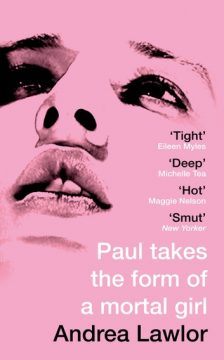 Paul Takes the Form of a Mortal Girl tells a series of stories that we already know, but it achieves its familiar ends through decidedly unfamiliar means. Andrea Lawlor’s first novel presents us with the queer young adulthood of Paul, who possesses a seemingly magical skill: the ability to change form, to will his body into whatever shape he would like it to take.
 The answer is that the last century of science has partially recapitulated Aristotle’s teachings on nature, for the most part unwittingly. Since roughly the turn of the twentieth century, the scientific enterprise has focused not only on the elemental, but increasingly also on large-scale phenomena: solids, fluids, organisms, ecosystems, human behavior, and computing machines. Scientists have often maintained that these systems cannot be understood solely in terms of action at the lowest levels of organization. Thus one hears of “systems theory” or “the theory of complex systems,” of “holism,” “irreducibility,” “downward causation,” “information theory,” and other musings from scientists that assert, to quote the physicist Philip Anderson, that “
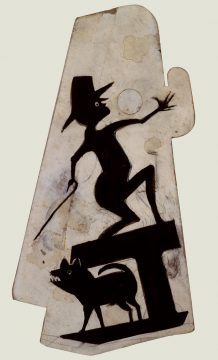 The art of Bill Traylor comes to us with the ghosts of slave ships, lynchings, chain gangs, Jim Crow, justice denied — an American night-story without end. Born in Alabama in 1853, Traylor was 9 years old when Lincoln signed the Emancipation Proclamation and 12 when slavery was abolished with the 13th Amendment. He bore his owner’s name for life and resided for 55 years near the plantation where he was born; then he moved to nearby Montgomery County, where he remained until his death in 1949. In 1927 or 1928, he moved alone to the city of Montgomery, and in 1929, his son was killed by police. Ten years later, when Traylor was 85 and essentially homeless, he began to draw and paint on the streets of Montgomery, and a massive arc of art as powerful and profound as any in the 20th century shot out of him. His drawings and paintings in ink, pencil, and gouache were made on found cardboard, candy-box tops, and other odds and ends. Today, only four years of his output remain, yet we have about 1,200 works.
 In the early 20
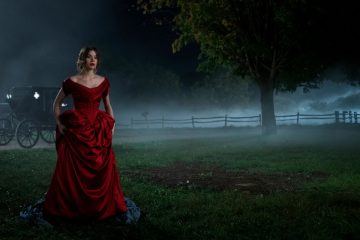 Emily Dickinson’s poems are obsessed with youthful themes: fame, popularity, intense bouts of emotion and, of course, a fetishization of death. Her work isn’t changed in Dickinson. The stanzas are true to the source material. Modernizing the way characters speak to each other, but keeping the poems consistent, allows Dickinson’s words to feel more approachable for an audience that came into their own by way of Lil Peep Instagram live-streams and SoundCloud emo rap. Most brilliantly, Dickinson isn’t trying to be a teen show. That’s precisely why it works as one. It kind of stumbles into itself, finding its footing along the way. There isn’t any clear direction or structure to help it stay on the same path. Dickinson doesn’t shy away from ludicrousness, but leans into it unabashedly. It’s an “unapologetic, crying on the floor at two in the morning, flirting with the fetishization of death even when floating on the undeniable highness of life” type of disaster.
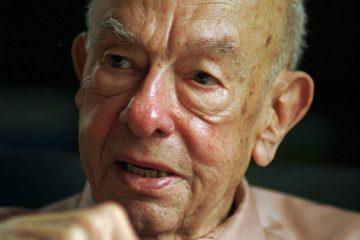 Willard Van Orman Quine is well known to the average analytic philosopher. True, he disdained much of the Pandora’s box of conceptual playthings often thought necessary for serious work in analytic philosophy nowadays, and his doctrines are thought to have been largely superseded. But he is treated by many – along with the earlier thinkers Gottlob Frege and
 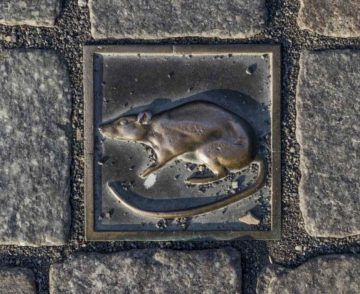 It took only a few seconds to spot one. Then another. As I walked into the small park around noon, dozens of rats could be seen scurrying in every direction. They dashed in and out of burrows scattered around the planting beds. They scampered between the safety of shrub cover and the trash bins containing a smorgasbord for them to feed on. They leaped on and off the unoccupied benches encircling the park. The rats of Churchill Square had returned.
 There are people who believe that the political polarization now afflicting the United States might finally start to subside if Americans of both parties could somehow become more empathetic. If you’re one of these people, the American Political Science Review has sobering news for you.
 IT IS A TRUTH

 Laura Tanenbaum in Jacobin:
 Rohit De and Surabhi Ranganathan in NYT: