
Enjoying the content on 3QD? Help keep us going by donating now.
Category: Recommended Reading
Pearl Fryar (1939 – 2026) Topiarist
Enjoying the content on 3QD? Help keep us going by donating now.
Wayne Perkins (1951 – 2026) Legendary Guitarist
Enjoying the content on 3QD? Help keep us going by donating now.
Why AI Needs A Sense Of Smell
Philip Maughan in Noem:
 Over the last few years, breakthroughs in AI have been almost too numerous to track. Chatbots can now pass the same exams required of doctors and lawyers. A cancer drug designed by AI has entered clinical trials. AI agents are serving as autonomous personal assistants. There have even been reports that AI can smell. “Computers Are Learning to Smell,” declared The Atlantic. “AI is digitizing our sense of smell,” according to the World Economic Forum. “AI tastebuds are better at identifying what’s in food than you,” claimed TechRadar, while a spellbound BBC Future reported that “An AI started ‘tasting’ colours and shapes.”
The truth, however, is that these headlines grossly embellish AI’s abilities. If you read the BBC Future article closely, for example, you’ll learn that a large language model (LLM) repeated the associations humans make between tastes, colors and shapes — sweet things are pink and round; sour things are yellow — observations that were captured in its training data. The reality is that very little progress has been made toward giving AI a sense of smell because pretty much nobody working in AI cares.
More here.
Enjoying the content on 3QD? Help keep us going by donating now.
How to train your brain to see possibility instead of doom
Hannah Critchlow in The Guardian:
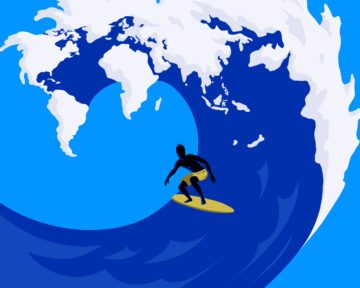 It can feel as though the world is tilting towards chaos: political shocks, economic instability, technological upheaval and a constant stream of bad news. Faced with so much uncertainty, many of us default to a sense of impending doom. But is that reaction hardwired – or can we train ourselves to keep a more open mind? A useful starting point is humility. Every generation, it seems, believes it inhabits uniquely turbulent times, as literary epics down the ages testify. Uncertainty has always been part of the human condition, and none of us can really know what tomorrow holds.
Yet recognising this does not make it easy to bear. In fact, our brains are exquisitely sensitive to uncertainty. From a neuroscientific perspective, unpredictability is costly. The brain is an energy-hungry organ that relies on following patterns and habits in order to conserve effort. When faced with ambiguity, it must work harder – analysing, predicting, recalibrating. This extra effort is not just tiring; it can feel actively unpleasant.
More here.
Enjoying the content on 3QD? Help keep us going by donating now.
Sunday Poem
Why I Write Poetry
Because I can’t trust God
to look after the world and my friends.
Worship sure, wandering forests of legend
braiding flowers from the Tree of Life in my hair
while God’s beard storms overhead.
But not trust. People die. Everyone dies.
It may be God’s will but it’s my won’t.
Sea turtles live a thousand years.
My words can’t become flesh.
My words can’t heal an open wound.
But I am a poet and I know we need more time
to make our own huge splendid mistakes,
mistakes we deserve, not just the small clinical mistakes
built into out bodies.
We could have many-colored rings spinning around our minds
like the rings of Saturn.
We could map constellations around a lover’s face
and every child could be the Messiah
because the world always needs saving.
God, it is a very beautiful world,
but no thank you, it is not enough.
No thank you for the sunrise when our eyes go blind.
A blank page is a place to list the creation
we weren’t given. A shopping list of eternity
where we’re never too sick to swallow fresh blueberries
and where the dance never ends.
A blank page is a paper bird to fold up and fly.
I can’t change anything but I am a poet
and if I can’t trust God I must speak
for the world and my friends.
Want more. Want so much more.
Test each day and night for ripeness
like a melon at the market.
You’re crucified on the hands of a clock,
pull out those nails.
I’m throwing you a rope of words.
Hold on.
by Julia Vinograd
Friday, April 17, 2026
On the Joys of Collecting Junk
Kate Bowler at Literary Hub:
 It’s beautiful in North Carolina in March, which means that Zach has set out to use his metal detector in the woods near our house. He is certain that we are about to embark on a new journey as a family: owning our own junkyard.
I tried to explain that a family who owns a junkyard near the woods is actually the premise of a recent bestselling memoir in which the heroine needs to be rescued from her family and taught to read. But to no avail. Yesterday he found a 1936 Chevrolet hubcap and I am done for.
I canvass friends for opinions on whether garbage will add to my quality of life or whether I will simply, you know, incur the wrath of my new neighbors. My friends, being my friends, invariably champion the necessity of objects piling up in my yard. My friend Alex tells me about his friend, a French artist in Russia, whose preferred canvas for paintings is old doors and bits of fencing.
More here.
Enjoying the content on 3QD? Help keep us going by donating now.
AI Alignment Is Impossible, not just in practice but in theory
Matt Lutz at Persuasion:
Unfortunately, I’m pretty sure that AI alignment is impossible.
How might an AI form a moral sense? There are basically two scenarios. In one scenario, moral facts are the kind of fact that one might simply figure out by thinking about them hard. In such a case, perhaps AIs would be good moral reasoners, and indeed even better moral reasoners than humans, in virtue of their advanced intellectual capacities.
In the second scenario, moral facts aren’t the sorts of things we can figure out by pure intellectual effort, but we can nonetheless train AIs to develop a moral sense in much the same way we train children in good behavior: by rewarding them when they’re good and punishing them when they’re bad.
The first scenario is doomed, for reasons first pointed out by the philosopher David Hume in his oft-quoted (and oft-misunderstood) passage where he indicates that there is a gap (not Hume’s term) between “is” and “ought.” Hume thought that reasoning is not some sort of truth-generator, a special faculty that takes intellectual effort as an input and spits out knowledge as an output. Rather, it is a process, where we move from one thought to the next, with our later thoughts hopefully (though not necessarily) supported by our earlier thoughts.
But the process is fallible. After all, if we are to reason our way to a moral conclusion, we must be reasoning from non-moral conclusions. Taking that into account, what operation of the mind could possibly take us from premises that describe the world to conclusions that tell us how to act?
More here.
Enjoying the content on 3QD? Help keep us going by donating now.
Stephen Asma: Psychopaths and the Dark Triad
Enjoying the content on 3QD? Help keep us going by donating now.
These Chimps Began the Bloodiest ‘War’ on Record and No One Knows Why
Carl Zimmer at the New York Times:
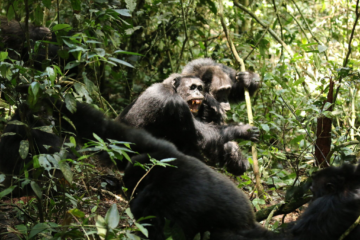 On Thursday, a group of researchers reported that the Ugandan chimps are locked in a primate version of civil war. Two factions split about a decade ago and have been engaged in a highly lethal conflict ever since.
Scientists have never seen such widespread, long-running bloodshed among chimpanzees. Further studies may shed light on the roots of warfare in our own species, although the Trump administration’s proposed budget, released on Friday, has cast doubt on whether the research will continue.
When scientists first started tracking the Ngogo chimpanzees, the first thing that struck them was the sheer number of apes: over 100 across a territory of about 10 square miles.
More here.
Enjoying the content on 3QD? Help keep us going by donating now.
Who Was The Demon Belial?
Enjoying the content on 3QD? Help keep us going by donating now.
The Dog’s Gaze
Kathryn Hughes at The Guardian:
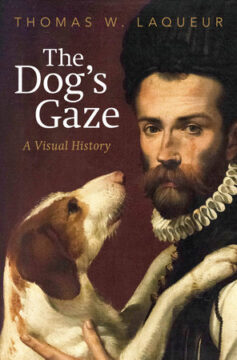 Thirty-five thousand years ago, in the Ardèche region of France, Paleolithic artists drew a spectacular bestiary on the walls of the Chauvet cave. Their focus was apex predators, so there were lots of lions, as well as mammoths and woolly rhinoceroses. Dogs were nowhere to be seen, and yet in the soft sediment on the limestone floor of the cave, there are traces of canid pawprints next to human footprints. Two fellow creatures, most likely a boy and a dog, stood together, about 10,000 years after the art was made, looking up at the walls in wonder. Here was a moment of shared contemplation, followed perhaps by a glance to see the other’s reaction.
In this luminous book, the American cultural historian Thomas Laqueur explores what he calls “the dog’s gaze”. The dog was the first animal to live companionably with humans, and Laqueur argues that this marks the boundary between nature and culture. It is this threshold status that has, in turn, qualified the dog to play a rich, symbolic part in western art. Just having dogs in a picture – snuffling for picnic crumbs in Seurat’s La Grande Jatte or trooping home in Bruegel the Elder’s Hunters in the Snow – becomes a way for an artist to pack an image with extra resonance and second-order meaning.
more here.
Enjoying the content on 3QD? Help keep us going by donating now.
Among the Antigones
Rhoda Feng at The Paris Review:
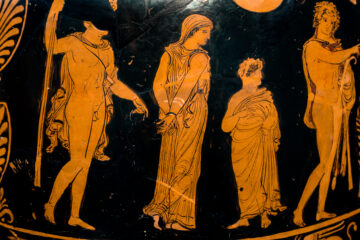 For a few weeks this spring, you couldn’t swing a thyrsus in New York without hitting a play about Antigone. Perhaps it started with Robert Icke’s Oedipus, the Broadway production from February, which featured a modern-day Antigone as a sulky teen who little suspects that her father is also her brother. Soon after, four different theaters across the five boroughs staged their own renditions of Sophocles’s famous play, reimagining his two-thousand-and-five-hundred-year-old mythic figure as, variously, a pregnant teenager, an analysis patient, an incestuous home renovator, and a freedom fighter in a fascist regime in the future. The latter, in a bid to underscore the theme of rebellion across the ages, went so far as to include audio from the ICE raids in Minneapolis.
It’s not hard to hazard the reasons for the renewed popularity of the Theban protestor who challenges the authoritarian rule of her uncle, King Creon, and is subsequently put to death. (One production titled its director’s note “Caution to the Resistance …”) But it is curious that, among the many iterations of Antigone now at hand, each has striven so forcefully to recast and reimagine her for the modern era.
more here.
Enjoying the content on 3QD? Help keep us going by donating now.
How AI Can Beat Cancer
Cyriac Roeding in Time Magazine:
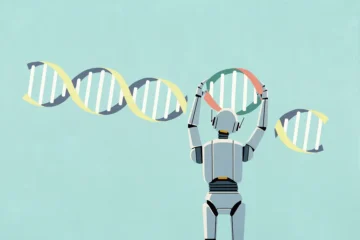 The core problem in oncology has always been one of discrimination. Cancer cells and normal cells are, at the molecular level, nearly identical. What distinguishes a cancer cell is dysregulation, a set of genetic switches flipped in the wrong direction, causing uncontrolled growth. For decades, finding and exploiting those switches required hunting through patient samples by hand, looking for patterns subtle enough to be almost invisible.
AI has changed what’s possible. Systems trained on genomic databases spanning tens of thousands of sequenced cancer samples can now identify the master regulatory patterns that are active specifically in cancer cells and not in surrounding healthy tissue. Unlike the biomarkers of older precision oncology, these are fine-grained genomic signatures that encode the difference between malignant and normal at the level of how genes are switched on and off.
More here.
Enjoying the content on 3QD? Help keep us going by donating now.
Revealed: how male and female brain cells differ in gene activity
Miryam Naddaf in Nature:
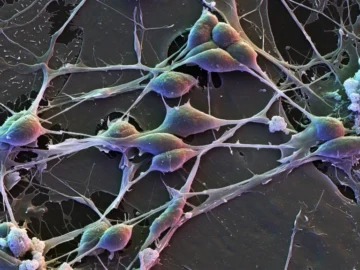 By analysing more than a million brain cells, researchers have uncovered widespread differences in patterns of gene activity between male and female brains.
The work, which defined sex on the basis of a person’s combination of sex chromosomes, could help to explain why the risk of developing some brain conditions — such as schizophrenia and Alzheimer’s disease — differs between males and females.
Although the differences were subtle, the team identified more than 100 genes that showed consistent variation in their expression between males and females across several brain regions. The work was published on 16 April in Science1.
More here.
Enjoying the content on 3QD? Help keep us going by donating now.
Thursday, April 16, 2026
Bronze Age Collapse
Enjoying the content on 3QD? Help keep us going by donating now.
The Surprising Folklore of Analog Horror
Elinor Dolliver at Film Quarterly:
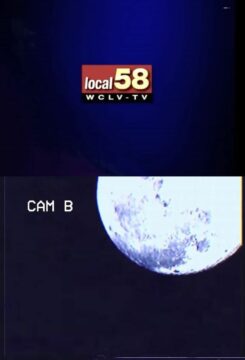 Analog horror is a type of short amateur cinema made and circulated on social media for free, primarily on YouTube, but also on platforms such as TikTok and Instagram. Its name derives from the digital fabrication of analog-video aesthetics, including defects like grain, noise, snow, and shudder, presented in an aspect ratio of 4:3 that mimics the screen dimensions of older generations of televisions. Audiences experience analog horror as viewers of cryptic and sinister tapes, which often take the form of training videos, documentaries, or children’s television, endowing the subgenre with a characteristic tone of dark or uncanny nostalgia. This is contrasted effectively with threatening elements, often supernatural in nature. Videos are short, ranging in length from just a few seconds to twenty minutes. Acting is rare, often replaced with computerized text-to-voice speech (an anachronistic aspect for audiences familiar with predigital media and aware of when the text-to-voice feature was popularized). Analog horror is produced by independent individuals referred to in the community as “creators” instead of “directors,” often without formal training or film equipment, and frequently using stock footage and software such as Blender and Photoshop.
more here.
Enjoying the content on 3QD? Help keep us going by donating now.
My Year in Paris With Gertrude Stein by Deborah Levy
Lucy Hughes-Hallett at The Guardian:
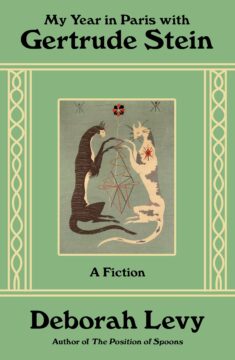 The narrator of Deborah Levy’s witty scherzo of a “fiction” – “novel” isn’t the word for this uncategorisable book – thinks that Gertrude Stein would have liked Sigmund Freud. She imagines them enjoying a cigar together while their wives make small talk. Would Frau Freud “have exchanged her recipe for boiled beef with Alice B [Toklas]’s recipe for hashish fudge”? The two never met (though with her interest in the “bottom character” and his in the “unconscious”, Stein and Freud would have had plenty to talk about), but that barely matters. This book is full of things that don’t actually happen, of relationships that are not what the people involved suppose them to be, of digressions and fantasies and encounters that are imagined but never take place.
It all starts with a lost cat. The cat is called “it”: lower-case “i” followed by lower-case “t”. This causes all sorts of linguistic confusion, highlighting the way we use the word “it” to mean something indeterminate (as in the first sentence of this paragraph), or something trivial, or something tremendous. The phrase “lost it” recurs, the “it” meaning – variously – one’s mind, sympathy with Ernest Hemingway, daring to be as unconventional as Gertrude Stein, the stream of consciousness “flowing under the mowed and manicured golf courses on which men swung their clubs in the 21st century”, the temptation to smile while being undermined by a patronising man, the drudgery of housekeeping, the thing – which might be obedience or shame – that holds an artist back from becoming a modernist … or love, or one’s mother, or a black-and-white cat with one deformed ear.
more here.
Enjoying the content on 3QD? Help keep us going by donating now.
The Memory Maker
Tim Requarth at Longreads:
 My wife insists we once took a yoga class together, early in our relationship. She remembers the teacher vividly (a French acrobat, rainbow dreads, apparently quite a character), where we sat (to the left of the door), and the color of the yoga mats (teal). I insist she is misremembering: I have never been to a yoga class, even to this day. I scrolled back years through my phone’s location history once to settle it, but we’d started dating not long after the iPhone came out, and if the data ever existed, it was gone. The yoga story comes up every few years, but we never resolve it. It is probably unresolvable. As a neuroscientist, I know how these things happen—the encoding mishaps, the source confusion, the neuroscience of how two people can end up telling different stories about the same afternoon. This knowledge has never once brought us closer to agreeing.
More here.
Enjoying the content on 3QD? Help keep us going by donating now.
Sean Carroll’s Mindscape Podcast: J. Eric Oliver on the Self and How to Know It
Sean Carroll at Preposterous Universe:
We are more familiar with ourselves than with anything else in the universe, but we generally don’t come very close to really understanding what our “self” is. That’s not too surprising, as selves are very complicated and we are burdened by all sorts of biases. Today’s guest is J. Eric Oliver, who has been teaching a popular course at the University of Chicago called “The Intelligible Self.” His academic specialty is political science, but he brings together ideas from psychology, neuroscience, and a broad swath of the humanities. His view is summarized in his recent book, How to Know Yourself: The Art and Science of Discovering Who You Really Are.
More here.
Enjoying the content on 3QD? Help keep us going by donating now.