
Category: Recommended Reading
Mobb Deep’s “The Infamous” Turns 25
Oliver Wang at the LARB:
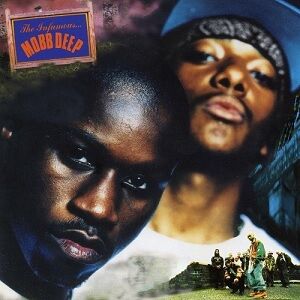 IN THE FALL of 1994, American radio and club DJs began receiving a promotional single in the mail: “Shook Ones, Pt. II,” by the Queens rap duo Mobb Deep. Those early promos came with little fanfare — no cover art, no liner notes, just a plain center sticker with the group’s name, song title, and record label logo. The reaction to “Shook Ones, Pt. II” was as spectacular as its arrival was understated. Its dark, discordant track and violent braggadocio powered the single onto hip-hop mix shows, and the song sparked fights in rowdier nightclubs whenever it rumbled over the speakers. Eminem’s hit 2002 film 8 Mile paid “Shook Ones, Pt. II” the ultimate homage by using it in the film’s cold open, a shot of auditory adrenaline jabbed into the heart of B-Rabbit as he prepares for an MC battle.
A quarter century later, “Shook Ones, Pt. II” and its associated album The Infamous, Mobb Deep’s second LP, are now embraced as consensus classics from hip-hop’s “golden era” of the early/mid-1990s.
more here.
Walls, Moats, and Borders
Rafia Zakaria in The Baffler:
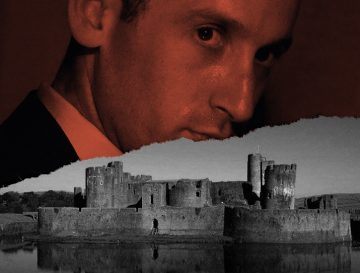 IF THE TRUMP ADMINISTRATION were a medieval court, and some, including the man at the top, would like it to be, then Stephen Miller would be the sly and artful courtier ever in search of hospitable moments in which to further his cause of an all-white America. He may sometimes get shafted and shamed, but Slinky Steve never gives up. Take a look at his most recent failure: after Trump tweeted with relish a Miller-inspired plan to “suspend immigration into the United States,” the plan ended up lifeless on the castle floor. Reportedly through the interventions of Jared Kushner, the luminescent son-in-law of the ruler, what would have been ambitious plan to install a gator-ridden, extra-deep moat around all the land was reduced to a mere puddle.
By the time it was signed on April 22, Trump’s executive order did not, as hardliners would have wished, halt all immigration; it only stopped the processing of green cards for immigrants not already in the United States—with a number of major exceptions, including for spouses and children of U.S. citizens and health care professionals—for sixty days. Foreign workers, both the highly skilled and the migrant laborers, could stay. It was a dud document, its teeth extracted by Kushner and other powerful men who had held the president, a devoted xenophobe, back. Miller likely spent the day after this defeat sulking in his West Wing dungeon, sharpening the proverbial knives he would need for the next battle. He still believed that victory was imminent, he told supporters of his moat-and-wall vision in a phone call, assuring them that he wouldn’t “leave them hanging.”
They will be left hanging, but not owing to the vertiginous details of Trump court politics, nor the mercurial fortunes of those who want the president’s ear. For an interminably long three-and-a-half years, Trump Inc. have been dangling the halcyon apparition of an all-white America before their followers. Every few months, they have been thrown a travel ban, a limitation of asylum, or a ban on refugees, so that their ardor for Trump never cools. This most recent order would have been another iteration of throwing scraps to this herd, a juicy bit of xenophobia to look forward to in uncertain times.
More here.
Is Everyone Depressed?
James Hamblin in The Atlantic:
 Over the past month, Jennifer Leiferman, a researcher at the Colorado School of Public Health, has documented a tidal wave of depressive symptoms in the U.S. “The rates we’re seeing are just so much higher than normal,” she says. Leiferman’s team recently found that people in Colorado have, during the pandemic, been nine times more likely to report poor mental health than usual. About 23 percent of Coloradans have symptoms of clinical depression. As a rough average, during pre-pandemic life, 5 to 7 percent of people met the criteria for a diagnosis of depression. Now, depending how you define the condition, orders of magnitude more people do. Robert Klitzman, a professor of psychiatry at Columbia University, extrapolates from a recent Lancet study in China to estimate that about 50 percent of the U.S. population is experiencing depressive symptoms. “We are witnessing the mental-health implications of massive disease and death,” he says. This has the effect of altering the social norm by which depression and other conditions are defined. Essentially, this throws off the whole definitional rubric.
Feelings of numbness, powerlessness, and hopelessness are now so common as to verge on being considered normal. But what we are seeing is far less likely an actual increase in a disease of the brain than a series of circumstances that is drawing out a similar neurochemical mix. This poses a diagnostic conundrum. Millions of people exhibiting signs of depression now have to discern ennui from temporary grieving from a medical condition. Those at home Googling symptoms need to know when to seek medical care, and when it’s safe to simply try baking more bread. Clinicians, meanwhile, need to decide how best to treat people with new or worsening symptoms: to diagnose millions of people with depression, or to more aggressively treat the social circumstances at the core of so much suffering.
Clearly articulating the meaning of medical depression is an existential challenge for the mental-health profession, and for a country that does not ensure its people health care. If we fail, the second wave of death from this pandemic will not be directly caused by the virus. It will take the people who suffered mentally from its reverberations.
More here.
Saturday Poem
Emily Dickinson at the Poetry Slam
I will tell you why she rarely ventured from her house.
It happened like this:
One day she took the train to Boston,
made her way to the darkened room,
put her name down in cursive script
and waited her turn.
When they read her name aloud
she made her way to the stage
straightened the papers in her hands —
pages and envelopes, the backs of grocery bills,
she closed her eyes for a minute,
took a breath,
and began.
From her mouth perfect words exploded,
intact formulas of light and darkness.
She dared to rhyme with words like cochineal
and described the skies like diadem.
Obscurely worded incantations filled the room
with an alchemy that made the very molecules quake.
The solitary words she handled
in her upstairs room with keen precision
came rumbling out to make the electric lights flicker.
40 members of the audience
were treated for hypertension.
20 year old dark haired beauties found their heads
had turned a Moses White.
Her second poem erased the memory of every cellphone
in the nightclub,
and by the fourth line of the sixth verse
the grandmother in the upstairs apartment
had been cured of her rheumatism.
The papers reported the power outages.
The area hospitals taxed their emergency generators
and sirens were heard to wail through the night.
Quietly she made her way to the exit,
walked to the terminal and rode back to Amherst.
She never left her room again
and never read such syllables aloud.
by Dan Vera
from The Space Between Our Danger and Delight
Beothuk Books.
Friday, May 22, 2020
The Trouble with Comparisons
Samuel Moyn in the New York Review of Books:
 For those doubtful about the fascism analogy for Trumpism—and I count myself as one of them—the point is to appreciate both continuity and novelty better than the comparison allows. Abnormalizing Trump disguises that he is quintessentially American, the expression of enduring and indigenous syndromes. A response to what he represents hardly requires a restoration of “normalcy” but a questioning of the status quo ante Trump that produced him. Comparison to Nazism and fascism imminently threatening to topple democracy distracts us from how we made Trump over decades, and implies that the coexistence of our democracy with long histories of killing, subjugation, and terror—including its most recent, if somewhat sanitized, forms of mass incarceration and rising inequality at home, and its tenuous empire and regular war-making abroad—was somehow less worth the alarm and opprobrium. Selective outrage after 2016 says more about the outraged than the outrageous.
More here.
Losing and Winning Strategies of the Covid War
Nilotpal Chakravarti in Medium:
Every epidemic, including Covid-19, turns around a single equation,
R = N x p x (1-f).
N is the average number of persons who come into contact with an infected person while she is infectious;
p is the probability of the virus being transmitted during a contact;
f is the fraction of the population immune to the infection.
When an infected person comes into contact with an uninfected person she spreads the virus to the contact with probability p; the contact may either be immune or susceptible. The probability of being immune is f while that of being susceptible is1-f. So p x (1-f) is the probability of the contact becoming infected.
R — the Reproduction Number — is the average number of persons an infected person infects in turn. The disease grows exponentially if R is greater than 1; decays exponentially and dies away if R is less than 1; and persists at a steady rate if R is exactly 1.
The epidemic equation severely restricts the tactics that may be used against the Sars-CoV-2 or any other virus for which no cure or vaccine is available just as the rules of chess dictate how the game may be played.
More here.
“White Flags”, an installation by Aaron Fein
White Flags by Aaron Fein from Aaron Fein on Vimeo.
Sweden is still nowhere near ‘herd immunity,’ even though it didn’t go into lockdown
Niamh Kennedy at CNN:
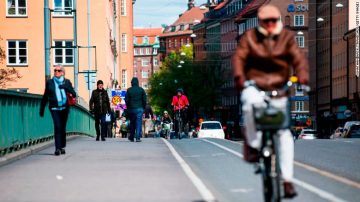 Sweden has revealed that despite adopting more relaxed measures to control coronavirus, only 7.3% of people in Stockholm had developed the antibodies needed to fight the disease by late April.
The figure, which Sweden’s Public Health Authority confirmed to CNN, is roughly similar to other countries that have data and well below the 70-90% needed to create “herd immunity” in a population.
It comes after the country adopted a very different strategy to stop the spread of coronavirus to other countries by only imposing very light restrictions on daily life.
Sweden’s chief epidemiologist Anders Tegnell said the number was a “little lower” than expected “but not remarkably lower, maybe one or a couple of percent.”
More here.
Leonora Carrington: The Lost Surrealist
https://www.youtube.com/watch?v=SxEF1bjgt5Q
Strange Miracles in the Desert
Julie Morse at The Believer:
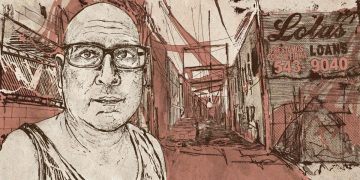 For a heroin addict, Ciudad Juárez is Mecca. It’s cheap, drug possession charges result in just a couple of nights in jail, and the ability to earn U.S. currency by begging or doing odd jobs in El Paso significantly increases a person’s buying power in Mexico. These are things Comar learned after he abandoned his trucker job and moved from New York to Juárez in 1998. It’s also what several U.S. citizens who suffer from long-term addiction have told me makes Juárez the perfect place to live. And there’s no reason why they’d ever want to go back.
“I thought the border was really a great chance to redefine myself and rearticulate my identity,” Comar tells me. “I wanted to cash in my old life because I wasn’t happy with it anymore, and I wanted to get a new life. Becoming something new is the essence of recovery.”
more here.
“Michael Kohlhaas,” the Book That Made the Novel Modern
Dustin Illingworth at The New Yorker:
 “Michael Kohlhaas,” which was recently reissued by New Directions in a sparkling new translation from Michael Hofmann, makes for a fine entry point into Kleist’s passionate, grotesque, hysterical, and deeply strange body of work. It begins, as it ends, in bureaucratic entanglement. Kohlhaas, en route to a Leipzig marketplace, is stopped by a castellan in the employ of the knight Wenzel von Tronka, who demands to see a travel permit. Lacking the necessary visa, Kohlhaas is coerced into leaving two of his finest horses as collateral, along with his trusty groom to watch over them. While passing through Dresden, he learns from a government notary that the permit is in fact a fairy tale. As so often occurs in “Michael Kohlhaas,” the law is invoked only to be disfigured by human cupidity. The castellan is merely an avatar, the first of several figures whose knowledge of the law allows them to shape or pervert it for private aims. Kleist introduces the self-serving technocratic interpreter to modern literature.
more here.
Look, don’t touch: what great literature can teach us about love with no contact
Joanna Briscoe in The Guardian:
 In our time of social distancing, the desire for physical contact has never been so intense. And yet we are untouchable. This experience has had its more conspicuous consequences, such as the government scientist Neil Ferguson breaking his own rules to meet his lover during lockdown. This notion of forbidden touch, unique and even shocking as it may be to us, has a multitude of echoes in literature. Cultural constraints and taboos on touch are reflected, overturned or used for dramatic purposes by writers throughout history, and our own bookshelves are newly rich with the comfort of identification. Who would have ever guessed that the plague-ridden, the apocalyptic or the edicts of Victorian England would have quite such resonance?
The sensual is, of course, as much enhanced by restraint as diminished by it, and the whole canon of forbidden, throbbing longing in literature contains particular potency in the present. Often by necessity, desire is all, and consummation, if it ever happens, can be secondary in impact to the distanced gazes, tiny brushes and glances that precede it. Little is as sexy, or as frustrating, as restricted touch. A physical gesture, however slight, is more often a turning point for characters than anything spelled out in dialogue. This was summed up by Iris Murdoch in The Black Prince: “Only take someone’s hand in a certain way, even look into their eyes in a certain way, and the world is changed forever.” Keats wrote that “touch has a memory”, and the anticipation or the recollection of the physical is often where the excitement, fervour and true poetry lie. As Emily Dickinson expressed it: “Within its reach, though yet ungrasped / Desire’s perfect Goal – / No nearer – lest the Actual – / should disenthrall my soul – ”
More here.
Can words do the dead justice?
Ann Wroe in More Intelligent Life:
 Casual readers of obituaries or listeners to eulogies often instinctively focus on the odder bits. Life, after all, is elemental, quicksilver, strange; it isn’t found in a solemn list of doings and accomplishments, lists of schools attended or prizes won. People like to know about the quirks of the individual who has gone – the jam-jar collection, the clashing clothes, the unwise taste for speed. They want to laugh in the face of death and rejoice in the richness of life. At the same time death, being surrounded by grief, lays on its cold hand and demands respect. How, then, to memorialise the departed?
The more public the forum, the more treacherous the minefield. Those useful mourning-rites of the Victorians – black armbands, black ribbons tied on door-knockers, black-edged announcement cards – have more or less vanished now, together with their shared view of what death was. Yet, in our nervousness, we still fall back on the formulas we know. In particular, we tend to keep a stiff-collar formality in the words we use. No letter is harder to write than one of condolence. Every week my local paper runs a half-page of black-rimmed death notices in which someone from a family has dutifully struggled to write a poem about love and loss. They are awkward, poignant and truly heartfelt; most use similar phrases about the grieving left behind. The loud message of these little boxes is that words must be written, but they fail. Most obviously, they do not last. And it seems that something should. The physical presence we knew in the world has to be marked with an object that is solid and individual – most simply a stone, like the cairns of achievement on top of hills we have climbed. The powerful had such markers, from the turfed tumuli of ancient warriors, crammed with daggers and warhorses, to the chest-tombs and weeping-angel memorials of the Victorians. Yet for centuries the poor were buried unmarked around their worship-places, higgledy-piggledy and one above the other until the churchyards rose like green cushions. The dead had left the world, but remained in it: part of the community, part of the natural scene.
More here.
Friday Poem
Everywhere a River
I do remember darkness, how it snaked
through the alders, their ashen flanks
in our high-beams the color of stone.
That hollow slap as floodwater hit
the sides of the car. Was the radio on?
Had I been asleep?
Sometimes you have to tell a story
your entire life to get it right.
Twenty-two and terrified, I had married you
but barely knew you. And for forty years
I’ve told this story wrong. In my memory
you drove right through it, the river
already rising on the road behind us,
no turning around.
But since your illness I recall it
differently. Now that I know it’s possible
to lose you, I’m finally remembering
it right. That night,
you threw that car in reverse,
and gunned it. You found us
another way home.
by Emily Ransdell
from New Letters , (Vol. 86, 2019)
Thursday, May 21, 2020
There Is No Writer Quite Like Arundhati Roy
Joel Whitney in Jacobin:
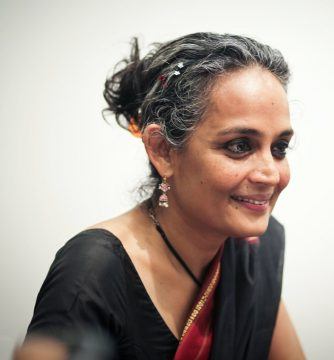 It’s possible to mark time in Indian politics by how long it’s been since Arundhati Roy has pissed off the government. Her meticulous, two-decades-long dissection of India’s unsustainable development, its Islamophobic Hindu nationalism and caste violence, alongside the United States’ pursuit of global empire has been proven accurately, darkly predictive.
When India’s December law restricting Muslim citizenship passed, readers of Roy’s essays had a framework, going back two decades, within which to place these developments. By midwinter, Muslims were being beaten and lynched in the streets of the capital. This was shocking but not unprecedented, and readers of her essays recalled her warnings over mass killings in Gujarat in 2002, an early flashpoint that she describes explicitly as a contemporary genocide.
Roy is known for two musical and beautifully complex novels. The Ministry of Utmost Happiness was longlisted for the Booker Prize in 2017; her debut, The God of Small Things, won that prize twenty years before. Last summer, to more muted fanfare, her essays were collected in an eight-hundred-plus-page edition by Haymarket Books called My Seditious Heart. As Roy approaches fifty-nine, the three books add up to a major literary achievement.
More here.
Graduate Student Solves Decades-Old Conway Knot Problem
Erica Klarreich in Quanta:
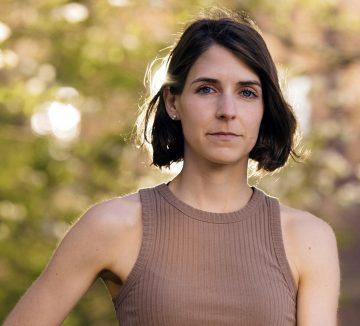 In the summer of 2018, at a conference on low-dimensional topology and geometry, Lisa Piccirillo heard about a nice little math problem. It seemed like a good testing ground for some techniques she had been developing as a graduate student at the University of Texas, Austin.
“I didn’t allow myself to work on it during the day,” she said, “because I didn’t consider it to be real math. I thought it was, like, my homework.”
The question asked whether the Conway knot — a snarl discovered more than half a century ago by the legendary mathematician John Horton Conway — is a slice of a higher-dimensional knot. “Sliceness” is one of the first natural questions knot theorists ask about knots in higher-dimensional spaces, and mathematicians had been able to answer it for all of the thousands of knots with 12 or fewer crossings — except one. The Conway knot, which has 11 crossings, had thumbed its nose at mathematicians for decades.
Before the week was out, Piccirillo had an answer: The Conway knot is not “slice.” A few days later, she met with Cameron Gordon, a professor at UT Austin, and casually mentioned her solution.
More here.
George Monbiot Debunks Michael Moore’s “Planet of the Humans”
We’re Not in This Together
 Ajay Singh Chaudhary in The Baffler:
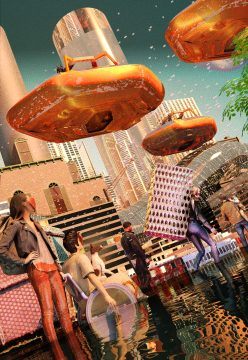
Over the past decade and a half, major insurance companies like AIG and Chubb have begun to offer private emergency services “to elite policyholders.” It is one of the more straightforward ways to think about the commodification of risk. Highly expensive assets face catastrophic threat; the insurance company packages that threat and sells two attractive products. The first is insurance against climate damage; the second is access to services to prevent having to pay out when damage occurs. From the firm’s point of view, they’ve sold two products at a tidy profit and avoided the exorbitant payout involved with actually covering insured losses. From the client’s point of view, despite a steep cost, the financial and psychological burden of losing their home is avoided. For these two parties, it is, indeed, a win-win scenario.
However, there are “externalities,” so to speak, in privatized social services. Such private services skirt or run right over what tiny regulations exist for them. They physically impede and complicate public emergency services. Protecting assets can be at odds with saving lives. And the same companies lobby for tax and infrastructure policies that necessitate their services, starving the public emergency service which, in the case of California, deploys severely underpaid incarcerated people to enhance dwindling state capacity. Although insurance companies and the emergency service contractors themselves focus on the high-end market, they are increasingly creating more affordable, less comprehensive packages for lower tiers of customers. This kind of tiered access to services is familiar to anyone who has encountered private or privatized social goods, like market-based health insurance. And yet it is also an extreme intensification, where there is seemingly no obstacle to privatized governance. In this example, we can see one microcosm of what I call right-wing climate realism.
More here.
What if Hillary had never married Bill? ‘Rodham’ answers that question
Elizabeth Toohey in The Christian Science Monitor:
 Hillary Rodham Clinton is a Rorschach test for our culture, as she herself has noted. In the 1980s as first lady of Arkansas, she was thought to have weakened Bill Clinton’s campaign as an incumbent by keeping her maiden name, so she took his. When his affair with Monica Lewinsky in the White House was revealed in the 1990s, Hillary’s popularity soared for standing by her man. Twenty years later, she was reviled for the same decision and called an enabler. She earned high approval ratings as a senator and as secretary of state, but her popularity plummeted when she ran for higher office. Curtis Sittenfeld’s novel “Rodham” poses the fascinating question: How would we feel about Hillary without Bill? For Sittenfeld, the answer is complicated. Some may dismiss Hillary’s political career as hinging on her husband’s, but as anyone familiar with her record at Wellesley College and Yale Law School knows, she was by all accounts a brilliant, outspoken student – and “Rodham” opens with the graduation speech she gave at Wellesley that propelled her to public notice .
By turns historical fiction, fan fiction, and a novel of manners, Sittenfeld’s portrait imagines how things might have been had Hillary said no to Bill’s proposal of marriage. It’s a peculiar fantasy, but one that will resonate with readers who think Hillary got a raw deal, both in her marriage and in the coverage of her 2016 presidential bid.
More here.