
From The New York Times:
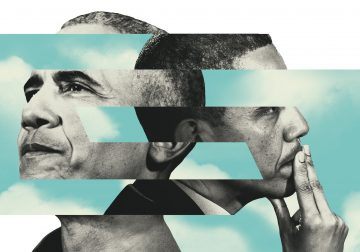 Barack Obama is as fine a writer as they come. It is not merely that this book avoids being ponderous, as might be expected, even forgiven, of a hefty memoir, but that it is nearly always pleasurable to read, sentence by sentence, the prose gorgeous in places, the detail granular and vivid. From Southeast Asia to a forgotten school in South Carolina, he evokes the sense of place with a light but sure hand. This is the first of two volumes, and it starts early in his life, charting his initial political campaigns, and ends with a meeting in Kentucky where he is introduced to the SEAL team involved in the Abbottabad raid that killed Osama bin Laden.
His focus is more political than personal, but when he does write about his family it is with a beauty close to nostalgia. Wriggling Malia into her first ballet tights. Baby Sasha’s laugh as he nibbles her feet. Michelle’s breath slowing as she falls asleep against his shoulder. His mother sucking ice cubes, her glands destroyed by cancer. The narrative is rooted in a storytelling tradition, with the accompanying tropes, as with the depiction of a staffer in his campaign for the Illinois State Senate, “taking a drag from her cigarette and blowing a thin plume of smoke to the ceiling.” The dramatic tension in the story of his gate-crashing, with Hillary Clinton by his side, to force a meeting with China at a climate summit is as enjoyable as noir fiction; no wonder his personal aide Reggie Love tells him afterward that it was some “gangster shit.” His language is unafraid of its own imaginative richness. He is given a cross by a nun with a face as “grooved as a peach pit.” The White House groundskeepers are “the quiet priests of a good and solemn order.” He questions whether his is a “blind ambition wrapped in the gauzy language of service.” There is a romanticism, a current of almost-melancholy in his literary vision. In Oslo, he looks outside to see a crowd of people holding candles, the flames flickering in the dark night, and one senses that this moves him more than the Nobel Peace Prize ceremony itself.
And what of that Nobel? He is incredulous when he hears he has been awarded the prize.
More here.
 We live in a golden age of science writing, where weighty subjects such as quantum mechanics, genetics and cell theory are routinely rendered intelligible to mass audiences. Nonetheless, it remains rare for even the most talented science writers to fuse their work with a deep knowledge of the arts. One such rarity is the Italian theoretical physicist Carlo Rovelli who, like some intellectual throwback to antiquity, treats the sciences and the humanities as complementary areas of knowledge and is a subtle interpreter of both. His best-known work is
 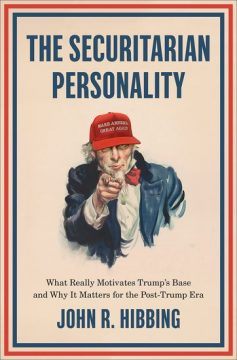 ON JULY 21, 2016, the Republican National Convention was in full swing and delegates in ruddy Americana and cowboy attire packed the Cleveland’s Quicken Loans Arena. Although it’s hard for most of us to recall, this was a time where even staunch Republicans were doubting Trump’s ascendency to the United States’s highest office. I was there, and remember it fondly, and was intrigued as to why those who did want Trump were willing to vote for a man who had called Mexicans rapists and had made fun of a handicapped New York Times journalist. A 52-year-old delegate from Vermont stressed the usual three prongs: the border, anti-terrorism, the military. Trump’s insensitivity mattered not. “To me,” the delegate said, “if you’re not safe, then you’ve got nothing.”
 In a series of breakthrough papers, theoretical physicists have come tantalizingly close to resolving the
 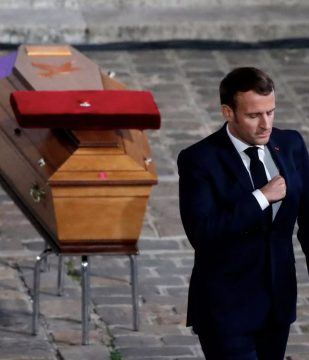 Five years ago, American journalists called me following the terrorist attack that took the lives of my former colleagues and friends at Charlie Hebdo. They all thought that we were going to elect Marine Le Pen. I tried to explain to them that it’s precisely because there is a leftist movement associated with Charlie—both anti-racist and secular, a left that remains lucid about the dangers of extremism—that we had a chance to avoid that fate. But my explanations were in vain.
 The evolutionary explanation for human connection to nature is a colossal safari through the African savanna, where our ancestors fought, fed, and frolicked for millions of years. The biologist E.O. Wilson speculated on this story in Biophilia, a slim volume on human attraction to nature. Wilson defined biophilia as an “innate tendency to focus on life and lifelike processes.” He argued that if other animals are adapted to their environments and are best-suited to the environments in which they evolved—for example, a thick white coat serves the polar bear well in its native cold and snowy Arctic—then is it possible that humans too, despite our ability to live anywhere on this planet, are best adapted to the particular environment in which we evolved?
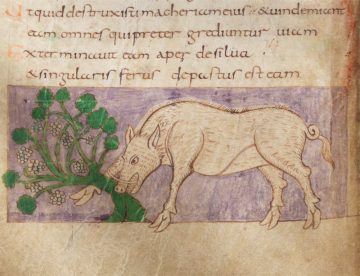 These are ancient texts, but the pig’s characterization as a ravenous and dirty animal has transcended particular historical moments. Christians in early medieval Europe made the same associations, and so do we. More than one historian has pointed this out over the years, partly with the goal of rehabilitating the animals’ reputation. But this flat stereotype, this singular beast, was not the only profile a pig could have, even in the past: “premodern” views were subtler than the shorthand symbolism suggests. In late antiquity and the early Middle Ages, farmers, policy makers, and philosophers were perfectly capable of holding multiple views of pigs simultaneously, of playing into a familiar caricature but also of honing in on the complexities of the species. They saw that pigs were not merely commodities that provided humans with meat or symbols that worked as handy metaphors. They were also creatures that were capable of adapting to and altering their environments, including the human environments that only partially constrained them. Pigs were difficult to fully domesticate, both physically and conceptually. They called attention to themselves and required some engagement with their complex lives.
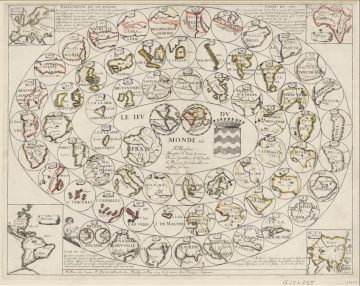 In 1795, Henry Carington Bowles released Bowles’s European Geographical Amusement, or Game of Geography, the latest in his family’s board game series. Allegedly based on a 1749 travelogue, “the Grand Tour of Europe, by Dr. Nugent,” it combined learned pretensions with simple rules. “Having agreed to make an elegant and instructive TOUR of EUROPE,” players took turns rolling an eight-sided “Totum” and moving their “Pillars” through the appropriate number of cities. Whoever returned to London first was “entitled to the applause of the company and honor of being esteemed the best instructed and speediest traveler”: an enviable but deceptive accolade. In fact, erudition and swiftness were inversely correlated in Bowles’s game; being “instructed” required that your Pillar be delayed.
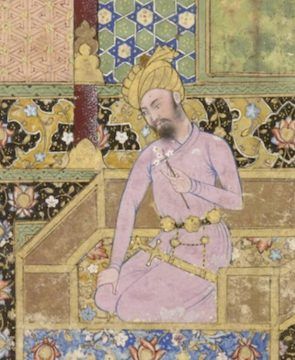 At the end of 1525, Zahiru’d-din Muhammad Babur, a Timurid poet-prince from Farghana in Central Asia, descended the Khyber Pass with a small army of hand-picked followers; with him he brought some of the first modern muskets and cannons seen in India. With these he defeated the Delhi Sultan, Ibrahim Lodhi, and established his garden-capital at Agra.
 BioNTech began work on the vaccine in January, after Dr. Sahin read an article in the medical journal The Lancet that left him convinced that the coronavirus, at the time spreading quickly in parts of China, would explode into a full-blown pandemic. Scientists at the company, based in Mainz, Germany, canceled vacations and set to work on what they called Project Lightspeed.
 Obama’s attempt to reconcile irreconcilable forces, to paper over the chasms, arguably gave Donald Trump his opening. Rather than confronting the banks whose reckless greed had caused the financial crisis, he allowed his Treasury secretary, Timothy Geithner, to “foam the runway” for them by allowing 10 million families to
  The manufacture of many chemicals important to human health and comfort consumes fossil fuels, thereby contributing to extractive processes, carbon dioxide emissions and climate change. A new approach employs sunlight to convert waste carbon dioxide into these needed chemicals, potentially reducing emissions in two ways: by using the unwanted gas as a raw material and sunlight, not fossil fuels, as the source of energy needed for production. This process is becoming increasingly feasible thanks to advances in sunlight-activated catalysts, or photocatalysts. In recent years investigators have developed photocatalysts that break the resistant double bond between carbon and oxygen in carbon dioxide. This is a critical first step in creating “solar” refineries that produce useful compounds from the waste gas—including “platform” molecules that can serve as raw materials for the synthesis of such varied products as medicines, detergents, fertilizers and textiles.
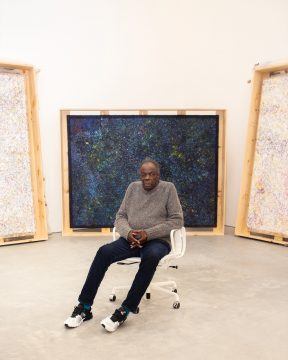 The show’s main news is in sculpture: there are several small pyramids and one immense one, all raised slightly off the floor and built of innumerable horizontal sheets of laminated plywood with regularly spaced bands of aluminum. Gorgeously dyed in sumptuous color—bringing out and celebrating the textures of the wood grain—the blunt structures radiate like light sources. Do they suggest late entries in the repertoire of Minimalism? They do, but with a sense of re-starting the aesthetic from scratch—getting it right, even, at long last. The pieces play a role in another of the show’s revelations: a series of large (up to twenty feet wide) neo- or post- or, let’s say, para-color-field paintings that owe the ruggedness of their paint surfaces to incorporations of leftover pyramid sawdust. Bevelled edges flirt with object-ness, making the works seem fat material presentations, protuberant from walls, rather than pictures. But, as always with Gilliam, paint wins. Thick grounds in white or black are crazed with specks, splotches, and occasional dragged strokes of varied color. While you feel the weight of the wooden supports, your gaze loses itself in something like starry skies: dizzying impressions of infinite distance in tension with the dense grounds, which are complicated by tiny bits of collaged and overpainted wooden squares. Registering the jittery chromatic harmonies and occasional underlying structures—ghosts of geometry—takes time. Seemingly decorative at first glance, the paintings turn inexhaustibly absorbing and exciting when contemplated. Like everything else in this show of an artist who is old in years, they feel defiantly brand spanking new.
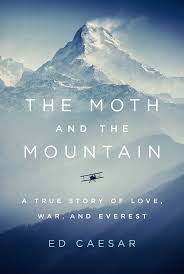 The Moth and the Mountain is a strange book. Several times this past month I’ve told friends about it, describing its central figure, Maurice Wilson: war hero, heartbreaker, daydreamer, globetrotter, irrepressible adventurer, the man who, in 1932, dreamed up a scheme to fly the moth of the title (a de Havilland biplane) on to Mount Everest, before hopping out and shinning up to the summit. My wide-eyed friends would blink and ask, ‘And this is a real story?’ and I’d nod, and then they’d ask the terminal question, ‘What happened next?’