Joshua Rothman in The New Yorker:
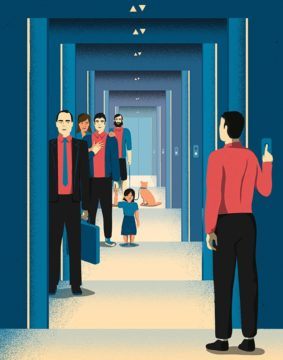 Once, in another life, I was a tech founder. It was the late nineties, when the Web was young, and everyone was trying to cash in on the dot-com boom. In college, two of my dorm mates and I discovered that we’d each started an Internet company in high school, and we merged them to form a single, teen-age megacorp. For around six hundred dollars a month, we rented office space in the basement of a building in town. We made Web sites and software for an early dating service, an insurance-claims-processing firm, and an online store where customers could “bargain” with a cartoon avatar for overstock goods. I lived large, spending the money I made on tuition, food, and a stereo.
In 1999—our sophomore year—we hit it big. A company that wired mid-tier office buildings with high-speed Internet hired us to build a collaborative work environment for its customers: Slack, avant la lettre. It was a huge project, entrusted to a few college students through some combination of recklessness and charity. We were terrified that we’d taken on work we couldn’t handle but also felt that we were on track to create something innovative. We blew through deadlines and budgets until the C-suite demanded a demo, which we built. Newly confident, we hired our friends, and used our corporate AmEx to expense a “business dinner” at Nobu. Unlike other kids, who were what—socializing?—I had a business card that said “Creative Director.” After midnight, in our darkened office, I nestled my Aeron chair into my ikea desk, queued up Nine Inch Nails in Winamp, scrolled code, peeped pixels, and entered the matrix. After my client work was done, I’d write short stories for my creative-writing workshops. Often, I slept on the office futon, waking to plunder the vending machine next to the loading dock, where a homeless man lived with his cart.
I liked this entrepreneurial existence—its ambition, its scrappy, near-future velocity. I thought I might move to San Francisco and work in tech. I saw a path, an opening into life. But, as the dot-com bubble burst, our client’s business was acquired by a firm that was acquired by another firm that didn’t want what we’d made.
More here.

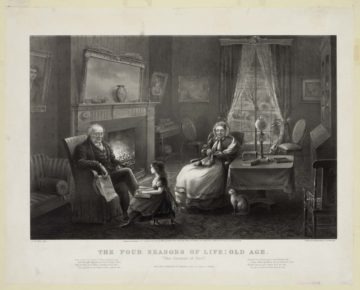 At other times and in other places, traditional ways of life, social classification, and metaphysical order gave shape and coherence to the course of life, providing a picture of aging well. Each period of life had its activities, duties, and forms of flourishing.
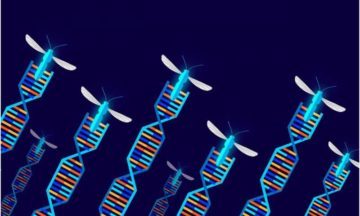 Gene drive organisms (GDOs), developed with select traits that are genetically engineered to spread through a population, have the power to dramatically alter the way society develops solutions to a range of daunting health and environmental challenges, from controlling dengue fever and malaria to protecting crops against plant pests.
 This year marks the seventy-fifth anniversary of publication of
 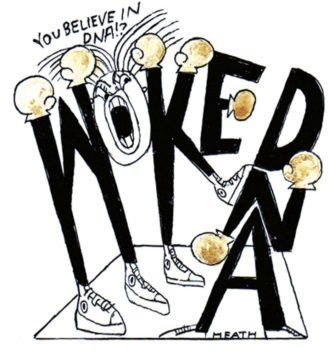 For, whether we like it or not, it is a true fact that we are cousins of kangaroos, that we share an ancestor with starfish, and that we and the starfish and kangaroo share a more remote ancestor with jellyfish. The DNA code is a digital code, differing from computer codes only in being quaternary instead of binary. We know the precise details of the intermediate stages by which the code is read in our cells, and its four-letter alphabet translated, by molecular assembly-line machines called ribosomes, into a 20-letter alphabet of amino acids, the building blocks of protein chains and so of bodies.
 As the US confronts both a political crisis of presidential succession and a worsening pandemic, it might be instructive, though perhaps not comforting, to learn that we’ve been here before.
 We are necessarily occupied here each week with strategies for getting ourselves out of the climate crisis—it is the world’s true Klaxon-sounding emergency. But it is worth occasionally remembering that global warming is just one measure of the human domination of our planet. We got another reminder of that unwise hegemony this week, from a study so remarkable that we should just pause and absorb it.
 This idea of Faulkner as fixated on the past has a long pedigree, perhaps beginning with “On The Sound and the Fury: Time in the Work of Faulkner,” a much-read 1939 essay by Jean-Paul Sartre. “In Faulkner’s work,” Sartre contends, “there is never any progression, never anything which comes from the future.” But what he describes in his quotations from the novel are Quentin Compson’s ruminations about time, not Faulkner’s. Sartre says that “Faulkner’s vision of the world can be compared to that of a man sitting in an open car and looking backwards.” But Sartre does not consider that in order for that vision to travel backwards the car has to move forward, and in that progress is change, which Warren Beck characterized as “man in motion” in his classic 1961 study, so titled, of the Snopes trilogy. Sartre—not the first philosopher to pursue an idea that overwhelms and distorts reality—argues that the past “takes on a sort of super-reality, its contours are hard and clear, unchangeable.” Tell that to any close reader of the 1936 novel Absalom, Absalom!, in which the past changes virtually moment by moment depending on who is talking.
 In 1938, Yasunari Kawabata, a young journalist in Tokyo, covered the battle between master Honinbo Shusai and apprentice Minoru Kitani for ultimate authority in the board game Go. It was one of the lengthiest matches in the history of competitive gaming—six months. In his 1968 Nobel Prize-winning novel inspired by these events, The Master of Go, Kawabata wrote of the decisive moment when, “Black has greater thickness and Black territory was secure, and the time was at hand for Otake’s [Kitani’s pseudonym in the book] own characteristic turn to offensive, for gnawing into enemy formations at which he was so adept.” A strategy that led Otake to victory.
 The term “soft matter” was coined in 1970, and has become common currency in science only in the past two or three decades. Yet the substances to which it refers – such as honey, glue, flesh, soap, leather, starch, bitumen, milk, pastes and gels – have been familiar components of our material world since antiquity. The phrase, incidentally, was coined by French scientist Madeleine Veyssié, a collaborator of physics Nobel laureate Pierre-Gilles de Gennes, one of the foremost pioneers of the field. The French term, matière molle, is something of a double entendre, which would doubtless have appealed to the suave and charismatic de Gennes, well known for his almost stereotypically Gallic romantic liaisons.
 Should Cambridge University academics and students
  It is our sad lot that we love perishable things: our friends, our parents, our mentors, our partners, our pets. Those of us who incline to nature draw this consolation: most lovely natural things – the forests, the lakes, the oceans, the reefs – endure at scales remote from individual human ones. One meaning of the Anthropocene is that we must witness the unravelling of these things too. A tree we loved in childhood is gone; a favourite woodlot is felled; a local nature preserve invaded, eroded and its diversity diminished; this planet is haemorrhaging species.
 A couple of days before he was scheduled to discuss, on the platform of the Tata Literary Festival 2020, his recent book Internationalism or Extinction, a group of India’s social and political activists wrote an open letter to Noam Chomsky in which they suggested that he boycott the festival. They cited the less-than-wholesome credentials of the festival’s sponsors, the Tatas, in the matter of human rights and apropos of how they ran their businesses. The activists reminded Chomsky that the Tatas’ business empire had expanded over the years by ruthlessly displacing – with active help from the Indian state, and often with brute force – vast tribal communities from their traditional habitats in several Indian provinces. They also talked about open-cast mining and other deleterious business practices the Tatas continued to pursue in flagrant disregard of environmental concerns. By lending his formidable name and his enormous prestige to the festival, the activists believed, Chomsky would only help “erase their (the Tatas’) crimes from public consciousness”.
 In the early 1980s, the painter, sculptor, and all-around technological savant