
Rafia Zakaria in The Baffler:
 At noon, one hour before the two chambers met in joint session, President Trump took the stage before a crowd not far from 1600 Pennsylvania Avenue. There he whipped up the faithful, men and women he had fed and fattened with stories of election fraud and voting dumps, to march on the Capitol and protest outside. The crowd cheered him on, considering themselves to be real (and armed) patriots there to save America at the “Save America rally.”
Everyone knows what happened next. Even as cable news switched between the House and the Senate, which had returned to their respective chambers to debate the objections to Arizona’s electoral votes, the crowd outside the Capitol grew and became ever more strident. As the objectors to the electoral vote count began to speak of feigned irregularities, the pulsating crowd laid siege to the Capitol. Then it was up the steps, and ultimately it stormed its way in. Photographs showed Confederate flag-bearing protesters in Statuary Hall, others standing in the Senate Chamber. Who could say whether some were carrying weapons? A photo later showed a man carrying plastic handcuffs, as if he hoped to take hostages.
It was eight o’clock in the evening—two hours after a 6 p.m. curfew came into effect on the streets of D.C. and after law enforcement had “retaken” the Capitol building—when the lawmakers met again. The people were the same, but the political calculations had unalterably changed. Sticking with a post-loss Trump, a move glibly rebranded by Senator Ted Cruz as “[protecting] the integrity of our democratic system,” now bore a greater political cost. Many Americans may have passively supported Trump’s efforts to own the libs and even to complain about fraud; few would be able to applaud the sight of armed protesters storming the Capitol, forcing lawmakers into lockdown and prompting foreign government officials to offer up best wishes for a return to order.
Arguably, it was the only way Trumpism could have been dealt a death blow.
More here.
 On Wednesday afternoon, as insurrectionists assaulted the Capitol, a man wearing a brown vest over a black sweatshirt walked through the halls of Congress with the Confederate battle flag hanging over his shoulder. One widely circulated photo, taken by Mike Theiler of Reuters, captured him mid-stride, part of the flag almost glowing with the light coming from the hallway to his left.
 The impact of Germany on Ortega’s thoughts about his own country can be seen in his first major publication, Meditations on Quixote (1914), a book which, far from merely being a commentary on the famous Spanish novel, serves as a summary of Orteguian thought. Influenced by the biologist Jacob Von Uekull’s idea that a living organism must be studied within its environment in order to be understood, Ortega argued that human life must also be understood through its circumstances: “Circumstantial reality makes up the other half of me as a person: I need it to imagine myself and to be my true self,” he wrote. Social status, historical period, nationality, geographic location, and economic situation are all relevant when it comes to understanding how one sees the world and oneself, since they determine our perspective. This idea is summarized in Ortega’s most famous quote: ‘‘I am I and my circumstance, and if I do not save it, I do not save myself.’’ In just the same way that Ortega ventures out into the world down the Guadarrama river near his hometown, or that the Ancient Egyptians would have ventured out down the Nile, we also venture out into the world from our own places of origin. Regardless of how many new ideas you may open yourself to, and no matter how much they change your way of thinking, it will always be you perceiving them; your past experiences, your childhood, your economic and social status, your nationality, your historical period are vital in defining you as a person.
 Their oeuvre comprises two categories, into which the bulk of Black Romantic art can also be slotted: “Home and Family Life” and “Religious and Spiritual Paintings.” The former is all nuclear bliss and filial piety—Mommy and Daddy dole out kisses and baths and lead the children in bedtime prayers. Little black girls come draped in the oversize uniforms of secretaries and teachers, the boys outfitted as preachers, lawyers, and athletes, all smiling a bit too wide and glowing the same glazed-honey-bun brown. The aforementioned Daniel belongs to the latter grouping, alongside other familiar biblical tableaux, the figures all recast as black and rendered with expressive detail. Christ, pressed hair agleam beneath the halo, shepherds his flock through thick Edenic brush. A personal favorite is Visitation, 1998, in which a white-robed girl gazes heavenward, the sky behind her a froth of crepuscular blues, greens, and plums. Her exposed neck imparts a devilish stroke of carnality welcome amid the otherwise pious scene. Likewise her glossed lips, which, along with her wispy bangs, situate her firmly in modernity, a Madonna-cum–round-the-way girl. Before her are lilies of all varieties and in all stages of bloom, their sharp, distinct oil lines contrasting with the gauzy, airbrushed sky. Smaller, yellow buds blossom throughout, a tonal invocation of the orisha Oshun, lover of honey, sensuality, and mayhem. The infusion of paganism and possibly Yoruba symbolism unyokes the portrait from its stodgy biblical origins and releases it into more rousing territory. Are we witnessing a visitation or a conjuring? Is hers the white robe of the Pentecost or the Priestess?
 Imagine a drowning city. The collapse of the Greenland ice sheets has led to a ten-foot rise in global sea-levels. You think this is bad, but it is followed by further melting at the Aurora Basin in East Antarctica, resulting in another forty-foot rise. In his novel,
  Data science is remaking countless aspects of society, and medicine is no exception. The range of potential applications is already large and only growing by the day. Machine learning is now being used to
 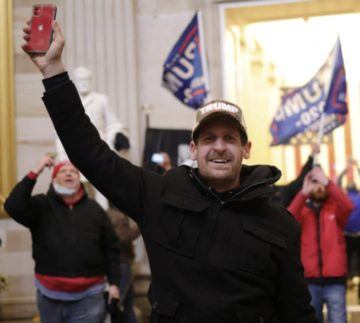 Although it is certainly true that Trump maintains a significant following among White women, his most fervent supporters tend to be White and male. Distributed across a wide swath of socioeconomic status, these men have unwaveringly — and even violently — supported the president, despite the historic risks his administration poses to public health, safety, and American democratic structures and ideals. No shortage of pundits and prognosticators have speculated about the factors underlying this support:
  There is
 In May of this year, The Washington Post published an article damningly titled “Millennials are the Unluckiest Generation in U.S. History.” The piece seemed to tell a truth that our cohort knows all too well: that the COVID-19 pandemic has brought not just an economic recession, but a regression. There were as many jobs in the spring of 2020 as there were in the fall of 1999. For those of us born between the years of 1981 and 1996, it is as if the post-crisis “growth” of the past 10 years never even happened.
 As the United States and much of the rest of the world struggles through a winter of intensifying death and disease, it is worth remembering that beyond the present darkness lies the dawn, as newly approved vaccines become widely available, and with that, perhaps, a return to something resembling normalcy.
 The Founding Fathers are a perennial source of both wisdom and controversy. Alexander Hamilton, the first U.S. Secretary of the Treasury, has taken pride of place in these public debates in recent years, thanks in part to Lin-Manuel Miranda’s musical and Ron Chernow’s 2004 biography. In this interview, Michael Busch speaks with journalist and economist Christian Parenti about his new book
  Marxism has had a long and troubled relationship with religion. In 1843 the young Karl Marx wrote in a critical essay on German philosophy that religion is “the opium of the people”, a phrase that would eventually harden into official atheism for the communist movement, though it poorly represented the true opinions of its founding theorist. After all, Marx also wrote that religion is “the sentiment of a heartless world” and “the soul of soul-less conditions”, as if to suggest that even the most fantastical beliefs bear within themselves a protest against worldly suffering and a promise to redeem us from conditions that might otherwise appear beyond all possible change. To call Marx a “secularist”, then, may be too simple. Marx saw religion as an illusion, but he was too much the dialectician to claim that it could be simply waved aside without granting that even illusions point darkly toward truth.
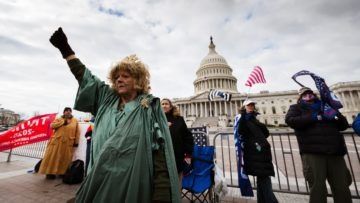 Insurrection Day, 12:40 p.m.: A group of about 80 lumpen Trumpists were gathered outside the Commerce Department, near the White House. They organized themselves in a large circle, and stared at a boombox rigged to a megaphone. Their leader and, for some, savior—a number of them would profess to me their belief that the 45th president is an agent of God and his son, Jesus Christ—was rehearsing his pitiful list of grievances, and also fomenting a rebellion against, among others, the klatch of treacherous Republicans who had aligned themselves with the Constitution and against him. “A year from now we’re gonna start working on Congress,” Trump said through the boombox. “We gotta get rid of the weak congresspeople, the ones that aren’t any good, the Liz Cheneys of the world. We gotta get rid of them.” “Fuck Liz Cheney!” a man next to me yelled. He was bearded, and dressed in camouflage and Kevlar. His companion was dressed similarly, a