
Robert B. Talisse at ARC Digital:
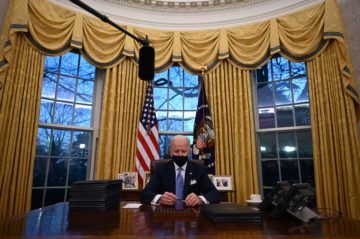 Our differences over policy are substantial, but they’re far less severe than we realize. Although we believe the country to be especially divided, we are no more at odds over policy than we were 40 years ago. This is because we tend to systematically misunderstand our oppositions’ political views.
Our divide lies not in policy disputes and competing legislative priorities, but rather in the fact that we dislike our opponents more intensely than ever.
This means that we strongly tend to see partisan rivals as depraved, untrustworthy, immoral, misguided, and dangerous, even when it comes to behaviors that are arguably nonpolitical. Consequently, we tend to judge nearly everything those on the other side do as objectionable, even in the case of actions that we approve of when committed by our allies.
Given these conditions, we should expect Biden’s call for unity to inflame our partisan divisions. Here’s why.
More here.
 I
I 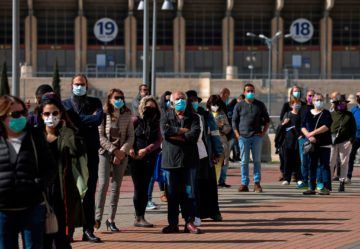 JERUSALEM — Israel, which leads the world in vaccinating its population against the coronavirus, has produced some encouraging news: Early results show a significant drop in infection after just one shot of a two-dose vaccine, and better than expected results after both doses. Public health experts caution that the data, based on the Pfizer-BioNTech vaccine, is preliminary and has not been subjected to clinical trials. Even so, Dr. Anat Ekka Zohar, vice president of Maccabi Health Services, one of the Israeli health maintenance organizations that released the data, called it “very encouraging.” In the first early report, Clalit, Israel’s largest health fund, compared 200,000 people aged 60 or over who received a first dose of the vaccine to a matched group of 200,000 who had not been vaccinated yet. It said that 14 to 18 days after their shots, the partially vaccinated patients were
  Didion, now eighty-six, has been an object of fascination ever since, boosted by the black-lace renaissance she experienced after publishing “The Year of Magical Thinking” (2005), her raw and ruminative account of the months following Dunne’s sudden death. Generally, writers who hold readers’ imaginations across decades do so because there’s something unsolved in their project, something that doesn’t square and thus seems subject to the realm of magic. In Didion’s case, a disconnect appears between the jobber-like shape of her writing life—a shape she often emphasizes in descriptions of her working habits—and the forms that emerged as the work accrued. For all her success, Didion was seventy before she finished a nonfiction book that was not drawn from newsstand-magazine assignments. She and Dunne started doing that work with an eye to covering the bills, and then a little more. (Their Post rates allowed them to rent a tumbledown Hollywood mansion, buy a banana-colored Corvette Stingray, raise a child, and dine well.) And yet the mosaic-like nonfiction books that Didion produced are the opposite of jobber books, or market-pitched books, or even useful, fibrous, admirably executed books. These are strange books, unusually shaped. They changed the way that journalistic storytelling and analysis were done.
 SM
SM  In April 2020, during the
  Kenny Chow was born in Myanmar, and moved to New York City in 1987. He worked for years as a diamond setter for a jeweller, earning enough to buy a house for his family before he was laid off in 2011. At that point, Chow decided to become a taxi driver like his brother, scraping together financing to buy a taxi medallion for $750,000. This allowed him to operate as a sole proprietor, with the medallion as an asset.
 Wikipedia was launched as the ugly stepsibling of a whole other online encyclopedia, Nupedia. That site, launched in 1999, included a rigorous seven-step process for publishing articles written by volunteers. Experts would check the information before it was published online — a kind of peer-review process — which would theoretically mean every post was credible. And painstaking. And slow to publish.
 I don’t mean to slight the brilliant, insanely brave writer
 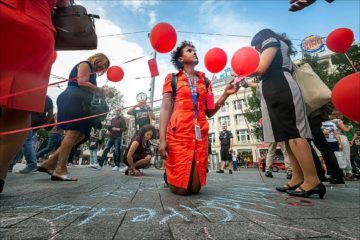 On World Hijab Day, 1 February, the Council of Ex-Muslims of Britain (CEMB) will premiere
  A
A