
Richard Haass in Project Syndicate:

The report issued Friday by the US intelligence community on the murder of Saudi journalist and permanent US resident Jamal Khashoggi in October 2018 at the Saudi consulate in Istanbul, Turkey mostly confirms what we already knew. The operation to capture or kill Khashoggi was approved by Mohammed bin Salman, Saudi Arabia’s Crown Prince and in many ways already the Kingdom’s most powerful person. MBS, as he is widely known, wanted Khashoggi dead, both to rid himself of a nettlesome critic and to intimidate other would-be critics of his rule.
We are unlikely to find a smoking gun, but MBS’s fingerprints are all over Khashoggi’s killing. There is not only abundant photographic and communications evidence that it was carried out by people close to the Crown Prince. There is also the simple reality that nothing of significant political magnitude happens in Saudi Arabia without MBS’s authorization.
Former President Donald Trump’s administration looked the other way at the time, as it often did in the face of flagrant human rights violations. Moreover, Trump wanted to avoid a rupture with MBS, whose anti-Iranian policies were appreciated and who was seen as central to his government’s willingness to purchase armaments from US manufacturers.
President Joe Biden’s administration feels differently. It has already distanced the United States from involvement in Saudi military operations in Yemen. And human rights are occupying a central role in its approach to the world. The fact that Biden has not communicated directly with MBS, and instead called the ailing King Salman, underscores Biden’s desire to separate the US relationship with the Kingdom from the relationship with the Crown Prince.
But this separation will likely prove impossible to sustain.
More here.
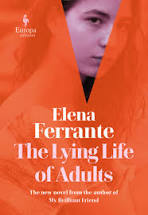 In Ferrante’s most recent novel, The Lying Life of Adults, we are pulled yet again into the story with the tale of a missing woman, Aunt Vittoria. Unlike Lila, she has not disappeared altogether but is estranged from her brother, Andrea, and her 12-year-old niece, Giovanna, who narrates the story. While Giovanna and her parents live in a middle-class section of Naples, Vittoria has remained in Pascone, the working-class neighborhood in the city’s Industrial Zone where she and Andrea were raised. Throughout the novel, we get conflicting stories from Vittoria and Andrea about what led to their estrangement. A dispute about who should inherit their mother’s apartment following her death was certainly the breaking point, but there had long been tension between them. Early on, it becomes clear that Andrea is frustrated that his sister did not respond to the poverty of their childhood in the same way he did: by leaving Pascone behind with no qualms or doubts and embracing the tastes and habits of the Italian bourgeoisie. But what takes longer to be revealed is that Vittoria is perhaps no better, that her working-class pride may not be as sturdy as she wants her young, wide-eyed niece to think.
 The interviewers often push Girard to explain how his theory applies to real life, and he is happy to oblige. The theory’s journey into the world is a great story in its own right. No sooner did his argument reach a certain “elegance” than Girard started to realize its growing applicability: “You suddenly see that there is a single explanation for a thousand different phenomena.” He first formulated his theory in a book of literary history, then went on to apply it to the study of mythology and religion, then to politics and international relations, then to society and economy, fashion and eating disorders, and whatnot. Just open a newspaper and pick something, anything, at random. Even the stock market? Especially the stock market, Girard would respond. That’s “the most mimetic institution” of all—indeed, a textbook illustration of how mimetic theory works: “You desire stock not because it is objectively desirable. You know nothing about it, but you desire stuff exclusively because other people desire it. And if other people desire it, its value goes up and up and up.” There is hardly a field, sphere of life, or situation, where Girard’s theory does not apply. He finds that fascinating. Some of his readers find it too good to be true. Others find it scandalous.
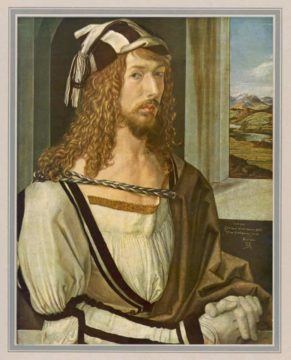 Albrecht Dürer was the first great sightseer in the history of art, travelling Europe to see conjoined twins, Aztec gold, Venetian gondolas and the bones of an 18ft giant. He crossed the Alps more than once and voyaged for six days in the freezing winter of 1520 to see a whale on a beach in Zeeland. The ship was nearly wrecked, but somehow Dürer saved the day and they eventually reached the shore. The sands were empty. The great creature had sailed away.
  If you were somehow able to travel back in time some 130,000 years and chance upon a Neanderthal, you might find yourself telling them about some of humanity’s greatest inventions, such as spanakopita and TikTok. The Neanderthal would have no idea what you were saying, much less talking about, but they might be able to hear you perfectly, picking up on the voiceless consonants “t,” “k” and “s” that appear in many modern human languages. A team of scientists has reconstructed the outer and middle ear of Neanderthals and concluded that they listened to the world much like we do. Their
 Scientists have come up with a computer program that can master a variety of 1980s exploration games, paving the way for more self-sufficient robots.
 Last spring,
 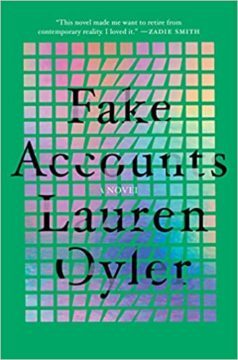 Since its consolidation at the end of the eighteenth century, the realist novel has been the premier vehicle for the depiction of contemporary life. For over two hundred years, a relatively fixed set of representational techniques – point-of-view, voice, description, dialogue, plot – has managed to adapt to the radical transformations of modernity: the nuclearization of the family, the entry of women into public life, the liberalization of sexual mores, industrialization and deindustrialization, urbanization and suburbanization, secularization, the lifeworlds of dominated classes and colonized nations, war on a planetary scale, and new conceptions of cognition and identity formation, to name just a few. By doubling down on its core strength – the linguistic representation of inner experience – the novel even managed to fend off challenges from rival media, like film and television. But over the last decade or so it has become clear that changes in the texture of the contemporary itself, due primarily to the diffusion of digital networked media, have begun to strain the capacity of the novel – as an institution, as a medium, as a form – to fulfil its traditional remit.
 During a rare excursion to a clothes shop I took last month, an older woman walked in, looked around at the other shoppers and exclaimed, “humans!” It was an unusual moment of bonding with strangers. Mostly I just hold my breath as people squeeze past me at the supermarket. In this year of staying two metres away from practically everyone, we’ve all become used to treating other people as potentially toxic. Now that vaccinations are under way, we’re allowed to hope that we will one day emerge from hibernation. What will socialising be like on the other side? And how will we cope with being together again?
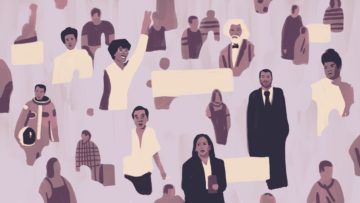 Black History Month has been celebrated in the United States for close to 100 years. But what is it, exactly, and how did it begin?
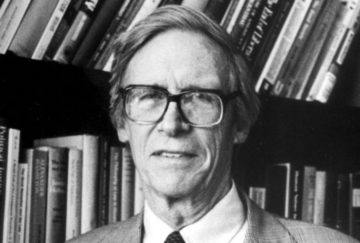 Joshua Cohen in Boston Review:
 Jamie McCallum in Aeon:
 Elizabeth Anderson in The Nation: