
Category: Recommended Reading
Bob Koester (1932 – 2021)
The clothing revolution: What if the need for fabric, not food, in the face of a changing climate is what first tipped humanity towards agriculture
Ian Gilligan in aeon:
 Archaeologists and other scientists are beginning to unravel the story of our most intimate technology: clothing. They’re learning when and why our ancestors first started to wear clothes, and how their adoption was crucial to the evolutionary success of our ancestors when they faced climate change on a massive scale during the Pleistocene ice ages. These investigations have revealed a new twist to the story, assigning a much more prominent role to clothing than previously imagined. After the last ice age, global warming prompted people in many areas to change their clothes, from animal hides to textiles. This change in clothing material, I suspect, could be what triggered one of the greatest changes in the life of humanity. Not food but clothing led to the agricultural revolution.
My recent work shows that clothing wasn’t just the unique adaptation of a more-or-less hairless mammal to the changing natural environments. The development of clothing led to innovations with many repercussions for humanity, beyond survival in cold climates. A need for portable insulation from the cold in the Palaeolithic promoted major technological transitions. These include stone toolkits for working animal hides and, subsequently, bone tools such as pointed awls and needles to make tailored garments. Later, during the coldest stage of the last ice age, Homo sapiens in middle latitudes devised multi-layered outfits with an inner layer of underwear. Equipped with effective protection from wind chill, our species could penetrate into the frigid Arctic Circle, further north than cold-adapted Neanderthals had managed to venture. From the northeastern corner of Siberia, modern humans strolled across an exposed land bridge to enter Alaska by 15,000 years ago, if not earlier, to likely become the first hominins to set foot in the Americas. At the Broken Mammoth site in Alaska, archaeologists have unearthed the fragile technology that made the journey possible: a 13,000-year-old eyed needle.
More here.
Saturday, May 15, 2021
The Ministry for the Future Seminar
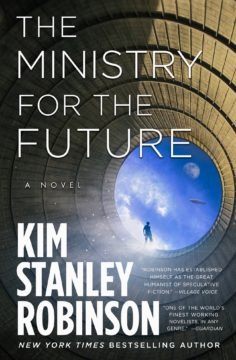
Crooked Timber is having a seminar on Kim Stanley Robinson’s Ministry for the Future.
The participants in the seminar:
- Henry Farrell blogs at Crooked Timber. Technocracy and Empire.
- Maria Farrell blogs at Crooked Timber. What is Ours is Only Ours to Give.
- Jessica Green is an associate professor of political science at the University of Toronto. Can the World’s Bankers Really Save the Climate?
- Oliver Morton is The Economist’s briefings editor. On Solar Geoengineering and Kim Stanley Robinson.
- Suresh Naidu is a professor of economics and international and public affairs at Columbia University. This Is How It Gets Better.
- John Quiggin blogs at Crooked Timber. Half the Earth?.
- Olúfẹ́mi O. Táíwò is an assistant professor of philosophy at Georgetown University. What’s In Our Way?
- Todd Tucker is director of governance studies at the Roosevelt Institute. Ministry for Your Future Soul
- Belle Waring blogs at Crooked Timber. The Sudden Tempest of Ultimate Summer
- Kim Stanley Robinson is a writer. Response.
More here.
Asia’s Anti-Colonialist Journey
 Thomas Meaney in The New Yorker:
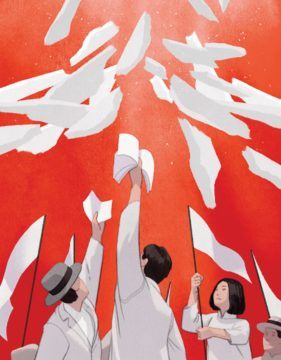
International conferences are notoriously difficult to organize, all the more so when the aim is global revolution and the world’s empires oppose your agenda. When, starting in 1919, Vladimir Lenin convened the first congresses of the Communist International, some Bolsheviks were disappointed by the characters who turned up—old-fashioned socialists, trade unionists, and anarchists, coming with false papers, in disguise, under aliases, and all apparently expecting hotel rooms. The Russian revolutionary Victor Serge observed, “It was obvious at first glance that here were no insurgent souls.” Lenin kept a blinking electric light on his desk to cut meetings short. But one of the arrivals made an impression. “Very tall, very handsome, very dark, with very wavy hair,” Serge recalled. It was Manabendra Nath Roy, an Indian who was a founder of the Mexican Communist Party. When ducking imperial authorities, he used a method described by a comrade: “If you want to hide revolutionary connections . . . you had better travel first class.”
Roy had cut an unusual path to Moscow. Born into a Brahmin family in West Bengal in 1887, he left India in his twenties on a series of missions to secure funds and weapons for an uprising against the British Raj. During the First World War, a group of Indian anti-imperialists wanted the Germans to open a second front against their common enemy. But Roy’s parleys with contacts in Java, China, and Japan yielded almost nothing. In Tokyo, he resolved to press onward to the United States: “I decided to take the bull by the horn, pinned a golden cross to the lapel of my coat, put on a very sombre face, and called at the American consulate.” Disguised as “Father Martin” and having, he said, “reinforced my armour with a morocco-bound copy of the Holy Bible beautifully printed on rice-paper,” Roy arrived in San Francisco in 1916.
More here.
Dismantle All of This Stuff: A Conversation with Noam Chomsky
 David Masciotra in the Los Angeles Review of Books:
DAVID MASCIOTRA: Did your and Marv Waterstone’s decision to publish the lectures from your course “What Is Politics?” derive from a sense of needing to return to fundamentals, perhaps due to the convergence of crises we are currently experiencing?
NOAM CHOMSKY: Marv and I felt that the content of the book, which does begin with essentials, like the nature of presupposed “common sense” — where people get their ideas and beliefs from — goes on to reach things that are very urgent and critical today. We based this on our own sense of things, and the reactions from the two class cohorts. One is undergraduate students at the University of Arizona, and the other is community people, older people. The two groups interact, and judging from their reactions, both seemed to find it valuable and instructive. That was encouragement enough for us to put it together, and there is material that goes beyond the lectures, of course. It seemed worth doing, and the reactions we’ve had so far reinforce that conclusion.
What do you believe is a prevalent misconception among Americans in answer to the simple question “What is politics?” And how would you correct that misconception?
Well, if this course was taught by a mainstream instructor, politics would be what is taught in a civics course: how the rules are in the Senate and House, who introduces legislation, who votes on it, the nuts and bolts of the workings of the formal political system. From our point of view, politics is what happens in the streets and what happens in corporate boardrooms. The latter overwhelmingly dominates the shaping and framing of what happens in the political system.
More here.
Arendt and Roth: An Uncanny Convergence
 Corey Robin in the NYRB:
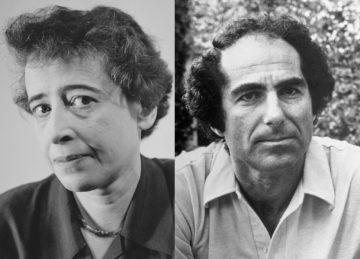
In 2014, the mystery writer Lisa Scottoline wrote an instructive essay for The New York Times about two undergraduate seminars she took with Philip Roth at the University of Pennsylvania in the 1970s. One of the courses was the literature of the Holocaust. Hannah Arendt was on the syllabus.
In his five-page discussion of those years at Penn, Roth biographer Blake Bailey makes no mention of this course or Arendt. Instead, he focuses on the other course, “The Literature of Desire,” and Roth’s erotic presence inside and outside the classroom. In the wake of the allegations of sexual assault and inappropriate behavior that have been made against Bailey, the omission may seem small or slight. Yet it is telling. As Judith Shulevitz argues in a searching analysis of the allegations and the biography, Bailey is as incurious about Jewishness as he is about the reality of women. When the two come together in the form of Arendt, his interest seems, well, nonexistent.
The result is a life stripped of one of its vital currents. Arendt was a real presence for Roth, and the unexpected convergence between their biographies and concerns, particularly regarding Jewish questions, is as uncanny as the doubles that populate Roth’s novels.
More here.
The Anatomy of Melancholy (In Our Time)
https://www.youtube.com/watch?v=rFwOV13Jjiw&t=873s
‘A User’s Guide to Melancholy’ by Mary Ann Lund
Nicholas Lezard at The Guardian:
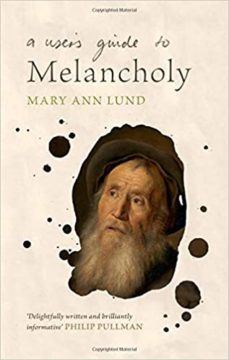 Mary Ann Lund’s book serves as an introduction not just to Burton’s magnum opus but to contemporary and historical conceptions of melancholy. Do not make the mistake of confusing “melancholy” with what we now call depression. Her brief is not so much to say why or how Burton’s style is so delightful but to give us a learned, broad and readable picture of Renaissance medicine, using Burton’s book as a starting point. Melancholy, in the early modern world, could present itself in bizarre ways. Think “Embarrassing Early Modern European Bodies”. She tells, for instance, the story of the classical scholar Isaac Casaubon (1559-1614), whose “postmortem revealed that his bladder was malformed and that the supplementary bladder was nearly six times as large as the main chamber”. The apparent reason was that he had regularly ignored the call of nature while being absorbed in his work. (That George Eliot chose the name for the dry-as-dust obsessive in Middlemarch is no coincidence; but I am not sure she knew about the bladder. Burton, whom she would have read, doesn’t mention it, but does cite Casaubon a couple of times.)
more here.
The Victorian Women Who Spoke to The Dead
Christine Leigh Heyrman at the NYT:
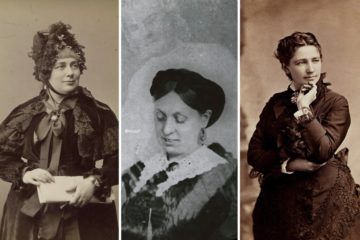 Although they inspired many imitators, the Fox sisters did not number among those mediums who subsequently developed Spiritualism as an organized movement in both the United States and Britain. Their ranks included Emma Hardinge Britten, who wrote its history and traveled the public lecture circuit as a trance medium in the late 1850s, delivering opinions about the issues of the day as dictated by the spirits. By contrast, Victoria Woodhull had cut her ties to Spiritualist groups when her claim to clairvoyant powers persuaded the tycoon Cornelius Vanderbilt to back her in founding the first female brokerage firm on Wall Street. But shortly thereafter she managed to recruit both Spiritualist and women’s rights organizations to support her bid for the presidency in 1872. Meanwhile in Britain, Georgina Weldon — not a medium herself but a stage-struck Spiritualist — fought the efforts of her husband and his squad of doctors to commit her to an asylum. She challenged Britain’s lunacy laws with more than a decade of agitation, which included parading sandwich-board men as pickets, scattering leaflets from a hot-air balloon, giving theatrical performances and offering antic testimony in court.
more here.
Between the Lines: Seeking solace in the work of the fourteenth-century Persian poet Hafez
Nilo Tabrizy in Guernica:
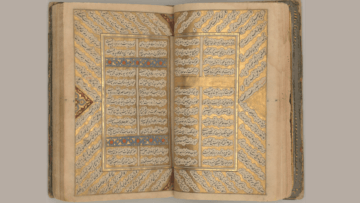 For the past year, I’ve been researching and studying the works of Hafez, one of Iran’s most beloved and influential poets. More than 600 years after his death, his work is still invoked regularly, quoted by Iranian politicians to skewer their rivals and by everyday Iranians in casual conversations over dinner. Normally, this is the part where I would share a verse of his work, or tell you how complex and beautiful his words are. I would to tell you how Iranians use his poems as a form of divination, like a tarot card reading of sorts. Instead, I am consumed with trying to understand why I’ve been devoting so much time to studying the verses of a poet from the fourteenth century right now, when my country is going through every imaginable version of pain. Wouldn’t it make more sense to focus on current national security issues instead of diving into the art of our past?
Recently I interviewed Afshon Ostovar, a renowned Iran expert who focuses on the IRGC. I was talking to him about the Qods Force, the unit that was commanded by Qassim Soleimani, the general killed by the United States in a drone strike in January. He told me he had noticed some recent tweets of mine about Persian poetry, and said he found it sweet to read something like that while both of our professional fields were dealing with an onslaught of depressing news.
After our interview, I kept thinking about what Ostovar said. Why am I always drawn to poetry, even in times when more pressing headlines should capture my attention?
Certainly, poetry is central to Iranian identity. The Shahnameh, an epic poem by Persian poet Ferdowsi, cemented this connection. Ferdowsi began writing this narrative of more than 50,000 couplets in 977 AD and completed the endeavor forty-three years later in 1010. The poem tells the mythical tale of the history of ancient Iran, a story stretching back from the creation of the world to the seventh century, when the Arabs conquered Iran. When Ferdowsi was writing, the Arab invasion imposed a new language and religion on the people of Iran. With Shahnameh, Ferdowsi preserved our language and history at a time when it was in danger of being lost forever.
More here.
Saturday Poem
Beautiful Empty Pages
What kind of work
Can I do in this world?
Who would be kind enough
To hire an old holy Bum,
One with a great reputation
For loving the charms
Of the lawless
And the wild artists and the lewd?
Maybe I could become a poet.
Maybe the Beloved
Will make my love so Pure
That He will come to sit upon
All my beautiful empty pages.
And when you come to look at them,
He might kick you
With His Beautiful Divine Foot.
by Hafiz
from I Heard God Laughing
renderings of Hafiz by Daniel Ladinsky
Trying to Imagine Post-Pandemic Life? Virginia Woolf and Toni Morrison Can Help
Michelle Orange in The New York Times:
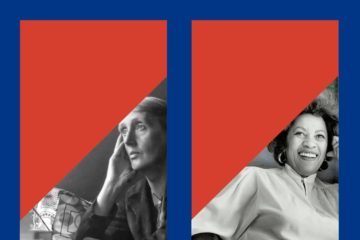 Early this spring, wary and disoriented despite the vaccine at work in my system, I sought a book to help me navigate the strange, bardo-like moment in which disaster and its aftermath begin to overlap. “To the Lighthouse,” Virginia Woolf’s 1927 masterpiece, was the one that kept coming to mind — specifically its experimental middle section, “Time Passes.” Parsed into 10 “chapters,” with its swirling rhythms, involuted structure and flights into abstraction, “Time Passes” presents an especial challenge to the pre-post-pandemic brain. I hoped to find in Woolf’s evocation of grief as a disruption of one’s sense of time not a solution but the solace of a riddle’s key connections laid bare.
Nine years after the end of World War I, which left 40 million people dead or wounded, and seven since a global flu pandemic killed at least that many, Woolf sought to mark the unmaking of the world as she knew it, and, with her depiction of the Ramsay family and the various artists and scholars in their midst, tell a new kind of story about grief and restoration. She envisioned the structure with a line drawing: two blocks, the before and after, connected by a thin corridor. “I am making up ‘To the Lighthouse’ — the sea is to be heard all through it,” Woolf wrote in her diary. “I have an idea that I will invent a new name for my books to supplant ‘novel.’ A new — by Virginia Woolf. But what? Elegy?” Dislodging elegy from its poetic traditions and long history of men memorializing other men, Woolf set out to explore its terms within a more expansive, narrative form.
More here.
Friday, May 14, 2021
When One City Gave People Cash, They Went Out and Got Jobs
David Byrne in Reasons to be Cheerful:
 Stockton, California has gotten a lot of press for its experiment in providing a basic income to its residents, but it wasn’t until a recent study looked at the first year of results that we saw proven evidence of what impacts the experimental program was having.
Besides feeling less pain and anxiety about their lives and their financial situations, a surprising percentage of the program’s recipients got jobs. By the end of the first year of the study (2019, before the pandemic began) full-time employment in the recipient group had risen from 28 percent to 40 percent — double the increase found among folks who didn’t receive the money.
This runs counter to some conventional wisdom, which says that free money disincentivizes work. Rather, the report, along with anecdotal evidence, seems to say the opposite: it is the uncertainty that low-income folks live with that makes it harder for them to find the jobs they desire. Providing this modest monetary cushion allows folks to realize their potential, which benefits the entire community.
More here.
The First Cell: Jump-starting the global cancer revolution
John Hewitt in Medical Xpress:
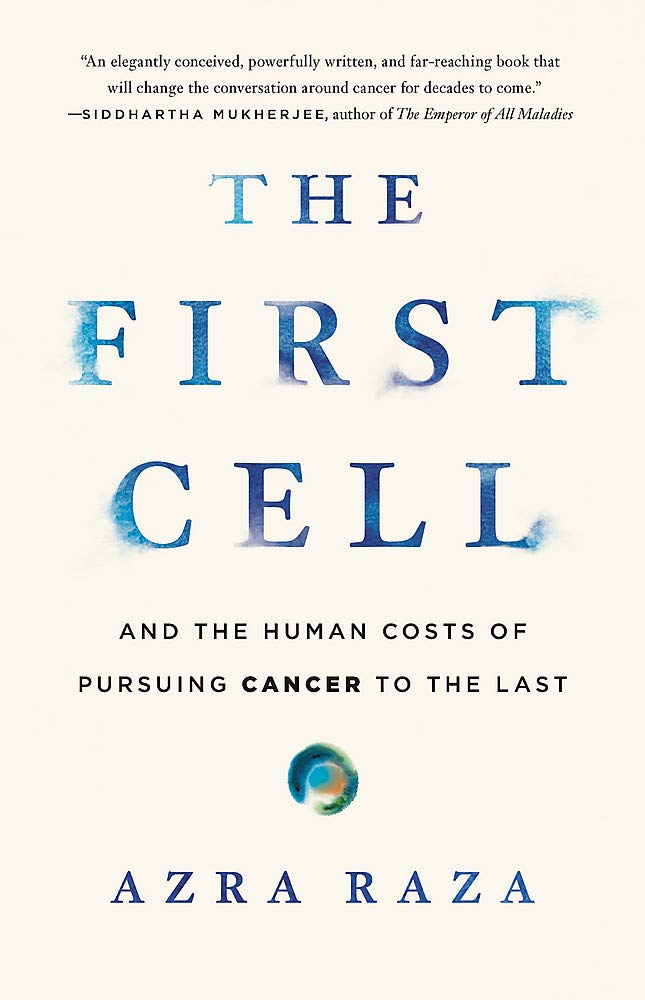 “The First Cell” is the title of a revolutionary book written in 2019 by oncologist Azra Raza from the Columbia University Medical Center. In it, she calls for a radical shift in cancer funding away from its current predominant focus on late stage treatments, and towards early detection of what she calls “the first cells.”
Shortly thereafter, a group of noted dignitaries in the field collectively called The Oncology Think Tank convened to begin hashing out this new imperative, and then bring it to fruition. In the popular magazine Scientific American, the group recently published their vision for a future when no cancer will be detected too late to treat. The logical entry point into this path begins with the most important resource now available—extant cancer survivors.
I recently spoke with Azra about her plans to establish The First Cell Center for Cancer Survivors (FICCCS), and asked her to provide a summary for us of how it might work.
More here.
Julia Galef: How Bayes’ equation changed the way I think
The World of Edward Said
Esmat Elhalaby in the Boston Review:
 On February 2, 1977, Palestinian poet Rashid Hussein died in his New York apartment. Hussein had been born forty-one years earlier in Musmus, a town not far from Nazareth. Politics for Hussein, Edward Said remembered, “lost its impersonality and its cruel demagogic spirit.” Hussein, Said wrote of his dear friend, “simply asked that you remember the search for real answers, and never give it up, never be seduced by mere arrangements.” Sharply critical of his own society and its rulers—he had a map of the Middle East on his wall with “thought forbidden here” scrawled across it in Arabic—Hussein was also a partisan of the Third World. “I am from Asia,” he pronounced in an early poem, “The land of fire / Forging furnace of freedom-fighters.”
Another of Hussein’s friends, Pakistani political scientist Eqbal Ahmad, wrote that he lived in “New York City as though it were a Palestinian town.” Born in 1936, Hussein was nearly the same age as Said. Had the dislocations of his life not burdened his soul so heavily—he died alone in his apartment, a lit cigarette setting fire to the mattress as he slept—Hussein may very well have lived alongside Said in Manhattan for a few decades more.
More here.
Alice Neel: They Are Their Own Gifts, 1978
Alice Rohrwacher’s Short “Four Roads”
Madeleine Seidel at Hyperallergic:
 Alice Rohrwacher’s most recent full-length feature, Happy as Lazaro, won the award for best screenplay at the 2018 Cannes Film Festival. Her latest short film, Four Roads, is a gorgeously composed meditation on community in the time of COVID. Shot in the rural Italian countryside in April 2020, during the early days of quarantine, the short follows Rohrwacher as she discovers an old camera and some expired film. She decides to see if she can connect with her neighbors through the “magic eye” of the camera, which allows her to interact with them while keeping a safe distance.
The director observes her neighbors — an elderly woman and her dog, a man tending to a secret garden, a large family on a farm — and the picturesque landscape they all share with a dreamlike sense of reverie, narrating the small everyday moments she captures. What makes Four Roads an incredibly special short is the true admiration Rohrwacher shows for these people.
more here.
Louis Menand’s Questionable Pantheon of Cold War–Era Luminaries
George Scialabba at The Baffler:
 One of The Free World’s larger themes is the replacement of Paris by New York as “the capital of the modern.” For nearly a century, Menand writes, “Paris was where advanced Western culture—especially painting, sculpture, literature, dance, film, and photography, but also fashion, cuisine, and sexual mores—was . . . created, accredited, and transmitted.” It was not the Nazi occupation that changed things; Paris got off lightly compared with other occupied capitals. (Though it would have been burned to the ground if the German commandant had not ignored Hitler’s orders.) And immediately after the Liberation in 1944, there was a cultural efflorescence. Existentialism was in vogue everywhere; its three main exponents—Sartre, Camus, and Beauvoir—were international celebrities. But the compass needle was turning: as Sartre acknowledged, “the greatest literary development in France between 1929 and 1939 was the discovery of Faulkner, Dos Passos, Hemingway, Caldwell, Steinbeck.” American leadership in painting was even more pronounced in the 1940s and 50s. Paris would always retain its aura, particularly for Black American writers and musicians, though not only for them—Paris would play a large part in liberating Susan Sontag, for example. But American global primacy was so complete in the fifties and sixties that the cultural primacy of its capital city could not be gainsaid.
more here.