Tessy Schlosser in The Ideas Letter:
On September 26 of this year, the streets of Mexico City once again filled with the faces and the voices of Ayotzinapa. Eleven years after the disappearance of forty-three students, the annual march has become part of a ritual calendar of protest: Names are spoken, banners are carried, justice is invoked. One demand is made—if the students were taken alive, they must be returned alive. “Vivos se los llevaron, vivos los queremos.” To say “they were taken alive” is to insist they might still be alive, suspended in a space where truth has yet to land. Investigations attempt to find that truth, often without resolution. A commission for “truth and access to justice” was established in December 2018 by presidential decree, exclusively dedicated to the Ayotzinapa case. The same demand is repeated. For most, September 26 has become a metronome of remembrance, a rhythm by which a nation counts its failures and measures its inability to face the disappearance not only of those forty-three students, but of the hundreds of thousands of others—most without marches, investigations, or commissions—who have been killed or who have gone missing over the past two decades.
Earlier that month, a UN independent commission—and Mexico’s own president—had called Israel’s campaign in Gaza a genocide. The calendar of the law, local or international, is procedural: It moves through hearings and rulings, through words that aim to gel events into crimes—“enforced disappearance,” “crimes against humanity,” “genocide.” These nouns aspire to tame violence by naming it. The law’s grammar seeks finality, the closure of history. Its aspiration is almost eschatological, with its promise that once a harm is labeled, the world might forever hold still. The law wants to stop time momentarily to address what has been done and prevent the past from repeating itself in the future. Sometimes a ruling brings relief, but even then, its language keeps moving under the surface: searching, yearning, raging, hurting, assessing, doubting.
More here.
Enjoying the content on 3QD? Help keep us going by donating now.

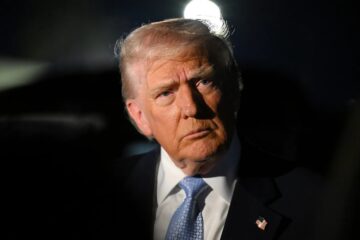 How should we understand the character of the American political present?
 I
I Seamus Heaney was a self-consciously self-made poet. In his essay ‘Feeling into Words’, he gives one of the best accounts available of ‘finding your voice’ as a writer. There were early stirrings of poetry in listening to his mother recite the Latin grammar of her schooldays; the ‘beautiful sprung rhythms’ of the BBC shipping forecast and ‘the litany of the Blessed Virgin that was part of the enforced poetry’ of a Catholic household. He learned to articulate the feelings these induced through reading English poetry at school, and in particular ‘the heavily accented consonantal noise’ of Gerard Manley Hopkins, in whose ‘staccato’ music Heaney heard an encouraging echo of his own ‘energetic, angular’ Ulster accent.
 The mathematical conundrums that Marijn Heule has helped crack in the last decade sound like code names lifted from a sci-fi spy novel:
 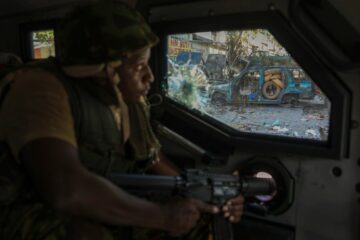 For decades, the United Nations has intervened in Haiti in a bid to address persistent political, economic and security crises. To date, all attempts have failed.
 ‘Perhaps it’s meditation by another name, but at this stage it’s become a necessity’, said Seamus Heaney about his ‘habit of deep preparation’ for poetry readings. Regardless of their size or significance, he would spend at least two or three hours considering what to read.
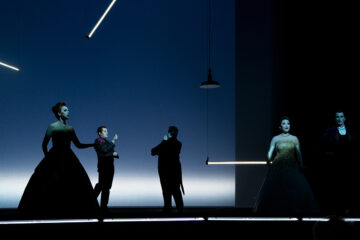 In the 1970s I went to a lot of very long Bob Wilson performances, among them the legendary Deafman Glance (1970) and A Letter for Queen Victoria (1974). They lasted for hours; some were all night. I often watched from the top of the nosebleed balcony—sometimes wrapped in a sleeping bag, the images onstage mixing with my dreams. Even now I’m not sure whether I dreamed something or saw it in a Bob Wilson performance.
 So who is Ray Kurzweil?