
Category: Recommended Reading
American Muslims Are 2 Times More Likely To Have Attempted Suicide Than Other Groups
Dalia Faheid on NPR:
 For an entire year that involved emergency room visits, legal proceedings, involuntary unemployment and the death of loved ones, Mehran Nazir struggled with a depressive episode. He would find his mind flooded with self-destructive thoughts. He’d faintly hope his plane from Newark to San Francisco would crash or that he would doze off at the wheel of his car and end up in a fatal accident. The normally extroverted Nazir would lie paralyzed in bed for hours doing nothing, not wanting to speak with family and canceling plans with friends. It came to a head when Nazir found himself on the brink of suicide. In his darkest moment, he drafted a will and decided where it would happen.
…Earlier this year, a murder-suicide involving a Muslim family in Allen, Texas, sent shock waves through the community. Brothers Farhan Towhid, 19, and Tanvir Towhid, 21, both of whom reportedly battled depression, made a pact to die by suicide and kill the rest of their family so they wouldn’t have to live with the grief. Since then, public discussions on mental health, trainings on suicide response and healing circles have taken on new urgency.
More here.
Malignant normality
Matthew Rozsa in Salon:
 There are many variations to Hans Christian Andersen’s classic literary folktale “The Emperor’s New Clothes,” but most have the same basic plot points: A vain emperor is duped by two con men into buying clothes that don’t exist. They trick him by saying that the non-existent fabric is actually visible, but only stupid and incompetent people can’t see it. The emperor pretends that he can see the clothes, and then ordinary people follow his lead — whether because they believe him, or because they are simply afraid to state otherwise. It is only when a child blurts out that he is naked that the illusion is shattered.
Andersen was unfamiliar with the psychological concept known as malignant normality, but his tale captures it perfectly. The folktale also teaches an important lesson about standing by one’s own common sense, even when social pressures are insurmountable, and remembering that confidence in your correctness is not enough on its own — particularly if those around you don’t buy in too. And the idea — of a narcissist with power and/or popularity normalizing an “alternate reality” that is patently absurd — clearly has analogues in schoolyard politics, global politics, and everything in-between.
The concept of malignant normality, as explained by psychiatrist Dr. Robert Jay Lifton, is rooted in history — specifically, in our understanding of Nazi Germany. Lifton argued that many Nazi doctors weren’t active ideologues, but were willing to send Jews to gas chambers because this was their job — even though they had taken a hippocratic oath.
The reality of institutionalized genocide, which had not seemed plausible to Germans only a dozen years earlier, had become a malignant normal. Not everyone had to buy into the ideas of Nazism, at least not in full. They simply had to live in a society where actions that would usually be considered atrocious are instead perceived as routine.
More here.
Saturday Poem
The Couple
for Ben, 1885-1971
for Sadie, 1888-1971
They died just months apart, made
twins by the desolate voyage, mariners
without a port, exiles together –
one pulled down into the end and then
the other, tethered as they were
to their damaged vessel, still somehow
afloat, barely, masts long-ago broken,
sails torn apart, something strange, slow
and powerful wearing away
even the dark polished oak, once thick
as elephant legs. And what they had left
was a leak-infested raft of a thing,
remnant, unsteerable, creature of tides
and storms. They roped themselves
to the hooks and rings that remained,
letting whatever prevailed take them,
surrendering to that fate, wasting, salt-encrusted.
Sixty-five years together in the silence.
Silence, silence, silence and the casual
passage of broken time.
The rabbi placed his hands on each
of their heads and spoke a blessing. She
the young redheaded immigrant, speaking
Hungarian, kosher, saying her prayers,
sweet faced, ambitious and afraid; and he,
the native-born poorboy, finding money
however, drinking, loving the racetrack
and the splendor of horses, singing
with the Irish in their bars. He fell in love
with her green eyes. Oceans, weren’t they?
by Lou Lipsitz
Friday, August 13, 2021
Daniel Mendelsohn on the Odyssey
From Octavian Report:
 Octavian Report: Why should we read the Odyssey?
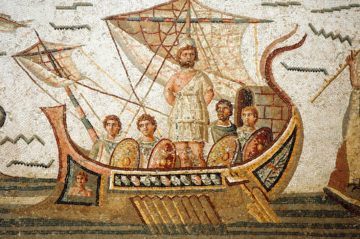
Daniel Mendelsohn: There’s a reason the classics are classics — and it’s not because they have better agents than books that aren’t classics. The classics are classics because they pose in a way that is lively and narratively interesting and challenging the most basic questions about human experience. The Greek and Roman classics are the foundation for our way of seeing the world. And therefore we read them because they tell us something true about life. In the case of the Odyssey, aside from everything else it is, it’s one of the great family dramas. It’s about homecoming, it’s about the meaning of home, it’s about how you know and how you prove your intimacy with members of your family. It’s about the bonds that connect family members over many years despite time and distance.
Beyond that, it’s in a certain sense the first science-fiction narrative. It envisions an adventurer who’s exposed to strange new civilizations (to quote the opening of Star Trek). Odysseus is the person from Greek civilization, from Western culture, touring abroad through alternative and new civilizations.
More here.
Turing Uncomputability
Jørgen Veisdal in Privatdozent:
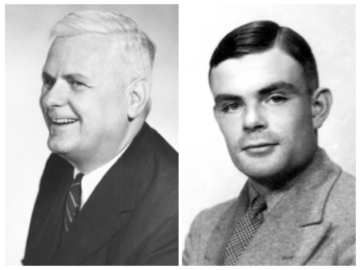 As Soare (2013) recounts, John von Neumann (1903–1957) happened to be in the audience as a representative of Hilbert’s program when Gödel, then 25 years old, took the podium to present his result. von Neumann immediately recognized that Hilbert’s program was over, and spent the next weeks preparing the proof of a related theorem. He had in mind an arithmetization of Gödel’s incompleteness result, to show that not only are formal systems incapable of proving every statement in them, they are also unable to guarantee proofs of their own consistency. He later presented his proof to Gödel, writing “using the methods you employed so successfully […] I achieved a result that seems to me to be remarkable, namely, I was able to to show that the consistency of mathematics is unprovable” (Dyson, 2005). Writing back, Gödel reportedly politely thanked the great man and informed him that he himself (Gödel) had written the same proof weeks earlier, and that it had already been submitted for publication.
More here.
Matches
Beyond Neoliberal Trade
Arjun Jayadev and J. W. Mason in the Boston Review:
 In the wreckage of World War I, it was hard to imagine a return to this borderless “economic Eldorado.” But today, it’s the relatively self-contained national economies of the mid-twentieth century that may seem like a lost world. To access the products of the whole earth, you don’t even have to pick up the phone; you can just log onto Amazon.
This return to—and surpassing of—prewar levels of economic integration has been paralleled by a revival of pre-Keynesian ideas about the international economy. The vast expansion of international trade over the past forty years is often presented as the result of simply removing artificial constraints—that is, as a victory of “free trade” over “protectionism,” a realization of the cosmopolitan and liberal ideals of the nineteenth century after the aberrant nationalism and state direction of the economy of the twentieth. This victory is often claimed as one of the great successes of the neoliberal era, one whose benefits are so obvious as to hardly need stating. One of us recently attended a panel on trade at a meeting of the American Economic Association, where the chair opened the discussion by saying, “Obviously, if you are in this room then you are for free trade, as much as we can get.” No one in the room seemed to disagree.
More here.
Introduction to Kabbalah and Jewish Mysticism – Part 1
On Didion’s “Let Me Tell You What I Mean”
Elroy Rosenberg at 3:AM Magazine:
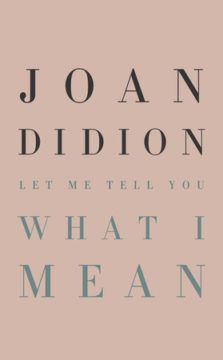 Naturally, there is something contradictory to be found in the emphasis on the “I” in Didion’s work and the supposed “sublime neutrality” which she represents. Considering the omnipresence of the former, the latter seems more or less unattainable. For many Didion readers, who simply cannot shake free of the need to label no matter how hard they wriggle, this paradox might seem unimportant. For me, it is the crux of her work, highlighted in her new collection of essays, Let Me Tell You What I Mean. Encapsulating many pieces from Didion’s emergence with her ‘Points West’ column which she shared with her husband, John Gregory Dunne, as well as later work for establishments like the New York Times Magazine and New Yorker, the collection is a continuation of Didion’s lifelong search for that meagre, almost incommunicable slice of the world where subjectivity and transparency live together hand in hand.
more here.
The Novels of Gwendoline Riley
Emma Garman at The Paris Review:

In 2007 Gwendoline Riley, then age twenty-eight and already the author of three acclaimed novels, described her writing life as lacking “any tremendous triumph or romance—I feel like I’m just always trying to be accurate, to get everything in the correct proportion.”
As literary aspirations go, it sounds modest. And by superficial measures, Riley’s novels are unambitious: light on conventional plotting, narrow in scope, and told from the perspectives of women close to herself in age and background. Riley has tried using the third person, she said in 2012, but it “always sounds so false.” As for adopting a male point of view: “Ugh, men’s brains! That vipers’ nest? No.” Her protagonists are writers, too, encouraging the frequent assumption that she draws directly from life. But to regard Riley’s fiction as titivated memoir is to misperceive what beguiles her readers: not barely mediated personal experience but its sedulous transmutation by a strange, rare talent. As Vivian Gornick wrote after reading the letters of Jean Rhys, a novelist with whom Riley shares some kinship: “The letters are the life, and the novels—there’s no mistaking it—are the magic performed on the life.”
more here.
Friday Poem
Fishing on the Susquehanna in July
I have never been fishing on the Susquehanna
or on any river for that matter
to be perfectly honest.
Not in July or any month
have I had the pleasure — if it is a pleasure —
of fishing on the Susquehanna.
I am more likely to be found
in a quiet room like this one —
a painting of a woman on the wall,
a bowl of tangerines on the table —
trying to manufacture the sensation
of fishing on the Susquehanna.
There is little doubt
that others have been fishing
on the Susquehanna,
rowing upstream in a wooden boat,
sliding the oars under the water
then raising them to drip in the light.
But the nearest I have ever come to
fishing on the Susquehanna
was one afternoon in a museum in Philadelphia,
when I balanced a little egg of time
in front of a painting
in which that river curled around a bend
under a blue cloud-ruffled sky,
dense trees along the banks,
and a fellow with a red bandana
sitting in a small, green
flat-bottom boat
holding the thin whip of a pole.
That is something I am unlikely
ever to do, I remember
saying to myself and the person next to me.
Then I blinked and moved on
to other American scenes
of haystacks, water whitening over rocks,
even one of a brown hare
who seemed so wired with alertness
I imagined him springing right out of the frame.
Napoleon plundered Europe’s art to bring prestige home to France
Terry Hartle in The Christian Science Monitor:
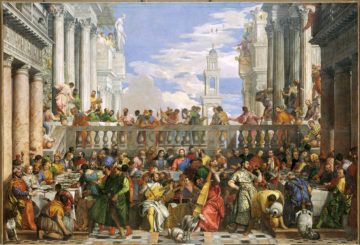 As his armies conquered most of Europe, Napoleon Bonaparte demonstrated an insatiable desire to steal art. These were not smash-and-grab operations. According to Cynthia Saltzman’s marvelous book, “Plunder: Napoleon’s Theft of Veronese’s Feast,” he sought out experts to advise him on which cultural treasures to ship back to Paris. Napoleon wanted to expand the art collection in the Louvre palace. He wrote to France’s five-member governing committee to “send three or four known artists” to choose the best paintings and sculptures.
The peace treaties Napoleon imposed on defeated foes usually required artworks to be forfeited. A 1796 treaty with Pope Pius VI, for example, was worded: “The Pope shall deliver to the French Republic one hundred paintings, busts, vases or statues at the choice of the Commissioners who will be sent to Rome.” At one point he even boasted to the governing committee, “we have everything that is a work of art in Italy, save for a small number of objects in Turin and Naples.”
The French justified this theft not only as part of the spoils of war but also as a way of demonstrating the French Republic’s dominant position in Europe’s new military, political, and cultural order, Saltzman writes. Possessing these objects would demonstrate “their passion for knowledge, their respect for history, their discipline, rationality, and expertise in the fine arts.”
Saltzman tells this story by focusing on the fate of one particular masterpiece: Paolo Veronese’s “The Wedding Feast at Cana.” Painted for the monastery of San Giorgio Maggiore in Venice in 1563, the painting recounts Jesus’ first miracle, the changing of water into wine. The giant canvas measures 22 feet by 33 feet and includes 130 life-size figures arranged across a richly colored and beautifully painted canvas.
More here.
What Misspellings Reveal About Cultural Evolution
Helena Miton in Nautilus:
 Something about me must remind people of a blind 17th-century poet. My last name, Miton, is French, yet people outside of France invariably misspell it as “Milton”—as in the famed English author, John Milton, of the epic poem Paradise Lost. It is not uncommon for people to misspell an unfamiliar name—yet 99 times out of 100 people misspell mine as “Milton.” That is the name that shows up on everything from my university gym card to emails from colleagues. It might seem trivial, yet this misspelling actually illustrates a key feature of how cultural practices emerge and stabilize.
When studying culture, one of the key questions scientists ask is about continuity: Why do people do the same things, in roughly similar ways, over long periods of time? Consider how traditional food recipes, say tamales, have maintained a stable core definition over generations—corn-based dough cooked in corn husks.
Cognitive anthropologists such as myself try to answer this scientific question by studying how human minds interact with culture. One approach, known as cultural evolution, draws from Darwinian theory to view the evolution in longstanding cultural practices as akin to the evolution of biological species.
Most cultural evolution theorists assume that these traditions are maintained through generations by faithful transmission, or what’s known as “cultural fidelity.” Because humans are considered to be particularly adept at acquiring information through imitation, it stands to reason, they say, that we’d copy our models without mistakes. Humans, these researchers assert, inherit cultural information in the same way DNA sustains genetic information, with low rates of random mutations. Considering cultural change in this way has led cultural evolutionists to rely heavily on the subfield of population genetics—and to use models that assume cultural continuity works solely through inheritance.
Yet cultural information is not actually passed on through generations with the same degree of fidelity as genetic information.
More here.
Thursday, August 12, 2021
“The Subversive Simone Weil”: Robert Zaretsky with Lottie Moore
Place, Pastness, Poems: A Triptych
Seamus Heaney at Salmagundi:
 Neruda’s declaration that “the reality of the world … should not be underprized” implies that we can and often do underprize it. We grow away from our primary relish of the phenomena. The rooms where we come to consciousness, the cupboards we open as toddlers, the shelves we climb up to, the boxes and albums we explore in reserved places in the house, the spots we discover for ourselves in those first solitudes out of doors, the haunts of those explorations at the verge of our security—in such places and at such moments “the reality of the world” first wakens in us. It is also at such moments that we have our first inkling of pastness and find our physical surroundings invested with a wider and deeper dimension than we can, just then, account for.
What I am talking about is at the time an unconscious process. It is neither sentimental nor literary, since it happens during the pre-reflective stage of our existence.
more here.
The Unexemplary Simone Weil
Alexa Hazel at The Point:
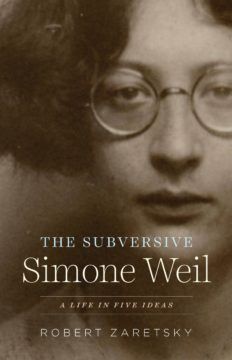 Simone Weil was difficult for those who knew her in life and no less difficult for those who encounter her now, through the writings that survived her death at the age of 34 in 1943. Robert Zaretsky’s new intellectual biography, The Subversive Simone Weil: A Life in Five Ideas (2021), evokes several difficulties in its epilogue. Weil’s character was “extreme.” Her ideas were largely impractical (“at worst inhuman”). He calls her attitude “merciless.” And yet, “I cannot resist returning time and again to this remarkable individual,” Zaretsky writes. She led an “exemplary” life. “For many of her readers,” he suggests, “Weil’s life has all the trappings of secular sainthood.”
Some do take a strong stance on Weil (saint, insane). Many more find themselves in what Zaretsky calls an “untenable position.” T.S. Eliot alludes to Weil’s “great soul” several times in his preface to the English translation of The Need for Roots. Eliot echoes Albert Camus, who collected and published much of Weil’s work after her death, and once called her “the only great spirit of our time.”
more here.
What can the decline of the Roman Empire and the end of European feudalism tell us about COVID-19 and the future of the West?
John Rapley in Aeon:
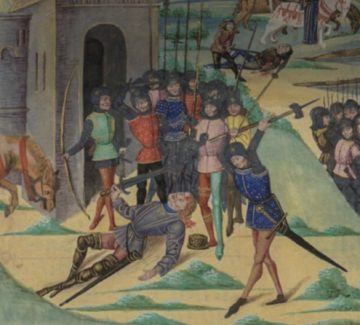 Neo-Malthusians credited environmental feedback loops, not moral failings, for regime collapse. In the 1960s and ’70s, works by Paul Ehrlich and Donella Meadows et al argued that the world’s population was growing so fast it would soon outstrip resource supplies, leading to (among other things) widespread food shortages. More recently, Jared Diamond wrote of the role that environmental depletion and diseases played in the fall of civilisations, and his theory that the collapse of Easter Island resulted from overexploitation of the natural environment has enjoyed particular resonance. For its part, the COVID-19 pandemic revived old theories about the role that diseases played in regime collapse, and we were reminded that plagues had laid low the Roman Empire and destroyed European feudalism.
Except, that wasn’t what happened. At least, not quite the way supposed.
More here.
Animals Can Count and Use Zero. How Far Does Their Number Sense Go?
Jordana Cepelewicz in Quanta:
 Practically every animal that scientists have studied — insects and cephalopods, amphibians and reptiles, birds and mammals — can distinguish between different numbers of objects in a set or sounds in a sequence. They don’t just have a sense of “greater than” or “less than,” but an approximate sense of quantity: that two is distinct from three, that 15 is distinct from 20. This mental representation of set size, called numerosity, seems to be “a general ability,” and an ancient one, said Giorgio Vallortigara, a neuroscientist at the University of Trento in Italy.
Now, researchers are uncovering increasingly more complex numerical abilities in their animal subjects. Many species have displayed a capacity for abstraction that extends to performing simple arithmetic, while a select few have even demonstrated a grasp of the quantitative concept of “zero” — an idea so paradoxical that very young children sometimes struggle with it.
More here.
The Truth About Intervening Powers in the Middle East
Trita Parsi and Matthew Petti in The American Prospect:
 Reviewing all of the region’s military interventions between 2010 and 2020, our research shows that several powerful states in the region intervene militarily in the affairs of their neighbors to roughly the same degree, defying the idea that the region’s instability can be blamed on a single pariah state.
Among these states—Iran, Israel, Qatar, Saudi Arabia, Turkey, and the United Arab Emirates—there is no outlier. While Washington has fixated on Tehran’s interventions, the data shows that the UAE and Turkey have of late outdone Iran in terms of military meddling in the affairs of their neighbors. Iran’s support for militias in Iraq and Lebanon has grabbed headlines in the American media, but the UAE has quietly been building its own international mercenary army with the help of contractors like Erik Prince, and Turkey has shuttled fighters from Syria to Libya and Nagorno-Karabakh.
More here.