
Aarathi Prasad in The Guardian:
 It was May 2020, just months after Sars-CoV-2 began ripping through the world, when it emerged that 97% of the British medical staff who had died of the disease were from communities categorised as black, Asian and minority ethnic. News reports pronounced it extraordinary, shocking. Would that staple of press briefing catchphrases – “the virus does not discriminate” – require reconsideration? Could the reason minorities were suffering more be because of some sort of genetic difference? By September, it was announced that heightened genetic risk was not responsible for these groups being up to three times more likely to die from the virus. Instead, researchers laid the blame squarely on environmental factors and healthcare disparities.
Less than a year later, there were reports that uptake rates for the Covid vaccination were lowest among ethnic minorities. Sage, the Scientific Advisory Group for Emergencies, warned that this could form a significant risk to the vaccine drive. Low uptake was also found to be rooted in social and political factors, from long years of structural and institutional racism and discrimination, and their impact on those who remain among the most deprived in modern Britain.
Black, Pakistani, Bangladeshi people, whose very presence in Britain is inextricable from our colonial past, still live in the most deprived areas, in crowded housing, in places with the worst air pollution, subject to a range of toxic conditions that have huge impacts on health outcomes.
More here.
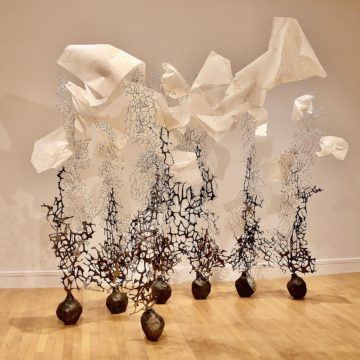 When Yas Crawford started feeling the effects of her chronic illness, she says she felt as if her body and mind were at war. “When you’re ill for a long time, your body takes over,” she says. “Your brain wants to do one thing, and your body does something else.”
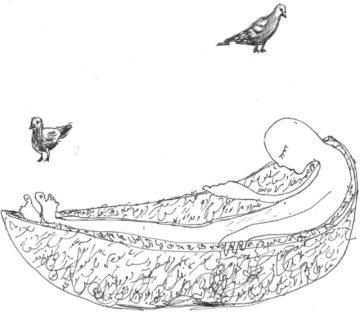 My beloved if
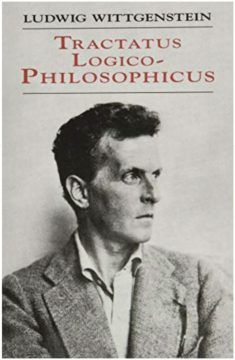 Somewhere along the crooked scar of the eastern front, during those acrid summer months of the Brusilov Offensive in 1916, when the Russian Empire pierced into the lines of the Central Powers and perhaps more than one million men would be killed from June to September, a howitzer commander stationed with the Austrian 7th Army would pen gnomic observations in a notebook, having written a year before that the “facts of the world are not the end of the matter.” Among the richest men in Europe, the 27-year-old had the option to defer military service, and yet an ascetic impulse compelled Ludwig Wittgenstein into the army, even though he lacked any patriotism for the Austro-Hungarian cause. Only five years before his trench ruminations would coalesce into 1921’s
  Biotechnology company Moderna is preparing to begin human trials on HIV vaccines as early as Wednesday, using the same mRNA platform as the firm’s COVID-19 vaccine.
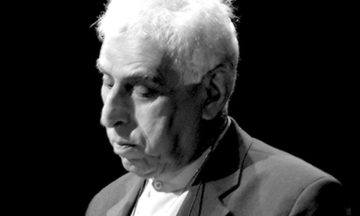 AT THE CASABLANCA Book Fair in Morocco back in 2009, the Iraqi poet Saadi Youssef was signing the seventh volume of his Complete Poetic Works. A flock of junior high school girls in their blue uniforms were standing nearby. One of them pointed to her friend, telling Youssef: “She, too, is a poet.” He smiled and gestured to the young poet to come forward. She hesitated: “I’m just a beginner.” “I, too, am a beginner. We are all beginners,” said Youssef. The septuagenarian who uttered those words is widely recognized as one of the greatest modern Arab poets. When he uttered those words, he had been writing and publishing poetry for more than half a century. It was neither a hyperbolic statement, nor false modesty on his part. Well into his 80s, one of the most remarkable features of Youssef’s poetry (and his persona) was his restlessness. He was audacious (even reckless, at times) and on an incessant quest for new beginnings.
 Hi. My name is Marc. I’m a guitarist who points extremely loud amplifiers directly at his head. Very often. Sometimes as often as 200 nights a year for the past 45 years. Audiologists say this could make one’s ears howl, create an uncomfortable sensation of density in one’s head, and eventually make it impossible to hear human conversation. Yet I persist . . . Why?
 L
L In the past few weeks, the Biden administration’s domestic agenda has come into sharp focus: a bipartisan Senate bill for physical and environmental infrastructure projects nearing passage; new statistics showing that COVID-19 relief has dramatically reduced poverty across demographic groups; an executive order aimed at concentrated market power, promoting competition and worker power; a $3.5 trillion budget proposal with large outlays in social spending, paid for by taxes on the rich and corporations; presidential speeches on behalf of better jobs for Americans at the bottom and middle of the economy. The sum of these and other policies is more ambitious, and more ideologically pointed, than the Biden campaign slogan “Build Back Better.” President Biden is using the resources of the federal government to reverse nearly half a century of growing monopoly, plutocracy, and inequality. Regardless of whether this agenda goes far enough, or whether Congress allows it to go anywhere at all, the administration is pointing the country in a fundamentally new direction.
 Arjun Jayadev and J.W. Mason in Boston Review:
 Virginia Jackson on the late Lauren Berlant, over at Critical Inquiry:
 Kate Aronoff in The New Republic:
 Aziz Huq in the Los Angeles Review of Books:
 A
A Illich was a purveyor of impossible truths, truths so radical that they questioned the very foundations of modern certitudes — progress, economic growth, health, education, mobility. While he was not wrong, we had all been riding on a train going in the opposite direction for so long that it was hard to see how, in any practical sense, the momentum could ever be stalled. And that was his point. Now that “the shadow our future throws” of which Illich warned is darkening the skies of the present, it is time to reconsider his thought.