
Estelle Tang in The Guardian:
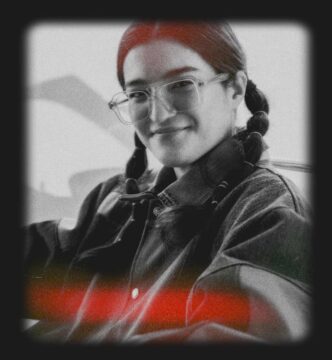 The very first sentence of Arabelle Sicardi’s book, The House of Beauty, reads: “When I tell you that beauty is a monster, I need you to know it is my favorite kind.” Sicardi, who splits their time between New York City and Los Angeles, has a love/hate relationship with the beauty industry. A writer and consultant working in beauty and tech, their projects include a beauty newsletter, a creative collective called Perfumed Pages and a non-profit arts project called the Museum of Nails Foundation. In their new book, they examine the impact of the $450bn beauty industry – the pretty and the very ugly.
Sicardi has written about beauty as “a terrorizing force” for their whole career, including a stint as a beauty editor at BuzzFeed, which proved a spiky learning experience. “I wrote a story critical of an advertising campaign and then got flak for it,” they recall. “I decided to leave because I didn’t want to deal with the politics and the insincerity of being told I can do something, but then having my work deleted. That type of situation still happens very regularly to writers for publications to this day,” they said.
More here.
Enjoying the content on 3QD? Help keep us going by donating now.
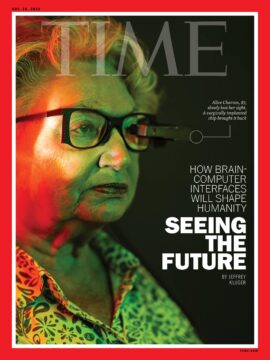 It’s been a long time since Alice Charton got a good look at a human face. There are plenty of people moving through her world, of course—her husband, her friends, her doctors, her neighbors—but judging just by what she can see, she’d have to take it as an article of faith that any one person was there at all. It was five years ago that the 87-year-old retired schoolteacher, living in a suburb of Paris, first noticed her eyesight failing, with a point in the middle of her field of vision going hazy, muddy, and dim. Soon that point grew into a spot, and the spot into a blotch—until it became impossible for her to recognize people, read a book, or navigate unfamiliar places on the streets.
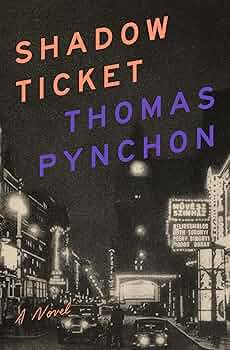 For my money, though, the book is most interesting for those aforementioned moments of tonal whiplash, scenes wherein big shifts of register or reference point are undertaken with remarkably little in the way of narrative scaffolding. Shadow Ticket, in addition to being extremely fun and almost indecently readable, is also replete with edges left conspicuously unsanded, a combination that might go some way toward frustrating or at least reframing the prevailing misconception of Pynchon as a willfully difficult, high-maximalist, paranoid outsider-recluse. It’s a reputation that has obscured a clear view of the author’s work in one form or another for the entirety of a long career, alternately burnishing the image of an enigmatic hipster sage or offering up a strawman for the excesses and overreaches of the showoff tradition he supposedly epitomizes. It’s made the name “Thomas Pynchon” into a byword for inaccessible genius, the Trystero horn into an enduring stall-wall Sharpie tag, and Gravity’s Rainbow into a punchline on The O.C., but, meanwhile, the, you know, actual books? Those have drifted considerably from these mythic calcifications, gradually resolving into a scope and style more characterized by shaggy plotting, political generosity, and out-and-out sweetness than anything resembling the lit-bro hazing rituals that some contemporary readers have been conditioned to expect.
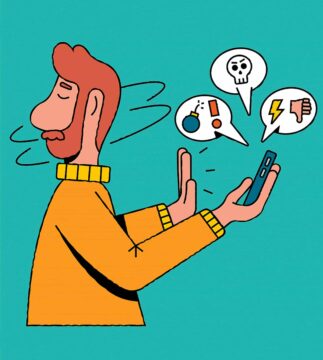 What we can see from the last two information crises is that they involve enormous leaps forward in knowledge and understanding, but also a period of intense instability. Following the invention of writing, the world was filled with new, beautiful ideas and new moralities. And there were also new ways to misunderstand each other: the possibility of misreading someone entered the world, as did the possibility of warfare motivated by different interpretations of texts. After the invention of the printing press came the Enlightenment, an explosion of new scientific knowledge and discovery. But before that period, Europe had plunged into the Reformation, which led to the destruction of statues and other artworks and many institutions that had been working at least adequately until then. And, to get to the heart of the matter, the Reformation in Europe meant a lot of people got burned at the stake, or killed in other terrible ways.
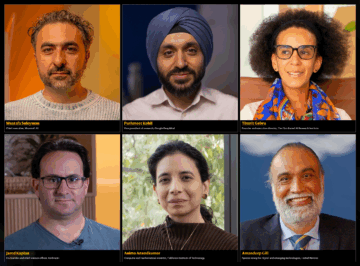 Artificial intelligence is booming. Technology companies are pouring trillions of dollars into research and infrastructure, and millions of people now interact with AI in one form or another. But what is it all for?
 We are at that strange stage in the adoption curve of a revolutionary technology at which two seemingly contradictory things are true at the same time: It has become clear that artificial intelligence will transform the world. And the technology’s immediate impact is still sufficiently small that it just about remains possible to pretend that this won’t be the case.
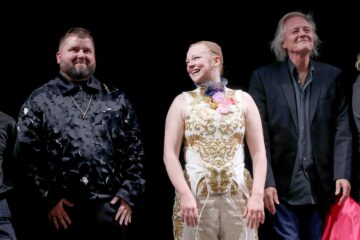 Last season on Broadway, one of the most buzzworthy shows was Kip Williams’s adaptation of Oscar Wilde’s novel “The Picture of Dorian Gray.” Originally presented by the Sydney Theater Company, the production featured 26 characters, all played by “Succession” actress Sarah Snook. When the show moved to London’s West End, Snook won an Olivier Award; when it came to Broadway, she won a Tony. Though the show was thoroughly modern, with plenty of technological wizardry, the story was not. Wilde’s novel was published in 1891. And that prompts the question: How is it that “Dorian Gray” continues to be relevant to modern audiences?
 Before a car crash in 2008 left her paralysed from the neck down, Nancy Smith enjoyed playing the piano. Years later, Smith started making music again, thanks to an implant that recorded and analysed her brain activity. When she imagined playing an on-screen keyboard, her
 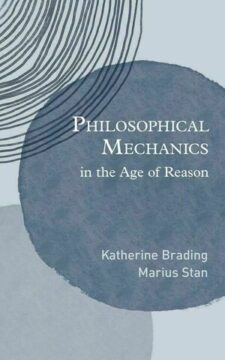 During the last quarter century, there has been an explosion of scholarship by philosophers of physics and, especially, historians of philosophy on Isaac Newton and his reception in philosophy. This growing interest is prima facie puzzling because Newton did not write a major philosophical work. And while he clearly elicited important philosophical responses (e.g., by Du Châtelet, Kant, Hume, etc.) and engendered important philosophical debates (e.g., Leibniz-Clarke), this does not justify or explain the growing attention. After all, not every person who was a significant interlocutor to philosophers in his own day should be subject of study by a community of historians of philosophy today. (We largely don’t do this for Digby, Mersenne, Riccioli, William Harvey, Kepler, Hooke, Halley, or De Volder, etc.) That Newton was seminal to the history of science and mathematics is insufficiently explanatory (because there is relatively little philosophical scholarship on Euler, the Bernoullis, etc.).
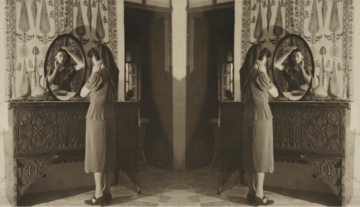 The Lord, Soraya Antonius’s vivid chronicle of Palestinian life before the Nakba of 1948, is a novel that moves fast, driven by fury and passion. Tales are told within tales; there are jump cuts and flashbacks. Antonius’s eye is as keen as her wit. The narrator of the book, which was first published in 1986, is an unnamed woman journalist in the Lebanon of the early eighties. She is covering current events—the 1982 Sabra and Shatila massacres are obliquely referred to at one point—but she also takes an interest in the region’s past, and is particularly curious to find out about a young man named Tareq, who grew up under the British Mandate and played a significant role in the 1936–1939 Palestinian uprising against colonial rule. Her curiosity leads her to the elderly Miss Alice, an Englishwoman who was Tareq’s teacher in a mission school founded by her father at the start of the twentieth century. Tareq, Miss Alice tells the narrator, was a boy of humble background and an undistinguished student, who, however, possessed uncanny powers that Miss Alice can’t really account for. How he put those powers to use will be the novel’s story.
 My hunch is that the contemporary artworks likeliest to one day appear prescient, albeit not always in reassuring ways, will come from para-artistic digital practices, whether artistic experiments with AI; so-called Red Chip art (which Annie Armstrong of Artnet News defines as works with flashy aesthetics that abjure art history); or folk forms such as NFTs, memes, or TikTok lore videos. What these practices have in common is not just that they’re relatively new, with strong ties to digital culture, but also that they’re only somewhat recognizable as great art, or even art at all, under our inherited value systems. Traditionalists gasp, often justifiably, at the ethical and aesthetic challenges AI art poses, or at Red Chip art’s tawdriness, or at digital folk art’s simplicity. But such practices are telling the old culture what’s happening to it, even if the message isn’t what most fine arts audiences want to hear.
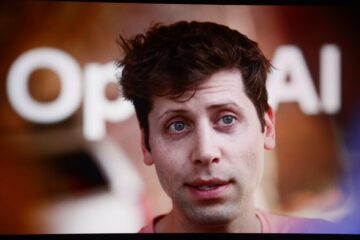 If Altman likes you, he will recommend that you read The Beginning of Infinity, by a British physicist who believes all evils and failures are due to insufficient knowledge. “Everything that is not forbidden by laws of nature is achievable, given the right knowledge.” We have entered “the beginning of infinity,” a period of unbounded progress.
 A
A This paper argues that humanity is on track to develop superintelligent AI systems that would be fundamentally uncontrollable by humans. We define “meaningful human control” as requiring five properties: comprehensibility, goal modification, behavioral boundaries, decision override, and emergency shutdown capabilities. We then demonstrate through three complementary arguments why this level of control over superintelligence is essentially unattainable.