
Category: Recommended Reading
What the global flow of guns tells us about how states fail
Pratap Bhanu Mehta in The Indian Express:
 There is an old adage that if you want to understand state building or state breakdown, follow the guns. In conflict zones like Afghanistan, it is all too easy to take recourse to debates over development and culture, while ignoring the dynamics of armed conflict, and the presence of weaponry that militarises society and embeds violence. Even a casual perusal of databases at Small Arms Survey, Geneva, that tracks violent conflict and the proliferation of arms, brings home some basic facts about state building and violence.
In their last year of comparative data base 2018, Afghanistan has a rate of 59.8 violent deaths per 1,00,000, below other conflict zones like Syria (187.9), and El Salvador (87). But this data base is also a reminder of two other large trends. First, violence tends to be sticky. Once embedded, it is hard to dislodge. South Africa has a rate of 40.6; Brazil 36.3. Most countries with relatively lower rates are in Asia, or are European social democracies. In Asia, India has a violent death rate of 3.9 per 1,00,000; Pakistan is at 5.9 while big countries like Indonesia, China and Japan are lower than 1. This contrast between Asia and the Americas on this aspect of state building and prevalence of violent death is striking, and rarely made as central to the development literature as poverty.
More here.
Thursday Poem
California Love Song
To ride the Ferris wheel on a winter night in Santa Monica,
playing nostalgic songs on a Marine harmonica,
thinking about the past, thinking about everything
Los Angeles has meant to me, is that too much to ask?
To kiss on the calliope and uproot world tyranny
and strum a rhythm guitar Ron Wood would envy,
to long for the lost, to love what lasts, to sing
idolatrous phrases to the stars, is that too much to ask?
Arm in arm to gallivant, to lark, to crow, to bask
in a wigwam of circus-colored atomic smog,
to quaff a plastic cup of nepenthean eggnog
over one more round of boardwalk Skee-Ball,
to trade my ocean for a waterfall,
to live with you or not at all, is that too much to ask?
by Campbell McGrath
from Nouns and Verbs, New and Selected Poems
Harper Collins, 2019
Wednesday, September 1, 2021
Salman Rushdie to bypass print and publish next book on Substack
Shelley Hepworth in The Guardian:
 Out of the gloom Salman Rushdie floats into view, his familiar face with short beard and glasses hovering on screen in front of a library that should win any competition for the most impressive Zoom bookshelf backdrop.
From his New York apartment he is here to share three things: he has made a deal to publish his next work of fiction as a serialised novella on Substack; he intends to fulfil a long held, once thwarted desire to be a film critic; and he still doesn’t have the courage to write poetry.
“I got very attracted to the idea recently, in this strange year and a half, of trying out things I’ve never done before,” he says.
“It’s to do with this enforced condition we’ve all been in of being pushed inwards … I published this book of essays [which was] the 20th book and I’m already writing the 21st book, which is a novel. I just thought: do something else. And exactly the moment I was thinking that this project cropped up.”
“This project” is Substack and came about after the newsletter platform wrote to Rushdie’s literary agent, Andrew Wylie, who asked him if it was something he wanted to do.
More here. And you can read and subscribe to Salman Rushdie’s Substack Newsletter here.
Sean Carroll’s Mindscape Podcast: Leidy Klotz on Our Resistance to Subtractive Change
Sean Carroll in Preposterous Universe:
 There is no general theory of problem-solving, or even a reliable set of principles that will usually work. It’s therefore interesting to see how our brains actually go about solving problems. Here’s an interesting feature that you might not have guessed: when faced with an imperfect situation, our first move to improve it tends to involve adding new elements, rather than taking away. We are, in general, resistant to subtractive change. Leidy Klotz is an engineer and designer who has worked with psychologists and neuroscientists to study this phenomenon. We talk about how our relative blindness to subtractive possibilities manifests itself, and what lessons might be for design more generally.
More here.
Does Math Reveal Reality?
Why Mass Immigration Is the Key to American Renewal
Deepak Bhargava and Ruth Milkman in The American Prospect:
 Could admitting millions more immigrants over the next decade be the jolt the U.S. needs to revive its economy, culture, and politics? After four years of restrictionism under President Trump, ongoing border controversies, and an escalating culture war led by nativists, this idea may seem counterintuitive or even far-fetched. But recent labor market trends, demographic changes, and even accelerating climate change all point to dramatically increased immigration as a logical catalyst for national renewal. Becoming the most welcoming country on Earth for migrants—breathing new life into our most flattering, if too often inaccurate self-image—could be our salvation.
To see the potential upside of increased immigration requires us to examine current realities with fresh eyes. For decades, advocates of restriction have dominated the national conversation around immigration, cloaking their xenophobia under the false claim that immigrants pose a threat to U.S.-born workers. Liberals have too often failed to challenge this claim, fearing that expansive immigration policies are a path to political oblivion. But our research shows that the conventional wisdom underlying both parties’ policies is wrong: Expanding immigration is the key to economic revitalization and the most effective means to counter the continuing authoritarian threats we face in the post-Trump era.
More here.
Bergson and Time
https://www.youtube.com/watch?v=pK8N47RFRd8&t=2638s
On Janet Malcolm
David Salle at Artforum:
 One of Janet’s themes as a writer was self-delusion in all its guises—the propensity we all share for telling ourselves stories that, at the very least, reconfigure events to cast ourselves in a more favorable light. I was stung by one line in the profile: that (I paraphrase) in all our time together, nothing I said about my work was of the slightest interest to her. Once my vanity recovered from the dismissal of my “thinking,” the veracity of Janet’s verdict was clear. (The passage continued to insist that nothing any artist ever says about their work is of interest.) I eventually came to feel more or less the same way—that nothing anybody says about their intentions or “process” is of any particular relevance unless it’s a one-liner by de Kooning. Who cares? This attitude is at odds with the prevailing reverence for that peculiar literary artifact, the artist’s statement, but such was the incontrovertible nature of Janet’s contrarianism. Like any good analyst, she was only interested in the story behind the story. The fact that a belief is widely held should be enough to raise our suspicions.
more here.
Peter Weiss And The Political Novel
Ryan Ruby at The Point:
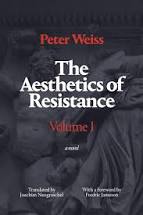 It seemed like a good idea to avoid the screen, but my resolve didn’t last long. The book I was reading at the time, On the Natural History of Destruction, a collection of W. G. Sebald’s lectures and essays about the literature of the Second World War, concludes with a piece on the German-Swedish writer Peter Weiss. Like most English-speakers who had heard of him, I knew of Weiss only as the author of the play The Persecution and Assassination of Jean-Paul Marat as Performed by the Inmates of the Asylum of Charenton Under the Direction of the Marquis de Sade (Marat/Sade for short), which had been made into a film starring Patrick Magee and Glenda Jackson during the brief vogue for interwar European aesthetic programs—in this case Brecht’s Epic Theater and Artaud’s Theater of Cruelty—among the countercultures of Britain and the United States in the 1960s. Sebald, however, mentions Marat/Sade only in passing. Instead, he discusses Weiss’s early career as a painter; his surreal autobiographical novella, Leavetaking; his controversial documentary play about the Frankfurt Auschwitz trials, The Investigation; and, at greatest length, his late three-volume novel about the German anti-fascist underground, The Aesthetics of Resistance.
more here.
‘Are we not humans?’ Pakistan’s domestic workers confront abuse
Shakeeb Asrar in The Christian Science Monitor:
 Last month, when Samina Farooq, a domestic worker, learned that a fellow female worker in Lahore had been beaten by her employer for spilling milk on the floor, she went to see her. Her message: You should quit now. “Bibis [female employers] beat us for dropping milk on the floor or deduct a portion of our salary if we mistakenly burn a piece of cloth when ironing. Are we not humans? Can’t we make mistakes?” says Ms. Farooq. After the employer acknowledged that she had treated her maid unfairly, the maid agreed to stay on. The International Labor Organization (ILO) estimates that Pakistan has more than 8.5 million domestic workers, mostly women and children. Some suffer appalling abuse at the hands of their employers. Last year an 8-year-old girl was beaten to death by her employers in Rawalpindi for letting their parrots escape.
Activists have long complained that in addition to high-profile abuses, domestic workers are routinely exploited behind closed doors, without any of the protections and benefits provided to formal workers. So, when the province of Punjab, Pakistan’s most populous, passed a law in 2019 that barred child labor in homes and extended labor law and social security to all domestic staff, it was hailed as a landmark reform. But the Domestic Workers Act, a first for Pakistan, hasn’t lived up to its promise because of resistance from employers, lax government oversight, and, perhaps surprisingly, lukewarm support from domestic workers themselves.
More here.
Why You May Have More Friends Than Your Friends Do
Joshua Holden in Nautilus:
 There’s a rude charm to the title, “Why Your Friends Have More Friends Than You.” It’s catchy, like the title of an antagonistic explainer: Here are the causes of your lackluster social life. It sounds more like a New York Times op-ed than an academic paper. But in fact, “Why Your Friends Have More Friends Than You” is a 1991 paper from Scott Feld published in the American Journal of Sociology. It now has some claim to fame for introducing into popular culture the so-called “friendship paradox,” which researchers have used to detect the early onset of contagious outbreaks and design effective vaccination strategies. New research, published in the Journal of Complex Networks, suggests the paradox is more nuanced than Feld figured it to be.
The paradox stems from our poor intuitions about networks and averages. If you were to guess how many friends you have, compared to the number of friends your friends have, how would you fare? You may say it’s your friends that have more friends than you, if you’re feeling modest. But it’s also the case that some of those friends who have more friends than you also have friends who have more friends than them, and so on. The friendship paradox says that this is true for everyone—on average, everyone has friends with more friends than they have.
More here.
Wednesday Poem
Before the cosmos – my love there was you
Long before there were
…. any stars
When the great empty void
…. was packed full of a hundred-thousand
other even emptier voids
There was a soft whisper in the dark
…. ..~ and maybe this whisper was more like a song
…. ~ and maybe this song was more like a poem
~ and maybe this poem was more like a prayer
And this soft whisper that was
a song that was a poem
that was a prayer
kept uttering your
name and saying
“I can’t wait for the
day you come to find me”
yes, even before
the first crack of
Genesis lightning
spread its dandelion
seed across the cosmos
you were the first thing
on the mind of a waking God
please hold on
…. you matter more than matter itself
please hold on
…. you have more time than time itself
please hold on
…. you have existed before existence
please hold on
by John Roedel
from John’s Website
Tuesday, August 31, 2021
“The Chair”: A Straussian interpretation
Scott Aaronson in Shtetl-Optimized:
 In one sentence, then, here’s my beef with The Chair: its script portrays a mob, step by step, destroying an innocent man’s life over nothing, and yet it wants me to feel the mob’s pain, and be disappointed in its victim for mulishly insisting on his innocence (even though he is, in fact, innocent).
With real-life woke controversies, there often lingers the question of whether the accused might really be a racist, fascist, sexual predator, or whatever else, adequate proof or no. What’s different here is that we know that Bill Dobson is none of those things, we know he’s decent to his core, because the writers have painstakingly shown us that. And yet, in a weird narrative pretzel, we’re nevertheless supposed to be mad at him, and to sympathize with the campaign to cancel him.
More here.
The surprisingly exciting story of the woman who studied slime moulds
Patricia Fara in Prospect:
 The pioneer of slime mould research was an extraordinary mycologist called Gulielma Lister (1860-1949). Like many female scientists, she has vanished into near obscurity, yet her colleagues celebrated her as the “Queen of Slime Moulds.” In 1905, she was among the first 25 women admitted as a Fellow of London’s prestigious Linnean Society. She made quite an impression on that august group: one younger admirer remembered that she “removed her hat in deference to the sexless character of a Fellow. It was an unusual thing then for a lady to remove her hat, but we all took our cue from Miss Lister and did the same.” She broke the conventions of her time, and a century later her research lies behind a major new approach to computer software.
More here.
Noam Chomsky speaks about Afghanistan with Lawrence Krauss
[The older conversation Krauss refers to (from May) is here.]
Internet and Blockchain Will Kill Nation-States
Tomas Pueyo in his Substack Newsletter:

We love telling ourselves that our political systems were crafted by great people coming up with novel ideas, wise founding fathers, patriots revolting against the establishment.
There’s a bit of that. But humans believe they have more agency than they actually do. In reality, what we do is more determined by our context, by systems that drive our actions. We are like pawns on a chessboard.
I find it much more interesting to ask: what underlying systems cause our current society? And if the systems change, how will our society change?
We’re in the first decades of such a massive change. Internet and blockchain are upending everything we know. They will eventually kill the most powerful establishment: nation-states. And I’ll prove it to you by talking with Rigobert.
More here.
The Tragic Side of Cinema
Notes on Chuck Close in Rome
Henri Cole at The Paris Review:
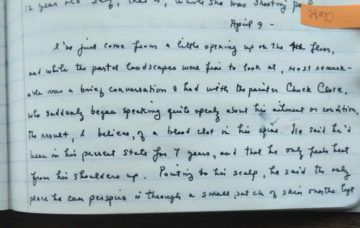 I’ve just come from a little opening up on the fourth floor, and while the pastel landscapes were fine to look at, most remarkable was a brief conversation I had with the painter Chuck Close, who suddenly began speaking quite openly about his ailment or condition, the result, I believe, of a blood clot in his spine. He said he’s been in his present state for seven years, and that he only feels heat from his shoulders up. Pointing to his scalp, he said the only place he can perspire is through a small patch of skin on the left side of his head. When he is touched anywhere below his shoulders, what he feels is an icy cold. He is happiest in the sun in his bathing suit.
When he paints, he straps his brushes to his wrists. It is easier for him to paint than to draw, because he can paint with his arm out before him; to draw requires more mobility than he has. He talked with such candor that a small group of us was drawn to him.
more here.
Nine Nasty Words: English in the Gutter – Then, Now, and Forever
Fergus Butler-Gallie at Literary Review:
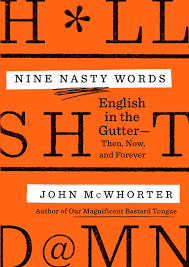 The lavatory facilities at Trisha’s bar, that glorious survivor of old Soho, adorned with photos of Al Capone and the pope, bear a legend written at eye level: ‘USE AS URINAL ONLY. NO SITTING.’ Except someone – I believe they are known usually as a ‘wag’ – has inserted an H into the final word, rendering it an equally familiar (and, arguably, more appropriate) piece of Anglo-Saxon. Or ought that to be Proto-Indo-European? As John McWhorter informs us in Nine Nasty Words, the history of that graffitied verb (though, as he points out, it can also be a noun, an adjective, a pronoun and even ‘with a bit of adjustment’ an adverb) goes back to the word skei – used by steppe dwellers of yore and meaning ‘to cut off’. It really is fascinating, the things one can learn in a lavatory.
Skei’s modern-day descendant is one of nine words profiled by McWhorter in this spirited and scholarly history of profanities. As you’d expect in a work by a professor of linguistics, etymologies and tales of bastardisation form a sizeable proportion of each chapter.
more here.