
Brendan Foht and Michael Shellenberger at The New Atlantis:
 We’re doing astonishingly well, and most environmental trends are going in the right direction. Carbon emissions have declined more in the United States than in any other country over the last twenty years, mostly due to fracking. Carbon emissions peaked in Europe in the mid-seventies, in the main European countries I should say. And some people think carbon emissions have peaked globally. I personally think they probably have another ten years of growth, but we’re close to global peak emissions, after which they will go down. We appear to be at peak agricultural land use, and that will go down. So Malthus was sort of spectacularly wrong, both on human progress, but also environmental progress.
But I don’t think that apocalyptic environmentalists are wrong because they are not good at math, or because they don’t know how to read a scientific paper, or because they don’t know what the UN Food and Agriculture Organization data say, or because they don’t know that the Intergovernmental Panel on Climate Change doesn’t predict any increase of deaths from natural disasters or food scarcity.
It’s not that they don’t know those things. They do know those things. They are motivated by something much more, much deeper, and it is definitely a morality.
more here.
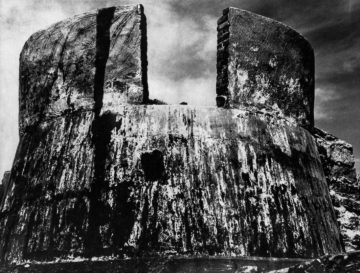 EARLY IN JULY 1958, the Japanese photographer Kikuji Kawada, then aged twenty-five and a staffer at the weekly magazine Shukan Shincho, visited Hiroshima for a cover story to run in the month following. He was there to photograph another photographer, Ken Domon, whose book Hiroshima had been published in the spring. Among Domon’s subjects: the scarred bodies of survivors of the atomic-bomb attack of August 6, 1945, and the skeletal dome of the city’s riverside industrial exhibition hall. When he had finished his assignment, Kawada lingered in the ruins below the Genbaku Dome, where brick and concrete walls were covered with stains composing, as he put it, “an audibly violent whirlpool.” Kawada took no photographs of the enigmatic markings, but returned two years later with a 4 x 5 view camera, and began making long exposures in “this terrifying, unknown place.”
 T
T It was a Monday morning, which was reason enough to meditate. I was anxious about the day ahead, and so, as I’ve done countless times over the past few years, I settled in on my couch for a short meditation session. But something was different this morning.
 I have seen many things (corpses, the Northern Lights, a beached whale), but a few sights have left a particularly vivid impression. One is of a boy I spotted in Istanbul eighteen years ago. He was fifteen or so, with a pathetic whispy moustache, wearing a suit for what appeared to be the first time. We were in the textile district of Zeytinburnu, and it seemed to me he was likely beginning a new life in his father’s small business, though I could be wrong. Whatever the occasion, the boy had deemed fitting to commission the labor of an even smaller boy, nine years old or so, to shine his shoes. The shoeshine kid was kneeling on the ground, scrubbing away with rags and polish from his portable kit, a borderline-homeless street gamin for whom all of our rhetoric about the sacred innocence of childhood means nothing at all. The fifteen-year-old stared down haughtily, like a small sovereign, and the nine-year-old, knowing his place, did not dare even to look up.
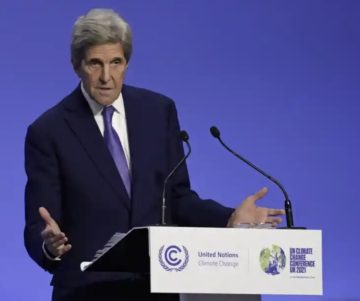 When it comes to climate finance, the gap between what is needed and what is on the table is dizzying. The talk at the conference was all about the annual $100bn (£75bn) that rich countries had promised to poorer nations
 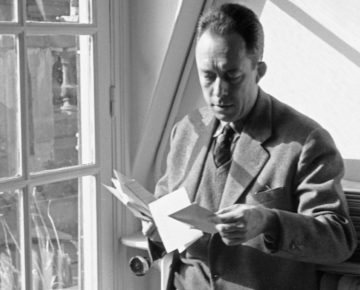 On Thursday evening, March 28, every seat and open space in Columbia University’s McMillin Theater was taken. Those who still stood in line and hoped for entry were out of luck. The scene was without precedent. No lecture delivered in French at Columbia had ever drawn more than two or three hundred listeners, and yet four or five times that many had come to hear Albert Camus read his prepared remarks entitled “La Crise de l’Homme” (“The Human Crisis”). What they heard was not the cultural excursion they had come for. Instead, it was arguably the most prophetic and unsettling speech Camus ever gave.
 Few historians write better about pictures than Uglow, and her commentaries make you look and look again at bright colour plates that deliver little shocks. Physically, linocuts are not large: the whirligig of Cyril’s The Merry-go-round and the glorious swirl of ’Appy ’Ampstead burst from confined spaces; The Eight and Bringing in the Boat are not much bigger than a sheet of A4. The technical ability required to succeed in this medium is immense. The same could be said for piecing together the lives of individuals who covered their tracks and told themselves stories that were only partially true. Enough scraps survive to suggest that Cyril loved Sybil and was sad to lose her (he went back to his ‘quiet’ and kindly, amenable wife, and nothing was said in the family about his twenty-year absence). Sybil, who settled happily on Vancouver Island and whose reputation grew as she continued to work, was always busy, if not sketching and painting and linocutting then teaching, making her own clothes and boiling prodigious quantities of jam. To her brisk denial that her domestic relationship with her artist-collaborator had been that of lover, Uglow responds, ‘and who can deny her the right to possess the facts of her own life?’
 Last May, after the Isla Vista shooter’s manifesto revealed a deep misogyny, women went online to talk about the violent retaliation of men they had rejected, to describe the feeling of being intimidated or harassed. These personal experiences soon took on a sense of universality. And so #yesallwomen was born—yes all women have been victims of male violence in one form or another.
 In the annals of transportation history persists a tale of how automobiles in the early 20th century helped cities conquer their waste problems. It’s a tidy story, so to speak, about dirty horses and clean cars and technological innovation. As typically told, it’s a lesson we can learn from today, now that cars are their own environmental disaster, and one that technology can no doubt solve. The story makes perfect sense to modern ears and noses: After all, Americans love their cars! And who’d want to walk through ankle-deep horse manure to buy a newspaper? There’s just one problem with the story. It’s wrong.
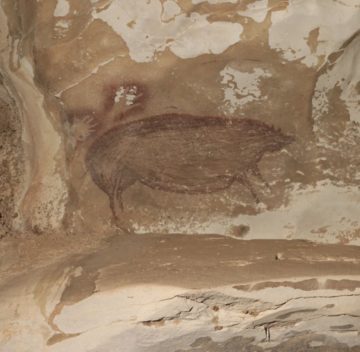 Gazing with recognition at this pig, Burhan also noticed the painted silhouettes of two human hands toward its rear. The over-all look of the art work suggested to Burhan that it was very old—but how old?
 Educational attainment is closely correlated with intelligence, but not perfectly correlated. How far you go in school depends not just on your IQ, but on other skills: how hard-working and motivated you are, how well you can cope with adversity – and arguably also less desirable qualities, like whether you so desperately seek societal approval that you’re willing to throw away your entire twenties on a PhD with no job prospects at the end of it. “Genes for educational attainment” will be a combination of genes for intelligence, and genes for this other stuff.
 “Arabs” are not real people in these works of fiction. Arrakis in Dune are not Iraqis in their homeland. They are figurative, metaphoric and metonymic. They are a mere synecdoche for a literary historiography of American Orientalism. They are tropes – mockups that are there for the white narrator to tell his triumphant story.
 H
H