
Lucy Ellmann in The Baffler:
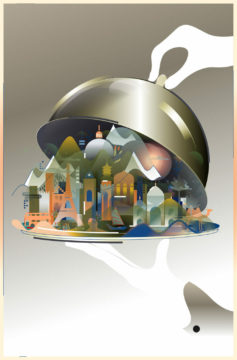 NOT ALL THAT LONG AGO, air travel was a clear badge of elite cultural distinction, from the “jet set” to the Sinatra-mangling ad slogan, “Come Fly With Me.” Droit-de-seigneur sexual fantasies of stewardess life were memorialized in that elegantly titled sixties tell-all Coffee, Tea, or Me? People actually used to dress up to take a plane. But that’s all over. Now you need a bulletproof vest when dealing with the cabin crew.
Airlines seem to be competing for Jerk of the Year awards. When they’re not bumping people off, figuratively or literally, they’re frighteningly “reaching out” to the customers they abused, customers with “issues.” (The language is patronizing and predatory.) We’re all sorry United’s planes are so attractive to terrorists. The staff must be under constant strain. But so are the passengers, with whom these tin-pot dictators are increasingly strict, banning leggings on ten-year-olds and bodily removing people from the passenger manifests.
Delta recruited airport police to threaten a couple with jail and the confiscation of their children, all for refusing to give up seats they’d paid for on a flight from Hawaii to LA. An American Airlines flight attendant bullied a tired mother of twin babies over her stroller, and then readied himself to punch a passenger who rose to her defense. These companies seem very exacting about how their customers behave—while apparently giving staff (or airport-based security officials) full license to unleash their inner demons. In airplane disaster movies, the pilot’s always wrestling with the yoke, trying to get full throttle; now these exertions are directed towards throttling the yokels.
More here.
 In 1914, when World War I broke out, Santiago Ramón y Cajal, the most influential neuroscientist in the world—the man who discovered brain cells, later termed neurons— published only one article, by far his lowest output ever. “The horrendous European war of 1914 was for my scientific activity a very rude blow,” Cajal recalled. “It altered my health, already somewhat disturbed, and it cooled, for the first time, my enthusiasm for investigation.” Cajal’s tertulia, or café social circle, was “overwhelmed with horror and abomination, erasing the last relics of our youthful optimism.” Science was supposed to be universal, but now, as mail became unreliable, telegraph lines were cut, trenches were dug, and borders were almost constantly closed, scientists could not even share their work internationally.
 When his first novel,
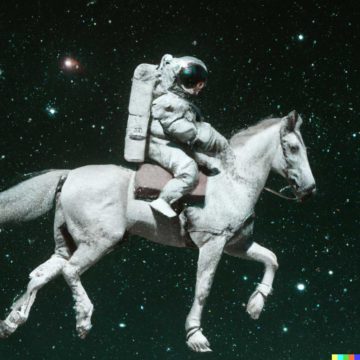 For many decades, part of the premise behind AI was that artificial intelligence should take inspiration from natural intelligence. John McCarthy, one of the co-founders of AI, wrote groundbreaking papers on
  I am trying, in reviewing Why We Are Restless, an excellent new book by Benjamin Storey and Jenna Silber Storey, to keep myself out of it. My usual essayistic approach, I fear, will lead a reader to think that I object to the book’s diagnosis of what went wrong with the modern world more than I do. Besides, the tendency of critics to involve themselves in their reviews is irritating, and surely an example of the type of Montaignean introspection that may well be making us restless. But Why We Are Restless stands out among other books like it by answering the question implied by its title with rigor and charity, by (mostly) succeeding in presenting the view it contests “in terms of the most decent human aspirations.” Cataloguing one’s own restlessness, or subjecting readers to one’s bargain-bin Tocquevillian observations about the United States of America, would veer dangerously into the Montaignean territory here scrutinized. I will make an attempt (essai), in other words, to share some thoughts (pensées) about this fine book.
 W
W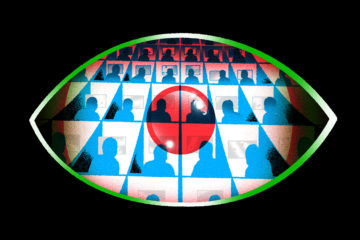 Are you an “insider threat?”
 When I want to know what the future is going to be like, I go ask
  Last summer, three researchers took a small step toward answering one of the most important questions in theoretical computer science. To
  The upside of many NFTs having a uniform visual style is that, theoretically, as many of the medium’s biggest fans will stress, there is something inherently democratic about their design and their acquisition. If not every NFT creator makes the kind of money Bored Ape Yacht Club makes, they still have a fairly equal opportunity to share their work. Searching OpenSea for pieces is still easier by far than buying physical work from a gallery or an auction, and the only barrier to entry is a working knowledge of cryptocurrency. Buyers and artists who grew up on the internet of the 00s, meanwhile, may experience deja vu when given the opportunity to customise what is effectively an avatar, harking back to online cartoons like Blingees or Dollz Mania. When a rash of articles appeared in 2021 suggesting NFTs might be the Beanie Babies of the 2020s, the comparison was meant to be an insult; still, it is hard to overestimate the power of nostalgia when it comes to millennials on the web.
 During his lifetime, there was a long line of people who thought Admiral Hyman Rickover was an insufferable son of a bitch, a contemptible ass, an overbearing, opinionated, power-hungry menace. Biographer Marc Wortman called him, “obstinate, egotistical, and abrasive…” (119)
 It was at a party in Greenwich Village, in the spring of 1920, that the critic Edmund Wilson first encountered
  We now know who is rich in America. And it’s not who you might have guessed. A groundbreaking 2019
  N
N