
Donna Dennis in The Paris Review:
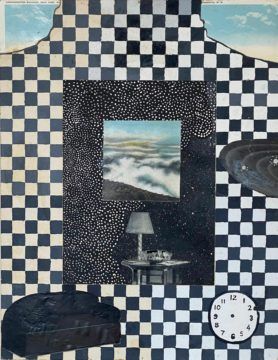 Ted and I saw one another off and on for about five years. In the spring of 1970, we lived together on Saint Mark’s Place in the East Village, until June, when Ted went to teach a course in Buffalo. I moved into the artists Rudy Burckhardt and Yvonne Jacquette’s loft on East Fourteenth Street while they summered in Maine. Ted stayed with me for a number of weekends that summer, and he proposed that we undertake a collaborative book. As I remember, I began the collaboration by making drawings with empty word balloons. I’m pretty sure Ted provided the project’s title at the outset. Ted would take the drawings—I think I made them in batches of four or five—back to Buffalo, where he began to fill in the words. We went back and forth this way, sometimes in person, sometimes by mail. I had forgotten all about this collaboration by the time Ted Berrigan’s youngest son, Eddie, contacted me in the summer of 2018. He wanted to bring me something his father and I had done together, which had recently turned up. As I looked at sixteen pages of my drawings and Ted’s handwritten words, the memories came back. These diaries describe some of them, along with the artistic milieu I was in in New York at that time—which included the painter Martha Diamond and the poets Bernadette Mayer, Michael Brownstein, Anne Waldman, and John Giorno.
More here.
 The arrival of widely available image synthesis models such as Midjourney and
 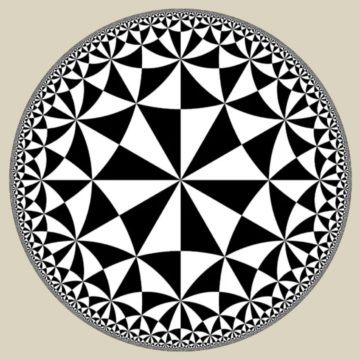 Of Euclid’s five postulates, which form the basis of Euclidean geometry, the fifth is the most controversial. Called the Parallel Postulate, it’s a pretty basic idea. Take a flat piece of paper, draw a line segment and then draw two lines that are perpendicular to it. The Parallel Postulate simply says that the lines will remain forever parallel, staying precisely the same distance apart even if we extend them to infinity on either side of the line segment.
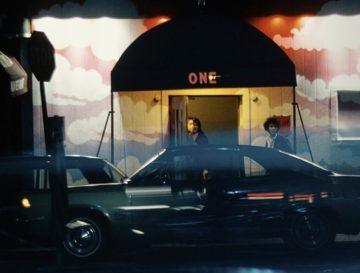 As you read this article, time will seem to pass. Right now, you are reading these words, but now you are reading these ones. What was present just an instant ago seems to have already slipped into the past. You will carry this feeling with you – as objects change and move, as thoughts run through your head, as feelings ebb and flow – until you fall asleep tonight. Heraclitus thought that time was like a river: ‘Everything flows and nothing abides; everything gives way and nothing stays fixed.’ Our experience of the world seems to back this up. It certainly feels as if time is sweeping us along. Yet, physicists and philosophers will tell you that Heraclitus was wrong. Time, they say, does not actually pass. In his
  David M. Higgins talks to Ajit George in LA Review of Books:
 Marco Roth in Tablet:
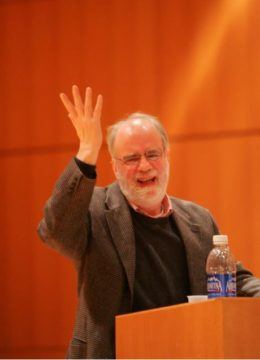 Sam Roberts in the New York Times:
 There is a secret. And that secret is how to make top-secret secrets not secret anymore using only your mind. All that stands between you and doing this is embracing the power of positive declassifying. Let others submit formal written declassification requests to the proper agencies. You are special. You are powerful. You are going to jail. The first step is gratitude. Close your eyes—but also maybe keep one open for the F.B.I.—and say meaningful thank-yous to those whose service you will be betraying.
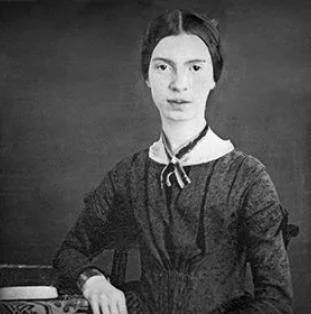 I measure every Grief I meet
With narrow, probing, eyes –
I wonder if It weighs like Mine –
Or has an Easier size.
I wonder if They bore it long –
Or did it just begin –
I could not tell the Date of Mine –
It feels so old a pain –
I wonder if it hurts to live –
And if They have to try –
And whether – could They choose between –
It would not be – to die –
More
I measure every Grief I meet
With narrow, probing, eyes –
I wonder if It weighs like Mine –
Or has an Easier size.
I wonder if They bore it long –
Or did it just begin –
I could not tell the Date of Mine –
It feels so old a pain –
I wonder if it hurts to live –
And if They have to try –
And whether – could They choose between –
It would not be – to die –
More 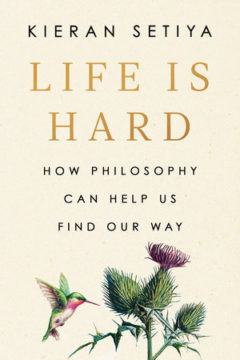 Philosophy’s role here is not primarily analytical. We cannot be argued into coping with suffering. Instead, Setiya’s book is guided by an insight from Iris Murdoch: that philosophical progress often consists of finding new and better ways to describe some stretch of our experience. This kind of progress is not won by logic. It requires careful attention, precise thinking and the ability to draw distinctions that cast light on that which is of value. Setiya is at his best when he has something or someone clearly in view – for example in his account of living with chronic pain, or his discussion of the philosopher and mystic Simone Weil.
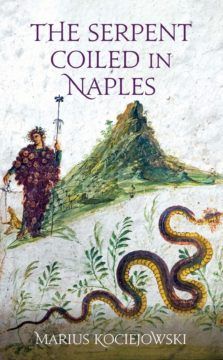 One day a few years ago, an Englishman walked into a tourist shop on the ground floor of a Neapolitan palazzo and told a woman he encountered there that he was searching for the soul of Naples. The building, named Palazzo del Panormita, for an obscure fifteenth-century author of erotic Latin epigrams, stands near a small piazza named for the River Nile, recalling the Egyptian traders who once lived in a mini-quarter within the city center’s ancient Greek grid. (There was a Greek settlement there before the Parthenon was built.) Today, that grid runs into a thoroughfare cut by the Spanish in the sixteenth century, when the Kingdom of Naples was under their imperial control. Named Via Toledo by the Spanish, the street became Via Roma three centuries later, when Naples, at last free of a series of foreign overlords, joined a unified Italy. And yet for many Neapolitans the idea of being governed from Rome was apparently as abhorrent as Spanish dominion: the name Via Roma aroused so much resentment that, in the nineteen-eighties, the city brought the old Spanish name back into official use. Even now, Neapolitans differ sharply on what their central commercial street should be called.
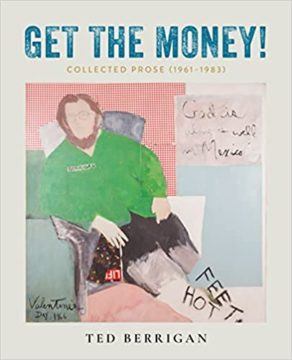 Though there is less of Berrigan’s prose than his poetry, the best of it—his early journals, the collaged “interview” with
 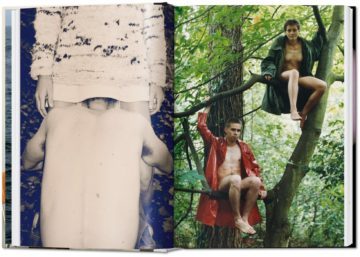 Over the course of his 36-year career, the photographer