
Category: Recommended Reading
John le Carré’s Search for a Vocation
Jennifer Wilson in The New Yorker:
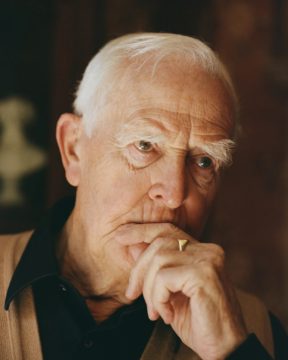 The summer I finished writing my dissertation, the C.I.A. tried to recruit me—as a spy. The call came in the middle of the afternoon, as I was working on a chapter about Tolstoy and midwifery. An older woman with an eerily friendly voice started going over what the training for a job in clandestine affairs would entail. I stifled a laugh. I didn’t know what was harder to believe: that anyone thought I could keep a secret or that a degree in Russian literature would qualify me to parachute out of a plane. Was I interested in learning more? O.K., I said, mostly out of nosiness, or at least that’s what I told myself. They would be in touch, she said.
I was not in a position to be particularly choosy about who paid my bills. I had a few months left of health insurance, and I—who cannot swim—had just sent a rather pleading application to work as a translator on a salmon-fishing boat in the Russian Far East. Still, I was a little let down by the agency’s approach. This was not how being recruited as a spy had played out in my mind, where a pastiche of scenes from movies and cheap paperbacks had created a fantasy so vivid it almost felt like a memory. I was supposed to be sitting at a bar, nursing my second shot of bourbon, flirting with the bartender and exuding the tousled sex appeal of someone who has not lived up to their potential. A stranger would strike up a conversation, all small talk at first, asking me about the menu, the town, where I got my taste for brown liquor. Then casually, menacingly, the stranger—bearing a striking resemblance to Al Pacino in “The Recruit” (2003)—would call me by my name.
More here.
This rapid-fire laser diverts lightning strikes
Elizabeth Gibney in Nature:
 A rapidly firing laser can divert lightning strikes, scientists have shown for the first time in real-world experiments1. The work suggests that laser beams could be used as lightning rods to protect infrastructure, although perhaps not any time soon. “The achievement is impressive given that the scientific community has been working hard along this objective for more than 20 years,” says Stelios Tzortzakis, a laser physicist at the University of Crete, Greece, who was not involved in the research. “If it’s useful or not, only time can say.”
Metal lightning rods are commonly used to divert lightning strikes and safely dissipate their charge. But the rods’ size is limited, meaning that so, too, is the area they protect. Physicists have wondered whether lasers could enhance protection, because they can reach higher into the sky than a physical structure and can point in any direction. But despite successful laboratory demonstrations, researchers have never before succeeded in field campaigns, says Tzortzakis.
More here.
Tuesday Poem
Coconut
Four times they drew,
checking blood
for sweetness—how quickly
the body can dissolve
what feeds it. “Glucose”
meaning sweet wine,
simple, meaning
how much of it hides
inside the coconut’s
husk, its tender white-
meat flesh, its milk,
the creamy-clear
colostrum, the same
as your seed-nut-fruit
dark-drupe nipples seep
each time you shower
or mistake a noise
for children’s crying.
You vomited the first time,
five-years-old and biting
its shredded meat, dried flakes
surrounded by dark chocolate.
You feel it even now, sand
between your teeth, sickness
rising, remembering
BOUNTY, the candy-bar
treat so you’d endure another
hour in the market, Ukraine’s
summer heat, your bountiless
childhood, everything
for sale to make departure
sweeter. You’ve refused it
since, the stick and sweet
of it. You’ve let go
anything you own,
your blood and choice
to eat a bountiful pint
of imported German
ice cream, impossible
in your insoluble childhood.
Sunday, January 15, 2023
How to Write English Prose
David Bentley Hart in The Lamp:
 Every great national prose, in just about any tongue, reaches its high meridian only by way of a prolonged and constant negotiation of just this tension between beauty and sublimity—between the decorative and the august, or between the splendid and the lucid. And this comes only at the end of long epochs of development. To be able to balance expressiveness and reticence, or to know when to cast that balance away, requires tact and ingenuity and taste on the part of writers; but it also requires a language of sufficient maturity. This is why prose of any consequence invariably arrives far later in a culture’s history than does great poetry. Poetry entered the world almost as early as words did; it is the first flowering of language’s intrinsic magic—its powers of invocation and apostrophe, of making the absent present and the present mysterious, of opening one mind to another. It comes most naturally to languages in their first dawn, when something elemental—something somehow pre-linguistic and not quite conscious—is still audible in them. Prose, however, evolves only when that force has been subdued by centuries upon centuries of refinement, after unconscious enchantment has been largely mastered by conscious artistry, and when the language has acquired a vocabulary of sufficient richness and a syntax of sufficient subtlety, and has fully discovered its native cadences.
More here.
How the Brain Calculates a Quick Escape
Tom Siegfried in Smithsonian Magazine:
 Escape behavior offers useful insight into the brain’s inner workings because it engages nervous system networks that originated in the early days of evolution. “From the moment there was life, there were species predating on each other and therefore strong evolutionary pressure for evolving behaviors to avoid predators,” says neuroscientist Tiago Branco of University College London.
Not all such behaviors involve running away, Branco notes. Rather than running you might jump or swim. Or you might freeze or play dead. “Because of the great diversity of species and their habitats and their predators, there are many different ways of escaping them,” Branco said in November in San Diego at the 2022 meeting of the Society for Neuroscience.
More here.
The idea of a ‘precolonial’ Africa is theoretically vacuous, racist and plain wrong about the continent’s actual history
Olúfẹ́mi Táíwò in Aeon:
 We should expunge, forever, the epithet ‘precolonial’ or any of its cognates from all aspects of the study of Africa and its phenomena. We should banish title phrases, names and characterisations of reality and ideas containing the word.
To those who might be put off by the severity of the proposal, or its ideological-police ring, I hear you and ask only that, with just a little patience, you hear me out. It will not take much to jolt us out of the present unthinking in assuming that ‘precolonial’ or ‘traditional’, and ‘indigenous’, has any worthwhile role to play in our attempt to track, describe, explain and make sense of African life and history.
When ‘precolonial’ is used for describing African ideas, processes, institutions and practices, through time, it misrepresents them. When deployed to explain African experience and institutions, and characterise the logic of their evolution through history, it is worthless and theoretically vacuous. The concept of ‘precolonial’ anything hides, it never discloses; it obscures, it never illuminates; it does not aid understanding in any manner, shape or form.
More here.
Fuck the Poetry Police
Dan Sinykin in the Los Angeles Review of Books:
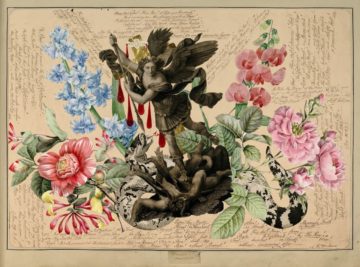 The game is rigged. It is rigged like capitalism is rigged. There is no puppet master, no conspiracy, only a field where advantages, to begin with, are distributed unequally. You can beat the long odds, but you have long odds to beat; a team of scholars has been working for almost 10 years to detail exactly how the rigging works. Juliana Spahr and Stephanie Young, later joined by Claire Grossman, began by noticing that poetry readings they regularly attended were held in “mainly white rooms.” They wanted to know why. To find out, they would need to widen their purview. The wider they went, the hungrier they became to understand who gets to succeed as a writer in the United States today. They wanted to reveal the system, to see all of it.
So, they collected data. Because prizes are a normative standard for success, they collected data on prizes — every prize since 1918 worth $10,000 or more in 2022 dollars. They recorded who won, what their gender and race were, where they earned their degrees, and who served as judges. Then they published what they found in a series of essays. What did they find?
More here.
Sunday Poem
“Many American men . . . do not have enough awakened
or living warriors inside to defend their soul houses.”
…………………………………………………. —Robert Bly, poet
Old Self
I chanced across my old self
today. He was sitting in the second
floor office where I used to work—
at the typewriter, young, thin guy,
in his late 20’s, white shirt, narrow
dark tie, serious demeanor, writing
an essay against the Vietnam War.
I came up the stairs and saw him—
a decent human being, diligent,
not remotely aware of the ambush
life had waiting — not knowing
he’d permit himself to be taken
prisoner and then, in confusion,
do desperate things, betray
what he loved — and that nothing
would enable him to survive
as he was.
I passed the open door
and wanted to cry out —warn him,
force the warriors to raise
their spears. But even hearing
my shout, he would have only
hesitated, then turned back to
his devoted, lonely and interminable
work.
by Lou Lipsitz
from Seeking the Hook
Signal Books, 1997
The Crows of Karachi
Rafia Zakaria in Orion Magazine:
 IT IS RAINING IN Karachi as I write this, an ugly, punishing rain that returns with increasing fury every year. This year, as every year, the monsoon is supposed to be the “worst ever,” and, like every year, the city’s flimsy slums and crater-riven roads will collapse with the weight of the rain. On these deadly rainy days, the water that falls from above meets the sewage that bubbles up from below, both equally careless about the location of their union. Some people will lose everything this very day and leave, returning to villages with no opportunity but less despair. Others will arrive in their place. This constant count of coming and going is the beat of Karachi, a city that grew suddenly out of the coastal desert when India’s Muslims needed a place to land in 1947.
In this migrant city, the hooded crows have always stayed, multiplying wildly to become the most common bird. A few years ago, a reader wrote a letter to the editor at Dawn, the English newspaper where I am a columnist, saying that if you want to estimate the filth and neglect of a city, count the crows. One study did, and found the letter writer’s words to be entirely true: when humans do not attend to waste and carrion, the crows nourish on it, multiplying with feral glee. Crows are everywhere in Karachi, damaging the windshields of jets parked at Jinnah Airport or lasciviously stealing the one piece of bread a beggar is eating on the side of the road. They also perch atop the giant garbage heap next to our house, wading carelessly in the dirty puddles, picking out bits of wire and plastic to fashion their very own urban nests.
More here.
Charles Simic (1938 – 2023) Poet
Jeff Beck (1944 – 2023) Guitarist
Janet Malcolm Remembers
Charles Finch in The New York Times:
 The field is all but clear now, and it seems safe to say that the two most important long-form journalists this country produced in the second half of the last century were Joan Didion and Janet Malcolm. Their differences are more evident than their similarities: the cold Los Angeles burn of Didion’s work, the measured New York ambiguity of Malcolm’s. Still, perhaps it’s no accident that both were white women, marginalized by definition, yet not so strictly that it prevented either from slipping into the mainstream as witness, as recorder. Both were born in 1934, and both died in 2021. A world goes with them.
These are the kind of truth claims that Malcolm spent a career questioning, of course. A writer for The New Yorker since 1963 — one of that magazine’s great reciprocal relationships, the reporter and the institution enriching each other — she specialized in subjects, including art, psychoanalysis and crime, that admitted of no easy truths, not even in the presence of facts.
That makes the dilemma of her superb final book, “Still Pictures,” obvious. How could a writer so famously, effectively skeptical of subjective stories write an autobiography? Malcolm solves the problem with characteristic elegance: Nearly every short chapter of “Still Pictures” is headed by a grainy black-and-white photograph, whose calls to memory she heeds, repels and bargains with in turn by subtle turn.
More here.
Lisa Marie Presley (1968 – 2023) Singer
Saturday, January 14, 2023
The NIEO as Global Keynesianism
 Herman Mark Schwartz in Progressive International:
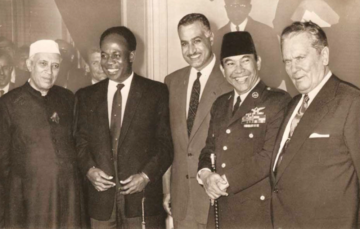
The countries promoting the NIEO were solidly anti-Marxist. Unlike Groucho Marx, they wanted to be a member of any club that might have them — specifically, the club of post-World War 2 developed, relatively sovereign nations using controlled domestic economies and particularly financial systems to promote faster industrialization and stable incomes for primary producers and workers more generally.
In essence, by promoting a new deal for recently decolonized nations and the mostly Latin American countries operating as informal dependencies under first the British and then the US empire, the NIEO group sought to generate a global equivalent of the US New Deal. The New Deal famously legitimized collective bargaining, stabilized agricultural production and prices while also subsidizing incomes, and funded a massive developmental upgrading of the US American internal periphery. In essence, the NIEO proponents sought to expand that post-war ‘fordist’ regulated economy to a global scale, just as immigrant and racial minorities sought access to stable income and employment inside developed country labor markets. Those minorities wanted western democracies to live up to their promises of equality for all citizens; NIEO proponents wanted western democracies to live up to the unfulfilled promises of the 1944 Bretton Woods conference and post-colonial sovereign equality.
More here.
The philistine war on AI art
 Justin E. H. Smith in Unherd:
Among the most ingenious moments in Kraftwerk’s admirable oeuvre is the point in 1981’s “Pocket Calculator” when a human voice self-contentedly sings: “By pressing down a special key / It plays a little melody.” The melody follows in confirmation. The genius here seems to lie in the blunt honesty of the singer, owning up to the contemporary condition of music as an art form that has largely been outsourced to machines. It’s not that the German electronic band invented the technology, nor that they were the first to make use of it. They are simply among the first to figure out how to elevate it to self-awareness, and to press it into a gesture of timely irony and potentially timeless beauty; that is, to make art out of it.
The little melody in question is of course a pre-set. Its sequence of notes is planned in advance, and once the key is pressed, the machine may be relied upon to do only the thing it has been programmed to do. The melody, it goes without saying, is no Bach fugue. It is simple, naïve, kind of dumb; and within the context of the song, it is utterly compelling.
Several conditions — technological, cultural, historical — had to fall into place in order for this melodic interlude, with its verbal introduction, to come across to the critical listener as an expression of genius. All of these conditions might be cited in response to any philistine tempted to declare, of the pressing down of that special key, that “I could have done that too”. We are used to hearing such petulant ressentiment, especially in connection with the 20th-century avant-garde in the figurative arts: “I could have entered a urinal in an exhibition, too”; “I could have painted an all-white monochrome, too”; etc. The simplest response is, “Yes, but you didn’t”.
More here.
Money and Mimesis
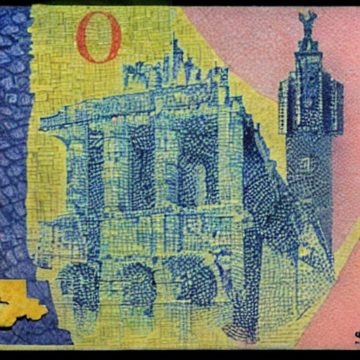 Jeremy Walton in Sidecar (image credit: Stable Diffusion):
On 1 January, Croatians entered the latest EU-mandated experiment in whether monetary ‘portrayal can be convincing’, when they substituted their national currency, the kuna, for the euro, becoming the first member-state to do so since Lithuania in 2015. Like all EU states other than Denmark, Croatia formally accepted the obligation to enter the eurozone with its accession as the Union’s 28th – and still most recent – member in 2013. Its relatively prompt adoption of the currency contrasts with the persistent euro-scepticism of countries such as Sweden, the Czech Republic and Hungary, which continue to maintain their own currencies despite being much older members of the EU. This is largely attributable to the unflagging enthusiasm for Brussels emanating from the centre-right government of Prime Minister Andrej Plenković and his party the Croatian Democratic Union (HDZ; Hrvatska demokratska zajednica). Under Plenković, the HDZ has refashioned itself as a Christian Democratic party of the sort that is increasingly rare in the epoch of ascendant right-wing populism in Europe and beyond.
Ursula von der Leyen, the President of the European Commission, visited Zagreb to sanctify Croatia’s definitive embrace of the euro. (She and Plenković pointedly paid for their coffees with them). Such political fanfare has not been a panacea to apprehension about the new currency regime; Croatian citizens are well-acquainted with the contortions and consternations that the euro can involve.
More here.
The Dollar and Climate
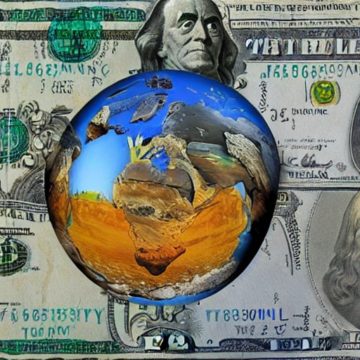 Daniel Driscoll in Phenomenal World’s Polycrisis (image credit: Stable Diffusion):
Amidst the turbulence of the Second World War, hundreds of delegates from the Allied Nations met in Bretton Woods, New Hampshire to construct a post-war economic system. While it might strike one as odd that post-war choreography began in 1944, a year before the war ended, the truth is that states were planning peacetime from the moment the war began. The West feared replicating the blunders of the Treaty of Versailles and wanted to establish the next post-war order with prudence.1 One principal task for Bretton Woods attendees was to implement an international monetary system. Several proposals existed, including Keynes’ Bancor, which would have established an International Clearing Union to issue a supranational currency, oversee currency exchanges, and correct global imbalances. The war had weakened Europe, however, and strengthened the US. US negotiators exploited their influence. While the adoption of the dollar as the global reserve asset would hand the US a significant upper hand, Europeans eventually relented because they could still convert dollars to gold and were assured that the arrangement was temporary.
Twenty-seven years later, a new crisis fractured the postwar economic peace enjoyed by the West. Rising inflation drove many countries, particularly European ones, to convert their US dollar reserves into gold. President Richard Nixon faced a choice between devaluing the dollar or pumping it up through perilous austerity measures. Global markets predicted that Nixon’s political savvy would drive him toward the former, but he shocked the world by taking a surprise third route, severing the dollar from the gold standard. There is a great deal of disagreement as to his decision’s long-term ramifications, but little debate about the global economic turmoil that immediately followed. Through it all, the dollar’s global hegemony endured, and it remains to this day.
More here.
For Thy Great Pain Have Mercy on My Little Pain
Frank Cottrell-Boyce at The Guardian:
 This is an extraordinary novel about two extraordinary women, the books they wrote and how those books survived. In 1934, while looking for a ping pong ball in the house of Lieutenant Colonel William Butler-Bowdon, a guest stumbled upon the only complete manuscript of The Book of Margery Kempe. Butler-Bowdon threatened to throw it on the bonfire, saying “then we may be able to find ping pong balls and bats when we want them”. Fortunately he changed his mind, and the manuscript of the earliest English autobiography is now safely in the British Library.
Born in 1373, one-time brewer Margery Kempe had visions of Christ which set her off on a series of rambunctious, incident-packed pilgrimages to the Holy Land, Santiago de Compostela and Prussia. She dressed in white, like a virgin, despite having at least 14 children. She was tried for heresy several times but always managed to successfully rebut the charges. In her debut novel Victoria MacKenzie has distilled this chaotic, episodic rampage of a life into a beautifully lucid account of a spiritual adventure. The Margery who emerges is boastful, vulnerable, courageous, confused, mouthy, libidinous, attentive and impossible not to love.
more here.
The Transgressive Power of Alba de Céspedes
Joumana Khatib at the NYT:
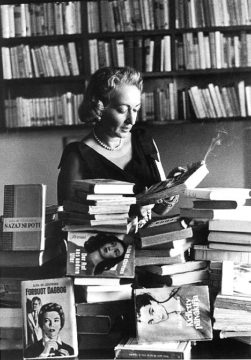 Rome, 1950: The diary begins innocently enough, with the name of its owner, Valeria Cossati, written in a neat script.
Valeria is buying cigarettes for her husband when she is entranced by the stacks of gleaming black notebooks at the tobacco shop. She’s not permitted to buy one there on Sundays, she’s told, but the tobacconist gives her one anyway, which she stashes under her coat. She doesn’t yet know there’s a devil hiding in its pages.
This deception begins the Cuban-Italian writer Alba de Céspedes’s novel FORBIDDEN NOTEBOOK (Astra House, 259 pp., $26), first published in 1952. Valeria is married with two adult children; the family is under financial strain, compelling her to work in an office and manage her household without the help of a maid. She has coped with these pressures handsomely, she believes. She is a “transparent” woman, simple, “a person who had no surprises either for myself or for others.”
more here.