
Category: Recommended Reading
The Post-Human Economy
Katherine Dee in Tablet:
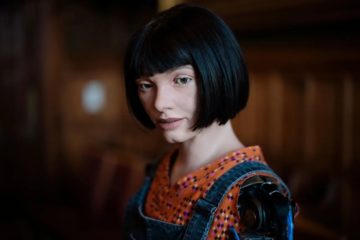 We’re supposedly on the brink of an artificial intelligence breakthrough. The bots are already communicating—at least they’re stringing together words and creating images. Some of those images are even kind of cool, especially if you’re into that sophomore dorm room surrealist aesthetic. GPT-3, and, more recently, chatGPT, two tools from OpenAI (which recently received a $29 billion valuation) are taking over the world.
Each new piece about GPT-3 tells a different story of displacement: Gone are the halcyon days of students writing original essays, journalists doing original reporting, or advertisers creating original ad copy. What was once the domain of humans will now be relegated to bots. The next technological revolution is upon us, and it’s coming for creative labor. Timothy Shoup from the Copenhagen Institute for Future Studies seems confident that with chatGPT and GPT-3, the problem is about to get much worse, and that 99.9% of internet content will be AI-generated by 2030. The future, in other words, will be by bots and for bots.
More here.
Yellow crazy ant males have two sets of DNA
From Phys.Org:
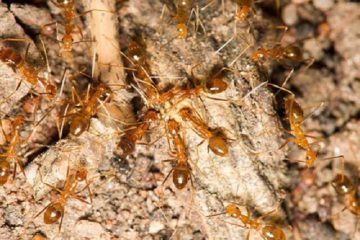 A small international team of molecular and evolutionary scientists has discovered that male yellow crazy ants (also known as long-legged ants) have two sets of DNA throughout their bodies. In their paper published in the journal Science, the group describes the unique find and discusses possible reasons for it. Daniel Kronauer with The Rockefeller University has published a Perspective piece in the same journal issue discussing the work by the team and suggests that the unique genetic feature of the ants may explain why they are such a successful invasive species.
Prior research has shown that yellow crazy ants, which are native to Asia and West Africa, have the ability to adapt well to new environments, making them a successful invasive species. Now it turns out that they may have an advantage that has not been seen before: Males have dual sets of DNA. One of the most basic concepts of biological science is that multicellular organisms develop from a single-cell zygote into a creature with a unique genome. The only exceptions to this rule have been chimeras, which are generally considered accidents of nature. In this new effort, the research team found another exception—male yellow crazy ants with dual sets of DNA.
More here.
Saturday, April 8, 2023
Who Owns Dungeons & Dragons?
 Emily C. Friedman in the LA Review of Books:
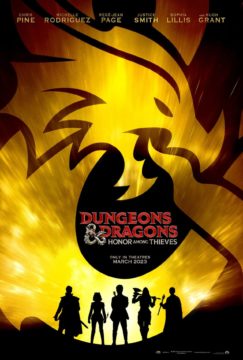
IN LATE FEBRUARY, Twitter user @ACassDarkly reported the following bewildering conversation around the new film Dungeons & Dragons: Honor Among Thieves, which debuted last weekend:
Person: “I can’t wait for the Dungeons & Dragons movie.”
Me: “Yeah it looks pretty fun.”
Person: “Do you think they’ll stick to the story?”
Me: “…?”
Person: “I just hate it when movies like that don’t stick to the story.”
Me: “The story of Dungeons & Dragons?”
This exchange is humorous because the popular tabletop role-playing game Dungeons & Dragons has no story—or rather, it has hundreds of thousands of stories, crafted at tables around the world, in dozens of languages, by the estimated 50 million current players. Or, as Chris Perkins, senior story designer for D&D, said last week in a promotional D&D Direct event, “What we write, you bring to life.”
But what Wizards of the Coast, the publisher of D&D, writes and sells is only a small portion of the creative material available to players. Game mechanics are not protected by copyright, and the imagined worlds owned by Wizards (such as the Forgotten Realms, the fantasy setting in which Honor Among Thieves takes place) are not required to play the game. “Homebrew” adventures, creatures, settings, and more have always been part of D&D, and over the past two decades, the Open Game License (or OGL) has allowed third-party creators to monetize their creative output with remarkably few restrictions. Publishing D&D content independently or with third-party publishers has now become an established pathway toward working on official D&D products with Wizards. The tabletop role-playing industry as a whole boomed under the OGL, as new companies have formed to provide both supplementary material for D&D and to incubate new game systems.
More here.
Drowning in Deposits
 Dylan Riley in Sidecar:
The failure of the Silicon Valley Bank and its knock-on effects such as the bailout of Credit Suisse has elicited the usual flurry of social-psychologizing in the ‘quality press’. On a recent New York Times podcast, the former Treasury official Morgan Ricks reached new heights of pseudo-profundity by claiming that the problem was ‘panic itself’ – and that it could be resolved simply by extending a blanket guarantee to all depositors.
Such an account of the crisis provides no concrete explanation of what happened. The precise causes of the bank’s collapse are, of course, debatable; yet the basic structural context and its main lessons seem clear. SVB, which is supposed to serve what is widely viewed as the most dynamic and innovative sector of the global economy, ‘tech’, had parked a huge quantity of its deposits in low-yield – but supposedly safe – government-backed securities and low-interest bonds. When the Federal Reserve began to raise interest rates, the value of these bonds declined, setting off a classic bank run as depositors scrambled to withdraw their money. Was the panic facilitated by social media or other means of digital communication that encouraged herd behaviour? Who knows, and who cares? The crucial point is that the bank was overwhelmed by the massive growth in deposits from its tech clients – and neither it nor they could find anything worthwhile to invest in.
In short, the SVB collapse is a beautiful, almost paradigmatic, demonstration of the fundamental structural problem of contemporary capitalism: a hyper-competitive system, clogged with excess capacity and savings, with no obvious outlets to soak them up. It must be emphasized that the current vogue for ‘industrial policy’ – quite pronounced in both the Biden and Macron governments inter alia – will do nothing to address this underlying issue.
More here.
Mercantilist Deals of the Great Powers
Kate Mackenzie and Tim Sahay in Polycrisis:
The maiden flight of a new cargo route between Shenzhen and Sao Paulo took off on Monday as European Commission President Ursula von der Leyen and France’s Emmanuel Macron prepared to travel to Beijing. US Vice President Kamala Harris has just been in Africa, attempting to avoid talking about China. Next week, Brazil’s President Lula and an entourage of hundreds of local business people will travel to the Chinese capital with plans to sign at least twenty bilateral agreements.
Each of these diplomatic journeys are the result of growing preoccupations with industrial policy, fragmentation, and the energy transition thanks to tensions around China and Russia. Trade flows, supply chains, and entire industries are rapidly being reorganized. Free trade led by “cooperative factions” in key countries has given way to “friend-shoring” led by “restrictionist” factions, largely on grounds of national security. New policies on export controls, visa bans, investment blocks, and sanctions are redirecting the flow of goods and people. US Allies, adversaries, and firms face hard questions: Who can invest in your country? Who can you sell to? What can and can’t you sell? Which countries do you risk arrest for trading with?
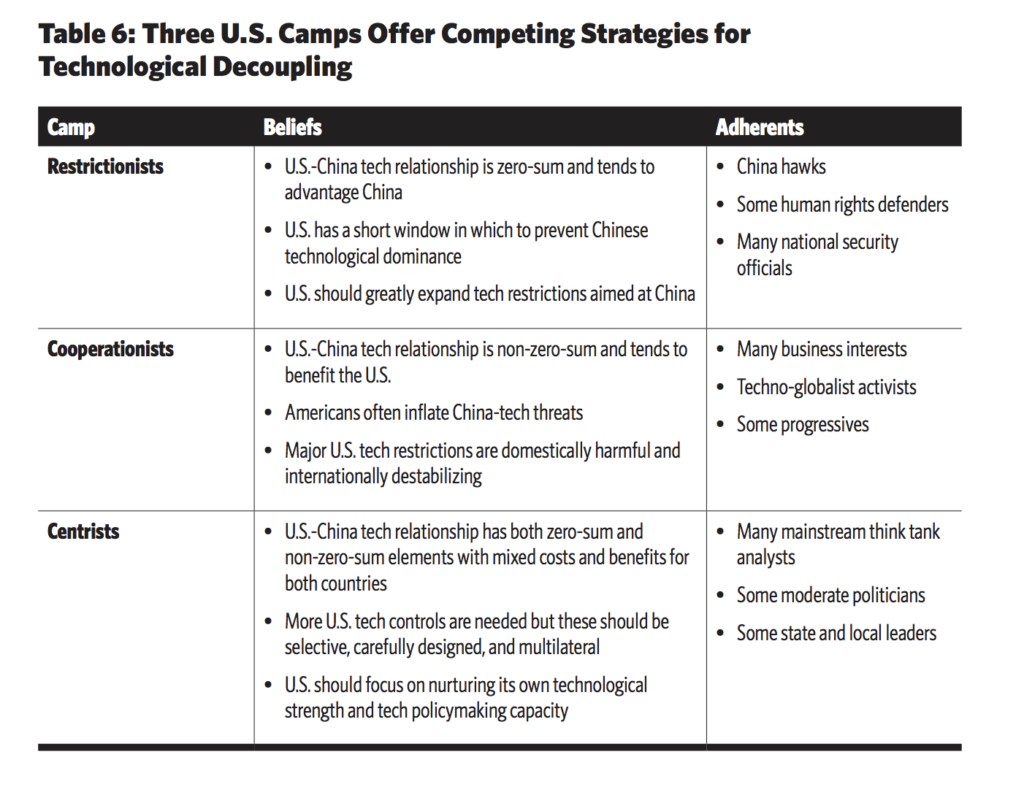
Table from US-China Technological “decoupling”: a strategy and policy framework by Jon Bateman (Carnegie Endowment for International Peace, 2022).
More here.
Can AI Ever Be Truly Conscious?
A Sociological Deep-Dive Into Big-Box Stores
Kate Briggs at The Washington Post:
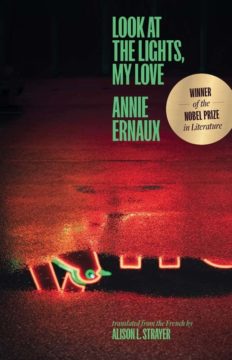 The effect of Ernaux’s diary is to make this clear: These are the places where life happens, where the social orders are made apparent and reinforced, where societies are “built.” Her local big-box store is the site of ideas, feelings and consequential interactions, where the politics of class, race, gender and privilege get played out — along with more private fantasies and reveries.
“Look at the lights, my love!” is an injunction a young mother makes to her child, pushing her up the moving walkway at Christmastime; Ernaux describes her own “rush of pleasure” at the prospect of interrupting her writing to drive to Auchan. Stores like this are frequented by the unemployed, adults with young children, the elderly, teenagers, the lonely, the homeless.
But, Ernaux points out, “when you think of it, there is no other space, public or private, where so many individuals so different in terms of age, income, education, geographic and ethnic background, and personal style, move about and rub shoulders with each other.”
more here.
Bruno Schulz: An Artist, A Murder, And The Hijacking Of History
Joshua Cohen at the NY Times:
 Bruno Schulz was a gnomish, cockeyed Polonophone Jew whose writing gave sophisticated expression to the wondrous vagary and uncertainty and foreboding of childhood, without forcing it to — actually, without letting it — grow up. His two volumes of fiction — the sum total of his surviving work save a few scraps that, given Schulz’s focus on youth, one hesitates to call juvenilia — are rife with how small it can feel to be small; they are claustral with the creeping tensions and melancholy of adult domesticity, and slyly attentive to the vulnerability of boredom that can, suddenly, crashingly, turn one’s head to sex.
The family that recurs throughout his corpus, a family that resembles his own, dwells in a dim, dusty house of uncountable rooms, stuffed with tailors’ dummies, taxidermy and raggedy toys, frescoes, panoramas, postcards, stamp albums and theatrical props. This visual excess, which is matched and mismatched by Schulz’s bric-a-brac prose, enables one of the author’s signature techniques: the description of a thing through a description of an image of that thing.
more here.
‘I spent years studying death, but it didn’t prepare me for grief’
Sarah Tarlow in The Guardian:
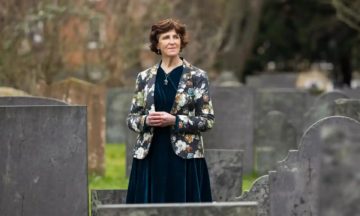 At about 9.15 on the morning of 7 May 2016, I came home and found my husband of two weeks, my partner of 18 years, dead in bed. Still, I go over and over the way that morning unfolded. I woke at my brother Ben’s house. Since I had left Mark alone overnight for the first time in months, and because he could not get his own breakfast or medication, I set off to drive home as soon as I was dressed and had drunk a cup of tea.
I texted Mark to say I was setting off, but I got no reply. Like the previous day, it was gloriously warm and sunny, and my drive along the empty A1 was easy and quick. I parked the car and walked up to the front door. I let myself in and shouted up, “Hello. I’m home!” No answer. “Mark?” I started up the stairs. It was quite silent. I had a sick, empty feeling, as though all the organs in my abdomen had suddenly dropped about a foot. I sort of knew, but I did not absolutely know. Not yet. I thought to myself, “This is the last moment before our world changes; these are the last steps in my old life.”
More here.
The stubborn sexism of American politics
Anna North in Vox:
 Sending threatening text messages to a female colleague. Making fun of another woman by mimicking her on the air. Asking a co-anchor if, perhaps, she was having trouble remembering a statistic in the newscast because she had “mommy brain.” These are just a few of the allegations — many of them captured on camera for the world to see — leveled at CNN anchor Don Lemon in a Variety report released on Wednesday. But Lemon was already facing increased scrutiny for voicing an extremely sexist opinion about a woman in a position of power. In February, Lemon pronounced, on air, that former South Carolina Gov. Nikki Haley, who recently announced her presidential bid, was not “in her prime.” Haley, at 51, is six years younger than Lemon.
The comment prompted widespread condemnation from both the left and the right, as well as from Lemon’s colleagues, and he was absent from CNN for two days. Lemon has since apologized for the Haley comments and, through a CNN spokesperson, denied the allegations in the Variety story.
More here.
Saturday Poem
White Corn Boy
I am the White Corn Boy.
I walk in sight of my home.
I walk in plain sight of my home.
I walk on the straight path which is toward my home.
I walk to the entrance of my home.
I arrive at the beautiful goods curtain which hangs at the doorway.
I arrive at the entrance of my home.
I am in the middle of my home.
I am at the back of my home.
I am on top of the pollen foot print.
I am on top of the pollen seed print.
I am like the Most High Power Whose Ways Are Beautiful.
Before me it is beautiful.
Behind me it is beautiful.
Under me it is beautiful.
Above me it is beautiful.
All around me it is beautiful.
by Anonymous
from American Indian Prose and Poetry —
Before the White Man Came
G.P. Putnam’s Sons, 1974
Friday, April 7, 2023
Ai Weiwei finds peace in Portugal: ‘I could throw away all my art and not feel much’
Steve Rose in The Guardian:
 It is a warm, clear spring morning and Ai Weiwei is giving me a tour of the huge new studio he is building about an hour’s drive from Lisbon. There is not another house in sight, just the flat green landscape of the Alentejo, and a big blue sky dotted with darting swallows. The studio, explains the artist, is a replica of his old one in Shanghai, which was finished in 2011 only to be almost immediately demolished by the Chinese authorities: officially, because it contravened planning regulations; unofficially, because of Ai’s outspoken criticism of the government. Months later, the artist was imprisoned for three months then placed under house arrest. When his passport was returned in 2015, he left the country and has not returned since.
“We live in a constantly changing landscape,” says Ai. His has certainly changed more than most people’s. After China, he set up in Berlin but left under a cloud, saying: “Nazism perfectly exists in German daily life today.” He moved on to the UK, where he has had run-ins with immigration authorities. On his first visit, he was initially granted a visa for just 20 days on account of his “criminal conviction” in China.
More here.
Light waves squeezed through ‘slits in time’
Davide Castelvecchi in Nature:
 A celebrated experiment in 1801 showed that light passing through two thin slits interferes with itself, forming a characteristic striped pattern on the wall behind. Now, physicists have shown that a similar effect can arise with two slits in time rather than space: a single mirror that rapidly turns on and off causes interference in a laser pulse, making it change colour.
The result is reported on 3 April in Nature Physics1. It adds a new twist to the classic double-slit experiment performed by physicist Thomas Young, which demonstrated the wavelike aspect of light, but also — in its many later reincarnations — that quantum objects ranging from photons to molecules have a dual nature of both particle and wave.
More here.
Taj Muhammad & Shad Muhammad Niazi Qawwal: “Guniyan ke Maharaj Khusrau”
The Labor of Play
Benjamin Tausig at Public Books:
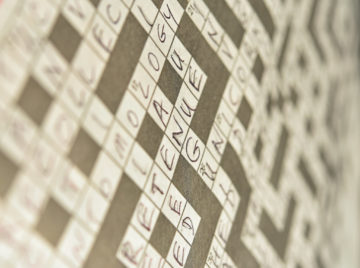 An Upper East Sider with advanced degrees playing Wordle over espresso; a suburban teenager pairing Call of Duty: Warzone with bong rips before work: both play, arguably, for the same reasons. Each delights in low-stakes release. Each enjoys the sense of completing a task (spelling words, killing enemies) that feels vaguely moral, and which the player might take pride in, even if virtually and for an audience composed only of themselves. What is different is only that the New York Times and other enlightened organs have now found ways to market trivial, dependence-inducing digital game products (already wildly lucrative in other settings) to the gentry. And the Times is hardly alone.
Is this boom in bourgeois gaming bad? The “inanity of many leisure activities” famously troubled the philosopher Theodor Adorno.
An ardent anti-capitalist—and a half-Jewish German refugee who feared that frivolous entertainment was a handmaiden to fascism (living in Los Angeles must have been interesting!)—Adorno had no problem with leisure, but he suspected that so-called free time had, in late capitalism, become little more than a recharging period between episodes of labor extraction, i.e., work days.
More here.
Bodies and Borders // Achille Mbembe
The Incredible Disappearing Doomsday
Kyle Paoletta at Harper’s Magazine:
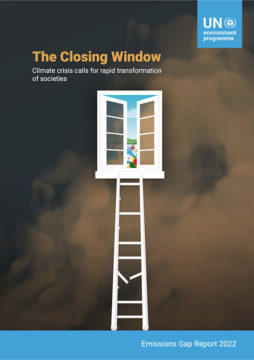 The first signs that the mood was brightening among the corps of reporters called to cover one of the gravest threats humanity has ever faced appeared in the summer of 2021. “Climate change is not a pass/fail course,” Sarah Kaplan wrote in the Washington Post on August 9. “There is no chance that the world will avoid the effects of warming—we’re already experiencing them—but neither is there any point at which we are doomed.” Writing in the Guardian a few days later, Rebecca Solnit highlighted a paragraph from a recent report published by the Intergovernmental Panel on Climate Change (IPCC) that said carbon-dioxide removal technology could theoretically “reverse . . . some aspects of climate change.” Though she admitted this was “a long shot” that would require “heroic effort, unprecedented cooperation, and visionary commitment,” Solnit nevertheless concluded, “It is possible to do. And we know how to do it.”
In the following months, a new mode of environmental reporting bloomed: the age of climate optimism was upon us.
more here.
The Mind-Bending Fiction Of Mircea Cărtărescu
Will Self at The Nation:
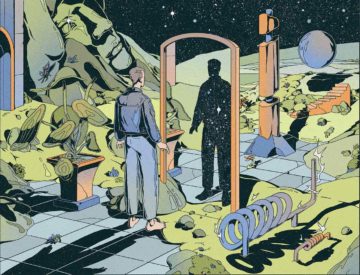 This attempt to imbue his texts with greater realism by rejecting the reality of his own literary vocation has been part of Cărtărescu’s methodology since the dark days of Ceauşescu’s pseudo-communist regime. In earlier works, this denial had taken the form of the verbatim publishing of his own journals and the attendant claim that he doesn’t live his life but rather “constructed” it. But Cărtărescu also gives his novel a gritty sense of realism through its setting as well as its bitter views of its protagonist. The Bucharest of Solenoid has the curious air of a building constructed according to Hitler and Albert Speer’s Theorie vom Ruinwert: namely with the aim of having it look better as it ages than when new-made. For decay is everywhere in the Bucharest of the counter-Cărtărescu. His city is an urban environment seemingly purpose-built to express impermanence and decay, one in which moldering old mercantile houses and newly built yet already decaying apartment buildings are rendered phantasmagorical by the nameless narrator’s wanderings through their chipped and spalling chambers. Repeatedly and elegiacally, the counter-Cărtărescu hymns the city of his birth as “the saddest city,” and just as the precision of his writing imbues a dream with great realism, so too does the crumbling nature of his hometown offer us fragments of material beauty—perhaps the very ones necessary to shore us up against our current ruination.
more here.
Life Evolves. Can Attempts to Create ‘Artificial Life’ Evolve, Too?
Shi En Kim in Scientific American:
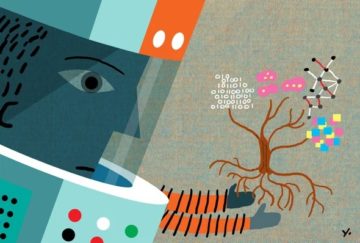 What is life? Like most great questions, this one is easy to ask but difficult to answer. Scientists have been trying for centuries, and philosophers have done so for millennia. Today our knowledge is so advanced that we can precisely manipulate life’s building blocks—DNA, RNA and proteins—to build biological machines and engineer new genomes. Yet despite all we know, no universal consensus currently exists on life’s fundamental definition.
The reason life’s definition still eludes us is simple: we know of just one type of life—the kind that exists on Earth—and it’s challenging to do science with a sample size of one. This is the so-called N = 1 problem (wherein “N” denotes the number of eligible candidates that scientists can study). No matter how ingenious researchers may be in divining life’s general principles from the single instance of which they’re sure, they have no way of confirming whether they’ve done so successfully until N increases. Searching for another instance of life—whether it’s found right here on Earth, elsewhere in the solar system or beyond—is one way to expand N. The search has scarcely begun, but it has already consumed billions of dollars and countless hours of labor, even though there is no guarantee that a discovery will ever come.
More here.