
Category: Recommended Reading
Ruminations in an Emergency: A new translation of Proust’s late masterpiece
Rebecca Porte in Bookforum:
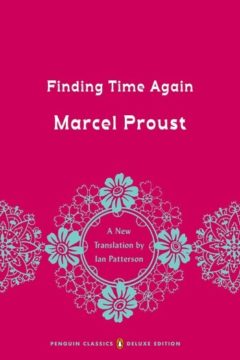 Patterson, a poet, essayist, and translator, has a good ear for the sonic qualities of the Recherche’s prose. This is particularly notable in the opening of the volume. Finding Time Again begins with one of Proust’s analogies between nature and artifice, couched in a meandering, multiclausal sentence that is, nonetheless, beautifully balanced in its Byzantine way, culminating in one of Proust’s classic, grammatical course corrections in which, after drifting away from the initial subject in a metaphorizing reverie, the sentence begins all over again without ending, usually after the nominal concession of a semicolon: “Toute la journée,” it begins, “all day long” as Patterson renders it, before describing the “slightly too bucolic residence” where the narrator finds himself,
one of those houses where every sitting-room looks like a conservatory and where, in the bedroom wall-paper, either the garden roses or the birds in the trees are brought vividly before you and keep you company, in a rather isolated way—it being of the old-fashioned sort in which each rose was so clearly delineated that if it were alive one could have picked it, each bird so perfect that it might have been caged and tamed, without any of the exaggerated modern décor in which, against a background of silver, all the apple trees of Normandy are arrayed in profile, Japanese-style, to turn the hours you spend in bed into a hallucinatory experience;
This takes us up to the semicolon, after which things start over: “all day long I stayed in my room.”
More here.
Engineered Bacterial “Syringes” Can Deliver Drugs Into Human Cells
Rohini Subrahmanyam in The Scientist:
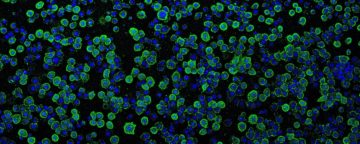 Sophisticated, effective drugs to treat diseases and other conditions aren’t any good if they can’t reach the part of the body or the specific cells that they’re designed to target. However, scientists have found a new way to deliver tiny proteins into specific cells, using small syringelike structures naturally found on certain bacteria. The study, published in Nature on March 29, could lead to better drug-delivery systems in medicine. “Delivery remains a critical bottleneck in medicine,” said study coauthor and MIT researcher Joseph Kreitz. “Although many powerful new therapies have been developed over the past several decades, we will need a deep bench of options to get these therapies into the right cells in the body.”
In the study, Kreitz, Broad Institute researcher Feng Zhang, and the rest of their team took inspiration from nature, relying on tiny microbes that have found a way around this problem. Endosymbiotic bacteria, or bacteria that depend on their host cells for survival, have developed tools such as the extracellular contractile injection system (eCIS), in which the bacteria use tiny syringelike nanomachines to inject protein payloads into their host cells. The host cells, in the case of the bacterium Photorhabdus asymbiotica, are the cells lining the gut of nematodes. In the new study, Zhang and the team re-engineered these so-called nanosyringes from Photorhabdus to target and deliver a wide variety of proteins into human and animal cells.
More here.
Friday Poem
Those Who Take the Meat From the Table
Teach contentment,
Those for whom the taxes are destined
Demand sacrifice.
Those who eat their fill speak to the hungry
Of wonderful times to come.
Those who lead the country into the abyss
Call ruling too difficult
For ordinary men.
by Bertolt Brecht
from Selected Poems Bertolt Brecht
Harcourt Brace, 1947
Thursday, April 20, 2023
The Sound Of Home: “Sonorous Desert” By Kim Haines-Eitzen
Leanne Ogasawara in The Rumpus:
 In Jo Walton’s 2019 fantasy novel Lent, Renaissance friar Girolamo Savonarola goes around Florence using his gift of prophecy to root out and banish demons. They do not exactly hide from him. Loud and in his face, the demons are detected first and foremost by their cacophony. Boldly bellowing in his ears, they are impossible for him to ignore. It is a swarming shrieking that fills up all the space in the rooms in which he finds himself.
For Savonarola, hell is an assault of sound.
In her new book, Sonorous Desert: What Deep Listening Taught Early Christian Monks—and What It Can Teach Us, Kim Haines-Eitzen thinks about the way hermits and monks in antiquity used to take to the hills and flee to the desert to remove themselves from the noise of everyday life; for in the midst of the city, how can a person hear the voice of God?
It wasn’t just the Christian mystics and desert fathers either. The Stoic philosopher Seneca described in great detail the noises coming from a bathhouse just below the room where he was writing, expressing his irritation at the distracting “babel” all around him.
More here.
Daniel Kahneman and Matthew Killingsworth resolve a debate
Matthew A. Killingsworth, Daniel Kahneman, and Barbara Mellers in PNAS:
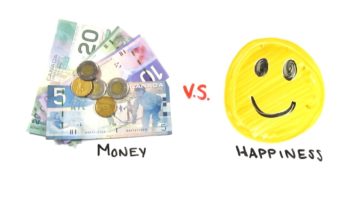 Can money buy happiness? Two authors of this article have published contradictory claims about the relationship between emotional well-being and income. We later agreed that both studies produced valid results and that it was our responsibility to search for an interpretation that explains both findings. We engaged in an adversarial collaboration and asked Barbara Mellers to be the facilitator. This article reports the outcome of our work.
More here.
Bill Gates on education, technology, and almost everything in between
Why do mass shooters kill?
Arie Kruglanski in The Conversation:
 The year 2023 is still young, and already there have been at least 146 mass shooting events in the U.S. on record, including the killing of five people in a Louisville, Kentucky, bank that the shooter livestreamed. There were 647 mass shootings in 2022 and 693 in 2021, resulting in 859 and 920 deaths, respectively, with no respite in sight from this ghastly epidemic. Since 2015, over 19,000 people have been shot and wounded or killed in mass shootings.
In the wake of most shootings, the news media and the public reflexively ask: What was the killer’s motive?
As a psychologist who studies violence and extremism, I understand that the question immediately pops to mind because of the bizarre nature of the attacks, the “out-of-the-blue” shock that they produce, and people’s need to comprehend and reach closure on what initially appears to be completely senseless and irrational. But what would constitute a satisfactory answer to the public’s question?
More here.
“But Where’s Its Anus?”: On Alien Lifeforms
Jaime Green at LitHub:
 I first read Carl Sagan’s Contact and Cosmos in high school, when I was working at a bookstore that let us borrow any book we had at least two copies of on the shelves. I loved them then and was excited to revisit these books in the course of my research for The Possibility of Life. A scene from Cosmos had stayed with me—and confounded me—for almost twenty years, and I was ready to make new sense of it. But when I got to the place in the book where the scene should have been, the chapter just ended.
Luckily, I was reading an e-book, so I could search anus… Zero results.
Let me explain.
The scene I remembered is in a classroom—I don’t know if Sagan was teacher or student—and the class is split into groups, each tasked with designing an alien life-form. The professor looks at their anatomy sketches and chides, “Where’s its anus?” What had haunted me across the decades was my confusion: Was the professor closed-minded, or were the students being careless?
more here.
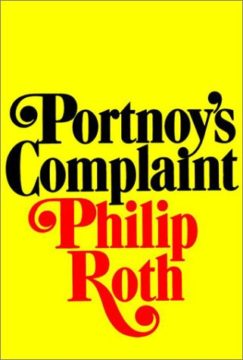
Philip Roth Unbound
Simone Giertz: Queen of Shitty Robots
US could soon approve MDMA therapy — opening an era of psychedelic medicine
Sara Reardon in Nature:
 For Rick Doblin, 2023 could be a landmark year: the year that the US government decides whether it will allow the use of hallucinogenic drugs to treat mental illness.
Doblin, who is based in Belmont, Massachusetts, is the founder and president of the non-profit organization Multidisciplinary Association for Psychedelic Studies (MAPS). He has spent nearly 40 years researching whether the experience produced by the psychedelic drug MDMA — also called ecstasy or molly — can help people with post-traumatic stress disorder (PTSD). In 2021, MAPS’s phase III clinical trial of 90 people with PTSD found that those who received MDMA coupled with psychotherapy were twice as likely to recover from the condition as were those who received psychotherapy with a placebo1 (see ‘Response to MDMA therapy’).
More here.
There Is Plastic in Our Flesh
Mark O’Connell in The New York Times:
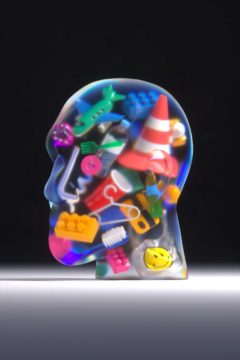 There is plastic in our bodies; it’s in our lungs and our bowels and in the blood that pulses through us. We can’t see it, and we can’t feel it, but it is there. It is there in the water we drink and the food we eat, and even in the air that we breathe. We don’t know, yet, what it’s doing to us, because we have only quite recently become aware of its presence; but since we have learned of it, it has become a source of profound and multifarious cultural anxiety.
Maybe it’s nothing; maybe it’s fine. Maybe this jumble of fragments — bits of water bottles, tires, polystyrene packaging, microbeads from cosmetics — is washing through us and causing no particular harm. But even if that were true, there would still remain the psychological impact of the knowledge that there is plastic in our flesh. This knowledge registers, in some vague way, as apocalyptic; it has the feel of a backhanded divine vengeance, sly and poetically appropriate. Maybe this has been our fate all along, to achieve final communion with our own garbage.
More here.
Thursday Poem
This, in my imagination, is the moment Robert Burns
turns to the life of poetry. —Nils Peterson
A Kind of Biography
All night the language dog
gnaws at the meaning bone.
Soon the sea begins
to question its shuffling
from East to West, and the stars
their vast, ordinary circuits.
So my friend has fled into his father’s fields.
He leans against a fence
and wonders what the ant means
and the moonlight grasses as they bend
and spread and flow beneath
a wind whose beginning seems obscure
and whose end, uncertain.
He notices that something of himself
has set off with the wind
and that he is now two.
He wonders at his doubleness.
Back home, he sits in the kitchen,
an ordinary boy watching
his mother cook breakfast,
but something of him is in
another place, and some other thing
Is with him even here.
by Nils Peterson
from The Dear Time of Our Talking
Frog On The Moon Press, 2020
Wednesday, April 19, 2023
In the Thrall of Duras
Ivone Margulies at The Current:
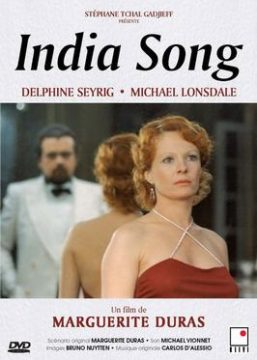 Marguerite Duras’s India Song is a hypnotic chant d’amour, a release system for the author’s polyphonic writing, and one of the most beautiful films in cinema history. In its extended central scene, at a French Embassy reception in Calcutta, four Cerruti 1881–clad men dance with and flit around a beguiling red-haired woman (Delphine Seyrig). Mesmerized, we join an unseen audience that speaks for and about these characters as they glide silently into the realm of legend. Filled with haunting rumbas and pierced by scandalous cries, this mirrored salon and its ghosts stay with us long after the film’s end.
Upon its release in 1975, Duras’s tale of doomed passion defied conventional cinema with its antinaturalist aesthetic, anachronistic setting, and unrepentantly Romantic stance. With its glamorous and compact theatricality, Duras’s work shared with her contemporaries Jacques Rivette, Manoel de Oliveira, and Jean-Marie Straub and Danièle Huillet a disregard for generic borders.
more here.
The Groundbreaking Art Of Lucie Rie
Ali Smith at The New Statesman:

On yet another of the many days we’re living through in which our government sends out poisonous, divisive and powermongering rhetoric about disallowing entry in the UK to refugees, especially those endangered people brave enough to arrive in small boats, I went to see the Lucie Rie exhibition, “The Adventure of Pottery”, at Kettle’s Yard in Cambridge. Rie, an international prizewinner when she was only in her thirties, had been ploughing an original furrow against the grain of ceramic design expectations in Vienna in the 1930s. She trained at the city’s Kunstgewerbeschule but made work like no one else, based on her own experiments on ancient Roman pots she’d seen in the vineyard of an uncle, and in her determination to make and use glazes her tutor had told her were impossible.
She arrived in England from Vienna as an Austrian Jewish fugitive from Hitler’s fascism in 1938 with a suitcase full of the pots she’d made wrapped in her clothes.
more here.
The Ceramic Presence in Modern Art
Revisiting Bruno Schulz
Leo Lasdun in The Millions:
 In Humboldt’s Gift, Saul Bellow’s roman à clef about his turbulent friendship with the poet Delmore Schwartz, the Bellow stand-in muses that “all the highly gifted see themselves shunted for decades onto dull sidings, banished exiled nailed up in chicken coops. Imagination has even tried to surmount the problems by forcing boredom itself to yield interest.” He goes on to name Joyce, Stendhal, Flaubert, and Baudelaire as a few sultans of solitude. If he’d wanted to sell it even harder, he might have tacked on the Jewish-Polish writer and artist Bruno Schulz. Unearthed again in a new biography by Benjamin Balint, Schulz was hamstrung by boredom and loneliness. Twice denied a paid leave of absence (which he requested in order to focus on his writing) from his job as a school teacher, and later boxed into a Jewish ghetto, Schulz spent nearly his entire life in Drohobycz, where he was born in 1892. The small slippery city has changed management a number of times: for most of Schulz’s adulthood, Drohobycz was part of Poland, before that Austria-Hungary, now it’s part of Ukraine (spelled Drohobych). Except for some short trips, Schulz never left his hometown, and he became well acquainted with isolation. In his own words, “loneliness is the catalyst that makes reality ferment”; in Balint’s words, Schulz “made of his solitude a way of seeing.”
More here.
Sean Carroll’s Mindscape Podcast: Hugo Mercier on Reasoning and Skepticism
Sean Carroll in Preposterous Universe:
 Here at the Mindscape Podcast, we are firmly pro-reason. But what does that mean, fundamentally and in practice? How did humanity come into the idea of not just doing things, but doing things for reasons? In this episode we talk with cognitive scientist Hugo Mercier about these issues. He is the co-author (with Dan Sperber) of The Enigma of Reason, about how the notion of reason came to be, and more recently author of Not Born Yesterday, about who we trust and what we believe. He argues that our main shortcoming is not being insufficiently skeptical of radical claims, but of being too skeptical of claims that don’t fit our views.
More here.
Feudalism by Design: On Quinn Slobodian’s “Crack-Up Capitalism”
Jodi Dean at the Los Angeles Review of Books:
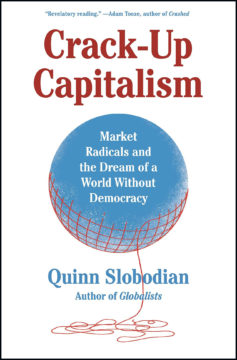 At a rally in 2019, California Assembly Speaker Anthony Rendon announced, “When you hear about folks talking about the new economy, the gig economy, the innovation economy, it’s fucking feudalism all over again.” Rendon was there to support legislation classifying most gig workers as employees rather than independent contractors. Assembly Bill 5 was intended to bring gig workers under the protection of existing California labor laws, and the bill passed. But the following year, California voters chose feudalism: they approved Proposition 22, a ballot measure heavily funded by Uber, Lyft, DoorDash, and Instacart, that would exempt app-based drivers from the labor protections that Assembly Bill 5 tried to secure. In March 2023, a state appellate court upheld Prop 22. By making exceptions for the big transportation and delivery apps, by saying that employment laws do not apply to them, California is entrenching the labor relations—the feudalism—that Rendon warned against.
More here.