
Category: Recommended Reading
Larry Mahan (1943 – 2023) Rodeo Cowboy
https://www.youtube.com/watch?v=VJlLRm2IvaU&ab_channel=MyRetroShare
Saturday, May 20, 2023
A photo essay to mark the 75th anniversary of the Nakba
 Nadia Saah in Jewish Currents:
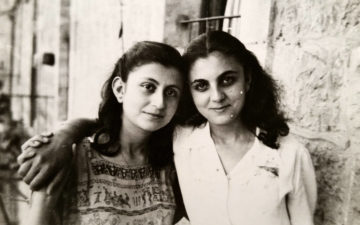
THIS PHOTOGRAPH IS OF MY MOTHER NINA, on the left. Her given name was Therese Yousef Saad, but her family called her Theresina because she was tiny and adorable—and she remained that way until her death in 2017. She is standing next to her cousin Leila on the balcony of her family’s home in Jerusalem. It is 1947, and she is engaged to my father Issa. (They would not marry until 1963. But that’s another story.) The photo conveys a deep intimacy: my mother’s easy grip on Leila’s hand; their closeness; the depth and warmth of my mom’s almond eyes. She is looking right at you, and at me. She is letting us in.
One year later, the Nakba ended her life in Palestine. I know that my mom and her family fled on a truck to As-Salt, Jordan, in May of 1948, and for a year and a half the six of them—she and her mother Lily, her father Yousef, her sisters Diana and Irma, and her baby brother Mattia—lived together in one room, over a barn. I know that on their first night they cried as they ate their dinner on the floor. And that the walls shook every time a horse kicked below them. I know that my mother prayed for their return to Jerusalem, until the day that she climbed the tallest hill in As-Salt to witness the waves of Palestinian refugees walking toward her with their belongings on their backs.
I will never know the full extent of what happened to my mother in the Nakba, but I can tell you that during the 47 years that I knew her, I never once saw this look in her eyes.
More here.
Green Capitalism and the Pitfalls of Climate Finance
 An interview with Adrienne Buller over at The Syllabus:
What is green capitalism and what are its goals and aspirations? Who are its cheerleaders, both in terms of institutions and actual individuals?
At its core, green capitalism is about rendering our response to climate and ecological crisis into a form that is compliant with market-based mechanisms. That sounds very simple. That is fundamentally all it really is. But how it plays out is often messier than it sounds.
Green capitalism is about finding a way to wedge all of the complexity of addressing climate and ecological crisis through the prism of the market. That requires finding prices for things, whether carbon or other forms of natural capital, and finding ways to adjust our financial modeling. The market seeks to bring forward neutral arbitration between market actors in pursuit of profit, and then views this as somehow inherently aligned with positive outcomes like curbing emissions or addressing biodiversity loss.
My first experience with green capitalism came from working at a nonprofit that helped private financial firms optimize their role in the green transition. The sustainable finance industry was a window into this clear mindset about how to address climate and ecological crisis: by making small, market-led tweaks, and by resisting the supposed messiness of politics.
Its advocates are everywhere. The finance industry itself is, in my view, the vanguard of this idea. You’ve got champions like Larry Fink, the CEO of BlackRock, as the poster child. But it’s also present in all kinds of European climate governance. The EU’s Green Deal is an archetypal policy program of green capitalism. As is the Inflation Reduction Act (IRA) in the US, which tries to crowd in market actors and find ways to make climate investments desirable for the private sector and its clients. It really is the predominant framework with which most policymakers, at least in the Global North, are forging ahead.
More here.
Is Multiculturalism an Oxymoron? On Martin Puchner’s “Culture”
 Robert N. Watson in LA Review of Books:
IN VERMONT, 25 years ago, I walked past a business whose sign read, “Amalgamated Culture Works.” My first thought was, “No, it doesn’t.”
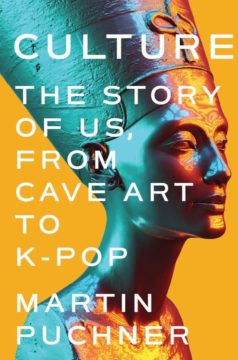
Martin Puchner thinks it does—and explains why in his wonderful new book. Culture: The Story of Us, from Cave Art to K-pop deploys the histories of a vast range of times and places to convince our culture-warring world that amalgamation can work very well. The “us” of the subtitle signals Puchner’s intention: in an era of atomizing identity politics, deployed by both the radical left and right, he wants readers to recognize the many historical instances when cross-cultural transmission has been—and still can be—beneficial, rather than larcenous or contaminating.
A twofold thesis unifies the book. One is that the leftist ban on “cultural appropriation” entails a misunderstanding of the way cultures can appreciate (in both senses) when they meet, rather than merely collide. This seems true: if I think your dinner order looks excellent, and therefore decide to order the same menu item, that is very different from sticking my fork into your plate and gobbling a chunk of your entrée. Puchner’s other thesis is that the conservative aversion to immigration and multiculturalism whitewashes the wonderfully multicolored patchwork of human history. He shows that those who reach across cultures can be heroic rather than invasive, arrogant, or exploitative.
The “story” part of the subtitle matters almost as much as the “us” part. Puchner vividly recounts many times when the importation of a foreign story has positively transformed a culture.
More here.
Interrogating the Complexities of the Tumor Microenvironment
Alison Halliday in The Scientist:
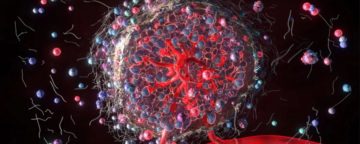 Cancer cells don’t exist in isolation – instead, they live within a complex ecosystem that also includes immune cells, stromal cells, the extracellular matrix, blood vessels and many other factors. The components of the tumor microenvironment constantly interact and influence each other, which can affect tumor behavior in either positive or negative ways.
“Tumor cells can take advantage of their surrounding microenvironment – by co-opting nutrients and blocking immune surveillance and the host response. But importantly, the tumor microenvironment can also curtail tumor growth and prevent metastasis,” says Janis Taube, professor of dermatology and pathology and co-director of the Mark Foundation for Advanced Genomics and Imaging at Johns Hopkins University, Baltimore. “It’s a double-edged sword – and so it’s all about getting the balance right and trying to tip it more in favor of the host than the tumor.”
Given the diversity of cell types and molecules that form the tumor microenvironment, it is necessary to apply a systems biology approach to study it.
More here.
Trump the Defamer
Rafia Zakaria in The Baffler:
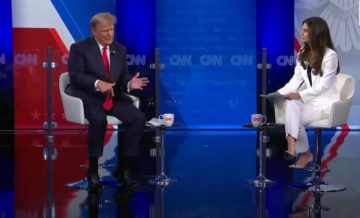 THE DAY AFTER a Manhattan jury held Donald J. Trump liable for sexually abusing and defaming writer E. Jean Carroll nearly three decades earlier, the former president came out swinging on a CNN broadcast from St. Anselm College in New Hampshire. “She’s a whack job,” he said. “This is a fake story, a made-up story,” he insisted. The paltry bit of feminist satisfaction I and millions of other American women had felt when the verdict came down suddenly seemed transitory. How much of a victory was the verdict if the perpetrator could come out with statements like this mere hours after it was delivered?
The jury of six men and three women had awarded Carroll $5 million in damages, including almost $3 million for the reputational damage she suffered by the former president’s public statements against her. Another $2 million was awarded because the jury believed the evidence that Trump had sexually abused Carroll at an encounter at a department store in New York City. Appearing on MSNBC, Carroll called the verdict a victory for all women because “we did away with the perfect victim concept.” That imaginary perfect victim, Carroll added, “always screams” and “writes the date in her diary.”
More here.
Bruno Schulz Biography
Joe Moshenska at The Guardian:
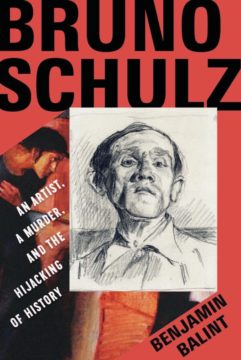 Reading Schulz’s works, it’s easy to see why he might have had such an effect on this array of creative minds. His stories defy description, explication, paraphrase. They are set in a phantasmagoric version of the city of Drohobycz (now in western Ukraine), where Schulz was born and died, and largely in and around the cloth shop on the market square that his parents owned, but in a version of these places where time and space have become molten and malleable. They take place in “years which – like a sixth, smallest toe – grow a 13th freak month” in “an illegal time… liable to all kinds of excesses and crazes”. The narrator’s father – a looming, manic, tragicomic version of Schulz’s own – at one point wastes away to nothing, leaving only “the small shroud of his body” and “a handful of nonsensical oddities”; at another he morphs into “a monstrous, hairy, steel blue horsefly”, a development that the narrator takes in his stride as just one of many “summer aberrations”. The stories read like the quintessence of the human imagination in its densest, strangest form, as if his language were a thick, sweet concentrate of the creativity that other writers dilute to a sippable weakness.
more here.
Saturday Poem
Sure There Is Food
There is eating one’s self
There is even truth now and then—
Of course a lie can be made to go
Farther that way
The trick is to get truth and lies
To sound just the same
That way you’ve got it made
Everybody is mad after a while
Then you can come up with a world
where madness is the normal thing
Of course those who rig it that way
End up mad themselves
But—who’s to know the difference?
This world’s the best example I know
by Kenneth Patchen
from Collected Poems, 1968
From War To Music
Dwight Garner at the New York Times:
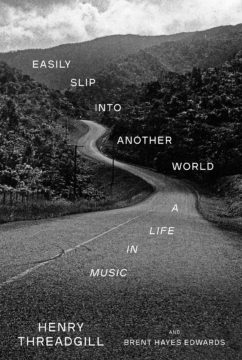 It’s rare to come across a new Vietnam War memoir from a major publisher in 2023. Most were written decades ago, when memories were fresh and wounds still raw. That generation of soldiers has begun to pass away.
Henry Threadgill’s “Easily Slip Into Another World” is an unusual entrant in the genre. For one thing, this astringent book is only in part about his war experience. The remainder is about his rebellious childhood in Chicago during the 1950s, his apprenticeship in that city’s pyretic music scene and — later, after the war — his variegated career as a composer, saxophonist and flutist touring the world and becoming, along with Ornette Coleman and Wynton Marsalis, one of the few jazz artists to have won a Pulitzer Prize.
There’s more here than an insane war story, in other words.
more here.
Henry Threadgill’s Zooid
Friday, May 19, 2023
El Salvador’s brutally effective gang crackdown is creating a dangerous new model for aspiring autocrats
Francisco Toro in Persuasion:
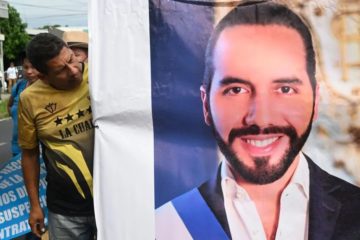 The most dangerous political experiment in Latin America is underway in El Salvador. A strange breed of populism is tipping the scale in the region’s age-old tug of war between authoritarianism and democracy. Rather than dividing the country, like populism usually does, it’s uniting it solidly behind a new consensus. More than anything, though, it’s succeeding, and doing so in the kind of impossible-to-miss way that turns heads up and down the hemisphere.
At the top of it all is the self-described “coolest dictator in the world,” the startlingly energetic Nayib Bukele. Having rounded up tens of thousands of suspected gang members in a series of police and military actions that don’t even pay lip service to due process of law, Bukele has become something of a national hero, with approval ratings now north of 90%. Under his watch, one of the most violent countries on earth has become considerably safer: a startling transformation that nearly all Salvadoreans seem profoundly grateful for.
More here.
Why colour is in the eye of the beholder
James Fox in The Guardian:
 For a long time, people believed that colours were objective, physical properties of objects or of the light that bounced off them. Even today, science teachers regale their students with stories about Isaac Newton and his prism experiment, telling them how different wavelengths of light produce the rainbow of hues around us.
But this theory isn’t really true. Different wavelengths of light do exist independently of us but they only become colours inside our bodies. Colour is ultimately a neurological process whereby photons are detected by light-sensitive cells in our eyes, transformed into electrical signals and sent to our brain, where, in a series of complex calculations, our visual cortex converts them into “colour”.
More here.
Jim VandeHei on how to write less but say more
These four challenges will shape the next farm bill – and how the US eats
Kathleen Merrigan in The Conversation:
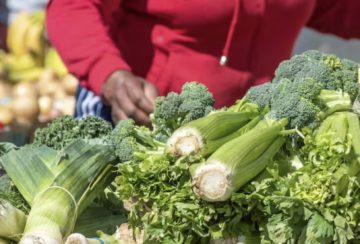 For the 20th time since 1933, Congress is writing a multiyear farm bill that will shape what kind of food U.S. farmers grow, how they raise it and how it gets to consumers. These measures are large, complex and expensive: The next farm bill is projected to cost taxpayers US$1.5 trillion over 10 years.
Modern farm bills address many things besides food, from rural broadband access to biofuels and even help for small towns to buy police cars. These measures bring out a dizzying range of interest groups with diverse agendas.
Umbrella organizations like the American Farm Bureau Federation and the National Farmers Union typically focus on farm subsidies and crop insurance. The National Sustainable Agriculture Coalition advocates for small farmers and ranchers. Industry-specific groups, such as cattlemen, fruit and vegetable growers and organic producers, all have their own interests.
More here.
Josh Tenenbaum: Scaling AI the Human Way
What Johnny Depp Has Become
Stephanie Zackarek in Time:
 The aging process is kind to no one, and that includes Johnny Depp.
On Tuesday, Depp was here in Cannes to walk the red carpet for the festival’s opening night film, Maïwenn’s misunderstood-mistress extravaganza Jeanne du Barry, in which Depp plays King Louis XV, whose devotion to his favorite extramarital squeeze brought scandal upon Versailles. When it was announced that a Depp film would be opening the festival, murmurs of “Sacre bleu!” were heard far beyond the kingdom, though perhaps not so much in France: the festival itself has opened its arms wide to Depp, who hasn’t exactly been untouched by controversy in the past few years, given his involvement in two high-profile defamation suits connected with allegations that he physically abused his former wife, Amber Heard. (The jury ruled that Heard defamed Depp on three counts and awarded him $15 million in damages; Depp was found guilty of one of three charges in Heard’s countersuit and she was awarded $2 million in compensatory damages.)
More here.
Friday Poem
On Visiting Central Park Zoo
The animals, hanging around in forms,
are each resigned to be what each one is,
imprisoned twice, in flesh first, then in irons.
The Bactrian camel is adjusted or is not
as, with his humps collapsed for lack of need
for water and with useless tufts of hair
like hummocks on the great plains of his flanks,
he stands around in shape and chews
a curd of solace, whether bitter, bland, or sweet,
who knows? Such is his formal pride,
his gargoyle’s face remains a stone
assertion as he pisses in between his splayed,
seemingly rachitic legs and stays
that way, in place, for want of something else
to do, caught in his double prison all the time.
Whatever he is, he goes on being what he is,
although ridiculous in forced review,
perseverant in not doing what he need not do.
by Alan Duggan
from New and Collected Poems
Ecco Press, New York, 1983
Unmixed Blessing: crops that can be propagated indefinitely, without sex
Erik Stokstad in Science:
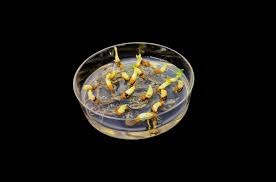 In early summer, unusual pollinators swoop over rice fields in Texas and Arkansas. Small, nimble helicopters fly low and steady so their rotors blow pollen from one row of plants to another. The flights help RiceTec, a plant breeding company, produce seed for high-yielding, robust varieties of rice grown across the southern United States. It’s an expensive and complicated way to create seed.
But the effort is worthwhile because the seeds sprout into plants with a mysterious robustness and resilience. The phenomenon, called hybrid vigor, comes from crossing two strains of inbred parents. Why hybrids are superior to normal plants is not clear, but one long-standing hypothesis is that favorable versions of genes from one parent dominate poor-performing, recessive genes from the other.
The development of hybrid varieties has boosted the yield of maize, sorghum, and other crops by up to 50% and has resulted in other valuable traits, such as better drought tolerance. But the method is only feasible in some species; there’s no practical way to produce hybrid wheat or soybeans, for example. And when it works, it’s extremely labor intensive.
More here.
On Chuck Berry
Ian Penman at Harper’s Magazine:
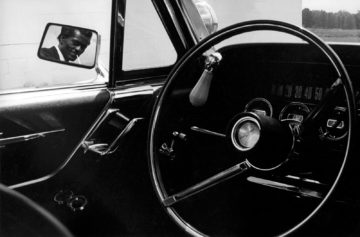 Berry never claimed that he invented rock and roll, and was always quite happy to point out where he’d gotten his inspiration: from the great hinterland and invisible college of rhythm and blues. He happily fessed up to his influences, such as Louis Jordan and T-Bone Walker. There was a lot of guilt-free recycling involved—transplanting a riff or a lick, a line or a trope, into fresh new settings. (Jordan’s guitarist Carl Hogan was the source for the famous opening guitar riff of “Johnny B. Goode.”) Even the execrable (but insanely popular) late hit “My Ding-A-Ling” was a virtual xerox of a roiling 1952 R & B side by the marvelous Dave Bartholomew. He tinkered, customized, and retooled songs as if giving an old car a new coat of paint, adding horsepower, then taking them back out on the open road again.
What he did do, indisputably, was visualize a whole new postwar landscape, and provide a soundtrack for its leisure time: a hybrid somewhere between white pop and black R & B. Smith has a lovely phrase for this: “Scraps and rags and things given away for free were pulled together and made into a brand new flag.”
more here.