 A Boston Review Forum, with a lead piece by Christine Sypnowich:
The last decade has delivered increasingly bleak portraits of vast inequalities in income, wealth, health, and other measures of well-being in many rich capitalist countries, from the United States to the United Kingdom. What should we do about them?
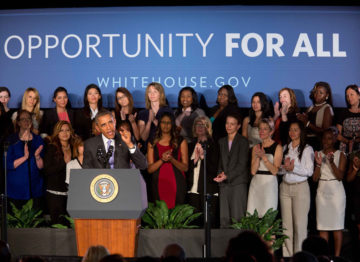
One common response is to argue that inequalities are only a problem to the extent that they reflect unequal opportunities. Economist Jared Bernstein—a longtime advisor to Joe Biden, now a member of the White House Council of Economic Advisers—expressed this view clearly in 2014 when he stated, “Opportunity and mobility are the right things to be talking about. . . . We always have inequality, and in America we’re not that upset about inequality of outcomes. But we are upset about inequality of opportunity.” Accordingly, in his first executive order as president, Biden proclaimed that “equal opportunity is the bedrock of American democracy.” For his part, British Labour leader Keir Starmer has stated his party’s aim should be to “pull down obstacles that limit opportunities and talent.” And Prime Minister Justin Trudeau has intoned that in Canada, where I live, “no matter who you are . . . you have every opportunity to live your life to its fullest potential.”
These statements are typical. In much of the West the tendency is to see equality as a matter of fairly distributed opportunities and to view an interest in outcomes as unreasonable, naïve, or even authoritarian. A similar focus on equality of opportunity is evident in the dominant strain of political philosophy in the Anglo-American world, liberal egalitarianism. In short, the prevailing political common sense tends to converge on the assumption that our egalitarian aspirations are realized once we have ensured equality of opportunity.
I think this view is seriously mistaken.
More here.

 Stephen Mulhall in the London Review of Books:
 Twice, quarterback Patrick Mahomes has led the Kansas City Chiefs to victory in the Super Bowl, the pinnacle of U.S. football. Although most fans have their eyes on the ball as Mahomes prepares to throw, his tongue does something just as interesting. Just as basketball star Michael Jordan did as he went up for a dunk, and dart players often do as they take aim for a bull’s-eye, Mahomes prepares to pass by sticking out his tongue. That may be more than a silly quirk, some scientists say. Those tongue protrusions may improve the accuracy of his hand movements.
 Ah, the magical season of prizes is once again upon us. Each spring brings, along with warm rains and budding flowers, Fulbrights, Rhodeses, Pulitzers and Guggenheims, as well as Oscars, Tonys and Indies — which are thought of so fondly they come with their own nicknames. Everybody, it seems, loves honors and prizes. And they certainly make for great entertainment. The award ceremonies for literary prizes are usually demure, decorous little things, but award shows on TV are like a country music hoedown. And the Oscars rank so high in the culture that actors measure their worth by rehearsing their acceptance speeches.
 W
W The great French writer Colette once speculated that “certain highly complex human beings” are marked by their “mental hermaphroditism.” The fabled essayist Susan Sontag was among them. She was a woman, but she dressed in the glamorously genderless garb of an intellectual celebrity and wrote on the weighty topics usually reserved for her male peers. In her journals, she mused that “to be an intellectual is to be attached to the inherent value of plurality.”
 When
When  Researchers are inching closer to mass-producing eggs and sperm in the lab from ordinary human cells. The technique could provide new ways to treat infertility but also open a Pandora’s box.
 After 35 years of living in relative control of my decisions, I had decided to see what would happen if I asked AI to control my life instead. Years of suboptimal performance, both personally and professionally, and numerous failed attempts at self-improvement had convinced me there had to be a better way, and I wondered if the collective knowledge hidden inside OpenAI’s hit tech product could help me. But when I asked Sam Altman’s ChatGPT to become my all-powerful leader, it seemed reticent, at least at first.
 A new generation of drugs is revolutionizing the treatment of obesity and
  Coming up with economic policy is a difficult, unforgiving task. To make the best of it, it helps to work with an accurate model of how the economy works. If you use a misleading model and act on it, you can’t reasonably expect good outcomes: in that scenario, we end up, as JM Keynes warned in the 1930s, with “madmen in authority”, acting according to the precepts of “some defunct economist”.