
Vikram Murthi at The Nation:
 The premise of Paul Schrader’s Master Gardener is, on paper, a provocation: A reformed white supremacist, living a secluded life in witness protection after flipping on his crew, falls in love with a young biracial woman during a period of shared crisis. The man in question, Narvel Roth (Joel Edgerton), toils away as a horticulturist employed by the estate of a wealthy, childless dowager, Mrs. Haverhill (Sigourney Weaver). His steadfast commitment to her land, and to the diurnal rhythms of gardening, helps him preserve order in his own life after spending much of it dedicated to death. In Narvel’s eyes, it’s an act of penance to give back to the earth with the same hands he previously used to poison it.
When Haverhill insists that Narvel take on her estranged grandniece Maya (Quintessa Swindell) as an apprentice, he cautiously agrees at first, but after warming up to her, he eventually sees it as another opportunity for atonement.
more here.
 Setsuko Nakamura was 13 years old when the atomic bomb hit Hiroshima.
 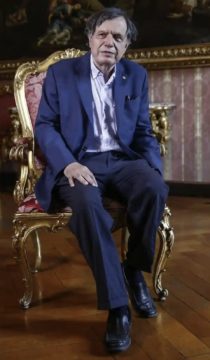 The multi-prize-winning theoretical physicist Giorgio Parisi was born in Rome in 1948. He studied physics at the Sapienza University in the city, and is now a professor of quantum theories there. A researcher of broad interests, Parisi is perhaps best known for his work on “spin glasses” or disordered magnetic states, contributing to the theory of complex systems. For this work, together with Klaus Hasselmann and Syukuro Manabe,
  The war in Ukraine has resurrected the ultimate technocratic fantasy: a winnable nuclear war. Intellectuals at the Hoover Institution are urging American strategists to “think nuclearly again,” reestablishing the idea that nuclear weapons are tools to assert U.S. primacy over Russia and China. This isn’t just talk. The Bulletin of the Atomic Scientists recently noted “steadily increasing U.S. bomber operations in Europe”—some near the Russian border. Though most Americans are unaware of it, escalation toward nuclear conflict is already under way.
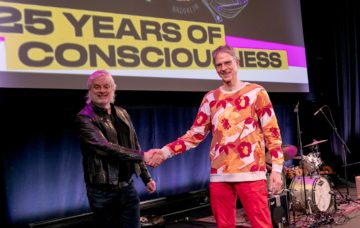 A 25-year science wager has come to an end. In 1998, neuroscientist Christof Koch bet philosopher David Chalmers that the mechanism by which the brain’s neurons produce consciousness would be discovered by 2023. Both scientists agreed publicly on 23 June, at the annual meeting of the Association for the Scientific Study of Consciousness (ASSC) in New York City, that it is still an ongoing quest — and declared Chalmers the winner. What ultimately helped to settle the bet was a key study testing two leading hypotheses about the neural basis of consciousness, whose findings were unveiled at the conference. “It was always a relatively good bet for me and a bold bet for Christof,” says Chalmers, who is now co-director of the Center for Mind, Brain and Consciousness at New York University. But he also says this isn’t the end of the story, and that an answer will come eventually: “There’s been a lot of progress in the field.”
 Two new drugs for treating obesity are on course to become available in the next few years — and they offer advantages beyond those of the
  Those of us who revere Octavia Butler’s work and have never stopped mourning her passing do so in part, I suspect, because we know that no matter what happens in this Universe there will never be anyone like Butler again—not as a person and certainly not as an artist. Like Toni Morrison, Butler was a literary eucatastrophe, (a sudden and miraculous grace: never to be counted on to recur), a literary Kwisatz Haderach (Butler loved Dune) that occurs so very rarely in a culture and only if it is lucky.
 It’s somewhat amazing that cosmology, the study of the universe as a whole, can make any progress at all. But it has, especially so in recent decades. Partly that’s because nature has been kind to us in some ways: the universe is quite a simple place on large scales and at early times. Another reason is a leap forward in the data we have collected, and in the growing use of a powerful tool: computer simulations. I talk with cosmologist Andrew Pontzen on what we know about the universe, and how simulations have helped us figure it out. We also touch on hot topics in cosmology (early galaxies discovered by JWST) as well as philosophical issues (are simulations data or theory?).
 Ecological collapse is likely to start sooner than previously believed, according to a new study that models how tipping points can amplify and accelerate one another.
 ‘G
‘G In “Planta Sapiens,” Paco Calvo, a philosopher of plant behavior, and his co-author, Natalie Lawrence, present the idea that flora are intelligent — that is, capable of cognition. In Calvo’s opinion, people pay more attention to animals than plants and this may explain why some of plants’ remarkable abilities have been overlooked. Our evolutionary history may also shape our reduced attention to the subject; plants are, after all, unlikely to attack people.