
Barbara Spindel in The Christian Science Monitor:
 After Betty Friedan got her Smith College classmates to complete a questionnaire about their lives at their 15th reunion in 1957, she immediately grasped the significance of their responses. Many of the highly educated women felt trapped by midcentury America’s constrictive domestic ideals, unfulfilled by the roles of housewife and mother. Friedan, a freelance writer and a wife and mother herself, was unable to interest any magazines in publishing her findings. She instead embarked on writing “The Feminine Mystique,” the explosive and groundbreaking book whose 1963 publication turned its author into a celebrity and, more significantly, is credited with igniting the second wave of the feminist movement.
Women’s rights as human rights
Rachel Shteir’s brisk, compelling biography, “Betty Friedan: Magnificent Disrupter,” conveys the enduring importance of her subject’s signature work, which excavated the quiet desperation of a primarily white and middle-class subset of American women. In describing what she famously called the “problem that had no name,” Friedan, according to Shteir, “laid the groundwork for women’s rights to be regarded as a civil right,” a notion that while taken for granted today was hardly obvious at the time.
More here.
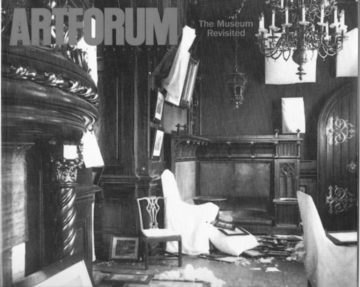 For someone working in the culture industries, the only thing worse than having the wrong position on a political controversy is having no position at all. Today’s artists are the high priests of the secular middle classes, with cathedrals (art galleries) in every major city. In recent years, rather than defend free expression and the exploration of
 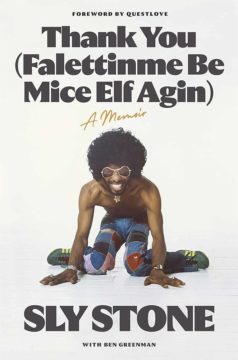 One thing that remains intact for Stone at age 80 is the sense of wordplay and fun-house language that distinguished his lyrics (read the song/book title out loud), and some of the biggest pleasures in “Thank You” come when we witness him teasing out a theme. His response to other people telling his story and analyzing his struggles: “They’re trying to set the record straight. But a record’s not straight, especially when you’re not. It’s a circle with a spiral inside it. Every time a story is told it’s a test of memory and motive. … It isn’t evil but it isn’t good. It’s the name of the game but a shame just the same.”
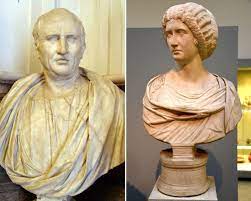 Spanning from 625 BCE to 476 CE, the Roman Empire is still one of the most iconic of all time. At their highest, the Romans conquered Britain, Italy, much of the Middle East, the North African coast, Greece, Spain, and, of course, Italy. From their inventions to their way of life, Ancient Rome was one of the most influential cultures the planet has ever seen. Being the first city to have over 1 million people is just one of the things the time period has to its name, leading many to wonder what life in Rome was really like.
 The first common argument for group minds is the argument from equivalence. I.e., a neuron is a very efficient and elegant way to transmit information. But one can transmit information with all sorts of things. There’s nothing supernatural about neurons. So could not an individual ant act much like a single neuron in an ant colony? And if you find it impossible to believe that an ant colony might be conscious, that it couldn’t emerge from pheromone trails and the collective little internal decisions of ants—if you find the idea of a conscious smell ridiculous—you have to then imagine opening up a human’s head and zooming in to neurons firing their action potentials, and explain why the same skepticism wouldn’t apply to our little cells that just puff vesicles filled with molecules at each other.
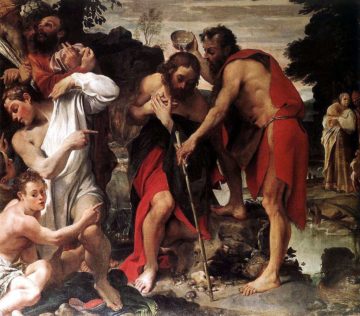 Who knows how many times I stood before Carracci’s Venus, Adonis and Cupid without noticing a crucial detail, a tiny mark that holds as in a cipher the meaning of the tale. Perhaps I had not looked as closely as I thought. “To see what is in front of one’s nose needs a constant struggle.” George Orwell’s remark about our observation of reality can be applied as well to works of art. Until recently, I had never noticed the speck of a red dot on Venus’ golden, shining skin, just on the edge of the small patch of shadow between her breasts, as if a pinprick had left behind a tiny trace of blood. I failed to see it even though the figure of Cupid was pointing from within the painting to where I should look. The picture itself discloses the key to decoding its riddle.
 When I was in graduate school, I couldn’t make it through most of the talks presented in my department. I got bored and frustrated and tuned out. It was before smartphones, so I would doodle or fall asleep.
 Last week, we
 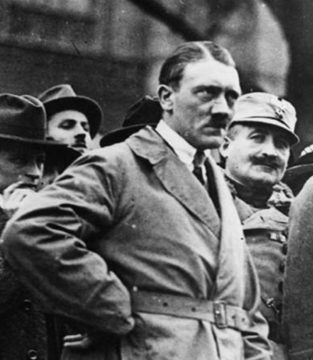 This month marks an instructive centenary. On the morning of November 9, 1923, a 34-year-old Adolf Hitler led a column of 2,000 armed men through central Munich. The goal was to seize power by force in the Bavarian capital before marching on to Berlin. There, they would destroy the Weimar Republic – the democratic political system that had been established in Germany during the winter of 1918-19 – and replace it with an authoritarian regime committed to violence.