
Alena Dvořáková at the Dublin Review of Books:
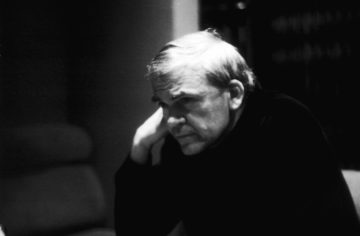
The good Kundera – the best-known twentieth century Czech writer – has been ubiquitous, his work available in many languages. Meanwhile, the darker Kundera – a constant presence on the Czech scene, the Kundera of Laughable Loves and The Joke who later sold out – has mostly skulked in the background, among the people of whom we know nothing, muttering in their incomprehensible Czech. This Kundera-in-hiding might make an occasional appearance in the writing of Western critics, but mostly tonly o be dismissed as a spectre without substance, the creation of those left behind (sometimes also called dissidents) who, filled with envy, cannot but consider the willing and successful emigrant as a traitor to the mother country. Imagine, he even dared to switch his writing language from Czech to French! And he chose not to return home after 1989! The bad faith of these Czech begrudgers would be inferred from their attempts to smear Kundera’s good name with baseless accusations, for example that he was a police informer. (For a dismissal much like this, see Jean-Dominique Brierre’s 2019 biography Milan Kundera, Une vie d’écrivain.)
more here.
 Charlotte Kent (Rail): Photography often gets discussed in terms of its stillness, of capturing or freezing a moment. But, in Where I Find Myself (2018) you wrote about watching Robert Frank and discovering photography’s motion: “that was at the heart of what I had seen: movements, the physicality of it, the timing, the positioning. I played third base, I knew about that kind of movement, it was energy in the service of the moment.” Can you describe how photography was about movement and this physicality? And then maybe also, how baseball comes into that?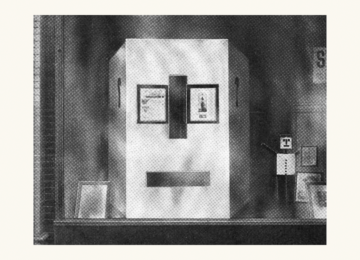
 Many industries are betting that they will benefit from the anticipated quantum-computing revolution. Pharmaceutical companies and electric-vehicle manufacturers have begun to explore the use of quantum computers in chemistry simulations for drug discovery or battery development. Compared with state-of-the-art supercomputers, quantum computers are thought to more efficiently and accurately simulate molecules, which are inherently quantum mechanical in nature.
 As news of Hamas’s murderous October 7 surprise attack on Israel started to circulate in the global information space, so too did the propaganda. According to one estimate, the Israel-Hamas war sparked the highest volume of global propaganda—emanating not just from Israel, Palestine and other Middle Eastern countries but also from Russia, China, and Iran—that experts had ever seen. Even more so than after Russia’s full-scale invasion of Ukraine in late February 2022, the outbreak of war between Israel and Hamas was springtime for propaganda.
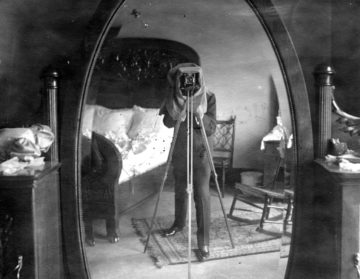 More shadows than men, really; just silhouettes, might as well be smudges on the lens. Hard to notice at first, the two undifferentiated figures in the lower left-hand of the picture, at the corner of the Boulevard du Temple. A bootblack squats down and shines the shoes of a man contrapasso above him; impossible to tell what they’re wearing or what they look like. Obviously no way to ascertain their names or professions. At first they’re hard to recognize as people, these whispers of a figure joined together, eternally preserved by silver-plated copper and mercury vapor; they’re insignificant next to the buildings, elegant Beaux-Arts shops and theaters, wrought iron railings along the streets and chimneys on their mansard roofs. Based on an analysis of the light, Louis Daguerre set up his camera around eight in the morning; leaves are still on trees, so it’s not winter, but otherwise it’s hard to tell what season it is that Paris day in 1838. Whatever their names, it was by accident that they became the first two humans to be photographed.
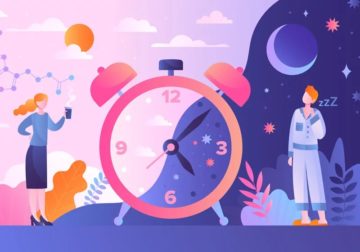 The rhythm of life is hardwired into our DNA. More than forty percent of the human genes that code for proteins
  Branagh’s Poirot films occupy an increasingly strange place in the increasingly weird ecosystem: the twenty-first century metroplex. Murder on the Orient Express (2017) entered an economy still starry on the possibilities of IP-mining, as top-grossing films of that year exclusively feature Disney properties and pop culture products as heroes. Death on the Nile (2022) appeared to an industry in the throes of its latest crisis, ravaged both by pandemic-induced closures and delays as well as the burgeoning sense that the terrain of our memories handled at the hands of slick corporate storytelling might not be a sustainable model of cultural dispensation. Indeed, several of the top-grossing films of 2022 feature the same trademarks from five years prior (Batman, Thor, the Minions) while folding in “new” revisitations (Avatar, Top Gun, Puss in Boots). Nile’s release, like so many films shot in the wilderness of late 2019 and early 2020, was pushed and pulled like taffy, a cultural object in search of distribution in an industry increasingly at the mercy of corporate conglomeration, content optimization, and a boring spring towards the moral and artistic middle.
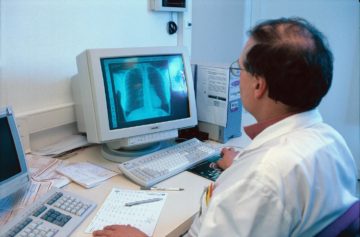 Modern biomedicine has, of course, delivered breakthrough treatments over the past century, treatments which have transformed the care of diseases which were once considered incurable. Aspirin for heart attacks. Insulin for diabetes. Potent antibiotics to treat infections caused by highly virulent organisms. These interventions are true marvels of the modern age: they’re safe and effective for conditions that affect millions. We should rightfully celebrate such treatments and work to make them widely and freely available.
 Cleaning, like cooking, childbearing, and breastfeeding, is a paradigm case of reproductive labor. Reproductive labor is a special form of work. It doesn’t itself produce commodities (coffee pots, silicon chips); rather, it’s the form of work that creates and maintains labor power itself, and hence makes the production of commodities possible in the first place. Reproductive labor is low-prestige and (typically) either poorly paid or entirely unwaged. It’s also obstinately feminized: both within the social imaginary and in actual fact, most reproductive labor is done by women. It is perhaps unsurprising, then, that political discussions of work often treat reproductive labor as an afterthought.
 T
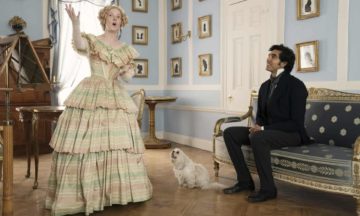
T Another Thanksgiving, another case study in the complex relationship between gratitude and discontent in America. In many respects, a typical U.S. family’s cup runneth over, especially relative to the situations facing families in places such as Ukraine, Gaza, Israel, Venezuela, Afghanistan — the list of poor, oppressed or war-torn nations is long. Macroeconomic data indicates that unemployment is hovering near all-time lows, that inflation is coming down, possibly without a recession, and that
  When describing her directing philosophy, Barbra Streisand has said that less is often more. Unfortunately, she did not take that to heart when writing her long-awaited memoir, My Name is Barbra, which clocks in at over 900 pages.
 AGI is
  More than at any other time since World War II, liberalism is under siege. On the left, some people insist that liberalism is exhausted and dying and unable to handle the problems posed by entrenched inequalities, corporate power and environmental degradation. On the right, some people think that liberalism is responsible for the collapse of traditional values, rampant criminality, disrespect for authority and widespread immorality.
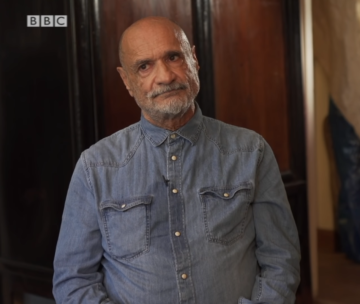 Ave had started making photocollages of wrestlers in the late ’90s, titling them after characters from the epic tenth-century Iranian poem the Shahnameh (Book of Kings). His main protagonist was Rostam, a warrior of legendary strength and wisdom whom Ave reanimated in images of the young Iranian wrestling champion Abbas Jadidi. In 1996, Jadidi had nearly claimed Olympic gold in Atlanta in an epic match settled by what appeared to be the whims of the American judges—a bit of geopolitical theater, perhaps, at a time when the US was dramatically ramping up sanctions against Iran. Jadidi brought home the silver and went on to win other championships (and enter local politics), but the loss of the gold was deeply felt in a country where wrestling traces its roots to pre-Islamic rites.