
Yascha Mounk and Coleman Hughes in Persuasion:
 Coleman Hughes: I think there’s a lot of people that might agree with some points I make about the prevalence of racism, the decline of racism, but they might think, “Well, what’s the harm in exaggerating racism a little bit? I can see the harm in under-exaggerating racism, but shouldn’t we err on the side of assuming that there’s more racism and white supremacy out there so that we’re really facing the problem?” And I wanted to highlight the fact that there is a potential harm, including to black people, but people of color in general, to exaggerating racism.
My grandfather wrote a short memoir of his life. He just turned 90 last year. And in this memoir, he writes of a time in the 1950s where he was one of the few black Americans in those days to have an engineering degree from Ohio State. He grew up in segregated D.C., and he started working at General Electric in the 1950s. And at that time there were basically two paths: You could be an engineer or you could be a manager. And the manager’s path had upward mobility. But he was warned by a well-meaning white colleague that the white engineers at GE would not work for a black manager. And he took that seriously and believed it. And so he just stayed in his humble engineering spot for many years. But then, something changed. The managing spot opened up, and he had been there for a long time, and he decided to go for it. And his boss was surprised, saying “I didn’t know you had any interest in this. You never displayed any interest.” He got the job, and lo and behold, it turned out his white colleagues had no problem working for a black manager.
More here.
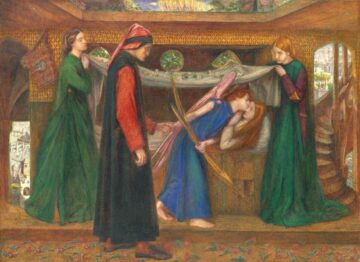 The Latin renders to “who is blessed for ever” and concludes an enigmatic, brief paragraph. First published in 1294, La Vita Nuova is a tantalizing prelude to the Florentine poet’s masterpiece, La Commedia, known today as The Divine Comedy. For centuries, readers and scholars have pored over La Vita Nuova (Italian for, literally, the new life)—convinced, as we often are, that a gifted writer’s nascent work contains the answers to longstanding mysteries.
 According to some estimates, consumers spend $62 billion a year on “anti-aging” treatments. But while creams, hair dyes and Botox can give the impression of youth, none of them can roll back the hands of time.
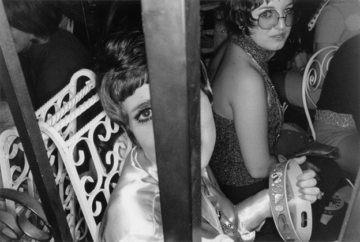 This photograph is the kind of photograph you’d throw away. If you’re working with a digital camera, you would immediately delete it. It’s a disaster. Trash it and move on. There’s a big metal bar in the middle of the shot. It must be from a gate or something. The metal bar not only dominates the very center of the picture, it’s also so close to the camera that the bar is blurred at the top. Technically speaking, that is a no-no. This is a terrible photograph.
 I’ve spent the last five years digging deep into the history of American crime forensics, writing a widely read 2020 New York Times story about
  Does free-market capitalism buttress democracy, or does it unleash anti-democratic forces? This question first emerged in the Age of Enlightenment, when capitalism was viewed optimistically and welcomed as a vehicle of liberation from the rigid feudal order. Many envisioned an equal-opportunity society of small producers and consumers, where no one would have undue market power, and where prices would be determined by the “invisible hand.” Under such conditions, democracy and capitalism are two sides of the same coin.
 Emory University primatologist Frans de Waal — who pioneered studies of animal cognition while also writing best-selling books that helped popularize the field around the globe — passed away March 14, 2024, from stomach cancer.
 The famed coastal dunes that
 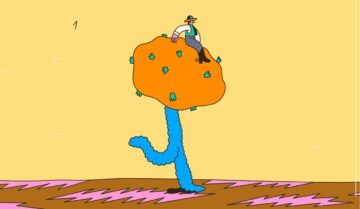 Since the 1950s, scientists have had a pretty good idea of how muscles work. The protein at the centre of the action is myosin, a molecular motor that ratchets itself along rope-like strands of actin proteins — grasping, pulling, releasing and grasping again — to make muscle cells contract.
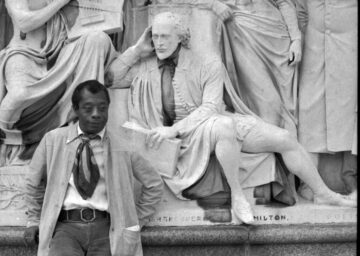 Weschler: It’s interesting in this context, you mentioned a second ago Giovanni’s Room, where part of the story is clearly about a deeply closeted white figure, an American in Paris, who gets involved with somebody who is clearly much more at ease with his sexuality. The relationship just curdles and he destroys both himself and his lover through his inability to be free. And he’s not only talking about gayness in that situation.
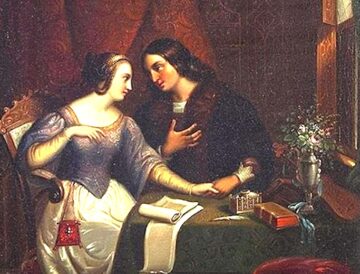 It is one of the great love stories of history and therefore inherently interesting because who isn’t interested in a great love story? Actually, it is a terrible love story as well. That is also what makes it interesting. The love part of the love story only lasted about a year in the early twelfth century. That’s when the great philosopher Peter Abelard was in Paris teaching and making fools of the other great minds to be found in Paris at the time, at least as he tells it, but other sources seem to confirm that Abelard was indeed just sharper and more witty and quicker on his feet than anyone else, plus he was a damn good poet and wrote wonderful popular songs and was handsome as hell.
 I interviewed de Waal in 2007 while researching my book
 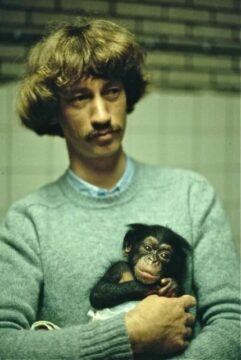 The Netherlands-born scientist spent decades studying chimpanzees and