
Category: Recommended Reading
Ants: Savvy Real Estate Shoppers
From Science:
When it comes to assessing real estate, the house-hunting ant (Temnothorax albipennis) has a more pragmatic approach than does the average human. These 3-millimeter-long insects aren't comparison shoppers, new research using ants tagged with tiny radio transmitters shows, but rather have some strict ideas of what they are looking for. And when they find it, they don't get distracted by what may be around the corner; they move. T. albipennis lives in the cracks in rocks, but just any old stone won't do. The ants look for nests that are dry and dark. Previous studies suggested that when their nest is destroyed, the ants comparison shop for a new abode: In the lab, scout ants that visited both a nearby, low-quality nest and a high-quality nest nine times farther away ultimately settled on the better nest and then alerted the rest of the colony to the new digs. It seemed that the scouts were comparing the two potential homes.
But the new study indicates that the ants follow a simpler rule to make their decision. Researchers led by behavioral ecologist Elva Robinson of the University of Bristol in the United Kingdom used an entomological pin to dot a bit of glue on an ant's thorax and then affixed a microtransmitter the size of a bit of glitter. The team attached these tags to every worker ant in nine colonies; each colony has between 100 and 200 workers and larvae. In the lab, Robinson's team simulated the ant's rock habitats with small stacks of glass and cardboard slides. She then destroyed their good homes by removing the top.
With their queen and larvae dangerously exposed, scouts set off in search of a new dwelling. As in the previous experiments, Robinson's team gave the ants two options: a nearby, low-quality home and a high-quality home nine times farther away. The majority of ants–about 75%–visited only one site and therefore could not be comparing them. Of the scouts that saw only the low-quality nest, 41% left after a short stay; in contrast, only 3% of the ants that visited the high-quality nest left. This suggests that the ants know what they're looking for–and after finding it, return to the old nest to recruit the rest of the colony to join them, the team reports online today in the Proceedings of the Royal Society B.
More here.
Thursday Poem
The City
C.P. CavafyYou said, “ I will go to another land, I will go to another sea.
Another city will be found, a better one than this.
Every effort of mine is a condemnation of fate;
and my heart is—like a corpse—buried.
How long will my mind remain in this wasteland.
Wherever I turn my eyes, wherever I may look
I see black ruin of my life here,
where I spent so many years destroying and wasting.”You will find no new lands, you will find no other seas.
The city will follow you. You will roam the same
streets. And you will age in the same neighborhoods;
and you will grow gray in these same houses.
Always you will arrive in this city. Do not hope for any other—
There is no ship for you, there is no road.
As you have destroyed your life here
in this little corner, you have ruined it in the entire world.from The Complete Poems of Cavafy; Harvest Books, 1961
Translation: Ray Dalven
Wednesday, April 22, 2009
obits have a new style, death still pretty much the same

The obituary seems to be experiencing a renaissance. In her 2006 book The Dead Beat, Marilyn Johnson reveals a worldwide ring of rabid obituary enthusiasts—members of the Church of Obituaries, she calls them. They flip past the Sports and Business sections eager to read the day’s death roll. They “surf the dead beat” poring [:)] over blogs and newspapers searching for fascinating facts about Antoinette K-Doe, who turned a nightclub into a public shrine to her husband, or the guy who invented sea monkeys. Obituaries aren’t dirty little secrets as much as they used to be, lurking in hidden corners and ready to terrify those who cross their path. They are public, normal, interesting, fun. There’s howtowriteanobituary.com which involves everyday people in the writing process, and patrickswayzeobituary.com, a forum writing the demise of the movie star even as he lives. There’s even a glossy online magazine with the snappy name Obit. But the real change is with the obituary writers. Once shamed to the backs of periodicals to deliver dour, Margie Zellner-style obituaries, many are now part of this new movement to “out” death by making it more accessible and “natural.” They are reconsidering the obituary not as the final judgment, but as a way death can be presented as a sum total of its stories. Everyone has stories, everyone dies, and in writing about death, death and life become more of a circle. The obituary is not the period on the sentence of existence, but a mere interpretation.
more from The Smart Set here.
Wednesday Poem
—Smokey Bear, the guardian of our forests, has been a part of the American scene for so many years it is hard for us to remember when he first appeared. Dressed in a ranger's hat, belted blue jeans, and carrying a shovel, he has been the recognized forest fire prevention symbol for over 50 years.
Smokey the Bear Sutra
Gary Snyder
Once in the Jurassic about 150 million years ago,
the Great Sun Buddha in this corner of the Infinite
Void gave a Discourse to all the assembled elements
and energies: to the standing beings, the walking beings,
the flying beings, and the sitting beings — even grasses,
to the number of thirteen billion, each one born from a
seed, assembled there: a Discourse concerning
Enlightenment on the planet Earth.
“In some future time, there will be a continent called
America. It will have great centers of power called
such as Pyramid Lake, Walden Pond, Mt. Rainier, Big Sur,
Everglades, and so forth; and powerful nerves and channels
such as Columbia River, Mississippi River, and Grand Canyon
The human race in that era will get into troubles all over
its head, and practically wreck everything in spite of
its own strong intelligent Buddha-nature.”
“The twisting strata of the great mountains and the pulsings
of volcanoes are my love burning deep in the earth.
My obstinate compassion is schist and basalt and
granite, to be mountains, to bring down the rain. In that
future American Era I shall enter a new form; to cure
the world of loveless knowledge that seeks with blind hunger:
and mindless rage eating food that will not fill it.”
And he showed himself in his true form of
Author J.G. Ballard dies after lengthy illness
Ben Hoyle in The Times of London:
Pinteresque, Dickensian, Shakespearean. Not many writers are so distinctive and influential that their name becomes an adjective in its own right. J. G. Ballard, who died yesterday morning after a long battle with cancer at the age of 78, was one of them.
“Ballardian” is defined in theCollins English Dictionary as: “adj) 1. of James Graham Ballard (born 1930), the British novelist, or his works (2) resembling or suggestive of the conditions described in Ballard’s novels and stories, esp dystopian modernity, bleak man-made landscapes and the psychological effects of technological, social or environmental developments.”
His influence stretched across a modern world that he seemed to see coming years in advance.
His dark, often shocking fiction predicted the melting of the ice caps, the rise of Ronald Reagan, terrorism against tourists and the alienation of a society obsessed with new technology.
As Martin Amis once said of him: “Ballard is quite unlike anyone else; indeed, he seems to address a different – a disused – part of the reader's brain.”
The bands Joy Division, Radiohead, The Normal, Klaxons and Buggles all wrote records inspired by Ballard stories.
More here.
The Calm and the Restless
The plainness of Edward Thomas' “The Owl” vs. the struggle of Gerard Manley Hopkins' “Carrion Comfort.”
Robert Pinsky in Slate:
Paint may be troweled or knifed onto the canvas in thick strokes or dribbled or splashed. In other works, the painter's strokes might be delicate, the surface nearly flat. Sometimes orchestration is elaborate or dense. Sometimes it is minimal and plain.
In a comparable way, one poem might generate its emotion with eloquent plainness, the force of directness. Another poem might work by turbulent or ecstatic or violent elaboration, the force of eruption. The two classic poems for this week illustrate what I mean.
“The Owl” by Edward Thomas (1878-1917) presents its narrative with a mild, somewhat conversational simplicity: Downhill I came, the speaker explains; then I was at the inn; then I heard the owl; and what the owl's cry brought to mind made me regard my comfort as “salted and sobered.” The poem gets its power from fine, crucial variations from ordinary speech. For instance, both “salted” and “sobered” fit the vocabulary of an inn—a place where salt is consumed and where people are sobered or not. The moral meanings of the phrase—comfort is both relished and tempered by a reminder of its opposite—grow out of that plain vocabulary. In the line after he uses the word “plain,” Thomas deploys some effective, precise words of one syllable; while he “escaped,” others in his predicament “could not, that night, as in I went.” Thomas' penetrating but apparently simple language—like a fine, scentless oil—goes deep into its subject. His moral reflection is tentative rather than assertive, minimal rather than sweeping, quiet rather than loud, and candid about appreciating his own good fortune. The poem respects the mysterious nature of fortune, and expresses that respect with its even, temperate voice. (There's an irony to the word “soldiers” in the final line. Thomas died as a soldier in World War I. He is the subject of the elegy “To E.T.” by his friend Robert Frost.)
More here.
In search of India
From The Guardian:
The theme of the London book fair this year is Indian writing. Vikram Seth, Amartya Sen, William Dalrymple and other writers in frequent circulation in this country are going to be joined by writers – K Satchidanandan, Javed Akhtar – distinguished or popular on their own terrain but less known here, for five days of discussions and celebrations. Something like this happened in 2006 to the Frankfurt book fair, when planeloads of Indian novelists and poets descended on the Intercontinental Hotel, waved to each other over breakfast, and then read from their work to courteous audiences in the afternoons and evenings.
The theme then, too, was India; and the “idea of India” acted as a catalyst to a process that might have already begun, but received, at that moment, a recognisable impetus – the confluence, in one place, of literary and intellectual dialogue with what is basically business activity, each bringing magic and movement to the other. The India-themed Paris book fair followed swiftly.
…
Qurratulain Hyder, novelist, short story writer and prose stylist of rare accomplishment, is one of Urdu's greatest writers. Literary critic Aamer Hussein has compared her to her contemporaries, Milan Kundera and Gabriel Garcia Marquez, as “one of the world's major writers: eclectic, iconoclastic and versatile”. In her 30s, she wrote her magnum opus, Aag ka Darya – published in English for the first time in 1998 as River of Fire – a great river of a novel, majestic in its sweep, grand in its vision. She maintained that writing can encompass “fact, reportage, imagination, documentary presentation, the epistolary form”, even cinematic treatment. All her novels, novellas and short stories are a testament to this belief, as well as to her cosmopolitanism and uncompromising secularism.
Ritu Menon, founder of Women Unlimited, India's oldest feminist press
More here. (Picture: Ms. Qurratulain Hyder, my beloved Aini Apa)
Subcontinent’s great singer Iqbal Bano passes away
From Associated Press of Pakistan:
ISLAMABAD, Apr 21 (APP): Subcontinent’s great and Pride of Performance ghazal, thumri and classical singer Iqbal Bano died in Lahore in local hospital after brief illness. She was 74, a private TV channel reported. Bano was born in Delhi in 1935. She won the Tamgha-e-Imtiaz (Pride of Performance) medal in 1974 for her contributions to the world of Pakistani music. She was musically talented, with a sweet and appealing voice. From a young age, Bano developed a love for music.
In Delhi, she studied under Ustad Chaand Khan of the Delhi Gharana, an expert in all kinds of pure classical and light classical forms of vocal music. He instructed her in pure classical music and light classical music within the framework of classical forms of thumri and dadra. She was duly initiated Gaandaabandh shagird of her Ustad. He forwarded her to All India Radio, Delhi, where she sang on the radio. Iqbal Bano was invited by Radio Pakistan for performances, she being an accomplished artist. Her debut public concert was in 1957, at Lahore Arts Council, before an elite crowd. Music lovers feted her beyond imagination. With each recital, she generated more and more public appeal. She was considered a specialist in singing the works of Faiz Ahmed Faiz. She has given such musical relevance to the ghazals of Faiz, that Bano and Faiz are apparently inseparable in popular imagination. Because of Faiz’s imprisonment and hatred of the Pakistani Government towards him, Bano roused a strong crowd of 50,000 people in Lahore by singing his passionate Urdu nazm, “Hum Dekhenge.”
More here.
Media Having Trouble Finding Right Angle On Obama’s Double-Homicide
From The Onion:
More than a week after President Barack Obama's cold-blooded killing of a local couple, members of the American news media admitted Tuesday that they were still trying to find the best angle for covering the gruesome crime.
“I know there's a story in there somewhere,” said Newsweek editor Jon Meacham, referring to Obama's home invasion and execution-style slaying of Jeff and Sue Finowicz on Apr. 8. “Right now though, it's probably best to just sit back and wait for more information to come in. After all, the only thing we know for sure is that our president senselessly murdered two unsuspecting Americans without emotion or hesitation.”
Added Meacham, “It's not so cut and dried.
Since the killings took place, reporters across the country have struggled to come up with an appropriate take on the ruthless crime, with some wondering whether it warrants front-page coverage, and others questioning its relevance in a fast-changing media landscape.
“What exactly is the news hook here?” asked Rick Kaplan, executive producer of the CBS Evening News.
More here.
Over-achievers and under-achievers
Stephen M. Walt in Foreign Policy:
Here's an IR theory puzzle: Why do some seemingly powerful states exert relatively little influence on world politics, while other states with more modest capabilities cast a bigger shadow than one would expect? Although there is no consensus on how national power should be defined or measured, most IR scholars would probably agree that there is a substantial but not perfect correlation between national power and international influence. Indeed, one could imagine a simple regression, with “power” on the X-axis and “influence” on the Y-axis, and a diagonal line bisecting that space. I'd expect most states to array themselves pretty close to that line: as their power increased (measured in terms of GDP, population, military capability, resource endowments, etc.) one would expect to see a corresponding increase in their global influence.
But what about the outliers — either the “overachievers” who swing a bigger bat than one would expect or the “underachievers” who wield less influence than their overall capabilities might provide? Here's my personal, decidedly un-scientific top five list in each category, followed by some thoughts on what might explain why some states punch above their weight and some potentially major powers cast a comparatively small shadow.
“OVER-ACHIEVERS” (in no particular order)1. Sweden.
With a population of only 9 million, one wouldn’t expect Sweden to cast much of a shadow, despite its advanced industrial economy. Yet for its size and population, Sweden has been a significant international player. Its welfare state and other social policies have been widely-studied and a model for others, and diplomats such as Dag Hammarskjold, Folke Bernadotte, and Olof Palme were all important international voices. Sweden still devotes a higher percentage of its GDP to foreign aid than any other country, and institutions such as the Stockholm International Peace Research Institute have amplified Sweden's visibility on major issues of arms control and disarmament. Awarding the Nobel Prizes probably doesn't hurt either.
More here. [Thanks to Kris Kotarski.]
Tuesday, April 21, 2009
Global justice and the renewal of critical theory: A dialogue with Nancy Fraser

Nancy Fraser: Let me start with the “post-socialist condition”. I coined this term in the mid 1990s to characterize the predominant mood following the fall of communism, in which an apparently de-legitimated social egalitarianism gave way to a miraculously resurrected free-market fundamentalism. Whenever I use the expression “post-socialist condition”, then, I put it in scare quotes to indicate that I am referring to an ideological trope. It's not, in other words, that I myself think socialism is irrelevant; rather, this was the common sense of the age. Naming an epochal shift in the grammar of political claims-making, the phrase signalled the fact that many progressive social actors had ceased couching their claims in terms of distributive justice and were resorting instead to new discourses of identity and difference. In this shift “from redistribution to recognition”, as I called it, presumptively emancipatory movements such as feminism and anti-racism, which previously militated for social equality, began in the post-Cold War era to reinvent themselves as practitioners of the politics of recognition. In writing of the “post-socialist condition,” then, I aimed to call attention to the decentring of the socialist imaginary, which had oriented leftwing struggles for a century and a half. I also sought to contextualize that sea change in political culture in relation to the spectacular rise of neoliberalism, whose proponents could only rejoice in the decline of social egalitarian. It was this constellation, in which identity politics dovetailed all too neatly with neoliberalism, that constituted the “post-socialist” mood.
More recently, however, I have come to realize that something else was going on as well, which brings me to the notion of the “global” that you mentioned. So let's fast-forward ahead to 2003, when I started writing about the “problem of the frame”. That is my expression for the new uncertainty that prevails today about the proper way of setting the bounds of justice and thus of deciding whose interests should count. In the Cold-War era, this “frame” issue was not a live question, as it generally went without saying that the unit within which justice applied was the modern territorial state.
$60 billion and counting: Carry trade-related losses and their effect on CDS spreads in Central and Eastern Europe
Raphael Auer and Simon Wehrmüller try to answer how big are Western European bank exposures in Eastern Europe in Vox EU:
Driven by the desire to catch up with Western Europe in terms of investment and consumption, and deceived by the low nominal interest rates on the Swiss franc, the euro, or the US dollar, households and non-banking sector firms in several Central and Eastern European (CEE) economies have accumulated the equivalent of $250 billion worth of debt denominated in a foreign currency. In Austria, mostly due to its proximity to Switzerland and the significant interest rate differential between the Swiss franc and the euro, total foreign currency exposure is equivalent to well over $100 billion.
What was advertised by both local and international banks to be a bargain has turned out to be a costly lesson for the entrepreneurs and households that took out these loans. For example, over the course of the last 6 months, the Swiss franc has appreciated by 31% against the Polish zloty, while the Hungarian forint has lost 14% against the euro. Given the large financial positions, these sharp currency appreciations have led to enormous aggregate losses for the borrowing nations.
Private households and firms have suffered a large part of the losses, but much of the currency exposure is concentrated in households and firms that are better equipped to bear the risks, thus somewhat mitigating the adverse real effects of these exposures (see Brown et al. 2008, Beer et al. 2008). Yet market participants anticipate that the government will ultimately bail out the private sector vis-à-vis its resident banks, thus also strongly affecting the outlook for public finances and market perceptions of sovereign default.
Come Together: Our Need to Cooperate
From Scientific American:
The natural world seems intent on synchronizing. Schools of fish, flocks of birds, herds of wildebeest, and swarms of fireflies all effortlessly coordinate their actions with one another. A recent study published by Scott Wiltermuth and Chip Heath of Stanford University in the journal Psychological Science, suggests that humans are no different. In fact, our ability to synchronize might be one of the most important developments in our evolution as a social species, a skill we need to successfully choreograph our dance moves at parties—and also, perhaps, to live together in stable, cooperative societies.
Examples of the power of human synchrony abound—from the awe-inspiring opening ceremony of the 2008 Summer Olympics to the fear-inspiring Nazi military march, to the ridiculous communal dances in which we find ourselves at weddings. Who hasn’t bad-mouthed the chicken dance in the buffet line and then been drawn in by that insufferable staccato? Like a Siren, the allure of synchrony pulls you into the group.
More here.
more pirate thoughts

When Jefferson was inaugurated president in 1801, he ordered all tributes to stop. Without informing Congress, Jefferson dispatched the Navy to the Mediterranean. By August 1801, U.S. frigates were engaged in open-sea battles with the corsairs off the shores of Tripoli. The war was settled by 1805, but with the distractions of the War of 1812—and the United States’ reengagement in privateering along its own coast—American shipping was again plundered in the Mediterranean, and ransoms were again paid for prisoners. In 1815 the Navy returned, capturing the flagship of the Algerian navy. The U.S. formed a coalition with the British and Dutch, who ultimately bombarded Algiers into submission. The Second Barbary War ended in a treaty guaranteeing the U.S. freedom of shipping. The age of imperialism commenced, and within a century most of Africa had been carved up into colonies. The British and Italians would eventually split what today has become the violent, broken, non-state of Somalia. Which brings us to the present and raises the question: Are the values espoused by the Somali pirates so very different from those upon which America was founded? They work hard, they revere property, and they believe in the pursuit of happiness. They aren’t Islamists and bear no natural alliance with the would-be theocrats of the now ousted Islamic Courts Union. If they have kindred spirits today, they are more likely to be found in the boardrooms of Morgan Stanley and Citigroup. Theft has become so codified, our commerce so digitized, that it is small wonder the robbing of actual ships laden with actual goods seems so romantically anachronistic. But all the ransoms paid to the Somali pirates would amount to roughly 0.002 percent of the bailout paid to AIG.
more from Lapham’s Quarterly here.
a boxer in a godforsaken town

ROBERTO BOLAÑO once wrote a story with Mijares’s hometown as both setting and title. “Gómez Palacio” is not a happy tale. The protagonist, a poet exiled from Mexico City to teach a handful of hapless writing students, dismisses the place as “some godforsaken town in northern Mexico.” Much of the city indeed looks as though a stiff wind would blow it over. Gómez Palacio is one of the principal municipalities of the Laguna (which is actually an agglomeration of four adjacent cities); so is Torreón, where I moved from Chicago in 2005, essentially to learn Spanish. It didn’t feel like exile to me, but there’s no denying the harshness of the environment. The weather is extreme: windstorms, floods, and, for ten months of the year, a desert heat so unyielding that local men call the Laguna La Ciudad de Huevos Congelados, the City of Frozen Balls, for the ice-cold beers they squeeze between their legs. The city’s principal landmark is an open-armed Jesus statue on a foothill overlooking Torreón. With charming disingenuousness, locals describe the statue as a reflection of the Laguneros’ hospitality and decency. No one mentions it’s a copy of Rio de Janeiro’s Christ the Redeemer.
more from Triplecanopy here.
Tuesday Poem
These Words Are Synonymous Now
Juan Felipe Herrera
On the way to school I tell my son
remember to read—read fast. At every curb
think of three things, examine the faces
the eyes—especially the eyes, be quick.
The other day I picked up an old paperback
Houdini, The Handcuff King who slipped off
Scotland Yard’s shackles in minutes.
Holding the book in my left hand, I churn it
with the fleshy mound of my palm my thumb
makes small circles on the cover.
These word are synonymous now:
University
Steel
Light
Nothing
Poets
Rags
Words
Paper
I am working on a play—the world in twenty years.
There is a sentry, a clown, and warrior; the slave colony
on the verge of escape from the video eye. The eye
sees everything. Picture the slender man in the supermarket
holding up a small can of cranberry sauce—weighing
the contents he is concerned with a stamp-size
inscription. Ingredients:
sodium fructose,
pectin, artificial flavoring.
Tomorrow his daughter will bleed from the mouth;
the blood will glisten hot, wavy—her boyfriend drinks.
She runs to him; he traps her when daddy sleeps.
There are too many recorded tragedies. No one listens.
Listen to the little bronze gears inside the computer;
everyone owns one, delivers upon the keys. Listen again:
the A
the Z
the Asterisk
slapping, so quiet,
mournful, so pious.
Treacheries.
Falsehoods.
Big words. My friends are afraid to speak them.
The television offers brilliant young men.
immense shoulder braces tumble across the green,
a pigskin against the solar plexus, a broken leg
juts out wanting to kick the audience, sweltering,
saliva on shirts, ribbons, cold bottle Pepsi’s.
I work toward good things, play inexpensive games—
a miniature clay house with two black windows,
pearled marbles with yellowish zig-zag lines,
a funny thumb-size, plastic, German lugar pistol.
I surprise myself. I finally figured people out.
The Rhyme-Master, Elder King of Ink
who bequeathes Grace upon the Speechless.
The Child-Molester who receives tribute
from his political colleagues.
The Daughter-Monkey caged by her own aging mother
who will never talk to another man again.
I think of my mother. Tiny ancient—who saved broken birds
from the sidewalk rubbing their heads with herbs who
waited nineteen years for me to return. I never did.
I read about the Thalamus, the intricate web of the brain.
My friends use these words too:
Literary production
Feminist Art
Ideology—the Underclass
while our little mothers shrink,
die without us. We never say Sacrifice. It smells of
religion.
My Aunt Lela is caught in a second-story above a ham and eggs
diner. She’s eighty-four when she walks she falls
on the cement every time her legs give out.
I tell her to use a cane like my mother did.
People don’t like to hear this, they say poetry must have
a fancy curl in the center—don’t complain, they say.
I ask them so you have better figures?
In the United States
the per capita income is $27,000 a year
in Malawi Africa it’s $160 in Nayarit Mexico up
on Indian land—a bowl of corn squash and seeds.
I sit at the library, gaze across the table; trees, windows
are continuous; the telephone pole connects with the leaves
darkness crawls up the bark, tears daylight to pieces.
These are labels and empty synonyms:
Poetry and chalkdust.
Horror and humanity.
Laughter and spit.
I tell my son—that’s good, learn the cello, listen to
its womb, take your time, observe, survive.
from: After Aztlan; Godine Publishers, 1992
forsaken favorites
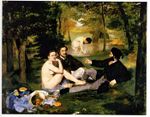
I don’t see the point of playing this game unless I make it a variant on the one where everybody owns up to the book he or she is most ashamed never to have read. The fallen idol whose fate leaves me by far the most uneasy—uncertain, that is, whether the fall is his or mine—is Manet. It keeps happening without my being wholly aware of it. This spring in Chicago, for instance, I realized at the end of a morning in the Art Institute that I had spent long minutes absorbed in the naiveties of a Delacroix lion hunt—wondering at the way the absurd wish-fulfillment called “North Africa” managed to focus and concentrate the painter’s energies, producing a green and blue like nobody else’s—and I’d never looked, for more than a moment or two, at Manet’s street-people on the opposite wall of the gallery. “Velazquez kitsch,” I found myself murmuring when I did. Whereas what Delacroix had done with Rubens! I think the process began some years ago in Munich, where Manet’s Luncheon in the Studio hangs—or did then—next to an early, simple-minded Cézanne called The Railway Crossing. I remember feeling a little guilty at the depth of my boredom with the Luncheon, and then abandoning myself, guiltless and gleeful, to Cézanne’s preposterous piece-by-piece assembly of a world.
more from Threepenny Review here.
Inspired Bicycles
New nucleotide could revolutionize epigenetics
Brett Norman in Eureka Alert:
Anyone who studied a little genetics in high school has heard of adenine, thymine, guanine and cytosine – the A,T,G and C that make up the DNA code. But those are not the whole story. The rise of epigenetics in the past decade has drawn attention to a fifth nucleotide, 5-methylcytosine (5-mC), that sometimes replaces cytosine in the famous DNA double helix to regulate which genes are expressed. And now there's a sixth. In experiments to be published online Thursday by Science, researchers reveal an additional character in the mammalian DNA code, opening an entirely new front in epigenetic research.
The work, conducted in Nathaniel Heintz's Laboratory of Molecular Biology at The Rockefeller University, suggests that a new layer of complexity exists between our basic genetic blueprints and the creatures that grow out of them. “This is another mechanism for regulation of gene expression and nuclear structure that no one has had any insight into,” says Heintz, who is also a Howard Hughes Medical Institute investigator. “The results are discrete and crystalline and clear; there is no uncertainty. I think this finding will electrify the field of epigenetics.”
Genes alone cannot explain the vast differences in complexity among worms, mice, monkeys and humans, all of which have roughly the same amount of genetic material. Scientists have found that these differences arise in part from the dynamic regulation of gene expression rather than the genes themselves. Epigenetics, a relatively young and very hot field in biology, is the study of nongenetic factors that manage this regulation.
More here.