Venice was settled originally by refugees fleeing the barbarian hordes—who, apparently, didn’t like water. But that was then. This week, Swoon, a 31-year-old Brooklyn artist whose name is Caledonia “Callie” Curry, is leading a waterborne invasion of the Venice Biennale (she didn’t bother to try to get in officially) with a crew of 30 artists, musicians, and miscreants in tow. Though they have raised some $150,000 for this crash party, the money won’t show in the boats they’ll travel in, because the boats are made of trash—a symbol of the freedom that comes with radical self-reliance, and one that is meant to effect change. “Throughout history, pranksters have been looking at fences and then pushing them aside,” Swoon has said (the name came to an ex-boyfriend in a dream, in which he imagined her future as a graffiti artist long before her career began). “Through action, you can move the perception. It’s almost like a magic trick.” Swoon and her group are emissaries from a specific underground culture: the bike-riding, Dumpster-diving, anarchist street-art movement that has flourished in Bushwick, Greenpoint, and areas near the Gowanus Canal over the past decade.
more from Vanessa Grigoriadis at New York Magazine here.
ON AUG. 10, 1996, a single power line in western Oregon brushed a tree and shorted out, triggering a massive cascade of power outages that spread across the western United States. Frantic engineers watched helplessly as the crisis unfolded, leaving nearly 10 million people without electricity. Even after power was restored, they were unable to explain adequately why it had happened, or how they could prevent a similar cascade from happening again – which it did, in the Northeast on Aug. 14, 2003. Over the past year we have experienced something similar in the financial system: a dramatic and unpredictable cascade of events that has produced the economic equivalent of a global blackout. As governments struggle to fix the crisis, experts have weighed in on the causes of the meltdown, from excess leverage, to lax oversight, to the way executives are paid. Although these explanations can help account for how individual banks, insurers, and so on got themselves into trouble, they gloss over a larger question: how these institutions collectively managed to put trillions of dollars at risk without being detected. Ultimately, therefore, they fail to address the all-important issue of what can be done to avoid a repeat disaster. Answering these questions properly requires us to grapple with what is called “systemic risk.”
Here in the United States, four decades of drug war have had three consequences:
First, we have vastly increased the proportion of our population in prisons. The United States now incarcerates people at a rate nearly five times the world average. In part, that’s because the number of people in prison for drug offenses rose roughly from 41,000 in 1980 to 500,000 today. Until the war on drugs, our incarceration rate was roughly the same as that of other countries.
Second, we have empowered criminals at home and terrorists abroad. One reason many prominent economists have favored easing drug laws is that interdiction raises prices, which increases profit margins for everyone, from the Latin drug cartels to the Taliban. Former presidents of Mexico, Brazil and Colombia this year jointly implored the United States to adopt a new approach to narcotics, based on the public health campaign against tobacco.
Third, we have squandered resources. Jeffrey Miron, a Harvard economist, found that federal, state and local governments spend $44.1 billion annually enforcing drug prohibitions. We spend seven times as much on drug interdiction, policing and imprisonment as on treatment. (Of people with drug problems in state prisons, only 14 percent get treatment.)
Some 3.9 billion years ago, a shift in the orbit of the Sun’s outer planets sent a surge of large comets and asteroids careening into the inner solar system. Their violent impacts gouged out the large craters still visible on the Moon’s face, heated Earth’s surface into molten rock and boiled off its oceans into an incandescent mist. Yet rocks that formed on Earth 3.8 billion years ago, almost as soon as the bombardment had stopped, contain possible evidence of biological processes. If life can arise from inorganic matter so quickly and easily, why is it not abundant in the solar system and beyond? If biology is an inherent property of matter, why have chemists so far been unable to reconstruct life, or anything close to it, in the laboratory? The origins of life on Earth bristle with puzzle and paradox. Which came first, the proteins of living cells or the genetic information that makes them? How could the metabolism of living things get started without an enclosing membrane to keep all the necessary chemicals together? But if life started inside a cell membrane, how did the necessary nutrients get in?
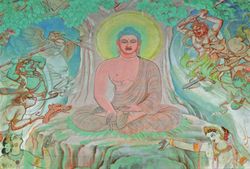
Buddha is said to have wooed his future wife by reeling off a huge number series.
In a world divided by culture, politics, religion and race, it is a relief to know one thing that stands above them — mathematics. The diversity among today's mathematicians shows that it scarcely matters who invents concepts or proves theorems; cold logic is immune to prejudice, whim and historical accident. And yet, throughout history, different families of humans have distilled the essence of the cosmos to capture the magic of numbers in many ways.
Mathematics in India shows just how different one of these ways was, and how culture and mathematical development are intimately connected. This carefully researched chronicle of the principal contributions made by a great civilization covers the earliest days of Indian history through to the beginning of the modern period. Regrettably, it stops short of the legendary mathematician Srinivasa Ramanujan (born 1887), whose name is still seen in today's research papers.
Kim Plofker's book fulfils an important need in a world where mathematical historiography has been shaped by the dominance of the Greco-Christian view and the Enlightenment period. Too little has been written on the mathematical contributions of other cultures. One reason for the neglect of Indian mathematics was Eurocentrism — British colonial historians paid it little attention, assuming that Indians had been too preoccupied with spiritual matters to make significant contributions to the exact sciences. Another reason is that many ancient Indian mathematical texts have long been extinct; often, the only indication that they existed comes from scholars who refer to the work of their predecessors. As Plofker wryly notes, two historians of Indian maths recently published articles in the same edited volume, wherein the estimates of their subject's origins differed by about 2,000 years.
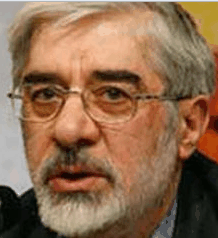
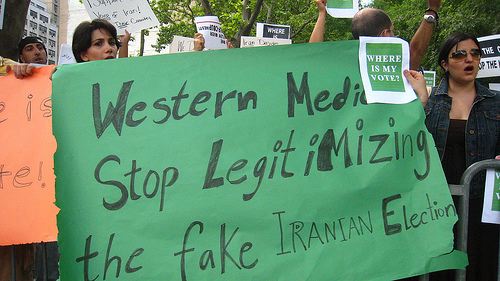
I AM UNDER EXTREME PRESSURE TO ACCEPT THE RESULTS OF THE SHAM ELECTION. THEY HAVE CUT ME OFF FROM ANY COMMUNICATION WITH PEOPLE AND AM UNDER SURVEILLANCE. I ASK THE PEOPLE TO STAY IN THE STREETS BUT AVOID VIOLENCE
Via Andrew Sullivan, who is covering events very comprehensively (much better than the MSM) here.
BBC (whose reporters are being protected from the police by demonstrators) has live reports from Tehran here.
The Telegraph: Unconfirmed reports that leaked election results show Mahmoud Ahmadinejad came third, here.
The Huffington Post: Live blogging the uprising, here.
Grand Ayatollah Sanei in Iran has declared Ahmadinejad's presidency illegitimate and cooperating with his government against Islam. From Andrew Sullivan.
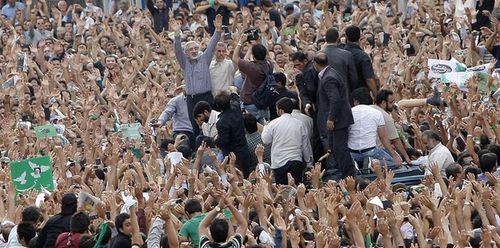
Al-Jazeera: Moussavi addresses tens hundreds of thousands of supporters, says he will fight in new elections, if called. More here.
Leave links to any kind of direct reporting out of Iran in the comments.
I'll be updating this page frequently, and adding stuff at the bottom as the day goes on.
Support the Uprising!
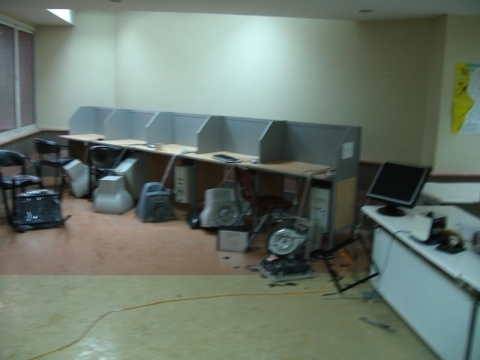
Security forces target computers in dorm raid at Tehran university:
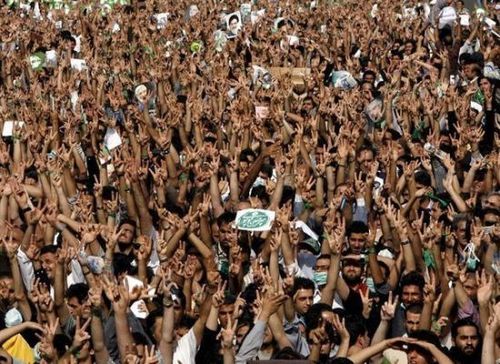
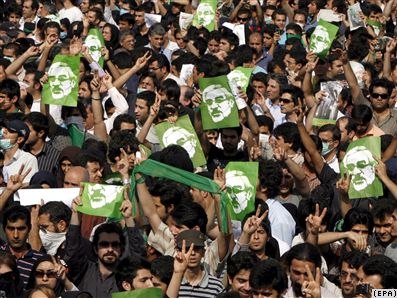
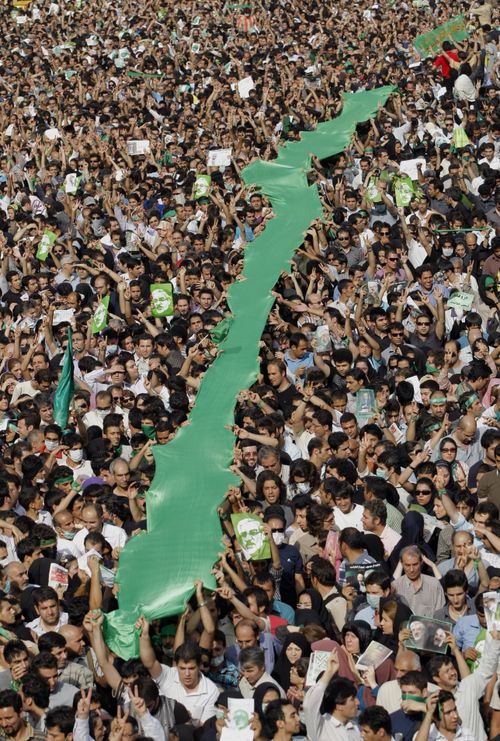
Press TV is now reporting on “hundreds of thousands” in today’s rally from Enqelab Square to Azadi Square, protesting the outcome of the Iranian election. The gathering is in defiance of the Ministry of Interior’s refusal to give a permit. So far, based on video and on the correspondent’s report, the rally appears to be peaceful and calm.
Just to bring home the significance of the previous item, Press TV is state-owned media. Until this morning, it has given almost no attention to the protests against Ahmadinejad’s election. The sudden change to in-depth, even effusive coverage of the demonstrations points to a wider political shift: whether this is in line with a “compromise” accepting the legitimacy of the claims of the protests (and, beyond that, the appeal to the Guardian Council) remains to be seen.
Moussavi appears:
The BBC: Millions protest in iran against election fraud in Iran:
Tweets coming out of Iran (again, via Andrew Sullivan):
“Mousavi now, 'these masses were not brought by bus or by threat. they were not brought for potatoes. they came themselves'”
“Tens of thousands of protestors are chanting 'No fear, No fear, we are with each other.'”
“It's worth taking the risk, we're going. I won't be able to update until I'm back. again thanks for your kind support and wish us luck.”
“Grand Ayatollah Saanei accompanies today's anti Ahmadinejad rally.”
“These people are not seeking a revolution,” said Ali Reza, a young actor in a brown T-shirt who stood for a moment watching on the rally’s sidelines. “We don’t want this regime to fall. We want our votes to be counted, because we want reforms, we want kindness, we want friendship with the world.”
12:43 PM ET — Cracks in the armor.“A source tells us that least one state run media channel has shown pictures of the protests and announced that Mousavi would be at the rally, which indicates that some in the media arerefusing marching orders.”
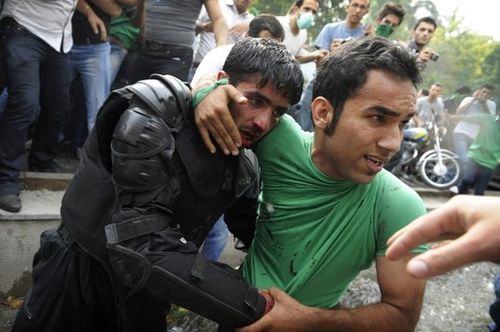
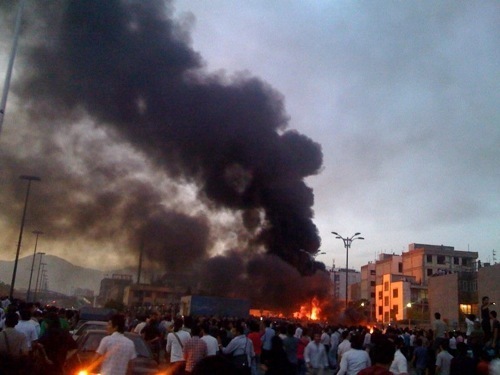
12:44 PM ET — At least one reported dead.ABC'sJim Sciutto: “sev reports of pro-govt militia firing on protesters, AP photog reports one protester dead”
From emailer Susan: @kapanak: Eyewitness relative from North Tehran just got back to me. District One and Three are in total Chaos.
12:47 PM ET — AP files.“TEHRAN, Iran (AP) — AP photographer sees pro-government militia fire at opposition protesters, killing at least 1.”
More from @persiankiwi: people are running in streets outside. There is panic in streets.people going ino houses to hide.
12:53 PM ET — More people shot?Emailer Walt sends a link tothis site, which is claiming (in Farsi) that she saw half a dozen hit by gunfire. I have seen no evidence corraborating this. But I note it because she also includes new cell photos from the scene:
And via Andrew Sullivan (who is providing amazing coverage of these events in real time):
Tehran University's Faculty Resigns En Masse
119 members of Tehran University faculty have resigned en-masse as a protest to the attack on Tehran University dorms last night. Among them is Dr Jabbedar-Maralani, who is known as the father of Iranian electronic engineering. They have asked for the resignation of Farhad Rahbari the appointed president of Tehran University, for his incompetence in defending the University's dignity and student lives.
3:10 PM ET — Back to basics.An Iranian civics lesson, in comic form, for those who are just getting interested in this. Via emailer Moazzam-Doulat, BBC has aninteractive version.
And now, Barack, “It would wrong for me to be silent,” walks the fine line perfectly:
And a good article in Salon (thanks to Zara Houshmand) is here.
McDonald wanted to test a hypothesis that the difference in cancer rates between the species could be due to differences in the way their cells self-destroy themselves — an important biological process known as programmed cell death or apoptosis.
The researchers saw that some of the genes for apoptosis were expressed differently in humans than in chimps, and their data suggests that human cells are not as efficient at carrying out programmed cell death as chimp cells, at least in the brain and other studied tissues.
What does apoptosis have to do with cancer?
Reduced amounts of apoptosis have been associated with an increased risk of cancer. Also, several genes involved in apoptosis are thought to “malfunction” in cancer cells. This makes sense: cancer cells divide uncontrollably and somehow seem to override the signal to self-destruct.
And what does that have to do with a large brain? During human evolution, it is thought that people were naturally selected for larger brains and increased cognition. There is also another hypothesis that to get these larger brains, we needed to have a high rate of neuron synthesis.
If Anna Letitia Barbauld’s was a voice of the Enlightenment, it hasn’t, until now, carried very far. Known in her own time as a poet and controversial essayist, her fame in the fifty years after her death rested almost entirely on fond memories of her reading schemes for very small children. She struggled through to the twenty-first century with a handful of anthology pieces (‘The Mouse’s Petition’, ‘Washing-Day’, Eighteen Hundred and Eleven) and a reputation for worthiness: not the stuff to attract a wide readership. William McCarthy’s twenty years of work on this author, which includes co-editorship of a fine Poems and Selected Poems and Prose, has now borne fruit in this monumental, quietly magnificent biography, which will surely do as much to promote Barbauld’s reputation as anyone could dream. McCarthy has no extravagant hypotheses or revisionist agenda, just a thoroughness about his subject that does Barbauld the best service, putting her back into context and showing her importance there. The eldest child of a relentlessly high-minded, low-Church family, Anna Letitia Aikin was a seriously intellectual child, shaped by her ‘infallible’ father, a Dissenting minister and teacher. She learned Greek and Latin and studied the Stoics, was the star of the Warrington intellectual scene (where one of the family’s closest friends was Joseph Priestley), and by her twenties was writing elegant, intelligent occasional verse that drew rave reviews in the London periodicals and overtures from ‘The Queen of the Blues’, Elizabeth Montagu.
In Laurie Sheck’s novel, “A Monster’s Notes” (Alfred A. Knopf: 544 pp., $28), Victor Frankenstein’s creation is alive and well and living in New York. Mary Shelley’s creation has come unstuck in time. He lives in New York or did until recently. He passes Tower Records, a Duane Reade drugstore. He takes notes on the news, developments in science. He reads abandoned books, is privy to whole correspondences, is a historian of his own loneliness. The novel’s first part is “Ice Diary”; the second is “Dream of the Red Chamber”; the last is “Metropolis/The Ruins at Luna.” But the best parts of the book are in the “notes” — lyric essays on time, space, leprosy, art. On Albertus Magnus, on John Cage. The sinews of this odd and unwieldy creature.
On March 11, 2003, about a week before President George W. Bush began bombing Iraq, the cultural historian Jackson Lears published an Op-Ed article in The New York Times pleading for sanity. He sensed that it was already too late, and suggested that war opponents might be “fingering a rabbit’s foot from time to time.” As a historian, however, Lears couldn’t help asking when the “regenerative” impulse to seek national glory through war first took root. The result is “Rebirth of a Nation,” a fascinating cultural history that locates the origins of Bush-era belligerence in the anxieties and modernizing impulses of the late 19th century. Lears describes his bookas a “synthetic reinterpretation” of the Gilded Age and Progressive Era, an effort to dislodge classics like Richard Hofstadter’s “Age of Reform”(1955) and Robert Wiebe’s “Search for Order, 1877-1920”(1967). It’s an ambitious project; both books, despite legions of critics, have shown remarkable staying power. Fortunately, Lears is well qualified for the task. One of the deans of American cultural history (as well as a professor at Rutgers University), Lears has spent decades writing about turn-of-the-20th-century debates over consumerism, modernity, religion and market capitalism. With “Rebirth of a Nation,” he expands his vision to include politics, war and the presidency as well.
Some words of caution from old 3QD friend, and spokesman for the International Campaign for Human Rights in Iran, Hadi Ghaimi:
As the Campaign reported earlier, the leading challenger to Ahmadinejad, Mir Hossein Moussavi, was informed by Iran’s Interior Ministry at 23:00 on 12 June that tabulated results showed him to be victor, and he was asked to wait on celebrations until Sunday.
A few hours later, the Ministry inexplicably reversed itself declaring a massive victory for Ahmadinejad. Iran’s religious Leader, Ayatollah Ali Khamenei, ignoring turmoil in the Ministry and rising protests, announced the victory and declared the process finished.
“The international community cannot accept such questionable election results, and should withhold recognition of these elections,“ stated Hadi Ghaemi, spokesperson for the Campaign.
“All must help the authorities understand that there will be no social peace in Iran and no credibility for the government abroad, without a re-run to discover which candidate actually deserves to govern,” he said.
At this time, Iran has been thrown into an unprecedented crisis of legitimacy. Thousands of Iranian citizens expressing their outrage, shock, and humiliation are facing the extreme danger of lethal violence at the hands of police and security forces in Tehran and throughout Iran.
“The stage has been set for a Tehran Tiananmen, in which massive violence will be unleashed in an attempt to intimidate the citizens from pursuing their dream of democracy,” Ghaemi said, referring to the 1989 massacre of many hundreds of Chinese pro-democracy demonstrators.
Humans communicate with one another using a dazzling array of languages, each differing from the next in innumerable ways. Do the languages we speak shape the way we see the world, the way we think, and the way we live our lives? Do people who speak different languages think differently simply because they speak different languages? Does learning new languages change the way you think? Do polyglots think differently when speaking different languages?
These questions touch on nearly all of the major controversies in the study of mind. They have engaged scores of philosophers, anthropologists, linguists, and psychologists, and they have important implications for politics, law, and religion. Yet despite nearly constant attention and debate, very little empirical work was done on these questions until recently. For a long time, the idea that language might shape thought was considered at best untestable and more often simply wrong. Research in my labs at Stanford University and at MIT has helped reopen this question. We have collected data around the world: from China, Greece, Chile, Indonesia, Russia, and Aboriginal Australia. What we have learned is that people who speak different languages do indeed think differently and that even flukes of grammar can profoundly affect how we see the world. Language is a uniquely human gift, central to our experience of being human. Appreciating its role in constructing our mental lives brings us one step closer to understanding the very nature of humanity.
In 1781, the naturalist Henry Smeathman published an account of termites in Sierra Leone that included an illustration, carefully labelled, of the mounds they built, the flora and fauna surrounding them, and some nearby Europeans. The only object, in fact, that is not labelled is the 'native’ standing in the foreground – he was 'only’ decorative. This image is the jumping-off point for JFM Clark’s brilliant tour d’horizon of the development of entomology in the 19th century, a work which encompasses far more than the development of bug hunters from amiable eccentrics indulging their 'futile and childish’ passion, to their role as scientific experts in the technocratic state. Bugs, as Clark convincingly shows, helped move science from the contents of a cabinet of curiosities, through scholarly classification to modern pragmatic application.
Clark’s first dozen pages succinctly outline a dizzying range of subjects that were changed by bugs. As the post-Enlightenment scientific revolution took hold of daily life, insects, as social animals, became a model through which questions of our own society could be filtered. The capitalist world, with its new disposable income, drove demand for collections. New printing technologies made lithographs and books on the subject cheaper and more widely available, while rapid urbanisation cast a glow over 'lost’ rural bliss. (Clark notes that Common Objects of the Country sold 100,000 copies in a single week, compared to an annual sale of 20,000 copies of Samuel Smiles’s Self-Help.) The rise of the professional classes led to the notion of 'scientists’ (a new word) as experts.
The miscalculations across five Administrations are by now generally understood: near-unequivocal support for anti-American militias during the nineteen-eighties; averted eyes as Pakistan pursued its covert nuclear ambitions; the abandonment of Afghanistan after the Soviet withdrawal; the failure to recognize the menace of Al Qaeda during the nineteen-nineties; erratic investments in Pakistan’s democracy, economy, and civil society; and, most recently, a war in Afghanistan after 9/11 which did not defeat Al Qaeda or the Taliban but chased them into Pakistan, where they regrouped and have proceeded to destabilize a country now endowed with atomic bombs.
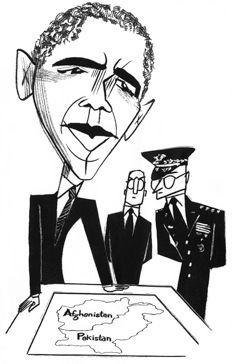
For several months, the Obama Administration has been rethinking American policy, hoping to depart from this history of dysfunction. It has announced a formal strategy: an adaptive counterinsurgency doctrine that seeks to emphasize the security and the prosperity of the Afghan and Pakistani people above all; economic and development aid; vigorous diplomacy; and carefully targeted warfare, particularly aimed at Al Qaeda. Already, however, Obama and his advisers have had to confront the puzzle of which policies in their new portfolio will promote stability in the region, and which will promote instability.
Just a few weeks ago, the Taliban advanced so close to Islamabad, Pakistan’s capital, that it seemed the Pakistan Army might have lost its will to fight. The Obama Administration urged the Army into battle. Fortunately, given the stakes, the Army acted, and it has evidently fought with gusto in recent days, but to such an extent that it has now churned up a million internal refugees, who constitute yet another pool of displaced and disaffected civilians that the Taliban will surely attempt to exploit.
“The essential American soul,” wrote D.H. Lawrence in a celebrated description, “is hard, isolate, stoic, and a killer.” Of course, he was talking about Natty Bumppo and similar rough-and-tumble frontier spirits. By contrast, the amoral Tom Ripley—novelist Patricia Highsmith's most famous character—is easygoing, devoted to his wife and friends, epicurean, and a killer only by necessity. By my count, necessity leads this polite aesthete to bludgeon or strangle eight people and watch with satisfaction while two others drown. He also sets in motion the successful suicides of three friends he actually, in his way, cares about. Yet aside from an occasional twinge about his first murder, Ripley feels no long-term guilt over these deaths. (Tellingly, he can never quite remember the actual number of his victims.) He was simply protecting himself, his friends and business partners, his home. Any man would, or at least might, do the same.