As their country descends into chaos, Pakistani writers are winning acclaim

From The Guardian:

Hitlist Pakistani novelists writing in English – long overshadowed by literary giants from neighbouring India – are now winning attention and acclaim as their country sinks into violence and chaos. Tales of religious extremism, class divides, dictators, war and love have come from writers who grew up largely in Pakistan and now move easily between London, Karachi, New York and Lahore. Since the publication of Mohsin Hamid's The Reluctant Fundamentalist two years ago, which was shortlisted for the Man Booker Prize, a new wave of Pakistani fiction is earning critical acclaim at home and around the world.

Last year came Mohammad Hanif's first novel, A Case of Exploding Mangoes – a dark comedy about the Islamic fundamentalist rule of General Zia ul Haq in the 1980s – and Nadeem Aslam's The Wasted Vigil, which is set in modern Afghanistan. Two keenly anticipated works are due out in the UK in the coming weeks: Kamila Shamsie's fifth, and reputedly finest, novel, Burnt Shadows, and a collection of short stories by Daniyal Mueenuddin, who was compared with Chekhov when some of the tales were previously published in the New Yorker. “Some of us have been writing for many years but suddenly we've had four or five novels coming out together and that's created a buzz,” said Shamsie, whose latest work is an ambitious story that starts off in Second World War Japan and moves to post-9/11 Afghanistan. “Indian writing has been established for 25 years or more, since Midnight's Children (Salman Rushdie's book, published in 1981). Pakistani writing is very much in its infancy.

More here.

Former Gitmo Guard Tells All

Scott Horton in Harper's:

ScreenHunter_04 Feb. 18 09.49 Army Private Brandon Neely served as a prison guard at Guantánamo in the first years the facility was in operation. With the Bush Administration, and thus the threat of retaliation against him, now gone, Neely decided to step forward and tell his story. “The stuff I did and the stuff I saw was just wrong,” he told the Associated Press. Neely describes the arrival of detainees in full sensory-deprivation garb, he details their sexual abuse by medical personnel, torture by other medical personnel, brutal beatings out of frustration, fear, and retribution, the first hunger strike and its causes, torturous shackling, positional torture, interference with religious practices and beliefs, verbal abuse, restriction of recreation, the behavior of mentally ill detainees, an isolation regime that was put in place for child-detainees, and his conversations with prisoners David Hicks and Rhuhel Ahmed. It makes for fascinating reading.

Neely’s comprehensive account runs to roughly 15,000 words. It was compiled by law students at the University of California at Davis and can be accessed here. Three things struck me in reading through the account.

First, Neely and other guards had been trained to the U.S. military’s traditional application of the Geneva Convention rules. They were put under great pressure to get rough with the prisoners and to violate the standards they learned. This placed the prison guards under unjustifiable mental stress and anxiety, and, as any person familiar with the vast psychological literature in the area (think of the Stanford Prison Experiment, for instance) would have anticipated produced abuses.

More here.

Girl poet takes on the Taliban with her pen

Stanley Grant at CNN:

ScreenHunter_03 Feb. 18 09.36 Tuba Sahaab looks nothing like a warrior. She is a slight girl of 11, living in a simple home in a suburb of Islamabad. But in Tuba's case, looks are deceiving.

With her pen, Tuba is taking on the swords of the Taliban. She crafts poems telling of the pain and suffering of children just like her; girls banned from school, their books burned, as the hard-core Islamic militants spread their reign of terror across parts of Pakistan.

A stanza of one of her poems reads: “Tiny drops of tears, their faces like angels, Washed with blood, they sleep forever with anger.”

Tuba is not afraid to express her views. Of the Taliban forcing young girls out of the classroom, she says: “This is very shocking to hear that girls can't go to school, they are taking us back to the Stone Age.”

Less than two hours from Tuba's home, the Taliban have control. The one-time holiday destination of the Swat Valley is now a no-go zone. Curfews are in place at all times. Militants kill with impunity.

Human rights activists and people on the ground in Swat Valley speak of a place called “slaughter square” where the Taliban leave the bodies of their victims with notes saying “do not remove for 24 hours.” No one touches the corpses out of fear of reprisals.

More here.

Tuesday, February 17, 2009

release from past sins?

Alan

In the aftermath of Barack Obama’s exhilarating victory, many on the Left are wondering how much of their agenda he’ll fight for, and as the early exaltations cool, progressives and militant liberals are staking positions, mustering arguments, and searching for the pressure points necessary to impel President Obama to hold war crimes trials for the Bush administration’s most appalling deeds. How far President Obama is willing to go in battling the inertia of a political culture that never seems willing to confront the sins done in its name is not yet clear, but the early signs don’t look promising. As Newsweek recently reported, “Despite the hopes of many human-rights advocates, the new Obama Justice Department is not likely to launch major new criminal probes of harsh interrogations and other alleged abuses by the Bush administration.” As far back as July, Cass Sunstein, an informal Obama advisor, set off progressive alarms by warning The Nation magazine that war crimes prosecutions against the Bush administration might set off a “cycle” of criminalizing public service, and that only the most “egregious” crimes should be pursued. Faced with such early hedging, those dedicated to pursuing war crimes against American officials must fight a two-front war: the first against those timid moderates within the center-left who shy away from the political costs of war crimes prosecutions, and the second against the reactionary nationalism of the American right, which still needs to be persuaded as to the moral necessity of such a campaign.

more from 3QD friend, the big-brained Alan Koenig, at the CUNY Advocate here.

Brad DeLong v. David Harvey on the Stimulus, Marx, Keynes, and Joan Robinson, But Mostly the Stimulus

See also the comment from the Dollars and Sense blog by Larry Peterson, about 1/6th of the way down.

Round I:

[Harvey]: In the United States, any attempt to find an adequate Keynesian solution has been doomed at the start by a number of economic and political barriers that are almost impossible to overcome. A Keynesian solution would require massive and prolonged deficit financing if it were to succeed. It has been correctly argued that Roosevelt’s attempt to return to a balanced budget in 1937-8 plunged the United States back into depression and that it was, therefore, World War II that saved the situation and not Roosevelt’s too timid approach to deficit financing in the New Deal. So even if the institutional reforms as well as the push towards a more egalitarian policy did lay the foundations for the Post World War II recovery, the New Deal in itself actually failed to resolve the crisis in the United States. The problem for the United States in 2008-9 is that it starts from a position of chronic indebtedness to the rest of the world (it has been borrowing at the rate of more than $2 billion a day over the last ten years or more) and this poses an economic limitation upon the size of the extra deficit that can now be incurred. (This was not a serious problem for Roosevelt who began with a roughly balanced budget).

[Delong]: [W]e can see that here we have an internationalized version of Fama's Fallacy. If we forced Harvey to actually construct on argument here, he might be able to: he might say that deficit financing means that the U.S. government borrow from somewhere, that Americans don't have the savings to finance deficit spending, and that foreigners' willingness to buy U.S. Treasury bonds is tapped out because of massive borrowing earlier in this decade. And it is at this point that we draw on neoclassical economics to save us–specifically, John Hicks (1937), “Mr. Keynes and the Classics,” the fons et origo of the neoclassical synthesis. Hicks's IS curve gives us a menu of combinations of levels of production and interest rates at which private investment spending and public deficit spending are financed out of the flow of savings. When the level of production is higher, private savings are higher–and thus the combination of private investent and deficit that can be financed is bigger. When the level of production is lower, private savings are lower–and thus the combination of private investment and deficit that can be financed is lower. Any level of deficit can be financed if the interest rate is such that the deficit plus the private investment spending equals the savings that come out of the incomes generated by the corresponding level of output. The question is thus not can government deficit spending be financed–for it can–the question is at what interest rate will financial markets finance that deficit spending.

Read more »

Tuesday Poem

Whittling
Coleman Barks

John Seawright's great uncle Griff Verner
spent much of his last days whittling neck-yokes
for his chickens to wear so

they couldn't get through the wide slat divisions of
his yard fence. There are other possible
solutions to this problem, but eggs have

yolks, and Griff Verner's chickens had yokes, and he
himself had that joke-job in a bemused
neighborhood that watched every move.

Somewhere there's a crate of Griff's chicken yokes, I hope,
as there's a wild shoebox of vision-songs
stashed by a poet whose name we don't know yet,

nor the beauty and depth of his soulmaking, hers. Griff's
white pine, Rembrantian fowl-collars may
have also served as handles to wring their

necks with when Sunday demanded. John's grandmother's
Methodist house had only two books in it, the Holy
Bible and Fox's Book of Martyrs. When it rained,

there wasn't much to do indoors, and on Sundays nothing, no
games, no deck of cards, no dominoes. Of course, no
television. I grew up in a house with no

television in the 1940's and on into the mid-50's. We were
in education. Sometimes at night there would
be five different people in four different

rooms reading five different books. John says once
his mother caught Sam and him playing cards
on the floor. She snatched up the deck and said,

“Well, you can play cards in jail.” There's always chores to
do in the methodical world, no spare time to waste or
kill. Throw those idle gypsy two-faces

in the trash. Let them find other haphazard palms to occupy.
John's father could carry on a side conversation with
him while typing a sermon. John remembers how as a

child he would sit and talk with his dad and watch him do
those two word things simul-manu-larynxactly
together in the after-dinner Friday night office.

Griff Verner's whittling comes when you're not spry
enough to chase chickens but take some interest
in the public's consternation with oddness.

On the Origin of Specious Arguments

Hugh Gusterson reviews Natural Security: A Darwinian Approach to a Dangerous World, edited by Raphael D. Sagarin and Terence Taylor, in American Scientist:

ScreenHunter_02 Feb. 17 12.51 I mainly learned from this volume that evolutionary theory can have a strangely narcotic effect on the brains of otherwise intelligent people, leading them to take quite bizarre positions. Take, for example, Bradley A. Thayer’s argument in chapter 8 that “Islamic fundamentalist terrorism may be considered a male mating strategy.” Thayer, a senior analyst in international and national security affairs at the National Institute for Public Policy, does acknowledge that there are a wide variety of causes for such terrorism. But he also argues that it is no coincidence that 15 of the 19 hijackers on 9/11 were Saudis, because Saudi Arabia practices polygamy, leaving many young males desperate for mates. According to Thayer, the 9/11 hijackers killed themselves in a spectacular effort to “increase their attractiveness as mates.” Leaving aside the question of why he would expect the murdering of thousands of innocent civilians to make someone sexually attractive, one might reasonably object that killing oneself is not a very promising reproductive strategy.

But Thayer has already thought of this: He points out that the hijackers were promised 70 virgins in the afterlife. He does not tell us whether the laws of natural selection also apply in heaven. He does, however, opine that the hijackers’ siblings, with whom they share genes, will also be rendered more attractive as mates. Like so much in this book, this is stated as self-evident fact, with no supporting evidence required. Did anyone check to see whether the hijackers’ siblings found themselves fighting off marriage proposals?

More here.

Chomsky On Sri Lanka and American Affairs

Eric Bailey interviews Noam Chomsky for the Sri Lanka Guardian:

Eric: In regards to the very top leadership of the LTTE, do you think it might be more healthy or harmful for Sri Lanka to create its own Nuremburg trials to try these top Tiger leaders?

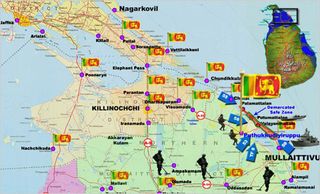
ScreenHunter_01 Feb. 17 12.41 Chomsky: I frankly doubt it because the Nuremburg trials, if they were serious, would have to avoid the profound immorality of the actual Nuremburg trials. Remember, the actual Nuremburg trials were trials of the defeated, not of the victors. In fact, the principle of the Nuremburg trials was that if the Allies had committed some crime, it wasn't a crime. So, for example, the German war criminals were not accused of bombing urban, civilian targets because the Allies did more of it than the Nazis did, and Nazi war criminals like submarine commander Dönitz was able to bring as defense witnesses, American and British counterparts who testified that they had done the same things so these automatically became non-crimes. In other words, a war crime is defined as something you did and we didn't do and that turns the trial into a sham. It has been a sham since. The Chief Justice at Nuremburg, Chief Robert Jackson, the American Chief Prosecutor, he made very strong statements at Nuremburg, admonishing the judges there that, as he put it, “we are handing the defendants a poison chalice and if we sip from it (meaning if we carry out crimes like theirs) then we must be subject to the same punishment.” Of course, nothing like that has happened or is even conceivable. Jackson said, “If we don't do this it means that the trial was a farce.” Well we haven't done it so that means the trial was a farce, even though the guilty were maybe the most guilty criminals in modern history. So a Trial modeled on Nuremburg would not be a good thing at all. It would simply be a trial of the defeated and that only engenders further hatred, anger, and promises an ugly conflict. An honest trial, which tries everyone, might be conceivable, but my guess is that it's probably not a good idea, just as it wasn't carried out in the countries that I mentioned.

More here.

Supercool Video Explains New F1 Rules

Chuck Squatriglia in Wired:

Red Bull Racing has put together a sweet animated video explaining the new rules Formula 1 has adopted for the 2009 season. Even if you aren't into F1, it's cool to see.

Formula 1 has adopted the most sweeping changes in the sport's history in an effort to increase overtaking and bring down the astronomical costs involved in racing. As we told you a couple of weeks ago, the new rules have significantly changed how the cars look. The rules effect everything from aerodynamics to tires to the number of engines each team can use during the season, which spans 17 races over 9 months.

Sebastian Vettel runs through what it all means and how it all works….

Are Academics Different?

Stanley Fish in the New York Times:

Fish That of course is the key question. Are academics different, and if so, in what ways, and to what extent do the differences legitimate a degree of freedom not enjoyed by the members of other professions? These and related questions were debated in Urofsky v. Gilmore (2000). In that case professors from a number of state colleges and universities in Virginia contended that their right of academic freedom was infringed by a law requiring state employers to gain permission from a supervisor before accessing sexually explicit materials on state-owned computers. Judge Wilkins, writing for the majority, treated the complaining professors as employees rather than as possessors of a special right, and observed that “It cannot be doubted that in order to pursue its legitimate goals effectively, the state must have the ability to control the manner in which its employees discharge their duties.” The professors had anticipated this reasoning and maintained that even if the law was “valid as to the majority of state employees, it violates the First Amendment freedom rights of professors at state colleges and universities.” Or, in other words, we understand the legal point, but it doesn’t apply to us, for we’re different.

More here.

Confessions of a Reluctant Flag-Waver

From The Root:

Presidents Day was once a rude interruption to Black History Month, a reminder of whose terms we were on. This Presidents Day I find myself celebrating.

Flagwaver There are cynical luxuries that come with being black in this country, like the ability to shrug off the dime-store rites of patriotism. We've seen America through a perpetually raised eyebrow, the yeah, whatever perspective that comes with the terrain on our side of American history. And here lies Presidents Day. Like July 4th, Thomas Jefferson and NASCAR— it comes awash in the crimson, white and navy trimming meant to remind us of our blessed status as Americans.

For most of my life, Presidents Day has been—aside from a day off—a crass interruption, a retaining wall built into Black History Month to ensure that we don't forget whose terms we're operating on. Even the name lacks purpose—there's no weighty adjective to highlight why a president warrants a holiday; no devotion to, say, those commanders in chief who were assassinated or who led the nation through particularly trying times. Years ago it was known as Washington's Birthday, which virtually guaranteed that some black people would give the notion the stiff-arm because honoring the first president means you are simultaneously celebrating a slaveholder.

But, as with all else concerning this country, it's not that simple. Black history and Presidents Day share an ancestral link in Abraham Lincoln. There was, in the receding tides of black history, a point when many of us admired him. Carter G. Woodson, who understood Lincoln's flaws better than most, nonetheless chose February for his inaugural “Negro History Week” because both Lincoln and Frederick Douglass were born that month.

More here.

In Pain and Joy of Envy, the Brain May Play a Role

Natalie Angier in The New York Times:

Envy Most human vices have enough sense to be very, very tempting. Lust, gluttony, sloth, hurling powerful if unimaginative expletives at a member of the political opposition, buying a pair of Thierry Rabotin snakeskin printed shoes at 25 percent off even though you just bought a pair of cherry-red slingbacks last week — all these things feel awfully good to indulge in, which is why people must be repeatedly abjured not to. One vice, however, dispenses with any hedonic trappings and instead feels so painful you would think it was a virtue, except that there’s no gain in lean muscle mass at the end: envy. Skulking at sixth place on traditional lists of the seven deadly sins, right between wrath and pride, envy is the deep, often hostile resentment you feel toward somebody who has something you want, like wealth, beauty, a promotion or the admiration of peers. It is a vice few can avoid yet nobody craves, for to experience envy is to feel small and inferior, a loser shrink-wrapped in spite.

“Envy is corrosive and ugly, and it can ruin your life,” said Richard H. Smith, a professor of psychology at the University of Kentucky who has written about envy. “If you’re an envious person, you have a hard time appreciating a lot of the good things that are out there, because you’re too busy worrying about how they reflect on the self.” Now researchers are gleaning insights into the neural and evolutionary underpinnings of envy, and why it can feel like a bodily illness or a physical blow. They’re also tracing the pathway of envy’s equally petty foil, the sensation of schadenfreude — taking pleasure when those whom you envied are themselves brought down low.

More here.

Zardari: We Underestimated Taliban Threat

From CBS News:

Asifzardari Of all the challenges facing President Obama, none will be more difficult to solve than the basket case that is Pakistan. The Muslim nation – whose support is critical to the U.S. mission in Afghanistan – is not only broke and embroiled in another crisis with its arch enemy India, it is now at war with Muslim extremists trying to destroy the government of President Asif Ali Zardari. As correspondent Steve Kroft reports, the growing insurgency run by the Taliban and al Qaeda is threatening the stability of a key U.S. ally that is believed to have as many as a hundred nuclear weapons.

For all of its 62 years, the government of Pakistan and its military have been obsessed with one thing: India, the enemy next door to the east with whom it has fought three wars. And every day for 50 of those years its soldiers at one of the border crossings have stared down their Indian counterparts, as their flags are raised and lowered.

But the biggest threat facing Pakistan today comes from within, from its lawless tribal territories on the western frontier, where the Taliban and al Qaeda were allowed to regroup and carry out attacks against U.S. troops across the border in Afghanistan, and now against the Pakistani government. During the past year, Islamic extremists have launched more than 600 terrorist attacks inside the country, killing more than 2,000 people. One suicide bombing last September, at the Marriott Hotel in the capital of Islamabad, killed 60 people just minutes away from the presidential offices, now occupied by a very unlikely leader, Asif Ali Zardari. Asked how important it is to stop extremism, President Zardari told Kroft, “It’s important enough. I lost my wife to it. My children's mother, the most populist leader of Pakistan. It's important to stop them and make sure that it doesn't happen again and they don't take over our way of life. That's what they want to do.”

More here. (Note: Thanks to AVM S.J.Raza).

Monday, February 16, 2009

Sunday, February 15, 2009

The Little Rock Nine

From factmonster.com:

AR_Little_Rock_Nine The Little Rock Nine, as they later came to be called, were the first black teenagers to attend all-white Central High School in Little Rock, Arkansas, in 1957. These remarkable young African-American students challenged segregation in the deep South and won.

Although Brown v. Board of Education outlawed segregation in schools, many racist school systems defied the law by intimidating and threatening black students—Central High School was a notorious example. But the Little Rock Nine were determined to attend the school and receive the same education offered to white students, no matter what. Things grew ugly and frightening right away. On the first day of school, the governor of Arkansas ordered the state's National Guard to block the black students from entering the school. Imagine what it must have been like to be a student confronted by armed soldiers! President Eisenhower had to send in federal troops to protect the students.

More here.

Realpolitik ambushes Obama, and not just at home: Uzbekistan

Christopher Flavelle in Slate:

ScreenHunter_02 Feb. 15 21.04 President Barack Obama's administration is not yet a month old, and editorialists have already accused the new president of losing his innocence after he was forced to abandon his lofty talk of bipartisanship over the economic stimulus plan. But a touch of partisan politics at home is nothing compared with the ethical predicament now looming in Central Asia, where Obama may soon need to choose either funding a vicious dictator in Uzbekistan or hindering the mission in Afghanistan. Getting into bed with Uzbekistan could be Obama's first ugly but necessary foreign-policy compromise.

On Feb. 3, Kurmanbek Bakiyev, the president of the Central Asian country of Kyrgyzstan, announced that he would close a U.S. air base that the United States opened in October 2001 to supply the campaign in neighboring Afghanistan. Two days after the Kyrgyz announcement, the AP reported that Washington is looking to reopen its air base in neighboring Uzbekistan, which had been shuttered in 2005, to take up the slack.

More here.

Darfur Update

Over at Security Council Report, as Japan takes over the Presidency of the Council:

Key Recent Developments

The situation in Darfur remains dire, with more than 2.5 million people living in internally displaced person (IDP) camps dependent on humanitarian assistance. Attacks against aid workers and their property reached unprecedented levels in 2008. These attacks were mainly attributed to rebel movements, but many incidents also occurred in areas under government control.

UNAMID has now lost 22 personnel, including a peacekeeper that died on 29 December. Violence and ongoing clashes continues to limit UNAMID and humanitarian access to affected populations.

Despite the unilateral declaration of a ceasefire on 12 November by the Government of Sudan, bombing attacks against rebels continue. In his briefing to the Council on 19 December, Under Secretary-General for Peacekeeping Operations, Alain Le Roy, said south and north Darfur had been bombed by the government in late November. After weeks of relative calm the Sudanese army bombed Justice and Equality Movement (JEM) positions in the Muhajeriya area of south Darfur on 13 January. Ground fighting between JEM forces and the government-backed faction of the Sudan Liberation Army/Movement led by Minni Minnawi (SLA/M) was also reported in the area, which hosts a civilian population of 30,000. On 18 January, JEM reportedly took full control of Muhajeriya, SLA/M’s former stronghold. Further government bombing was reported on 24 January. UNAMID reported 3,000 newly displaced as a result of the fighting. Clashes were also reported between the government and rebels on the outskirts of El Fasher in north Darfur on 26 January. Assistant Secretary-General for Peacekeeping Operations Edmond Mulet briefed the Council on the two situations in closed consultations on 28 January. The Council condemned the increased military activities and called on all parties to cease hostilities. In addition to clashes between the government and rebels, inter-ethnic fighting in other parts of south Darfur has resulted in hundreds of deaths since early December and the displacement of thousands of civilians.

Leading Rwanda Expert Killed in Buffalo Plane Crash

From the website of Human Rights Watch:

2009Alison_Des_Forges It is with enormous sadness that Human Rights Watch announces the death of our beloved colleague Dr. Alison Des Forges, who was killed in the crash of Flight 3407 from Newark to Buffalo on February 12, 2009. Des Forges, senior adviser to Human Rights Watch's Africa division for almost two decades, dedicated her life to working on Rwanda and was the world's leading expert on the 1994 Rwanda genocide and its aftermath.

“Alison's loss is a devastating blow not only to Human Rights Watch but also to the people of Rwanda and the Great Lakes region,” said Kenneth Roth, executive director of Human Rights Watch. “She was truly wonderful, the epitome of the human rights activist – principled, dispassionate, committed to the truth and to using that truth to protect ordinary people. She was among the first to highlight the ethnic tensions that led to the genocide, and when it happened and the world stood by and watched, Alison did everything humanly possible to save people. Then she wrote the definitive account. There was no one who knew more and did more to document the genocide and to help bring the perpetrators to justice.”

Des Forges, born in Schenectady, New York, in 1942, began working on Rwanda as a student and dedicated her life and work to understanding the country, to exposing the serial abuses suffered by its people and helping to bring about change. She was best known for her award-winning account of the genocide, “Leave None to Tell the Story,” and won a MacArthur Award (the “Genius Grant”) in 1999.

More here. [Thanks to Karen Ballentine.]

Space Collision Called ‘Catastrophic Event’

Vladimir Isachenkov of the Associated Press:

ScreenHunter_01 Feb. 15 19.35 The crash of two satellites has generated an estimated tens of thousands of pieces of space junk that could circle Earth and threaten other satellites for the next 10,000 years, space experts said Friday.

One expert called the collision “a catastrophic event” that he hoped would force President Barack Obama's administration to address the long-ignored issue of debris in space.

Russian Mission Control chief Vladimir Solovyov said Tuesday's smashup of a derelict Russian military satellite and a working U.S. Iridium commercial satellite occurred in the busiest part of near-Earth space — some 500 miles (800 kilometers) above Earth.

“800 kilometers is a very popular orbit which is used by Earth-tracking and communications satellites,” Solovyov told reporters Friday. “The clouds of debris pose a serious danger to them.”

Solovyov said debris from the collision could stay in orbit for up to 10,000 years and even tiny fragments threaten spacecraft because both travel at such a high orbiting speed.

More here.