No individual ‘fathered’ modern African literature

From The Guardian:

Chinua-Achebe-in-2002-002 As soon as I heard about Chinua Achebe's rejection of the label “father of modern African literature“, I did two Google searches. One, was for “father of modern European literature” for, surely, if modern African literature has a father, European literature could not possibly be a bastard. The second, was for “father of primitive African literature”, since such a competent fatherless father (which in this case would be Achebe) would be something worth documenting. I hate to disappoint eager readers, but both searches drew a blank.

I thoroughly agree with Achebe's rejection of the label, because, as he has said, “there were many of us – many, many of us”.

More here.
Black in the Age of Obama

Charles M. Blow in the New York Times:

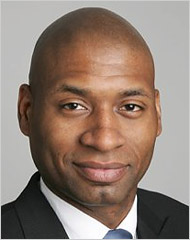
Blow_portrait_190 We are now inundated with examples of overt racism on a scale to which we are unaccustomed. Any protester with a racist poster can hijack a news cycle, while a racist image can live forever on the Internet. In fact, racially offensive images of the first couple are so prolific online that Google now runs an apologetic ad with the results of image searches of them.

And it’s not all words and images; it’s actions as well. According to the Federal Bureau of Investigation’s 2008 hate crimes data released last week, anti-black hate crimes rose 4 percent from 2007, while the combined hate crimes against all other racial categories declined 11 percent. If you look at the two-year trend, which would include Obama’s ascension as a candidate, anti-black hate crimes have risen 8 percent, while those against the other racial groups have fallen 19 percent.

This has had a sobering effect on blacks. According to a Nov. 9 report from Gallup, last summer 23 percent of blacks thought that race relations would get a lot better with the election of Obama. Now less than half that percentage says that things have actually gotten a lot better.

More here.

Saturday, December 5, 2009

The Warwick Commission on International Financial Reform

Warwick At the University of Warwick:

The current international financial crisis asks us to rethink our answer to an important question: what are our financial systems for? The Warwick Commission on International Financial Reform provides an answer by bringing together a range of world-class economists, political scientists, and lawyers to explore how we can best enhance international financial stability through regulation that is sensitive to variations in what countries want from their financial systems. The Commission has identified key reforms for a well-regulated financial system. Among these reforms is a stress on dealing with boom-bust cycles, introducing macro-prudential regulation, recognising the need for a better allocation of risks among financial institutions, dealing with issues of regulatory capture, and bolstering national rules with international coordination to promote international financial stability. The Commission's report is now available to read here

. Here are videos on Warwick Commission scholars discussing the report and the commission.

A Distant Pleasure

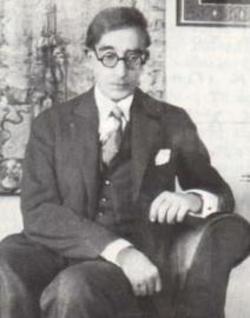
Cavafy Keith Taylor on two new translations of Constantine Cavafy's poems:

My obsession with C.P. Cavafy, the definitive poet of modern Greek, started almost 40 years ago. Neither classicist nor philologist, certainly not a systematic scholar of anything, I was captivated by the poems that allowed immediate access, such as the famous “Waiting for the Barbarians,” where the irony of the ending—“And now what’s to become of us without barbarians. / Those people were a solution of a sort”—loses none of its power for its lack of subtlety.

I puzzled over other poems, too: what could I make of the music in “The God Abandons Anthony?” What was it, and where was it going? I looked for answers. As histories of the classical world, of the Hellenized Levant, of the transition from paganism to Christianity, and of Byzantium presented themselves to me in haphazard ways, I felt compelled to read them simply because they might help me understand a Cavafy poem. When the opportunity came to study modern Greek, I jumped at it. A large part of my reading life revolved around Cavafy. Many have been equally fascinated.

I know bookstore clerks, the assistant manager of a grocery store, and a professor of mathematics who can quote part of the almost canonical Edmund Keeley and Philip Sherrard translation of “Ithaka”: “As you set out for Ithaka / hope the voyage is a long one, / full of adventure, / full of discovery.” After Maurice Tempelsman read this translation at the funeral of Jacqueline Kennedy Onassis, the poem assumed a special place in the American national story. It might be impossible and unnecessary for a new translation to supplant that. Still, Daniel Mendelsohn’s new C.P. Cavafy: Collected Poems has provided context and versions of the poems that deepen and sometimes fundamentally alter our sense of many of them, and of the poet himself.

enlightening todorov

9781843548133

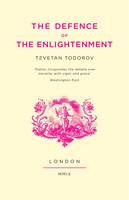
There is a sect of rationalists who never cease harping on the childishness of religion, and it has to be admitted that there is sometimes something to their complaint. One of the symptoms of a childish mentality – a condition that afflicts adults, not children – is the conviction that things must be either good or bad. Evil can never come from good, it is believed, for the essential nature of good is to be simple and pure. The essence of the Christian religion, for example, is love. In that case, how could Christianity have anything to do with religious warfare or persecution? Such blemishes can only be the result of a perversion of Christian teaching, which in its original purity contained nothing hateful. No doubt much that is odious has been done in its name, but Christianity – the essence or spirit of the religion – is innocent of all evil. This is childish reasoning, if only because it fails to understand that like every religion Christianity is made up from a variety of sources, not all of them wholly benign. Pure Christianity is a figment of fundamentalism, a way of thinking that is typical of the childish mind. But fundamentalism is by no means confined to those who call themselves fundamentalists, or to religious believers. Nowadays it is defenders of the Enlightenment who provide some of the best examples of fundamentalist thinking, and Tzvetan Todorov is a case in point. In this stiff and leaden volume he seeks to rescue the Enlightenment from distortions. He does so in the faith that once it has been properly understood no one – no one who is not fanatical, deluded or ill-willing, at any rate – can fail to accept the Enlightenment’s essential message.

more from John Gray at Literary Review here.

the master of shadows

50822262-01165324

It’s hard to imagine an artist more thoroughly out of fashion than the great 17th century Flemish master Peter Paul Rubens. Even the adjectives with which his name is associated are out of style. A contemporary woman described as “Rubenesque” certainly would be affronted and, in Los Angeles, probably reduced to tears. High Baroque, the style in which he painted, is nowadays synonymous with pointless complexity. The classical texts that inspired so many of his masterpieces are nowadays little read outside specialized academia. The fervent Counter-Reformation aesthetic that animates the great altar pieces and devotional paintings seems more than slightly overheated, even to those remnant Catholic traditionalists to whom the era’s theology still speaks

more from Tim Rutten at the LA Times here.

the red book

ArticleLarge

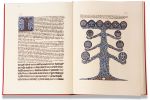
From 1914 until 1930, C. G. Jung recorded, revised, rewrote, recopied and painstakingly illustrated what he considered “the numinous beginning” from which all the rest of his work derived. “The Red Book,” or as Jung called it, “Liber Novus,” consisted of some 200 parchment pages of meticulous calligraphy and visionary paintings collected into a huge folio bound in red leather. While its content, either whole or in part, was made available to a handful of colleagues and patients, its publication was postponed until now, nearly 50 years after his death, because Jung feared the book’s potential impact on his reputation. After all, anyone who read it might conclude what Jung himself first suspected: that the great doctor had lost his mind. Jung began what would become “The Red Book” shortly after he had fallen out with Freud, each unable to accept the other’s understanding of the unconscious. Though Jung agreed with Freud’s basic theory that the unconscious mind existed beyond the reach of consciousness and yet influenced human behavior, he believed Freud’s conception of it as a dark vault of repressed urges and denied emotions was incomplete and unnecessarily negative — too focused on neurosis. The 1912 publication of Jung’s “Psychology of the Unconscious,” which had grown out of his psychoanalysis of the heroes and heroines of “mythology, folklore and religion” made the two doctors’ differences of opinion public, and the Zurich Psychoanalytical Society, with which Jung was actively involved, broke away from Freud’s International Psychoanalytic Association.

more from Kathryn Harrison at the NYT here.

Saturday Poem

A Man is Only as Good . . .

A man is only as good
as what he says to a dog
when he has to get up out of bed
in the middle of a wintry night
because some damned dog has been barking;

and he goes and opens the door
in his vest and boxer shorts
and there on the pock-marked wasteground
called a playing field out front
he finds the mutt with one paw

raised in expectation
and an expression that says Thank God
for a minute there I thought
there was no one awake but me
in this goddamned town.


by Pat Boran

from New and Selected Poems
Dedalus Press, Dublin, 2007

Angels to Radios: On Rainer Maria Rilke

From The Nation:

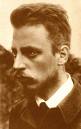
Rilke It is said that the tradition of English poetry began with Caedmon–an illiterate seventh-century lay brother who, ashamed of his inability to versify when the harp was passed around at a feast, fell asleep in his stable among the animals and dreamed of an angel. This angel, too, bade him sing, and again Caedmon protested that he did not know any songs; but then, inexplicably, he found himself obeying the angel's dictum: “Sing the beginning of the creatures!” Immediately on waking he wrote down the eulogy to the world and its maker that had been transmitted to him in his dream; today the nine-line Anglo-Saxon “Caedmon's Hymn” is the earliest known English poem–a product of what poets now often call “dictation.” The gods (or God), the muses (or the Muse); afflatus, ecstasy, poetic madness: the lore of poetry worldwide attests to the claim that poetry at its best emerges from somewhere “other”–a source beyond the poet's ego and conscious mind. Sometimes the poem appears in dreams, as with Caedmon; sometimes during autohypnosis, as with William Butler Yeats. James Merrill's medium of choice was his Ouija board; Jack Spicer's, his orphic radio. A key interchange in the transition from angels to radios is the visionary poetry of Rainer Maria Rilke.

More here.

Listen, if you will, to the voice of hatred.

Adil Najam at All Things Pakistan:

Once again, Pakistanis stare into the darkness of nothingness, looking for answers. There are few words of sympathy from those who claim to be our friends. There are only sneers and jeers from those who are our enemies.

Why, one asks, why? Why do they hate us so?

In this video interview one would-be suicide bomber speaks up. It is harrowing. Listen, if you will, to the voice of hatred. Listen, if you can, to what Pakistan’s enemy sounds like.

More here.

Art v books: a critical double standard

Jonathan Jones in The Guardian:

ScreenHunter_13 Dec. 05 12.10 “This year's Booker shortlist was worthless; none of the novelists on it has any chance of being remembered in 50 years, none of these books can compare for one second with the great tradition of English literature. Set one of these minor talents alongside a Jane Austen or a Joseph Conrad, and it is clear we live in mediocre cultural times. The Booker should be abolished.”

No, I've never read a comment like that about a Booker prize shortlist either. I have, however, read (and written) many such critiques of Turner prize shortlists. But why does contemporary art get such a rough ride in comparison with the contemporary novel?

Critics and the public are prepared to say infinitely more dismissive things about new art than ever gets said about new literary fiction: it's common for modern art to be mocked as “junk”, but rare for even the most outrageous or embarrassing novel to be dismissed as not worth the paper it's written on.

More here.

The Diaries of Sofia Tolstoy

From The Guardian:

Leo-Tolstoy-Sitting-with--001 For Leo Tolstoy and his extended household, diaries were an early version of Facebook. Everyone had his or her own page, and most people were fanatical recorders of their own feelings. The great man himself kept voluminous diaries, making entries almost to the day of his death. His doctor, his secretary, his disciples, his children, and – most of all – his wife also kept journals. Of these, the greatest diarist of them all was Sofia, the Countess Tolstoy.

She began keeping diaries at 16 but did so avidly after 1862, when she married Tolstoy. She never stopped writing in her journal until her death in 1919, as the Bolshevik revolution threatened to overwhelm Yasnaya Polyana, the 4,000-acre estate where she had lived for more than half a century. “There was a meeting to decide how best to defend Yasnaya Polyana against looting,” she writes in her final entry. “Nothing has yet been decided. Carts, oxen and people are streaming down the highway to Tula.” History, as it were, threatened to destroy everything she loved. Tolstoy was of noble lineage, with a large estate and many celebrated books to his name. He had travelled widely in the west, and gambling and whoring were particular obsessions. Yet he seemed willing, even eager, to settle down with an innocent girl of 19, who eventually bore him 13 children, helped him in his work (she personally copied out War and Peace as well as Anna Karenina many times), and supervised a complex estate.

More here.

Friday, December 4, 2009

Crawling Around with Baltimore Street Rats

Abigail Tucker in Smithsonian Magazine:

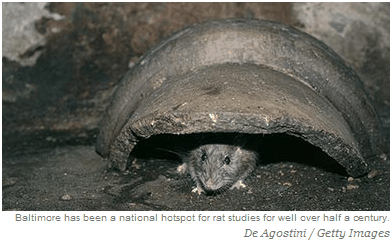
ScreenHunter_12 Dec. 05 10.47 Glass has been following the secret lives of wild Norway rats – otherwise known as brown rats, wharf rats, or, most evocatively, sewer rats — for more than two decades now, but Baltimore has been a national hotspot for rat studies for well over half a century. The research push began during World War II, when thousands of troops in the South Pacific came down with the rat-carried tsutsugamushi disease, and the Allies also feared that the Germans and Japanese would release rats to spread the plague. Rats were wreaking havoc on the home front, too, as Christine Keiner notes in her 2005 article in the academic journal Endeavor. Rats can chew through wire and even steel, obliterating infrastructure. Rodent-related damage cost the country an estimated $200 million in 1942 alone. Rat bites were reaching record highs in some areas.

Worst of all, one of the only tried-and-true rat poisons –an extract from the bulb of the Mediterranean red squill plant–was suddenly unavailable, because the Axis powers had blockaded the Mediterranean. Scientists scrambled to find a chemical substitute.

More here.

Bad Sex in Fiction Award 2009

From Literary Review:

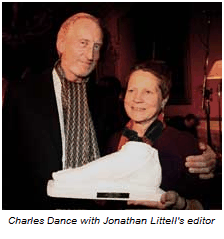
ScreenHunter_11 Dec. 05 10.38 Jonathan Littell has won the seventeenth annual Literary Review Bad Sex in Fiction Award, for The Kindly Ones (Chatto & Windus). The prize (a plaster foot) was presented by award-winning actor Charles Dance. It was accepted on Littell's behalf by his editor at Chatto & Windus, Alison Samuel.

The awards were announced at a lavish ceremony on Monday 30th November 2009, at the In & Out (Naval & Military) Club in St James's Square, where the 400 guests raised a toast to the winner.

The Kindly Ones, originally published in French, won the Prix Goncourt in 2006. It has sold over a million copies in Europe.

The judges used the occasion to praise an ambitious and impressive novel. They said: 'It is in part a work of genius. However, a mythologically inspired passage and lines such as “I came suddenly, a jolt that emptied my head like a spoon scraping the inside of a soft-boiled egg” clinched the award for The Kindly Ones. We hope he takes it in good humour.'

Jonathan Littell was unavailable for comment.

More here.

The Origin of Big

Carl Zimmer in his excellent blog, The Loom:

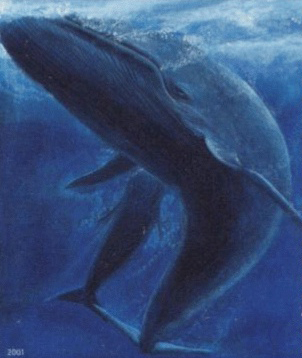
Faroe_stamp_402_blue_whale_(Balaenoptera_musculus)_crop On this happy anniversay–the 150th anniversary of the Origin of Species–let us contemplate one of evolution’s great works: the origin of giants.

Whales are the biggest animals to ever live. Blue whales can get up to 160 tons–about as heavy as 2000 grown men. They are trailed in the rankings by the fin whale and a few other related species of whales. There are no lobsters in their ranks, no clams, no rodents. All these giants feed in much the same way. They swallow up water and filter it through fronds in their mouths called baleen. Most of the food they eat is tiny stuff, like krill and other small invertebrates. So some scientists have wondered how big whales manage to put enough tiny bits of food in their bodies to get to such huge sizes.

Unfortunately, whales dine out of sight, so scientists have had to tackle those questions with indirect clues. Jeremy Goldbogen, a biologist now at the University of British Columbia, has gathered all the clues he can, from data recorders carried by diving fin whales to video of baleen whales feeding near the ocean surface. To make sense of that data, he has worked with zoologist Robert Shadwick and ad paleontologist Nick Pyenson, also of UBC, as well as Jean Potvin, a physicist whose speciality is parachutes.

Yes. Parachutes. Let me explain.

More here.

Controversial Signs of Mass Cannibalism

From Wired:

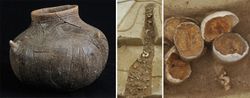
Cannibalism At a settlement in what is now southern Germany, the menu turned gruesome 7,000 years ago. Over a period of perhaps a few decades, hundreds of people were butchered and eaten before parts of their bodies were thrown into oval pits, a new study suggests. Cannibalism at the village, now called Herxheim, may have occurred during ceremonies in which people from near and far brought slaves, war prisoners or other dependents for ritual sacrifice, propose anthropologist Bruno Boulestin of the University of Bordeaux 1 in France and his colleagues. A social and political crisis in central Europe at that time triggered various forms of violence, the researchers suspect.

“Human sacrifice at Herxheim is a hypothesis that’s difficult to prove right now, but we have evidence that several hundred people were eaten over a brief period,” Boulestin says. Skeletal markings indicate that human bodies were butchered in the same way as animals. Herxheim offers rare evidence of cannibalism during Europe’s early Neolithic period, when farming first spread, the researchers report in the December Antiquity. Artifacts found at Herxheim come from the Linear Pottery Culture, which flourished in western and central Europe from about 7,500 to 7,000 years ago.

More here.

Iranian protest movement is alive

3QD friend Hadi Ghaemi in The Huffington Post:

ScreenHunter_10 Dec. 04 14.05 Much of the international public and media consider mass protests in Iran to have ended, because images of hundreds of thousands of demonstrators no longer appear on TV screens and front pages, as they did in June and July. But the protest movement is alive and continues to challenge the legitimacy of Mahmoud Ahmadinejad's government, and to demand fundamental rights.

At the forefront of this movement are university students. Iranian campuses are scenes of daily protests. Monday, December 7, is the National Student Day in Iran. It commemorates events back in 1953, when few months after a CIA-backed coup restored the monarchy at the expense of overthrowing the democratic government of Prime Minister Mohammad Mossadeq. On December 7, 1953, military forces put down student protests at Tehran University, killing three student leaders. Ever since, December 7 has been the symbol of standing up to tyrannical rule and dictatorship.

This year, the civil rights movement in Iran is seizing on the historical importance of this day to once more stage protests.

More here.

Friday Poem

Apple-Pears

each ninth month of the year
the buds fallen & fruit forming
copper-gold jewels a child’s round cheeks

sah-lay, we call them, the sound of new seasons
two notes plucked from a song played on strings

they came to us: Chinese fruit to a Chinese family
from wartime sailboats, Captain Blueberry
guarding cuttings in his metal chest
my parents planted it like Jack’s magic seed
in time, the fruit came like doubloons

* * *

we explain they are apple-
pears, I explain them like I explain myself:
like one thing, like another
but neither, you must taste it to know it

as I leave for university
the sah-lay skins are yellow and green

mother & I find two ripe small imploded moons
we peel & cut the flesh honied & crisp
the translucence is still
on my tongue when I say goodbye:

mother’s efficient hug, brisk, her
small frame bony under my arms
father’s soft belly & tilted head
embrace, his eyes water

reaching high altitude, I recline
pocket of impossible life amidst thousands
of miles of empty air and light
dwarf nuggets hidden in
my body turn fibrous, dissolve.

by Andy Quan

from Slant
publisher: Nightwood Editions, Madeira Park, B.C., 2001

Mind Matters: In Defense of Downtime

From Science:

AlarmClock_Comstock_160 When I was first employed by a government research organization some years ago, my supervisor, although bright, kind, and productive, was so committed that she regularly labored into the wee hours of the morning and on weekends. She rarely took vacations. No one who worked with her could keep up with the pace, certainly not me. Typically, I would leave work at about 6 or 7 each evening after crossing off most of the items on my to-do list. Invariably, when I returned the next morning before 8, my in box was overflowing.

Lacking control over my workload, I felt stressed. My productivity suffered, as did my morale. Other employees became so dispirited and worn out that they left. (These were days when jobs were abundant.) Nonstop work–without sufficient downtime for family, friends, and solitude–violates the natural rhythms of life and nature. My supervisor was a perfectionist: obsessive, competitive, extremely mission-driven, and excessively failure-aversive. These traits made it difficult for her to set healthy boundaries between work and the rest of her life. And those traits affected not just her life but also the lives of all the members of the team.

More here.

Venas Abiertas

Nikil Saval in n + 1:

ScreenHunter_09 Dec. 04 11.39 In nearly every respect, the coup in Honduras was an almost parodic recreation of the old, bad times of military dictatorships in the 60s and 70s, when coups swept nearly every country in Latin America. The story inevitably involved a president who threatened to undermine bourgeois (and thereby US) interests, however modestly, and thus signed away his life and liberty. Deposed President Manuel Zelaya, who in his administration's early stages might have seemed yet another empty elite candidate from his country's Liberal Party, moved slightly left under the pressure of social movements, raising the minimum wage and publicly speaking about badly needed agrarian reforms in his desperately poor country (the third poorest in the Western hemisphere, after Haiti and Nicaragua). Popular desire for more inclusion in the political process led to a non-binding “encuesta,” or poll, regarding the formation of a Constituent Assembly to reform the constitution, which, due to its inconsistencies and enshrinement of the old, wealthy landowning class, Costa Rican president Oscar Arias has called “the worst constitution in the world.”

Zelaya's moves towards greater reforms threatened the country's long-entrenched power elite. His modest fraternizing with Venezuelan President Hugo Chavez, who provided subsidized oil to the country, suggested a hidden hand in the reforms (in fact, the result of national-popular, rather than foreign, pressure). When the coup came, the only surprise was that the US did not have a direct hand in supporting it. The indirect hand, however, like God in his universe, was everywhere visible.

More here.