Helping strangers, learning other lives and escaping escapism: a conversation with filmmaker Ramin Bahrani

Ramin Bahrani is the director of such films as Man Push Cart, Chop Shop and the new Goodbye Solo. He was named, somewhat controversially, as being on the vanguard of the “neo-neo realism” by A.O. Scott in the New York Times and called “the new great American director” by Roger Ebert. Colin Marshall originally conducted this conversation on the public radio show and podcast The Marketplace of Ideas.

Bahrani, Ramin, director of CHO I’ve been reading Roger Ebert for over ten years, and I’ve never seen him praise someone as much as he praises you. He’s given your films four stars, he’s put Chop Shop on his list of “the great movies”, he had this wonderful blog post about you. How must this feel, to get such accolades from a man like Ebert?


It’s very humbling, and I’m very grateful because Roger Ebert is a legendary critic, known as the most important in America for decades. I’d like to stress that it’s not just me; he’s said this about a handful of other important directors that I really learned a lot from, like Martin Scorsese, and that makes it all the more wonderful a feeling. Watching Mean Streets as a teenager was one of the most important cinematic moments of my life. It really got me interested in making movies, and what kind of movies, and how to make them. Roger has the ability to write about films in a profound way anyone could understand, and that’s a rare gift. I really appreciate all that he’s done for my films.

It must also feel, just looking at this from the outside, that there’s a little bit of a – maybe a lot of an – “upping the ante” feel to it. Is there an anxiety-inducing side to this?

It’s natural for any artist, when the work seems to be catching on and people are paying attention and enjoying it, that there’s always some kind of an anxiety. You want to make sure the next one is good too, but when it actually comes to the nitty-gritty of doing the work or writing the script, making the film, it’s important to put those things aside. Just follow your own vision and do your best to make a film you believe in, that you believe an audience could enjoy and appreciate and understand and be challenged by. That’s what I’m working on now. I’m working on a new project, and at some point you really just have to put everything aside and move forward.

It just has to be you, your collaborators, the project and nothing else in your mind?

I’m glad you mention the collaborators. That’s a big part of it: Michael Simmonds, my cinematographer, my co-writer and others, but I do think about the audience with every film. It’s incredibly important, as we’re working, to make sure: can the audience understand what’s going on? I don’t just mean plot-wise, which is critical – can the audience understand what’s going on in the story? – but if we’re going after certain emotions, or if we’re going after certain ideas or certain questions, do we think the audience can understand those? Increasingly, what’s been on my mind with each film, Chop Shop and Goodbye Solo even more: would an audience be engaged by the story? Not just wonderful people like you who love movies and are cinephiles, but I honestly. and my collaborators also, we think about our moms, our brothers. People who like good movies but aren’t necessarily cinephiles. Could they enjoy the movie also?

Read more »

Sunday, January 24, 2010

Can Pop Music Survive Without a Mass Market?

1261594563-largeJ. Gabriel Boylan in The Nation:

Unlike the introduction of the compact disc, which was developed by major labels and music retailers, as well as Phillips and Sony, the current tumult was unplanned and unforeseen. Digital technology has put far more power in the hands of ordinary consumers to wrest music from its gatekeepers. But crashing the gates has caused the music economy to dip down between cheap and free; people are storing more music on their hard drives than they're likely to listen to in the next decade, yet major labels, music retailers and even jukebox manufacturers are spiraling toward obsolescence. Offbeat and invaluable aspects of the mass music experience are slipping away as well, from the cranky exclusivity of the niche record shop to the tastemaking role of college radio to the music press itself.

The conventional, romantic view of the history of popular music is one of pure eras and movements reaching a creative peak before being co-opted, oversold or otherwise spoiled by runaway commercialism. Ragtime enthusiasts, rockabilly fans and punk proselytizers all claim that the early days of their favorite pet sounds were the best, most revolutionary and purest. The only truly lucky genres are those nobody ever liked–at least they were able to fade away honorably. The history of the popular music industry is often told in the same way, from its quirky, tentative beginnings through its benign, if greedy, golden age, when big labels could be handmaiden to terrific music reaching the masses. The cause of the industry's demise, the story goes, was avarice: the labels prized dastardly strategies for persuading music fans to part with as much cash as possible. The result, then, is the current mess. The potential chaos of a future where music is unprotected and unsellable (that is, an unviable profit center for labels or artists) might be worrying, but it's a prospect the industry created. Kot, a music critic at the Chicago Tribune, is excited about the new ways that bands are selling their music and trying honorably not to fade away. He is pleased that digital technology allows music to live and breathe beyond the grip of the record industry, which he thinks doesn't deserve any sympathy, since its response to the digital revolution has been not bold ideas about marketing or distribution but lots of lawsuits.

Iago and the Apologetics of Evil

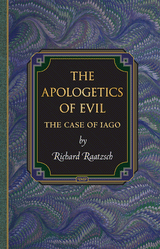
J8926 Over at Notre Dame Philosophical Review, Colin McGinn on Richard Raatzsch's The Apologetics of Evil: The Case of Iago:

Perhaps Iago is the only person not puzzled by Iago, and there are signs in the play that he isn't entirely clear about Iago either. We know his actions perfectly well, and he works as a dramatic figure, but we don't understand why he does what he does — we don't grasp his motivation. We observe his plot to destroy Othello by instilling jealousy (and incidentally Cassio and Desdemona) but we don't discover what motivates him to undertake such a plot — with its evil, its risk, and its extremity. Worse, we seem to apprehend that he has no motivation; he is a motivational blank tablet, ontologically not merely epistemologically. In The Apologetics of Evil Richard Raatzsch edges probingly around this void, trying his best to make sense of it: his book is astute, determined, sensitive — but not an unmitigated success. The puzzle of Iago persists.

Raatzsch is on the right track when he notes the phonetic affinity of “Iago” and “ego”: Iago is certainly egotistical, egoistic, and egocentric. He recognizes no standard beyond himself; indeed, he hardly seems to grasp the reality of other people at all, save as tools, marks and dupes — always means, never ends. Raatzsch sees the character Iago as an incarnation of what he calls the “the concept of Iago”, the idea he embodies: he is best understood as a paradigm or exemplar. But it is still unclear what concept he embodies. He seems like a pathological version of something, but of what exactly? Iago is memorable and exciting, and universally hated by audiences of Othello; we have strong feelings about him. He also seems locked in a kind of dark conceptual symbiosis with Othello — as if he is the other half of a hybrid organism. Othello is warm, ingenuous, honorable, trusting, yet fatally credulous and weak; Iago is none of those things, but cold, deceptive, manipulative, and impervious to anything but his own perverse will. We feel we understand Othello — only too well, in fact — while Iago challenges our normal ways of explaining human action. It all seems so gratuitous.

The introduction to the book can be found here.

$123,000,000,000,000*

China_flagsRobert Fogel makes the case that we’re underestimating China’s rise, in Foreign Policy:

In 2040, the Chinese economy will reach $123 trillion, or nearly three times the economic output of the entire globe in 2000. China’s per capita income will hit $85,000, more than double the forecast for the European Union, and also much higher than that of India and Japan. In other words, the average Chinese megacity dweller will be living twice as well as the average Frenchman when China goes from a poor country in 2000 to a superrich country in 2040. Although it will not have overtaken the United States in per capita wealth, according to my forecasts, China’s share of global GDP — 40 percent — will dwarf that of the United States (14 percent) and the European Union (5 percent) 30 years from now. This is what economic hegemony will look like.

Most accounts of China’s economic ascent offer little but vague or threatening generalities, and they usually grossly underestimate the extent of the rise — and how fast it’s coming. (For instance, a recent study by the Carnegie Endowment for International Peace predicts that by 2050, China’s economy will be just 20 percent larger than that of the United States.) Such accounts fail to fully credit the forces at work behind China’s recent success or understand how those trends will shape the future. Even China’s own economic data in some ways actually underestimate economic outputs.

It’s the same story with the relative decline of a Europe plagued by falling fertility as its era of global economic clout finally ends. Here, too, the trajectory will be more sudden and stark than most reporting suggests. Europe’s low birthrate and its muted consumerism mean its contribution to global GDP will tumble to a quarter of its current share within 30 years. At that point, the economy of the 15 earliest EU countries combined will be an eighth the size of China’s.

This is what the future will look like in a generation. It’s coming sooner than we think.

What, precisely, does China have going so right for it?

Sunday Poem

Danse Russe

If when my wife is sleeping
and the baby and Kathleen
are sleeping
and the sun is a flame-white disc
in silken mists
above shining trees,
if I in my north room
dance naked, grotesquely
before my mirror
waving my shirt around my head
and singing softly to myself:
“I am lonely, lonely.
I was born to be lonely,
I am best so!”
If I admire my arms, my face,
my shoulders, flanks, buttocks
against the yellow drawn shades,
Who shall say I am not
the happy genius of my housedhold?

by William Carlos Williams, 1917

My Life with the Taliban

From The Telegraph:

Taliban-m_1564470f Spies, generals and ambassadors will pounce on this book, poring over its pages for clues to a way out of the Afghan morass. They will be disappointed, and perhaps dismayed as well. Mullah Abdul Salam Zaeef, a founder of the Taliban in 1994 and a minister during its short-lived regime, has much to say about the wars in Afghanistan and the roles he has played in them. As a teenage refugee from the Soviet invasion, he joined the mujahideen, and a few years later was fighting alongside Mullah Omar when the future Taliban leader lost an eye.

He has written a fascinating account of his own remarkable life which gives real insight into why the Taliban was formed, what motivates it, and what it is now trying to achieve. It is what he has to say about hopes of ending the current war, however, that will be of most interest to the spooks and diplomats in Kabul, Washington and London; they will have been hoping that Mullah Zaeef would point the way towards a negotiated end to the fighting. But he does not, and what he has to say suggests that ending the bloodshed could prove extremely difficult, if possible at all.

More here.

How a Lack of Control Leads to Superstition

Michael Shermer in Scientific American:

Cultivate-your-garden_1 Imagine a time in your life when you felt out of control—anything from getting lost to losing a job. Now look at the top illustration on this page. What do you see? Such a scenario was presented to subjects in a 2008 experiment by Jennifer Whitson of the University of Texas at Austin and her colleague Adam Galinsky of Northwestern University. Their study, entitled “Lacking Control Increases Illusory Pattern Perception,” was published in Science.

Defining “illusory pattern perception” (what I call “patternicity”) as “the identification of a coherent and meaningful interrelationship among a set of random or unrelated stimuli … (such as the tendency to perceive false correlations, see imaginary figures, form superstitious rituals, and embrace conspiracy beliefs, among others),” the researchers’ thesis was that “when individuals are unable to gain a sense of control objectively, they will try to gain it perceptually.” As Whitson explained the psychology to me, “Feelings of control are essential for our well-being—we think clearer and make better decisions when we feel we are in control. Lacking control is highly aversive, so we instinctive­ly seek out patterns to regain control—even if those patterns are illusory.”

More here.

Whitewashing Haiti’s History

Sidney Mintz in the Boston Review:

Every medium of communication in the world is now overrun with pronouncements about Haiti. Many have been ill-informed, and a few maliciously intemperate. The extreme comments have the effect of making those that are mildly reasonable in tone seem more reliable; some, more so than they deserve. The New York Times, for instance, editorializes about Haiti’s “generations of misrule, poverty and political strife,” as if those nouns were enough to explain the history of Haiti.

HAITi%20flag Nations have beginnings, and then national histories, and the history of each is unique. I know how obvious that is. But the penchant among journalists and political scientists for creating phony categories such as “kleptocracies,” “developing nations,” and “failed states,” and then using these categories to obstruct serious talk, in this case about Haiti, immobilizes us and conceals the need to uncover the weight of local and particular history.

The New World’s second republic has indeed known political strife, bad leadership, and poverty. But to judge Haiti fairly, it is essential to remember that the country won its independence under the worst imaginable circumstances. The Haitians declared their freedom in 1804, when the New World was mostly made up of European colonies (and the United States) all busily extracting wealth from the labor of millions of slaves. This included Haiti’s neighbors, the island colonies of France, Great Britain, Denmark, and The Netherlands, among others. From the United States to Brazil, the reality of Haitian liberation shook the empire of the whip to the core. Needless to say, no liberal-minded aristocrats or other Europeans joined the rebel side in the Haitian Revolution, as some had in the American Revolution.

The inescapable truth is that “the world” never forgave Haiti for its revolution, because the slaves freed themselves.

More here.

Bed sharing ‘drains men’s brains’

From the BBC:

ScreenHunter_02 Jan. 24 09.33 When men spend the night with a bed mate their sleep is disturbed, whether they make love or not, and this impairs their mental ability the next day.

The lack of sleep also increases a man's stress hormone levels.

According to the New Scientist study, women who share a bed fare better because they sleep more deeply.

Professor Gerhard Kloesch and colleagues at the University of Vienna studied eight unmarried, childless couples in their 20s.

Each couple was asked to spend 10 nights sleeping together and 10 apart while the scientists assessed their rest patterns with questionnaires and wrist activity monitors.

The next day the couples were asked to perform simple cognitive tests and had their stress hormone levels checked.

More here. [Thanks to Kris Kotarski.]

Saturday, January 23, 2010

Losing Andrew Lange

Jennifer Oullette in Discovery News:

ScreenHunter_01 Jan. 24 09.24 Cosmology suffered a great loss yesterday with the passing of Andrew Lange, co-leader of the BOOMERang experiment, which provided the first experimental evidence that our universe is flat, and offered strong support to the supernova evidence for dark energy. Lang was a professor of physics at Caltech, and that tight-knit community is reeling from the news that Lange apparently took his own life. I only met Lange once, but my husband Sean, a Caltech colleague, knew him well and offers his own eulogy (of sorts) over at Cosmic Variance:

It’s hard to convey how unexpected and tragic this news is. Very few people combined Andrew’s brilliance as a scientist with his warmth as a person. He always had a sparkle in his eye, was enthusiastically in love with science and ideas, and was constantly doing his best to make Caltech the best possible place, not just for himself but for everyone else around him. He was one of the good guys. The last I spoke with him, Andrew was energetically raising funds for a new submillimeter telescope, organizing conferences, and helping plan for a new theoretical physics center. We are all walking around in shock, wondering how this could happen and whether we could have done anything to prevent it.

The only way I can think to honor Lange is to tell you a bit more about his most famous work. BOOMERang stands for Balloon Observations Of Millimetric Extragalactic Radiation and Geophysics, and it's essentially a balloon-borne telescope designed to make measurements of the cosmic microwave background radiation — the “afterglow” of the Big Bang that still pervades our universe. The first flight, in 1997, concentrated on North America, while two subsequent flights in 1998 and 2003 circled the South Pole.

More here.

Mass homeopathy overdose

Catherine Bennett in The Guardian:

Homeopathy1 There is still time to sign up for one of the most rational dates of 2010: next week's mass homeopathy overdose. At 10.23am on Saturday 30 January, anti-homeopathy activists, organised by the Merseyside Skeptics Society, will down entire bottles of homeopathic remedies outside branches of Boots, the better to demonstrate that these preparations are worthless.

Even though sales of Hahnemann's potions are likely to be unaffected, there remains a chance that the survival of hundreds of sceptics might persuade officials at Nice, the National Institute for Health and Clinical Excellence, to re-examine the funding of homeopathy within the NHS. It remains one of the world's great mysteries that the health service, with its austere, cash-strapped commitment to evidence-based medicine, should continue to spend an estimated £4m a year on sugar pills. Just a few months ago, it refused to prescribe an effective liver cancer drug, because it would not be “cost-effective”.

More here. [Thanks to Lindsay Beyerstein.]

the germ of history’s great alterations

C988f158-06f9-11df-b058-00144feabdc0

A 24th-century digital archaeologist peers back through the murk of time to the early 21st, seeking, amid the welter of sounds, images, objects, the perfectly emblematic object or personification of that remote and fevered time. Such a symbol, she assumes, must be an image or an artefact, for no one except antiquarians could imagine that ancient screeds of print could have anything to say about the epoch now known as DigiOne. She pauses for a moment in her memory archive, arrested by names with a cultic ring to them, presumably typical of archaic cyber-time: Gaga, Kaka, Banksy, Bono? But then up through the ether shimmies a dazzling apparition, tagged to 2007, a diamond-encrusted skull, fashioned by one D Hirst, entitled “For the Love of God” and, apparently, exhibited in a White Cube. Noticing that shortly after it was given to the world, the financial citadels of capitalism crumbled in panic, she writes a memo to self: “Poss blogothesis? ‘Diamond, Cube, Sphere: Solid Forms in the Age of Meltdown?’” For it can’t be fortuitous that the skull, with its mega-carat cranial studs, was produced at the tipping point of what historians came to call the Great Derivative Delirium?

more from Simon Schama at the FT here.

dick

Philip-k-dick

When, one evening in 1976, Philip K. Dick invited Tim Powers to his Fullerton apartment, the Cal State student expected the kind of night he often passed with the science-fiction titan: a wide-ranging conversation, fueled by wine and beer, about religion, philosophy and Beethoven. The night began the usual way. But it took a strange turn as Dick’s wife, Tessa, and her brother began grabbing lamps and chairs. “She and her brother were carrying things out of the house,” recalls Powers. “I said, ‘Phil, they’re taking stuff, is this OK?’ ” ” ‘Powers, let me give you some advice, in case you should ever find yourself in this position,’ Dick said. ‘Never oversee or criticize what they take. It’s not worth it. Just see what you’ve got left afterward, and go with that.’ “And then,” Powers recalls, “her brother said, ‘Could you guys lift your glasses? We want the table.’ ”

more from Scott Timberg at the LAT here.

it could have been anything

11-10-1989-brandenburger-tor

Europe’s geopolitical map, just 20 years after the breach of the Berlin Wall, looks like a foregone conclusion today — the natural upshot of Communism’s demise and the spread of liberal democracy. The Central Europeans are snugly in the European Union; NATO presides over a largely peaceful continent; and though spats between the West and an authoritarian Russia occasionally flare, this is surely understandable given all the givens. But this order of things was hardly inevitable, as Mary Elise Sarotte, a professor of international relations at the University of Southern California, reminds us in “1989: The Struggle to Create Post-Cold War Europe.” Between the wall’s opening (November 1989) and Germany’s unification (October 1990), history lurched forward with no fixed destination. Sarotte describes a host of competing conceptions of post-cold-war Europe that flourished, mutated and perished in the maelstrom of events that led up to German unity. In the end, the visions of President George H. W. Bush and Chancellor Helmut Kohl prevailed — which may not necessarily have been the best of all possible outcomes, though Sarotte stops short of this conclusion.

more from Paul Hockenos at the NYT here.

But Enough About Me

Daniel Mendelsohn in The New Yorker:

Book In August of 1929, Sigmund Freud scoffed at the notion that he would do anything as crass as write an autobiography. “That is of course quite an impossible suggestion,” he wrote to his nephew, who had conveyed an American publisher’s suggestion that the great man write his life story. “Outwardly,” Freud went on, perhaps a trifle disingenuously, “my life has passed calmly and uneventfully and can be covered by a few dates.” Inwardly—and who knew better?—things were a bit more complicated:

A psychologically complete and honest confession of life, on the other hand, would require so much indiscretion (on my part as well as on that of others) about family, friends, and enemies, most of them still alive, that it is simply out of the question. What makes all autobiographies worthless is, after all, their mendacity.

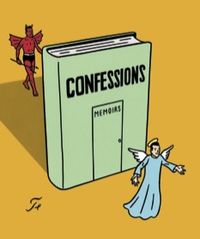
Freud ended by suggesting that the five-thousand-dollar advance that had been offered was a hundredth of the sum necessary to tempt him into such a foolhardy venture. Unseemly self-exposures, unpalatable betrayals, unavoidable mendacity, a soupçon of meretriciousness: memoir, for much of its modern history, has been the black sheep of the literary family. Like a drunken guest at a wedding, it is constantly mortifying its soberer relatives (philosophy, history, literary fiction)—spilling family secrets, embarrassing old friends—motivated, it would seem, by an overpowering need to be the center of attention. Even when the most distinguished writers and thinkers have turned to autobiography, they have found themselves accused of literary exhibitionism—when they can bring themselves to put on a show at all. When Jean-Jacques Rousseau’s “Confessions” appeared, shocking the salons of eighteenth-century Paris with matter-of-fact descriptions of the author’s masturbation and masochism, Edmund Burke lamented the “new sort of glory” the eminent philosophe was getting “from bringing hardily to light the obscure and vulgar vices, which we know may sometimes be blended with eminent talents.” (The complaint sounds eerily familiar today.) When, at the suggestion of her sister, Virginia Woolf started, somewhat reluctantly, to compose an autobiographical “sketch,” she found herself, inexplicably at first, thinking of a certain hallway mirror—the scene, as further probing of her memory revealed, of an incestuous assault by her half-brother Gerald, an event that her memory had repressed, and about which, in the end, she was unable to write for publication.

More here.

The Shopping Cure

From The New York Times:

Shop The Egyptian Islamist theoretician Sayyid Qutb believed the West — in particular the United States — posed an existential threat to Islam. He feared that globalization, spearheaded by the American colossus, might eventually destroy Islam by tempting pious Muslims with freewheeling capitalism, the separation of religion from government and the unleashing of decadent “animalistic desires.” Qutb, in word and in deed, took up the sword against Gamal Abdel Nasser’s secular government. Nasser hanged him in 1966, but Qutb’s ideas transformed the world by inspiring Osama bin Laden’s Qaeda theology. Vali Nasr, in his outstanding new book “Forces of Fortune,” shows that Qutb was at least half wrong. Globalization, free trade and market economics aren’t a threat to Islam per se. What they are a threat to is the totalitarian vision of Islam that Qutb’s followers hope to impose.

Nasr, a professor at the Fletcher School of Law and Diplomacy of Tufts University, writes that the Middle East will liberalize when it is transformed by a middle-class commercial revolution. “The great battle for the soul of Iran — and for the soul of the region as a whole — will be fought not over religion, but over business and capitalism,” he says. What he calls the “Dubai effect” is only just beginning to be felt around the region. The cutting-edge skyscrapering emirate is hardly a normal society; neither is it a democracy or (as we now know) a country free of its own economic problems. But middle-class people from all over the Muslim world continue to travel there; they admire its business-friendly regulatory environment and its respect for personal liberty. They often go home and wonder why their own countries are so poorly governed.

More here.