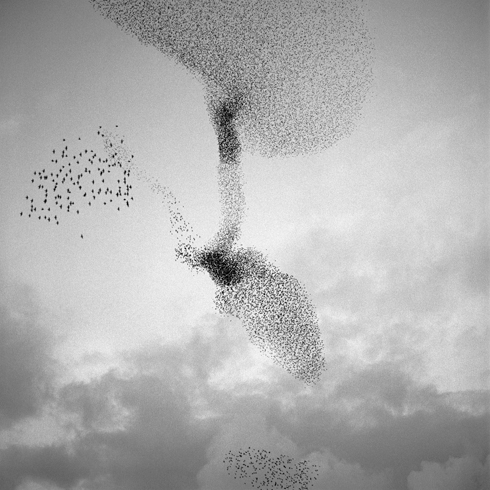
OMG BFF LOL MALL from OMGBFFLOL on Vimeo.
[Thanks to Jesse Schaefer.]

OMG BFF LOL MALL from OMGBFFLOL on Vimeo.
[Thanks to Jesse Schaefer.]
From the website of NPR:
Edward Tufte has a big backyard that stretches for hundreds of acres near Cheshire, Conn. Over the years, he's filled that space with giant metal sculptures as big as the trees.
“I think it was Richard Serra who said that the market for big, outdoor landscape pieces is like the market for Canadian experimental poetry,” he says. “So I can never be accused of being market-driven in the art world.”
Tufte is an accomplished grand-scale sculptor, but he is perhaps more famous for making charts, graphs and diagrams beautiful. He's been called the “DaVinci of Design” and the “Minister of Information.” His books — with titles like The Visual Display of Quantitative Information — are widely read by Web architects, scientists and basically anyone else who's interested in presenting data creatively and clearly.
And, the new edition of Microsoft Office will include a Tufte creation: the “sparkline.” It's a small graphic, the size of two short words, which can be embedded in text to depict stock markets or baseball stats.
If that weren't enough, Tufte has also been recruited by the White House to join the Recovery Accountability and Transparency Board, to advise and devise ways to track how the $787 billion stimulus package is being spent.
More here.
Pervez Hoodbhoy in Dawn:
The Israeli bulldozer that crushed Rachel Corrie, the 23-year-old American-Jewish pro-Palestinian activist, stands ever-ready to crush challenges to absolute Israeli supremacy. That the peace flotilla was attacked in international waters, and that a Hamas leader was murdered by the Mossad in Dubai, send identical messages: Israel knows no boundaries.
With such a bloody-minded adversary, none of the 700-plus persons on the six peace boats had illusions of a pleasure cruise. Nevertheless, they probably felt reasonably secure. After all, the world was watching — on board was a Holocaust survivor, white-as-lilies members of parliament from European countries, and even a six-month baby of unknown colour and descent.
So, even discounting those from Muslim countries, including three from Pakistan, the constellation of those calling for an end to Gaza’s blockade was impressive. The hope of a violence-free ending was reasonable. But that did not happen.
Why did Israel choose to murder nine peace-seeking foreigners in broad daylight? Although it claims otherwise, this had little to do with “restoring Israel’s deterrence” or capping the peashooters in Gaza. Instead, one must listen to Moshe Yaalon, then chief of staff of the Israeli Defence Forces, who said in 2002 that “The Palestinians must be made to understand in the deepest recesses of their consciousness that they are a defeated people”. By massacring the Mavi Marmara’s activists — whose names and religion are still unknown — Israel wants Gazans to know that even the international community cannot save them.
More here.
Splinter
'''''''''''''''''''''''''''''''
I like you, a twenty-year-old poet writes to me.
A beginning carpenter of words.
His letter smells of lumber.
His muse still sleeps in rosewood.
Ambitious noise in a literary sawmill.
Apprentices veneering a gullible tongue.
They cut to size the shy plywood of sentences.
A haiku whittled with a plane.
Problems begin
with a splinter lodged in memory.
It is hard to remove
much harder to describe.
Wood shavings fly. The apple cores of angels.
Dust up to the heavens.
by Ewa Lipska
translation by Robin Davidson & Ewa Elżbieta Nowakowska
from The New Century
Northwestern University Press, 2009
From Salon:
A study recently published in the journal Research in Social Stratification and Mobility found that just having books around the house (the more, the better) is correlated with how many years of schooling a child will complete. The study (authored by M.D.R. Evans, Jonathan Kelley, Joanna Sikorac and Donald J. Treimand) looked at samples from 27 nations, and according to its abstract, found that growing up in a household with 500 or more books is “as great an advantage as having university-educated rather than unschooled parents, and twice the advantage of having a professional rather than an unskilled father.” Children with as few as 25 books in the family household completed on average two more years of schooling than children raised in homes without any books. According to USA Today, another study, to be published later this year in the journal Reading Psychology, found that simply giving low-income children 12 books (of their own choosing) on the first day of summer vacation “may be as effective as summer school” in preventing “summer slide” — the degree to which lower-income students slip behind their more affluent peers academically every year. An experimental, federally funded program based on this research will be expanded to eight states this summer, aiming to give away 1.5 million books to disadvantaged kids.
Perhaps the most intriguing part of the USA Today article comes at the very end, where one Chicago schoolteacher tells the reporter that the importance of getting books into the house “seems so simple, but parents see it differently.” They're as “excited” as their kids are when the books come in the door. It's not that the parents are hostile or even indifferent to books. Most likely, books and reading feel like the privilege and practice of an unfamiliar world: a resource that's out there somewhere, but not entirely accessible.
More here.
From American Scientist:
The basic argument of intelligent design was famously set forth in the watchmaker analogy of William Paley in 1802: The complexity and functionality of a watch imply a watchmaker; analogously, the complexity and functionality of living things also imply a designer, albeit one vastly more potent than a mere watchmaker. This argument rests on a simple analogy between the design of human artifacts and the design of natural forms. For the analogy to work, we must first accept that we design our inventions with purpose and foresight. On this point, most evolutionists and creationists agree. What distinguishes these two camps is that, when accounting for the origin of living things, proponents of intelligent design summon a divine creator, whereas evolutionists credit natural selection. Thus, evolutionists share with creationists the same understanding of design; they differ only in how they invoke it.
Discussions of design are prominent in the writings of evolutionists from Darwin to Dawkins. Pondering the implications of his theory of natural selection for Paley’s “old argument of design in nature,” Charles Darwin wrote in his autobiography that we can no longer argue that “the beautiful hinge of a bivalve shell must have been made by an intelligent being, like the hinge of a door by man. There seems to be no more design in the variability of organic beings and in the action of natural selection, than in the course which the wind blows. Everything in nature is the result of fixed laws.” A century later, Richard Dawkins pursued the issue of design and divided the world “into things that look designed (such as birds and airliners) and things that don’t (rocks and mountains).” He further divided those things that look designed into “those that really are designed (submarines and tin openers) and those that aren’t (sharks and hedgehogs).”
More here.

It is, of course, sheer folly to imagine that one can pass judgments which are either accurate or just upon poems written in a language which one does not know.
Irrespective of their relative merits, some poets lose less in translation than others. Even in the crudest prose translation a non-Italian reader can immediately recognize that Dante is a great poet, because much of the impact of his poetry depends upon his use of similes and metaphors drawn from sensory experiences which are not confined to Italians but common to all peoples, and upon his gift for aphoristic statements expressed in the simplest everyday words for which every language has a more or less exact equivalent: e.g., “That day we read in it no further.”
Translation also favors poets like Hölderlin and Smart, who were dotty; for their dislocation of normal processes of thinking are the result of their dottiness, not their language, and sound equally surprising in any: e.g., “ now the heroes are dead, the islands of Love are almost disfigured. Thus everywhere must Love be tricked and exploited, silly.”
A poet like Campion, on the other hand, whose principal concern is with the sound of words and their metrical and rhythmical relations, cannot be translated at all. Take away the English language in which his songs were written, and all that remains are a few banal sentiments.
The most notorious case of an untranslatable poet is Pushkin. Russians are unanimous in regarding him as their greatest poet, but I have yet to read a translation which, if I did not know this, would lead me to suppose that his poems had any merit whatsoever.
Complete ignorance, however, is perhaps less likely to lead one’s critical judgment astray than a smattering of a language. Ignorance at least knows it does not know. When one recalls the fantastic overestimation of Ossian by the German Romantics or of Poe by Baudelaire and Mallarmé, one thinks twice before expressing enthusiasm for a foreign poet.
IN THE CASE OF Mr. Voznesensky, at least I know that he is greatly admired by many of his fellow countrymen, and, after reading literal prose translations of his poems, studying metrical models, and listening to tape-recordings of him reading his own work, I am convinced that his admirers are right.
Rachel Shabi in The Guardian:
The Israeli government has been forced to apologise for circulating a spoof video mocking activists aboard the Gaza flotilla, nine of who were shot dead by Israeli forces last week.
The YouTube clip, set to the tune of the 1985 charity single We Are the World, features Israelis dressed as Arabs and activists, waving weapons while singing: “We con the world, we con the people. We’ll make them all believe the IDF (Israel Defence Force) is Jack the Ripper.”
It continues: “There’s no people dying, so the best that we can do is create the biggest bluff of all.”
The Israeli government press office distributed the video link to foreign journalists at the weekend, but within hours emailed them an apology, saying it had been an error. Press office director Danny Seaman said the video did not reflect official state opinion, but in his personal capacity he thought it was “fantastic”.
Government spokesman Mark Regev said the video reflected how Israelis felt about the incident. “I called my kids in to watch it because I thought it was funny,” he said. “It is what Israelis feel. But the government has nothing to do with it.”
More here. Decide for yourself whether you think it’s funny:
Hello,
The voting round of our science prize (details here) is over. A total of 1475 votes were cast for the 80 nominees (click here for full list of nominees). Thanks to the nominators and the voters for participating.
Carla Goller has designed a “trophy” logo that our top twenty vote-getters may choose to display on their own sites. So here they are, in descending order from the most voted-for:
 Rangle: The Science Education with makeshift equipment
The editors of 3 Quarks Daily will now pick the top six entries from these, and after possibly adding up to three “wildcard” entries, will send that list of finalists to Richard Dawkins on June 11. We will also post the list of finalists here on that date.
Good luck!
Abbas
So, Alyosha, Maybe it's True
…………………..
So, Alyosha, maybe it is true
that we live in perhaps.
Perhaps the earth . . . perhaps the sky . . .
chemical winds, auroras, tides,
chalk hills and blistered pines
and the microtonal bells.
And those who swallow ink
(the ringers of bells),
perhaps they will inherit
the bogs and salt marshes,
the swamp grass and samphire,
jacket with torn pockets, shredded cuffs.
Will inherit the sea-foam, the dust,
the ferrous mud
that reabsorbs us.
by Michael Palmer
from Thread
Publisher: New Directions, New York,
forthcoming
From The Telegraph:
In mid-October 2008, when it looked like the presidency might really be within Barack Obama’s grasp, some campaign workers resorted to desperate last-minute tactics. Faced with a prospective voter in Nevada who said she didn’t trust black people, a young Obama volunteer replied: “One thing you have to remember is that Obama, he’s half white and he was raised by his white mother. So his views are more white than black really.”
At the time, it seemed profoundly depressing that such means of persuasion were necessary. After all, those views had been used by people on the other side of the racial divide, too – “just because you are our colour doesn’t make you our kind”, the civil rights activist Al Sharpton had said. Now, perhaps, it’s possible to see that sentiment as an important part of who Obama is: not just the first African American president of the United States but, as David Remnick puts it in The Bridge, “the first President who reflect[s] the variousness of American life”, a “shape-shifter” who had to “fashion an identity in a prolonged and complicated way”.
More here.
From The New York Times:
I’m all in favor of women fulfilling their potential in science, but I feel compelled, at the risk of being shipped off to one of these workshops, to ask a couple of questions:
1) Would it be safe during the “interactive discussions” for someone to mention the new evidence supporting Dr. Summers’s controversial hypothesis about differences in the sexes’ aptitude for math and science?
2) How could these workshops reconcile the “existence of gender bias” with careful studies that show that female scientists fare as well as, if not better than, their male counterparts in receiving academic promotions and research grants?
Each of these questions is complicated enough to warrant a column, so I’ll take them one at a time, starting this week with the issue of sex differences. When Dr. Summers raised the issue to fellow economists and other researchers at a conference in 2005, his hypothesis was caricatured in the press as a revival of the old notion that “girls can’t do math.” But Dr. Summers said no such thing. He acknowledged that there were many talented female scientists and discussed ways to eliminate the social barriers they faced. Yet even if all these social factors were eliminated, he hypothesized, the science faculty composition at an elite school like Harvard might still be skewed by a biological factor: the greater variability observed among men in intelligence test scores and various traits. Men and women might, on average, have equal mathematical ability, but there could still be disproportionately more men with very low or very high scores. These extremes often don’t matter much because relatively few people are involved, leaving the bulk of men and women clustered around the middle. But a tenured physicist at a leading university, Dr. Summers suggested, might well need skills and traits found in only one person in 10,000: the top 0.01 percent of the population, a tiny group that would presumably include more men because it’s at the extreme right tail of the distribution curve.
“I would like nothing better than to be proved wrong,” Dr. Summers told the economists, expressing the hope that gender imbalances could be rectified simply by eliminating social barriers. But he added, “My guess is that there are some very deep forces here that are going to be with us for a long time.”
More here.
I’m not sure why “Clipperton” is one of my favorite Cousteau episodes. It’s not much fun. The island is a forbidding place. “Here,” Cousteau says, “other creatures, including man, have little place. Yet by a harsh irony, man himself…is creating a world hostile to all but the hardiest species, a world hostile even to himself.” The background score of “Clipperton” is downright scary. The island’s primary occupants — rabidly omnivorous crabs — eat every shred of life the island has to offer. Here, nature exists largely as a force of evil, and Cousteau seems preoccupied by the way the natural malevolence of the island bleeds into the story of human monstrosity. Interspersed between shots of eels eating crabs eating boobies eating fish, we are told the story of the last ill-starred colonists who tried to settle in Clipperton and failed. At the turn of the 20th century, the British and Mexican governments created a mining settlement on Clipperton. Ramon Arnaud, survivor and son of the colony’s commander, is taken back to the island for the first time since he left in 1917. Over a checkered tablecloth, Ramon recounts the harrowing years after all the men in the struggling colony — including his father — died off save one, Alvarez the lighthouse keeper. Arnaud tells us how Alvarez declared himself King of Clipperton, raping the women and girls left on the island, shooting those who resisted. In 1917, a passing U.S. Navy ship finally rescued them, just as Ramon’s mother and the family’s young nursemaid had bludgeoned Alvarez to death with a hammer.
more from Stefany Anne Golberg at The Smart Set here.
The sky over Beijing on an October morning in 2008 was the color of a bruise, a livid yellow-brown that, my friends explained, was a sandstorm off the Gobi Desert, plus inversion, plus smoke from the coal that heats and powers the city, plus automobile exhaust. Visibility was minimal. You could make out cars going by in the street and barely make out figures walking on the opposite sidewalk. They looked like people wading through morning haze in a T’ang dynasty poem. It seemed a metaphor for contemporary China: the Gobi desert for the vastness of it, the coal smoke for the industrial revolution, phase one, and the carbon dioxide for the industrial revolution, phase two. By the next morning a wind had come up, a light rain had passed through, and the sky was pure azure. From our slight elevation in the north of the city we looked out over crisp blue air and high clouds, the sprawl of endless neighborhoods, and, hovering over them, a forest of cranes—Beijing transforming itself. In the interim, I’d sat in an auditorium listening to a poetry reading, in Chinese and English, and seen the premiere of a new Chinese film. Both were so surprising that they made the suddenly transformed weather also seem like a metaphor.
more from Robert Hass at The Believer here.
Few developments central to the history of art have been so misrepresented or misunderstood as the brief, brave, glorious, doomed life of the Bauhaus—the epochally influential German art, architecture, crafts, and design school that was founded in Goethe’s sleepy hometown of Weimar in 1919. It then flourished from 1925 to 1932 in Dessau, an industrial backwater where the school’s first director, Walter Gropius, built its image-making headquarters (see illustration on page 25); and it ultimately but vainly sought refuge in cosmopolitan Berlin, where it closed in 1933, when Hitler took power. Now, nine decades after its inception and three quarters of a century after its dissolution, the Bauhaus has finally been explained to the museum-going public in terms much closer to its actual intent and immense achievement than ever before.
more from Martin Filler at the NYRB here.
More here.
From The Telegraph:
Lytton Strachey referred to E M Forster as “the Taupe”: a cruelly perfect nickname for a writer whose whiskery and short-sighted appearance was matched by a manner so self-effacing he seemed to disappear while you were looking at him. Inevitably this poses problems for a biographer. It is hard to make a case for the public importance of someone who only occasionally popped into view – appearing alongside a sobbing Winston Churchill at T E Lawrence’s funeral, or waving off Auden and Isherwood as they departed for America – before retreating into a network of secret tunnels.
For Wendy Moffat, in this superbly illuminating biography, Forster’s buried life was also his real life, and his tunnels were shared with a host of other writers whose homosexuality made it difficult to break cover. Far from being a solitary burrower, she points out, Forster was part of an underground movement, a mole only in the sense that he lived in respectable society without being detected as the true radical he was.
More here.
Alex Pareene in Salon:
No question! No question, at all, that this flotilla was a setup, designed to trick the Israeli commandos into boarding it, from a helicopter. That is why those “humanitarian” activists were so well-armed with… poles and chairs and sticks and things one would find on a boat. They had set a trap, for Israel, to trick Israel into killing between 9 and 20 people. (But because Friedman is very balanced he admits that it was very stupid of Israel to fall for this trap and kill those people.)
You must always remember that while reasonable people consider Thomas Friedman to be a joke — a barely literate cartoon mustache of oversimplification whose understanding of global politics is slightly less comprehensive than a USA Today infographic and who possesses about as much insight into world events as a lightly vandalized Wikipedia stub entry — the sort of people who ineptly manage and run the nation take him very seriously and look to him to form their opinions about important subjects outside (and sometimes relating to) their immediate expertise, be that foreclosing on families or running the Defense Department for the Bush Administration.
More here.

Power of plasma
Princeton University's fourth annual “Art of Science” exhibition features scientific imagery focused on the theme of energy. The $250 first prize for 2010 goes to “Xenon Plasma Accelerator” by Jerry Ross, a postdoctoral researcher at the Princeton Plasma Physics Laboratory. The photo shows a plume from a Hall-effect thruster, which uses magnetic and electric fields to ionize and accelerate propellant.
More here.