Outsourcing Grading

Photo_4608_carouselAudrey Williams June in The Chronicle of Higher Education:

Lori Whisenant knows that one way to improve the writing skills of undergraduates is to make them write more. But as each student in her course in business law and ethics at the University of Houston began to crank out—often awkwardly—nearly 5,000 words a semester, it became clear to her that what would really help them was consistent, detailed feedback.

Her seven teaching assistants, some of whom did not have much experience, couldn't deliver. Their workload was staggering: About 1,000 juniors and seniors enroll in the course each year. “Our graders were great,” she says, “but they were not experts in providing feedback.”

That shortcoming led Ms. Whisenant, director of business law and ethics studies at Houston, to a novel solution last fall. She outsourced assignment grading to a company whose employees are mostly in Asia.

Virtual-TA, a service of a company called EduMetry Inc., took over. The goal of the service is to relieve professors and teaching assistants of a traditional and sometimes tiresome task—and even, the company says, to do it better than TA's can.

[H/t: Linta Varghese]

Counterintuitive Cure: A Nanovaccine That Stops Autoimmune Disease by Boosting the Immune System

From Scientific American:

Nanovaccine-for-autoimmune-disease_1 The human body's immune system can quickly track down and kill cells that don't belong. Take certain kinds of bacteria: molecules on their surfaces flag them as foreign invaders, alerting the body's defenders to the breach and drawing a full-fledged attack on anything waving that molecular flag. But sometimes the system mistakenly attacks the body's own cells. The result is autoimmune disease, such as type 1 diabetes, in which the insulin-producing beta cells of the pancreas are attacked and destroyed by T cells.

Scientists have struggled to find ways to treat autoimmune disease without compromising overall immunity. Therapies that suppress the immune system carry the risk of letting infections and even tumors go unchecked. But researchers in Canada have found a way to prevent type 1 diabetes in mice by doing just the opposite—vaccinating to boost the immune system. The approach, published April 8 in Immunity, exploits the immune system's built-in safety mechanism—a group of regulatory T cells whose job is to squelch overactive immune responses.

More here.

Claim over ‘human ancestor’ sparks furore

From Nature:

News.2010.Hominid A team from the University of the Witwatersrand in Johannesburg, South Africa, has revealed two remarkably well preserved hominin fossils aged just under two million years old. The fossils were discovered at Malapa cave, part of a site known as the Cradle of Humankind, some 40 kilometres west of Johannesburg. But the researchers' suggestion that the fossils represent a transitional species in human evolution, sitting between Australopithecus and Homo species, has been criticized by other researchers as overstated. The fossils, a juvenile male and an adult female, were found together in the Malapa cave, part of an eroded cave system, leading to speculation that the two fell to their deaths while searching for water. The fragile parts of the skeleton that are often missing from fossils this old, such as the hands and feet, have been preserved (see videos showing fossilized cranium here and here). The collar bone of the first specimen was discovered by team leader Lee Berger's nine-year-old son during a visit to the site in 2008.

Controversially, the researchers have named the fossils as a new species, Australopithecus sediba. 'Sediba' means fountain or wellspring in Sotho, which is one of the 11 official languages of South Africa. Berger deems this an appropriate name, as he says that A. sediba is a good candidate for being the transitional species between the southern African hominin, Australopithecus africanus, and early Homo species — either the earlier Homo habilis or even a direct ancestor of the more recent Homo erectus. The research is published in Science. But palaeoanthropologist Tim White of the University of California, Berkeley, says that A. sediba and A. africanus are merely chronospecies: names given to describe slightly different anatomy in fossils from a single evolving species. White says that the suggestion by Berger and his team that this lineage split before the emergence of Homo is “fossil-free speculation”, adding that “the obsession with Homo in their title and text is difficult to understand outside of a media context”.

More here.

Thursday, April 8, 2010

Lavender Hall

Lavender Hall One in four adults in the U.S. suffer from a diagnosable mental disorder in a given year—over 57.7 million people. A much smaller share of this group, about 6%, suffer from a severe and persistent mental illness, such as schizophrenia, bipolar disorder, obsessive compulsive disorder or major depression. My friend Lisa Guidetti is working on a documentary on the issue and is looking to raise finishing funds for editing and post production on the film. So check out the trailer if you're interested, and consider helping.

Lisa:

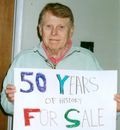
Lavender Hall is a feature documentary about a residential care home housing a wild bunch of irreverent residents with backgrounds from pianist to plastic surgeon. A family-run residential care home in an era of expanding corporate-run facilities, Lavender Hall is an anachronism. So too is its owner, Bill Kopec, with his drill sergeant-like approach to caring for residents. Founded and run by Bill’s mother in the seaside town of Wildwood, NJ, Bill struggled to keep his mother's dream alive after her death. After almost 50 years of caring for incongruous residents, most from Ancora, the local psychiatric institution, Bill Kopec is closing Lavender Hall. He managed the home every weekend on top of being a full-time Executive at Xerox. But with Bill now older than most residents, and no family member willing to take over, the home will be demolished to make way for condos. Numerous Lavender Hall residents battle serious problems. Linda, the youngest resident at 52, is a chronic alcoholic, bi-polar, with an eating disorder. Some, like Joel, have been at Lavender Hall for more than 19 yrs, and at 62 composes and performs dozens of original operettas and musical theatre works, despite his severe autism. This dysfunctional family of 14 residents will be made homeless in 4 months unless their only advocates, Bill Kopec and his daughter Renée, can navigate the medical insurance labyrinth to find them new homes. Lavender Hall is a frequently funny and occasionally disquieting portrait of the oddball residents and their equally eccentric carers. We reveal the challenges of the enduring life on the invisible margins of society, when you are considered either too old or too crazy for anyone to care what you do.
BillKopec50yrs

Lavender Hall’s residents represent two growing problems in the US: how to care for an aging population that cannot afford care for themselves, and the lack of support available to those with mental health or addiction problems, many of whom are elderly. Too many are housed in secure psychiatric units instead of having access to supported independent living or residential homes. And upon Lavender Hall’s closing, many of the residents could be re-institutionalized, overmedicated, and placed at the mercy of a system that erodes their independence and control of their lives. Normally off limits to cameras, this film’s unprecedented access to a privately run facility hopes to cross that threshold of crazy and breach that lonely aging divide. But as Debbie the Care Assistant warns, “If you're not crazy when you come in, you're crazy when you leave!”


Man Arrested at LHC Claims He’s From the Future

Lhc_aprilfool I love this image of the future. Nick Hide in CNet:

A would-be saboteur arrested today at the Large Hadron Collider in Switzerland made the bizarre claim that he was from the future. Eloi Cole, a strangely dressed young man, said that he had travelled back in time to prevent the LHC from destroying the world.

The LHC successfully collided particles at record force earlier this week, a milestone Mr Cole was attempting to disrupt by stopping supplies of Mountain Dew to the experiment’s vending machines. He also claimed responsibility for the infamous baguette sabotage in November last year.

Mr Cole was seized by Swiss police after CERN security guards spotted him rooting around in bins. He explained that he was looking for fuel for his ‘time machine power unit’, a device that resembled a kitchen blender.

Police said Mr Cole, who was wearing a bow tie and rather too much tweed for his age, would not reveal his country of origin. “Countries do not exist where I am from. The discovery of the Higgs boson led to limitless power, the elimination of poverty and Kit-Kats for everyone. It is a communist chocolate hellhole and I’m here to stop it ever happening.”

[H/t: Ajay Chaudhary]

Derrida: An Autothanatography

200px-Derrida_main Marco Roth in n+1:

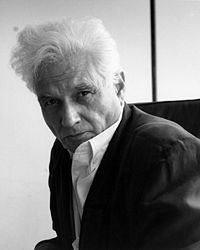
A man's death from pancreatic cancer at the age of seventy-four will not change any of this nor resolve old disputes. Death is not a metaphor, although there certainly exists a powerful rhetoric of death and nothing calls up rhetorical excess like death. And yet I want to mourn Derrida in a way that I've never felt about public figures or writers. I want to make hyperbolic claims about the end of an era: the last great generation of intellectuals, Derrida and Edward Said in the last year. They are passing. We couldn't grasp them when they lived. Will we even bother now they're dead? That's a selfish fear behind an odd sentiment. Does complexity matter? And to whom? Especially now when we prefer certainty, loyalty, iterability, and information (preferably the kind that confirms what we know already), when Bernard Lewis and Bernard Henri Levy are the house intellectuals of choice? How good those two must feel to know that they've at least lived long enough to see their ideological enemies buried.

Only an American would pair Said and Derrida as representatives of a hope for the future of thinking and education that was always more than just fashionable theory, although fashion itself is a decayed form of hope. The fashion for theory and the words “Orientalism” and “Deconstruction” was as much a result of intelligent, angry and alienated Americans fastening on to a promise without quite grasping the training and the commitment to lonely thinking through a fixed tradition required to make it a reality. Despite its rapid politicization, “theory” in America or la pensée 68 in France, was not going to change the world (if by world we mean government). Theory, however, could and did change individual lives. Briefly, it redeemed difficulty and especially a discomfort some people felt intuitively about subject and object, language and self. Those people who felt they stood on shaky foundations suddenly had a home for their native anti-foundationalism. They too could become theorists. Think of it as a job creation program for all intellectual nerds, outcasts and misfits, people whose kind of intelligence meant that they weren't even comfortable around most other intelligent people. The betrayal by the American system of higher education of those who'd enrolled enthusiastically in these job placement programs is a sad but minor footnote to the history of the 1990s. I don't mean the dwindling number of jobs for French, German, and philosophy PhDs or the corporatization of the University, although that's part of it. The betrayal began before, when those who showed glimmers of interest in theory were led to think that their curiosity would be nurtured into knowledge by a series of occasional course offerings and visiting instructors who rarely stayed long enough to ground a program. Instead of finding themselves in an academy, however, these students found themselves in the agora, fighting for money, time, attention, and space against better organized guilds. Theory did not, in itself, corrupt the young. The siege mentality surrounding theorists and theory did.

the cleanest race

CleanestRacecvrfinal_small

On my first visit to Pyongyang in 1979, handlers and interviewees repeatedly spoke of the North Koreans’ constant need to be on guard against “impure elements.” The unfamiliar term, puzzling at first, turned out to mean the country’s enemies. The implication was that the North Koreans themselves were pure. Indeed, as B.R. Myers argues in his provocative and important new book, a childish fantasy of purity is at the core of the ideology that the North Korean regime has used so effectively to control its people. It is a doctrine that, according to Myers, owes relatively little to Marxism-Leninism, or to Confucianism. It is, rather, “an implacably xenophobic, race-based worldview derived largely from fascist Japanese myth.” Like Japan’s Hirohito, the late North Korean President Kim Il Sung was popularly portrayed as the parent of an unsophisticated “child race whose virtues he embodied.” Each of the two rulers “was associated with white clothing, white horses, the snow-capped peak of the race’s sacred mountain, and other symbols of racial purity.” Each was “joined with his subjects as one entity, ‘one mind united from top to bottom.’ ” Each was “the Sun of the Nation,…the Great Marshal…whom citizens must ‘venerate’…and be ready to die for.”

more from Bradley K. Martin at TNR here.

to save something from the flood which catches us by surprise

8dfa21dde564beddfdde1f12634a5267,29,1

Tadeusz Różewicz is a poet of dark refusals, hard negations. He is a naked or impure poet (“I crystallize impure poetry,” he writes), an anti-poet relentlessly, even ruthlessly determined to tell the truth, however painful it may be. He scorns the idea of the poet as prophet and speaks from the margins—a stubborn outsider. “A poet is one who believes / and one who cannot,” he declares. He dwells in uncertainties and doubts, in the insecure, gray areas of life—skepticism is his native mindset—and strips poetry down to its bare essentials: words alone on a page. He is bracingly clear and shuns the floridities—the grand consolations—of the traditional lyric. His characteristic free-verse style is a non-style, a zero-sum game. “I have no time for aesthetic values,” he says. Rather, he treats modern poetry as “a battle for breath” and writes with an anxious, prolific, offhanded urgency. He is wary and intense, a bemused seer of nothingness. I consider him the Samuel Beckett of modern Polish poetry.

more from Edward Hirsch at VQR here.

genius was a god

2081446863_806e46a43a-245x300

When a modern person thinks of artistic genius, they imagine an individual. Some have quantified genius by standardized exams – for example, the I.Q. test – but most know a genius by his work. The Brothers Karamazov is proof that Fyodor Dostoyevsky is a genius. Be it Shakespeare, Mozart, or Michelangelo, the man of genius is epoch-making because his work acutely affects history and seems to redefine our basic categories of human potential. Yet in our common imagination, the artistic genius is not only an individual of excellent output, but an individual of a certain disposition. The man of genius is exceptional in intelligence, originality, and creativity. While free from all that restrains the average person, he bears the greatest burden of all: the burden of being him.

more from Michael Toscano at Curator here. (h/t bookforum)

the first beautiful hints

04strogatz4-custom2

In middle school my friends and I enjoyed chewing on the classic conundrums. What happens when an irresistible force meets an immovable object? Easy — they both explode. Philosophy’s trivial when you’re 13. But one puzzle bothered us: if you keep moving halfway to the wall, will you ever get there? Something about this one was deeply frustrating, the thought of getting closer and closer and yet never quite making it. (There’s probably a metaphor for teenage angst in there somewhere.) Another concern was the thinly veiled presence of infinity. To reach the wall you’d need to take an infinite number of steps, and by the end they’d become infinitesimally small. Whoa. Questions like this have always caused headaches. Around 500 B.C., Zeno of Elea posed a set of paradoxes about infinity that puzzled generations of philosophers, and that may have been partly to blame for its banishment from mathematics for centuries to come. In Euclidean geometry, for example, the only constructions allowed were those that involved a finite number of steps. The infinite was considered too ineffable, too unfathomable, and too hard to make logically rigorous.

more from Steven Strogatz at The Opinionater here.

a literally ecumenical humanity, idiosyncratic and in reciprocal contact

Tiepolo_003_apollo_e_diana_1757y

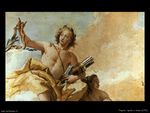
We know what Giambattista Tiepolo looked like, because he put himself in so many of his frescoes. There he is in 1726 at the age of thirty, with his wonky nose and his ironic trembly lips and his lively scared eyes, standing beside the furious figure of Jacob on the wall of the Patriarch’s Palace in Udine. And there he is again twenty-seven years later, beside his son Domenico, the eyes a little sadder, the lip a bit more tremulous, on the ceiling of the Prince-Bishop’s palace staircase at Würzburg, the matchless Treppenhaus, which for two centuries was the largest fresco in the world and is still one of the most beautiful. But about what Giambattista Tiepolo thought we have scarcely a clue. “Of all the greats of painting Tiepolo was the last one who knew how to keep silent”, declares Roberto Calasso in this superbly ambitious, quirky, sometimes querulous, sometimes lyrical and finally persuasive essay. It is no disability that Calasso should be famous as an imaginative and painstaking explorer of myth rather than as a historian of art. For it takes a close reading of those enormous frescoes to make Tiepolo declare himself to us in the same way as Kafka was made to speak in K. and the dusty lumber of Greek myth was shined up in The Marriage of Cadmus and Harmony. There is perhaps no other way to rescue Tiepolo from the condescension of posterity and to reinstall him in the high culture of the West.

more from Ferdinand Mount at the TLS here.

The planet-hackers are coming

From MSNBC:

Earth Should we put more pollutants into the air to keep Earth's temperature down? How about covering polar ice with reflective panels to cut down on melting? Or putting a giant umbrella in space to shade the planet? Some of the ideas for easing Earth's warming trend may sound crazy – but in a newly published book titled “Hack the Planet,” Eli Kintisch says scientists may have no choice but to give them a try. The only thing crazier than geoengineering is what we're doing now to the atmosphere by continuing to dump carbon dioxide into it,” he told me.

Kintisch, a staff writer for the journal Science, delves into the flip side of the global climate issue: If we're in the beginning stages of a radical warm-up in global temperatures, caused in part by greenhouse-gas emissions, what can we do about it? One part of the answer is to reduce those emissions. Scientists, engineers and policymakers are working on strategies to do that. We could see cleaner cars, less carbon-intensive energy sources, and perhaps carbon-curbing legislation as well. But some researchers say that still won't be enough. Some of the less crazy ideas for hacking the planet might still have to be put into effect. That's why Kintisch calls geoengineering “a bad idea whose time has come.”

More here.

High noon in the middle east

From Prospect Magazine:

Grenade “Netanyahu thinks he is the superpower,” remarked Bill Clinton bitterly in 1996, “and we are here to do whatever he requires.” Today, as the Americans and the Israelis refuse to budge on the fraught issue of settlements in East Jerusalem, this statement rings truer than ever. US-Israeli relations are at a historic low. But the current standoff is about much more than settlement-building. Underlying it is Washington’s concern that Netanyahu’s repeated gestures of provocation—like the establishment of Jewish heritage sites in the Palestinian territories—are drawing the region towards a conflict unprecedented since 1948. And this time there is a nuclear dimension.

The widely-reported Israeli “insult” to the US—publishing tenders for the construction of apartments in the contested territory of East Jerusalem just as Vice President Joe Biden was in the country announcing peace talks—was considered so audacious that Obama’s tough response has been largely supported, even in overwhelmingly pro-Israel America. The same was the case for Clinton in 1996. This time, however, US-Israeli differences run far deeper. The muffled drums of war have been gathering volume in the middle east for some time, and Obama is seizing the chance to send a clear message: that the US will not be drawn into conflict by the Israelis.

More here.

Wednesday, April 7, 2010

Can Apple Maintain Status as Religion of the ‘Creative Class’?

Andy Jordan over at the blog Digits of the WSJ:

Apple’s core following has traditionally been the creative class. They are graphic designers and artists, and they constitute a “church” of sorts.

“When you find other Mac users, they’re so happy to find other people, it’s like the underdog,” says Peter Isgrigg, Product Manager at Apple specialist Tekserve in Manhattan, and self-proclaimed Mac fanatic, and subject of my new video on Apple’s cult-like status.

“When you’re in a minority and you find other people in that minority group, you tend to latch on to them and you tend to find a source of pride, or positivity in that uniqueness, and I think that’s where a lot of Mac users get that fantatacism,” Mr. Isgrigg says.

Apple in a sense cultivated this “underdog” or creative-class status to successfully market its products. Consider Apple’s “Think Different” ad campaign, or its ubiquitous Apple vs. PC ads featuring a young, hip Justin Long.

Apple has also not discouraged a religion-like following of its products. The notion is reinforced by the messianic aspect of founder Steve Jobs, who returned to Apple to save the company, and has done so several times.

There’s also the popular perception among devotees that Apple is “good” and competitors like IBM, Microsoft, and now even Google are “evil.” In the 1984 Mac commercial, “IBM was Big Brother; it represented this dystopian technological future where people were being damned by technology, and the Mac was the technology of liberation, of individual creativity and freedom,” says Leander Kahney, Editor of cultofmac.com.

With the release of the iPad, the question is whether Apple can maintain this “underdog” or special status.

It’s ultimately about who we are.

Tariq-ramadan-190

DKK: I’m fascinated by your attraction to Nietzsche as a student. You wrote your dissertation on him, and I can certainly understand the appeal of his engagement with suffering, as well as the eventual affirmation that you find in his work. But what attraction was there for you in Nietzsche’s wrestling with nihilism and his characterization of the implosion of Christianity?

TR: You know, many people misunderstand this, because they think that I was coming to Nietzsche because he was very critical towards Christianity, and that, as a Muslim, I was very happy when he said, “God is dead.” It’s exactly the opposite, in fact. I read Nietzsche for other reasons. I read everything that was published. I had to do this. I wanted to add to the concept of suffering in Nietzsche’s philosophy, which was Nietzsche as a historian of philosophy. Because he was, as Heidegger said, the last metaphysician. And he took a very strong and critical look at everything which was coming out of the Western tradition. But he was distorting Socrates, Hegel, and even Schopenhauer and other scholars.

more from Tariq Ramadan at The Immanent Frame here.

The Master of Historical Fiction

Waverley

“There are some writers who have entirely ceased to influence others, whose fame is for that reason both serene and cloudless, are enjoyed or neglected rather than criticised and read. Among them is Scott. Yet there are no books perhaps upon which at this moment more thousands of readers are brooding and feasting in a rapture of silent satisfaction. The Antiquary, The Bride of Lammermoor, Redgauntlet, Waverley, Guy Mannering, Rob Roy, The Heart of Midlothian — what can one do when one has finished the last but wait a decent interval and then begin again upon the first…” This was the opening of an essay by Virginia Woolf on The Antiquary, in The New Republic in December 1924, a century after the publication of Redgauntlet, Walter Scott’s last indisputably great novel. It is now almost two centuries since the first of his novels, Waverley, was published in 1814. Sadly, it’s probable that the claim made in the third sentence no longer holds good. Woolf’s “common reader” has, it seems, deserted the first master of the historical novel, ironically at a time when the genre is more fashionable than it has been for more than 100 years. All six of last year’s Man Booker shortlist were set in the past, with the winner, Hilary Mantel’s Wolf Hall as far back as the 16th century.

more from Allan Massie at The Standpoint here.

Is white the new black?

100412_r19507_p233

Glenn Beck excels at expressing adventurous thoughts in memorable language, but he outdid himself when, one morning last summer, he offered a diagnosis of President Obama. He said, “This President, I think, has exposed himself as a guy, over and over and over again, who has a deep-seated hatred for white people, or the white culture. I don’t know what it is.” (The context was one of the summer’s most entertaining reality shows—the one starring the black Harvard professor and the white police officer who arrested him.) In September, Beck sat for an interview with Katie Couric, and she asked him a deceptively simple question, which had been posed by a Twitter user named adrianinflorida: “what did u mean white culture?” Whatever adventurous thoughts this query inspired, Beck did not seem eager to share them. “Um, I, I don’t know,” he said. Finally, after two minutes of temporizing, he arrived at a nonresponsive response that was both honest and sensible: “What is the white culture? I don’t know how to answer that that’s not a trap, you know what I mean?” Often, the most appropriate answer to that question is a joke, or a series of jokes. In 2008, a canny young white Canadian named Christian Lander started a blog called “Stuff White People Like,” which soon became a best-selling book bearing the same title; it listed a hundred and fifty of white people’s favorite things, from recycling to the Red Sox. (This magazine made the list, too, at No. 114.)

more from Kelefa Sanneh at The New Yorker here.

The PhilPapers Surveys of Philosophers

David Bourget and David Chalmers on their survey of philosophers in PhilaPapers:

The PhilPapers Survey was a survey of professional philosophers and others on their philosophical views. (It was originally called “The Philosophical Survey”, but we have retrospectively retitled it for reasons given below.) What follows are some thoughts on the conception and design of the survey, including responses to some feedback regarding the survey. We will discuss the results separately.

Why a survey of philosophers' philosophical views? We decided to do this in part because like many philosophers, we have an interest in the sociology of philosophy, and we were interested to see some hard data about this sociology. We are also interested in the experimental use of online tools as a method of philosophical communication. Using the PhilPapers technology to execute a survey of philosophical views plays into both of these interests.

Some findings:

A priori knowledge: yes or no?

Accept or lean toward: yes662 / 931 (71.1%)
Accept or lean toward: no171 / 931 (18.3%)
Other98 / 931 (10.5%)

Abstract objects: Platonism or nominalism?

Accept or lean toward: Platonism366 / 931 (39.3%)
Accept or lean toward: nominalism351 / 931 (37.7%)
Other214 / 931 (22.9%)

Aesthetic value: objective or subjective?

Accept or lean toward: objective382 / 931 (41%)
Accept or lean toward: subjective321 / 931 (34.4%)
Other228 / 931 (24.4%)

Analytic-synthetic distinction: yes or no?

Accept or lean toward: yes604 / 931 (64.8%)
Accept or lean toward: no252 / 931 (27%)
Other75 / 931 (8%)

Epistemic justification: internalism or externalism?

Accept or lean toward: externalism398 / 931 (42.7%)
Other287 / 931 (30.8%)
Accept or lean toward: internalism246 / 931 (26.4%)

A Media That Looks Away

5379.kamal Hartosh Singh Bal in Open the Magazine:

I see an injustice. Even as the Indian media, rightly so, has been filled with reports of Gujarat Chief Minister Narendra Modi being questioned by the Supreme Court appointed Special Investigation Team, an event in Canada has gone unreported. The recent visit of Kamal Nath, Union minister of road transport and highways, to the country triggered the ire of Sikhs who have not forgotten his role in the 1984 massacres, when he was part of a mob that set afire two Sikhs within sight of Parliament at Rakabganj Gurdwara.

Surely the events in Canada were worth at least one news story, to say nothing of attracting the attention of India’s otherwise frenzied TV anchors. Robert Oliphant, Canadian MP and co-chair of the Canada-India forum of MPs, was quoted saying he chose not to attend a reception for Kamal Nath once he learnt of the man’s questionable character and allegations against him. Jack Layton, leader of the New Democrat Party, which controls two provinces in the country, issued a press release: ‘The New Democratic Party of Canada is concerned that a divisive and controversial Indian politician, Kamal Nath, has been invited to Canada… Out of respect for the Canadian Sikh community, I am urging my caucus not to attend events featuring Kamal Nath.’

Where, in all this, were the liberal South Asian voices from North America that were so easily mobilised against Narendra Modi? Why is there no coverage of the charges against Kamal Nath?

[More on the 1984 anti-Sikh pogroms can be found here.]

Who’s the Daddy?

Dnapaternity Catherine Nixey in More Intelligent Life:

Precise statistics on human infidelity are hard to come by. What evidence there is tends to indicate that human lovebirds are little better than their feathered counterparts. In 1970 a group of researchers looking into blood groups tested the blood types of inhabitants in a block of flats in Liverpool. They were startled to see that their results indicated a paternal discrepancy of 20-30%. Thinking, perhaps unfairly, that this might be something to do with Liverpudlians, they moved south and repeated the test, only to find similar results. In 1984 a group of scientists in Nottingham looked at women seeking fertility treatment because their husbands were sterile. Despite their husbands’ sterility, 23% of the women managed to become pregnant before receiving treatment.

Other studies have produced a more comforting picture. Recent research in Sweden and Iceland found rates of non-paternity between 1% and 2%. But while these figures may be reassuring in one sense, scientifically they are far from comforting. The disparity between them is enormous. Clearly large-scale, randomised testing is needed to find reliable average levels of non-paternity. The results would not just be interesting but useful in areas such as heritable diseases. There’s just one problem: such tests could be a source of considerable distress. As a result, much of the information that is available on paternity has emerged, like the 1970 Liverpool study, as a by-product of studies with other aims.

Now, the sale of over-the-counter tests may mean that large-scale testing will occur anyway. It is a prospect that many genetics, religious and parenting associations have reacted to with alarm. Their anxiety is the same as that of the reluctant researchers: they fear that such tests will sow doubt and discord. Prashant Patel would disagree. “These tests do not create problems within families,” he says. “The problems are there already.”