The Errors of Our Ways

From The New York Times:

Wrong In 1650, Oliver Cromwell asked the Church of Scotland to reconsider its decision to side with the royalists instead of him. “I beseech you, in the bowels of Christ, think it possible you may be mistaken.” The church didn’t think it possible, of course, so Oliver’s army took Scotland. According to Kathryn Schulz, each of us is our very own Church of Scotland — ­often mistaken, oddly oblivious and typically immune to a good beseeching. ­“Being Wrong: Adventures in the Margin of Error” is an insightful and delightful discussion of the errors of our ways — why we make mistakes, why we don’t know we are making them and what we do when recognition dawns.

Schulz begins with a question that should puzzle us more than it does: Why do we love being right? After all, she writes, “unlike many of life’s other delights — chocolate, surfing, kissing — it does not enjoy any mainline access to our biochemistry: to our appetites, our adrenal glands, our limbic systems, our swoony hearts.” Indeed, as she notes, “we can’t enjoy kissing just anyone, but we can relish being right about almost anything,” including that which we’d rather be wrong about, like “the downturn in the stock market, say, or the demise of a friend’s relationship or the fact that at our spouse’s insistence, we just spent 15 minutes schlepping our suitcase in exactly the opposite direction from our hotel.”

More here.
Saturday Poem

Lascaux

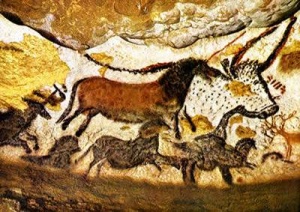
The writing is on the wall…Lascaux
With dirty, ochre fingers, black soot
Crocus yellows, and white wax,
I smear my woes, my dreams, my story,
Onto the granite canvas of time.

Bison, horses, buffalo run,
Run off my fingertips
Into a forever story of running.
Run solo, run with the herd,
Neither toward, nor from.
Run in dreams… finger dreams.
My own dreams of running free,
Free from hungry thought.

By firelight,
My oily fingers caress
Stone walls of home, so
That my grandchildren's
Grandchildren may learn
Of the herd and the hunt,
And my dreams.

I tell of my dreams
With soiled fingers –
That they may learn
To tell their stories
With their own oily hands.

by Daniel Armstrong
from The Delaware Poetry Review,
Spring 2010

the moral sense

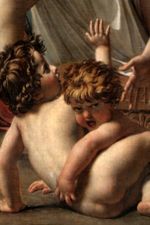
Paris-sep07.1188873000.evil-baby-within-giant-painting

Where does our sense of right and wrong come from? Most people think it is a gift from God, who revealed His laws and elevates us with His love. A smaller number think that we figure the rules out for ourselves, using our capacity to reason and choosing a philosophical system to live by. Moral naturalists, on the other hand, believe that we have moral sentiments that have emerged from a long history of relationships. To learn about morality, you don’t rely upon revelation or metaphysics; you observe people as they live. This week a group of moral naturalists gathered in Connecticut at a conference organized by the Edge Foundation. One of the participants, Marc Hauser of Harvard, began his career studying primates, and for moral naturalists the story of our morality begins back in the evolutionary past. It begins with the way insects, rats and monkeys learned to cooperate.

more from David Brooks at the NYT here.

a cockroach crawling about amidst dismantled splendors

C14326

In 1939, with Europe already sinking into World War II, 46-year-old Henry Miller left Paris, knowing that a cycle of his life had come to an end. As an expatriate in Paris he’d found his voice, and published the novels — “Tropic of Cancer,” “Black Spring” and “Tropic of Capricorn” — which made his name. He’d had his legendarily steamy and dangerous affair with Anais Nin, and George Orwell had fired a salute on his behalf, hailing him as “a Whitman among the corpses.” Miller, although banned in America, had arrived, and then, restless as ever, he accepted the invitation of another writer, his friend Lawrence Durrell, to visit Greece and the island of Corfu. Miller, being Miller, didn’t merely nibble and float in Lotus-land: First published in 1941, “The Colossus of Maroussi” (New Directions: 240 pp., $12.95), which has been reissued with accompanying essays by Will Self and Ian S. MacNiven, documents his attempt to devour the Hellenic experience and turn it to advantage.

more from Richard Rayner at the LAT here.

secret somerset

Tbrcover-custom1

In 1962, William Somerset Maugham’s nephew, Robin, his own literary efforts having not amounted to much, informed his wealthy and famous uncle that an American publisher, Victor Weybright, had offered him an advance of $50,000 to write Maugham’s biography. “Obviously I can’t afford to turn down such a good offer,” the younger Maugham explained. “As you know, although I earn enough from my writing to keep me going each year, I haven’t a penny of capital.” The letter’s affectionate tone notwithstanding, Maugham had no trouble grasping its import and responded by sending Robin a check equal to the one he would have received from Weybright. “I give you my word that I shall not write any other biography about you — ever,” Robin replied. “I’m really awfully shy about all this, but I’m also very ­grateful.” “Shy” is a peculiar adjective to use to describe blackmail, which was, as Selina Hastings makes clear in her biography, “The Secret Lives of Somerset Maugham,” Robin’s intention. Himself homosexual, Robin had been privy to Maugham’s erotic and emotional involvements with other men since he was a teenager, and might well have been the object of more than avuncular interest on Maugham’s part. (“I’m not saying I think there was incest,” ­Glenway Wescott recalled, “but Willie was infatuated with Robin.”)

more from David Leavitt at the NYT here.

Live From Ground Zero

Amy Davidson in The New Yorker:

I must say that this ad leaves me almost speechless with rage:

Just to be clear, the plan for the proposed community center, to be called Park51, does not, as the ad, which was paid for by something called the National Republican Trust PAC, might suggest, actually involve spiking a minaret into some smoldering ruins, to the sound of masked men cackling. (“Where we weep, they rejoice.”) It would be on the site of a defunct Burlington Coat Factory, on Park Place, two blocks away from Ground Zero. In the same vicinity, there are several fast-food places, bagel shops, banks, shoe stores, a movie theatre, a couple of churches, at least one gentleman’s club, and, even nearer, Century 21, the discount department store.

I do not mean—I hope this is obvious—to call for an expulsion of strip clubs or designer-sale free-for-alls from the zone around Ground Zero, but to point out that the area is a busy, living neighborhood that has flourished since and in defiance of the terrorist attacks. (It is home, among other things, to a great Little League, on whose fields there is, depending on how the games go, both weeping and rejoicing.) A mosque near Ground Zero is not, as the ad says, a way to “celebrate that murder,” but a celebration and sign of everyday life, and the way it continues, as well it should. Downtown is a community, one in which Muslims live. Why on earth shouldn’t there be an Islamic community center?

More here.

Biological roots of today’s anger

David P. Barash in the Chronicle of Higher Education:

Photo_6128_carousel “No fair” must rank among the loudest and most readily evoked complaints. Nor is the din of inequity limited to children. Consider the widespread anger generated by the Wall Street and AIG bailouts: Regardless of whether they were justified as national policy, those and other departures from perceived evenhandedness have a long history of rousing departures from citizen complacency, and even from civility. Ditto for outrage over executives getting outsized bonuses and golden parachutes while the rest of us are left to soldier on as best we can.

In evolutionary terms, what's going on here?

Another way of asking that question is to turn it around. Why do we feel so violated? Lixing Sun, a professor of biology at Central Washington University, thinks we have a “fairness instinct.” And he may be right. He maintains that high on the roster of human propensities is a “Robin Hood mentality” that characterizes our species and qualifies as one of those “mental modules” that evolutionary psychologists consider part of our likely biological inheritance.

More here. [Thanks to Ali Altaf.]

Friday, July 23, 2010

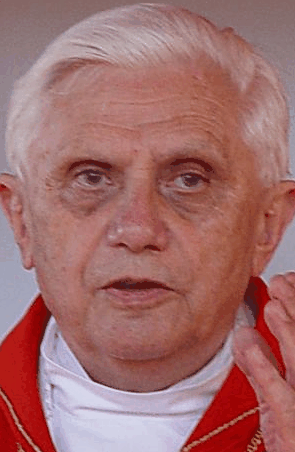
UK government acts to prevent arrest of Pope

Andrew John in Digital Journal:

ScreenHunter_04 Jul. 23 23.43 The UK government is said to have set in motion a law change that will prevent the Pope from being arrested when he visits the country in September.
Officials in Whitehall – the UK government’s administrative offices – are said to be worried over plans by the atheist authors Richard Dawkins and Christopher Hitchens to have Pope Benedict arrested for crimes against humanity, because of his alleged cover-upof priestly assaults on children.
“Mr Dawkins, the atheist campaigner, and Mr Hitchens, an atheist author, asked human rights lawyers in April to put together a case for charging the Pope over his alleged cover-up of sexual abuse of children in the Catholic church,” reportsPink News today.
Its report adds: “Justice Secretary Ken Clarke proposed changes to the law today which would require the consent of the Director of Public Prosecutions to any arrest warrant issued under universal jurisdiction.”
The Pope’s proposed visit has ever been free of controversysince it was announced last year.
A recent suggestion by the Pope’s second-in-command, Cardinal Tarcisio Bertone, that child abuse and paedophilia were connected with homosexuality brought condemnation even from fellow Catholicsin the UK.
More here.

Frans de Waal: Fair is fair

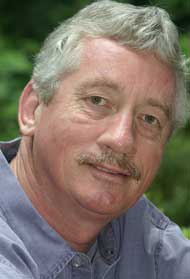
This post is the first in a four-part series of essays for Scientific American by primatologist Frans de Waal on human nature, based on his ongoing research. De Waal and other researchers appear in a series of Department of Expansion videos focusing on the same topic. [See below for parts 2, 3, and 4.]

Frans de Waal in Scientific American:

FransWeb Fairness is viewed differently by the haves and have-nots. The underlying emotions and desires aren't half as lofty as the ideal itself. The most recognizable emotion is resentment. Look at how children react to the slightest discrepancy in the size of their pizza slice compared with their siblings'. They shout, “That's not fair!” but never in a way transcending their own desires.

An experiment with capuchin monkeys by Sarah Brosnan, of Georgia State University's CEBUS Lab, and myself illuminated this emotional basis. These monkeys will happily perform a task for cucumber slices until they see others getting grapes, which taste so much better. They become agitated, throw down their measly cucumbers, and go on strike. A perfectly fine vegetable has become unpalatable! Not all economists, philosophers and anthropologists were happy with our interpretation, because they traditionally consider the “sense of fairness” uniquely human. But by now there are many other experiments, even on dogs, that confirm our initial findings.

More here. And here are parts two, three, and four.

The worst poster boys for Islam

Nadeem F. Paracha in Dawn:

2905 While formulating Islamic laws, a rationalist and contextual approach to Islamic sources should be taken, keeping in mind Islam’s core values i.e., justice and mercy.

Islamic rules should always meet the following criteria: Compatibility with reason and compatibility with the requirements of (modern) times and people’s preferences.

How is that possible, wouldn’t the traditionalists protest?

Well, let’s take the example of Quranic verses dealing with slavery. Understandably, the institution of slavery was perceived as perfectly acceptable in the seventh century. But from eighteenth century onwards, through a widespread civil consensus between various world civilisations (including the Muslims), slavery was abolished as being an inhuman act.

Just imagine what the state of the Muslims would have been had they insisted on retaining slavery. The so-called Muslim ummah would have stood completely isolated with millions of Muslims preferring to adopt a more accommodating religion.

So my point is that when traditionalists demand that the Quran be understood literally and laws should then be based on this literalist reading, they are actually undermining the evolutionary spirit of the Holy book and relegating its status to being a document frozen in the social, political and cultural ethos of a distant past.

Islam and Islamic law should be understood and implied by each generation according to its own conditions.

We should define Islam in such a way that it does not undermine its global standing. For this we need educated, pragmatic and rational political and cultural spokespersons. Obviously, people like the Al Qaeda and the Taliban are the worst poster boys for Islam in the modern world.

More here.

Your Move: The Maze of Free Will

Galen Strawson in the New York Times:

Clip_image002_057 You arrive at a bakery. It’s the evening of a national holiday. You want to buy a cake with your last 10 dollars to round off the preparations you’ve already made. There’s only one thing left in the store — a 10-dollar cake.

On the steps of the store, someone is shaking an Oxfam tin. You stop, and it seems quite clear to you — it surely is quite clear to you — that it is entirely up to you what you do next. You are — it seems — truly, radically, ultimately free to choose what to do, in such a way that you will be ultimately morally responsible for whatever you do choose. Fact: you can put the money in the tin, or you can go in and buy the cake. You’re not only completely, radically free to choose in this situation. You’re not free not to choose (that’s how it feels). You’re “condemned to freedom,” in Jean-Paul Sartre’s phrase. You’re fully and explicitly conscious of what the options are and you can’t escape that consciousness. You can’t somehow slip out of it.

You may have heard of determinism, the theory that absolutely everything that happens is causally determined to happen exactly as it does by what has already gone before — right back to the beginning of the universe. You may also believe that determinism is true. (You may also know, contrary to popular opinion, that current science gives us no more reason to think that determinism is false than that determinism is true.) In that case, standing on the steps of the store, it may cross your mind that in five minutes’ time you’ll be able to look back on the situation you’re in now and say truly, of what you will by then have done, “Well, it was determined that I should do that.” But even if you do fervently believe this, it doesn’t seem to be able to touch your sense that you’re absolutely morally responsible for what you next.

More here. [Thanks to Jonathan Kramnick.]

Sticking the world together with words

From The Guardian:

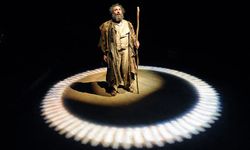
Antony-Sher-as-Prospero-i-002 We're so used to hearing writers worship words: “Oh, I've always been passionate about language, every sentence is crafted with loving care.” So used to hearing of the positive power of literature: “If only she'd read some serious fiction, the break-up wouldn't have come as such a trauma!” Even of its supposed political importance: if only Israelis and Palestinians would read each others' novels, says Amos Oz, they would begin to come to some accommodation. If only Americans translated more foreign literature, says translator Edith Grossman, US foreign policy would be more understanding. The mafia can be beaten, says Roberto Saviano, with words! And then, the Bible's weird announcement: “In the beginning was the Word”. As if everything outside language were secondary and irrelevant.

But what if language and literature were as much a part of the problem as the solution?

Consider.

Invented, not part of nature, words are thrust upon us the moment we emerge from the womb. Heads stuffed with them, we start to imitate. The right sounds in the right sequences get us what we want. Soon these patterns of sound seem as natural as breathing. For stream of consciousness, read stream of words.

More here.

Top 10 new species of 2009 named

From MSNBC:

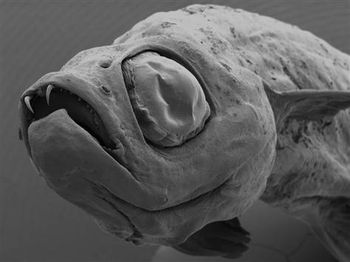
Fish In this age of vampire hysteria, a minnow with toothlike fangs is a shoo-in for a top 10 list.

The translucent Dracula minnow, Danionella dracula, is a member of the Cyprininform group of fish, most of which lost their teeth about 50 million years ago. Males of the Dracula minnow species, however, re-evolved fanglike structures that protrude from the jaw bone.

The freshwater minnow was discovered in Myanmar. Scientists say the males use their fangs for sparring with each other. Females lack the vampiresque structures.

Morehere.

I wrote “How to Write about Africa” as a piss-job

Wainaina

“How to Write about Africa” grew out of an email. In a fit of anger, maybe even low blood sugar — it runs in the family — I spent a few hours one night at my graduate student flat in Norwich, England, writing to the editor of Granta. I was responding to its “Africa” issue, which was populated by every literary bogeyman that any African has ever known, a sort of “Greatest Hits of Hearts of Fuckedness.” It wasn’t the grimness that got to me, it was the stupidity. There was nothing new, no insight, but lots of “reportage” — Oh, gosh, wow, look, golly ooo — as if Africa and Africans were not part of the conversation, were not indeed living in England across the road from the Granta office. No, we were “over there,” where brave people in khaki could come and bear witness. Fuck that. So I wrote a long — truly long — rambling email to the editor. To my surprise, Granta wrote back right away. The editor, Ian Jack, disavowed the “Africa” issue — that was before his time, he said. A year or so later, another Granta editor called. They were doing a new “Africa” issue, and they wanted my perspective. Sure, sure, I said. And then forgot. And then remembered, felt guilty, felt the weight of a continent on my back. I was blocked and more blocked. I drank a Tusker. Finally I wrote something about Bob Geldof. It was shit, said the editor — not his words, but he meant to say that, and he was right. So I went back to work. The deadline came. The deadline went. I was busy working on a short story, busy working on my novel. A cold Tusker. The new Kwani. The beach, in Lamu. The editor called with an idea — why don’t we publish your long crazy email?

more from Binyavanga Wainaina at Bidoun here.

Ghana’s turn

Ghana-1

Early one December morning in 1965, a few months after my arrival in Ghana, I was jolted out of a tropical sleep by a pile of Daily Graphic newspapers whumping onto the concrete floor of my small room. “What are those for, Atinga?” I called out groggily to Atinga Naga, the residence cleaner, as he stood at the door, several more such loads balanced in his arms. “You’ll see!” And indeed I did. Within minutes came an eruption of shouts, rubber flip-flopped footsteps, and slamming screen doors — unusual noises amid the staid gentlemanliness of Legon Hall, my University of Ghana residence. I leaped up and joined the swarm now flying from bathroom to bathroom, where we found our worst fears realized: the country, in its ninth year of independence, had run out of toilet paper. The new Ghana on which I had staked my future was in crisis. Not many weeks later, in the dark early morning of February 24, 1966, we heard the sound of distant guns and knew instantly there had been a coup d’état. The campus — and the capital, Accra — erupted as cheering crowds danced in euphoric and spontaneous celebration.

more from John Schram at The Walrus here.

sesame street socrates

Aristotle

“My ideas evolved from long hours in local bars, talking, talking, talking, always about morality. People were always asking ‘Who do you think you are, Socrates?’ They said it with contempt, but I would smile and say, ‘Thank you.’” – Tim Cooney

The television show Sesame Street recently celebrated its 40th anniversary. To commemorate the occasion there have been a host of events, including the publication of several books. A review of one of them, Street Gang: The Complete History of Sesame Street by Michael Davis, caught my eye when I saw a mention in it of the late Timothy J. Cooney, ex-husband of J oan Ganz Cooney, the creator of Sesame Street. Tim was a fascinating person in his own right, and I immediately bought the book to see what it had to say about him, for I had gotten to know Tim in the last decade of his life, well after his marriage had ended.

more from Tim Madigan at Philosophy Now here.

Thursday, July 22, 2010

Europe starting to realize homeopathy is nonsense

From Der Spiegel:

ScreenHunter_01 Jul. 23 12.37 For months now, a bitter battle has been taking shape in Great Britain between defenders of homeopathy, who are supported by no less than Prince Charles, and detractors who point to the lack of scientific evidence that the remedies offer anything more than a placebo effect. The royal family themselves have been adherents to homeopathy for generations and even Queen Elizabeth is given homeopathic remedies. After the war, her father King George VI even saw to it that Britain's National Health Service (NHS), the country's subsidized healthcare system, picked up the tab for homeopathic treatments.

Homeopathy is based on two fundamental ideas that skeptics like Singh can only shake their heads at. The first is the idea of the law of similars. The inventors of homeopathy believe that the cause of a symptom should also be treated with the cause. When treating someone, a homeopath considers which substance would cause the same symptoms in a healthy person. Arsenicum album, for example, which the activists in the campaign tried to overdose on, should in theory cause restlessness and nausea in a healthy person. But in an ill person, it is supposed to heal exactly these symptoms. If a patient has a fever, then a homeopath will look for a substance than can cause a fever in a healthy person.

The second principle is that of dilution: The more a medical ingredient is diluted and shaken, the stronger its effect will be — at least that's the assumption. But most homeopathic substances are so strongly diluted that molecules of the active ingredient can no longer be traced. Homeopaths still believe in the effects because they are convinced the water has a “memory.” Scientific proof for the claim is wanting.

More here.

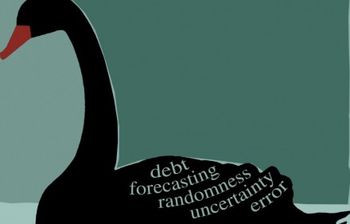
Beware those Black Swans

The bestselling economist Nassim Nicholas Taleb argues that we can’t make the world financial system immune to shocks –– but we can make sure it’s much more robust by building randomness into our planning.

Nassim Nicholas Talib in The New Statesman:

20100630_2010+26swan_w Let me summarise my ideas of how Mother Nature deals with the Black Swan. First, she likes redundancies. Look at the human body. We have two eyes, two lungs, two kidneys, even two brains (with the possible exception of company executives) – and each has more capacity than is needed ordinarily. So redundan­cy equals insurance, and the apparent inefficiencies are associated with the costs of maintain­ing these spare parts and the energy needed to keep them around in spite of their idleness.

The exact opposite of redundancy is naive optimisation. The reason I tell people to avoid attending an (orthodox) economics class and argue that economics will fail us is the following: economics is largely based on notions of naive optimisation, mathematised (poorly) by Paul Samuelson – and these mathematics have contributed massively to the construction of an error-prone society. An economist would find it inefficient to carry two lungs and two kidneys – consider the costs involved in transporting these heavy items across the savannah. Such optimisation would, eventually, kill you, after the first accident, the first “outlier”. Also, consider that if we gave Mother Nature to economists, it would dispense with individual kidneys – since we do not need them all the time, it would be more “efficient” if we sold ours and used a central kidney on a time-share basis. You could also lend your eyes at night, since you do not need them to dream.

Almost every major idea in conventional economics fails under the modification of some assumption, or what is called “perturbation”, where you change one parameter or take a parameter henceforth assumed to be fixed and stable by the theory, and make it random.

More here. [Thanks to Ali Altaf.]