
Gary Saul Morson at The New Criterion:
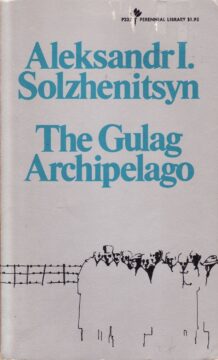 When Aleksandr Solzhenitsyn’s The Gulag Archipelago: An Experiment in Literary Investigation appeared in 1973, its impact, the author recalled, was immediate: “Like matter enveloped by antimatter, it exploded instantaneously!” The first translations into Western languages in 1974—just fifty years ago—proved almost as sensational. No longer was it so easy to cherish a sentimental attachment to communism and the ussr. In France, where Marxism had remained fashionable, the book changed the course of intellectual life, and in America it helped counter the New Left celebration of Mao, Castro, and other disciples of Marx, Lenin, and Stalin.
What was it that made this book so effective? And what did Solzhenitsyn mean by calling it “literary,” even though everything in it was factual? To answer these questions is to grasp why Gulag towers over all other works of the Soviet period and, indeed, over all literature since the middle of the twentieth century.
Before Solzhenitsyn, Western intellectuals of course knew that the Soviet regime had been “repressive,” but for the most part they imagined that all that had ended decades ago. So it was shocking when the book described how it had to be written secretly, with parts scattered so that not everything could be seized in a single raid.
more here.
Enjoying the content on 3QD? Help keep us going by donating now.
 T
T Henry Grabar has had enough
  THERE ARE SOME things the American mind can’t fully grasp: a certain way of smoking a cigarette, a particular fit of track pant, Rita Ora as a genuine celebrity. But above all, we struggle with the reality that the largest cultural event in the world happens entirely off of our radar and outside of our influence. The
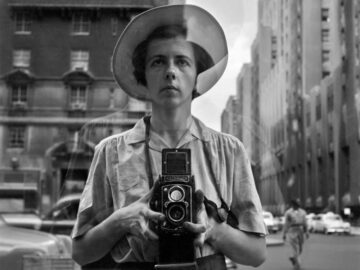 Vivian Maier took more than 150,000 photographs as she scoured the streets of New York and Chicago. She
  For many, AI helps fuel a faith that technology will deliver us from ecological disaster, even as that disaster takes hold. This techno-optimism is often framed as the foe of the “ecological turn”—a constellation of beliefs that instead see salvation in living more ecologically, as a part of nature.
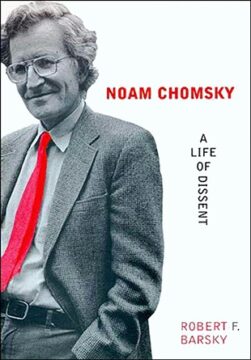 Unlike the many members of the left who captivated him as a young man — such as Dwight Macdonald, George Orwell, and Bertrand Russell — Noam Chomsky himself did not come to left-libertarian or anarchist thinking as a result of his disillusionment with liberal thought. He quite literally started there. At a tender age, he had begun his search for information on contemporary left-libertarian movements, and did not abandon it. Among those figures he was drawn to, George Orwell is especially fascinating, both because of the impact that he had on a broad spectrum of society and the numerous contacts and acquaintances he had in the libertarian left. Chomsky refers to Orwell frequently in his political writings, and when one reads Orwell’s works, the reasons for his attraction to someone interested in the Spanish Civil War from an anarchist perspective become clear.
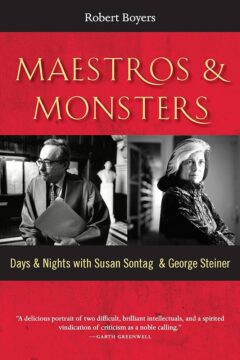 If ever there was ‘an individual who has a high intellectual potential’, Sontag was it. She was reading Thomas Mann aged eleven, matriculated at Berkeley at fifteen and was writing essays of superlative, inspirational elegance and density by her late twenties. Being intelligent – being more intelligent than anyone else – was not just important to Sontag: it was the thing she needed her mosaic to depict. The cultural critic Mark Greif, who knew her late in her life, said that ‘Susan made you acknowledge that she was more intelligent than you. She then compelled you to admit that she felt more than you did.’ Sontag may have ‘felt more’ than other people – certainly, she swore that her life’s work was ‘to see more, to feel more, to think more’. But there is considerable evidence actually that she spent her life refusing to feel – refusing, that is, to feel vulnerable. She had been vulnerable as a child; she never accepted this, and never got over it.
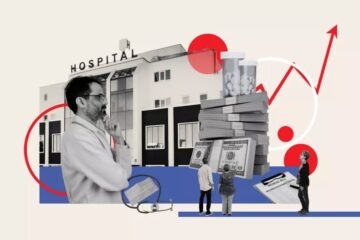 Nearly half of all Americans struggle to afford access to quality health care and prescription medications. This is the warning of the latest report from the Healthcare Affordability Index, which tracks how many in the U.S. have been forced to avoid medical care or haven’t been able to fill their prescriptions in the last three months—and how many would struggle to pay for care if it was needed. Affordability has fallen six points since 2022, down to a record low of 55 percent since the index was launched back in 2021. According to the researchers, this descent mainly affects two age groups: those aged 50–64 (down eight points to 55 percent over the same period) and those 65 and older (down eight points to 71 percent).
 In the age of technology everywhere, we are all too familiar with the inconvenience of a dead battery. But for those relying on a wearable health care device to monitor glucose, reduce tremors, or even track heart function, taking time to recharge can pose a big risk.
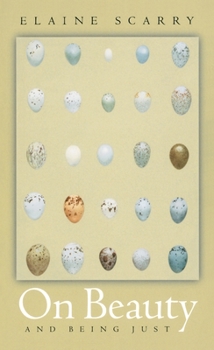 Elaine Scarry lives in a pale pink house near the Charles River in Cambridge, Massachusetts. A tall hedge runs along the front, rising to the second story and nearly engulfing the white picket gate through which one passes into Scarry’s garden. Flowers thrive in dense beds overlooked by crabapple trees and yews. Toward the back of the house, a curved wall of windows divides the garden from the garden room. Scarry’s longtime partner, the writer and scholar Philip Fisher, keeps a house nearby and they split their time between the two. Fisher does the cooking, and they eat dinner at his place. When it’s nice out they like to go for a drive.
 The genome sequence reveals the order in which the chemical building blocks (of which there are four distinct types) that make up our DNA are arranged along the molecule’s double-helical strands. Our genomes each have around
  “This virus in its current state does not look like it has the characteristics of causing a pandemic. But with influenza viruses, that equation could entirely change with a single mutation,” says Scott Hensley, an immunologist at the University of Pennsylvania in Philadelphia.
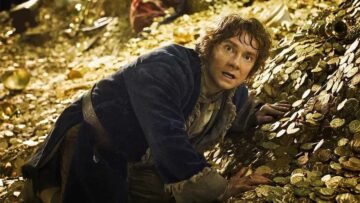 Most economic debates are about income, not wealth. When we talk about income taxes, or welfare benefits, or labor’s share of national income, we’re talking about the amount of goods and services that get created every year, and how those goods and services get allocated among the various people in a society. But in the 2010s, we saw a lot of debate about wealth instead — wealth taxes, wealth inequality, and so on.
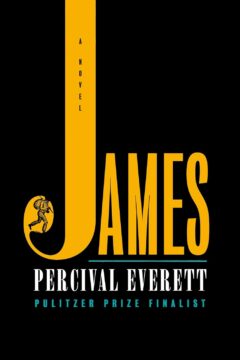 KARL KRAUS WROTE THAT EVERYTHING FITS WITH EVERYTHING ELSE. Maybe. Maybe everything in an artist’s corpus, no matter how incongruous, reflects, repeats, rhymes. Yet this is not the case for Percival Everett. No thematic or formal schema is suitable. He climbs the stairs sideways. His patently ridiculous conceits seem like challenges to his own mischievousness, bids to marry his uniquely sweeping curiosities to a bardic impulse. Charmingly, he’d never admit as much. “I know nothing,” he said in a recent New Yorker profile. “I’m just a dumb old cowboy.” Sure. It remains a considerable feat for Everett to have remained eccentric in the increasingly rational and prefabricated business of literature. He has his prevailing modes—racial satires, Westerns, crime procedurals, retellings of ancient myths, despondent autobiographical metafiction—but all of them are in flux, appearing in different admixtures. It’s hard to imagine another author pulling off, or even attempting, Glyph (1999),a novel about a toddler with a farcically high IQ; in Everett’s hands, the gambit is hilarious, bone-dry, and tragic. Erasure (2001), a canny parody of writers and racial fetishization, is even more affecting as a portrait of senescence. I Am Not Sidney Poitier (2009), a hysterical abuse of Ted Turner, the media, and various social structures, is also a repudiation of Everett’s previous work. (About Erasure, the author-character, Percival Everett, remarks, “I didn’t like writing it, and I didn’t like it when I was done with it.”) To apply superficial categories is to miss the point; Everett understands that each person is witness to a series of absurd debacles, and his fiction poses the question: What, if anything, is there to be made of our continued looking?