Love remains a main source of regret for typical American

From PhysOrg:

Sources_of_regret You’re not alone. A new study by Neal Roese, Kellogg professor of marketing, finds that romance is the most common source of regret among Americans. Other common sources of regret include family interactions, education, career, finances and parenting. For the study, Roese and Mike Morrison of University of Illinois at Urbana-Champaign analyzed data from a telephone survey of 370 adult Americans. Subjects were asked to describe one regret in detail, including the time in which the regret happened and whether the regret was based on an action or inaction. “We found that one’s life circumstances, such as accomplishments or shortcomings, inject considerable fuel into the fires of regret,” Roese said. “Although regret is painful, it is an essential component of the human experience.”

Key findings from the study include:

• About 44 percent of women reported romance regrets versus 19 percent of men. Women also had more family regrets than men. About 34 percent of men reported having work-oriented regrets versus 27 percent of women reporting similar regrets. Men also had more education regrets than women.
• Individuals who were not currently in a relationship were most likely to have romance regrets.
• People were evenly divided on regrets of situations that they acted on versus those that they did not act on. People who regretted events that they did not act on tended to hold on longer to that regret over time.
• Individuals with low levels of education were likely to regret their lack of education. Americans with high levels of education had the most career-related regrets.

More here.

South Asia Scholar Says Pakistan’s Police, Not Military, Is Key to Fighting Terrorism

From The Record:

AbbasHassan2009 Fourteen years ago, Hassan Abbas served on the police force in his homeland, Pakistan. Now from his perch at the School of International and Public Affairs, Abbas has come up with a plan to reform his country’s weak police system, which he argues would be far better than the military at fighting terrorism. “Nuclear bombs and attacks are not going to save Pakistan from militant threat,” says Abbas, the Quaid-i-Azam Professor with the South Asia Institute. “You need better law enforcement mechanisms to tackle the growing violence and crime in the country.” In February, Abbas’ research was published in a report released by the nonpartisan United States Institute of Peace. His recommendations include improving coordination between various policing agencies, streamlining the decision-making process, modernizing investigative skills and increasing police salaries.

Abbas’ research is timely as Pakistan becomes increasingly dangerous. Earlier this month, minority affairs minister Shahbaz Bhatti was gunned down in his car. Bhatti, a Roman Catholic, was the second government official to be assassinated in the past two months for seeking to reform Pakistan’s harsh blasphemy laws, which impose the death penalty for insulting the Prophet Muhammad. Salmaan Taseer, the Punjab governor, was murdered in January by one of his own bodyguards after he called for a pardon of a Christian woman sentenced to death under the law.

More here. (Note: This proposal is almost exactly similar to what our own 3qd editor Abbas Raza had sent as an aopen letter to President Musharraf more than five years ago)

‘Eurydice’ Emerges From Darkness

This is a story about one 3QD writer's poem and quotes another 3QD writer! Paul Levy in the Wall Street Journal:
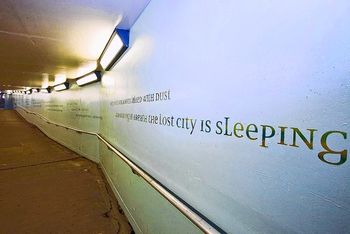
EI-BJ837B_EURID_G_20110323181856 For years, harried commuters in a gloomy South Bank underpass drew courage from the words that greeted them as they entered a long pedestrian tunnel to Waterloo Station.

“I am not afraid as I descend, step by step, leaving behind the salt wind blowing up the corrugated river…” begins “Eurydice”—a poem by Sue Hubbard based on the story from Greek mythology, in which Orpheus tries to retrieve his dead lover Eurydice from the Underworld. The poem was painted in bronze and rust on both walls of the underpass 10 years ago, its stanzas taking people all the way from either entrance to the other, past occasional homeless men sleeping in the tunnel.

The poem was commissioned when Avery Architects renovated the Southbank cultural center, a concrete city that houses the London Eye, IMAX Cinema, the British Film Institute, the Hayward Gallery and the National Theatre complex, among others. In 2001 the Arts Council and the British Film Institute selected Ms. Hubbard, a poet with a track record as a public-places artist, able to collaborate easily with graphic designers and visual artists. The font, “Disturbance,” was designed by Jeremy Tankard.

The public welcomed the poem, which stretched along the wall of the tunnel, which runs from the IMAX cinema to Waterloo Station. In autumn 2009, Time Out magazine listed the poem as one of the best-kept secrets of London.

So it came as a shock when just weeks after the poem's brush with broader cultural fame, workmen employed by Network Rail, which owns the site, painted over it. A modern protest movement ensued.

More here.

Villainous Aggressor, Falling Man, Human Shield

Terrance Tomkow in his blog:

If we have any rights, we surely have the right to self-defense. And yet self-defense has proven very puzzling to Rights theorists. To see why, take a simple case:

VILLAINOUS AGGRESSOR
There are two agents, AGGRESSOR and VICTIM: AGGRESSOR resents VICTIM for his sauve good looks and skill on the dance floor and has made it clear that he intends to kill him. One day AGGRESSOR shows up at the dance hall, gun in hand. He takes a shot at VICTIM but misses narrowly. He prepares to fire again, taking more careful aim, but VICTIM too has a gun and his only hope of surviving is to return fire and kill or disable AGGRESSOR.

Is it morally permissible for Victim to shoot aggressor? Of course! But now here's the puzzle. Rights Theorists have wanted to say:

  1. It is permissible for VICTIM to shoot AGGRESSOR because VICTIM has the right to self-defense.
  2. VICTIM has the right to self-defense because he, like everyone, has the right not to be killed or harmed. (That is why, if you are attempting to kill or harm him, you are doing something wrong.)
  3. In defending himself, VICTIM will kill or harm the AGGRESSOR.
  4. If the AGGRESSOR, had a right not to be killed or harmed, then it would be impermissible to kill or harm him.

The puzzle is: what happened to AGGRESSOR’s right not to be harmed?

It seems we must say that, by launching his attack, the attacker somehow loses his right not to be harmed. But where does it go?

More here.

Thursday, March 24, 2011

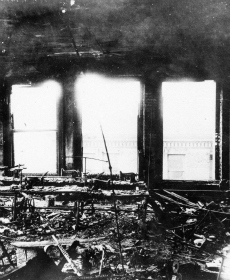
Preserving the Triangle Factory Fire’s Lessons, 100 Years Later

110324_golstein_lead Nancy Goldstein in The American Prospect:

Tomorrow marks the 100th anniversary of the notorious Triangle Shirtwaist Factory fire that trapped and killed 146 workers, most of them young immigrant women, on the upper floors of a New York City sweatshop. It's a time to honor and mourn the Triangle's victims, commemorate the tragedy's importance as a turning point in the history of the American labor movement, and reaffirm the crucial role of unions and regulatory bodies in advancing worker rights. Both are taking a beating in America's 21st-century iteration of the Gilded Age, as industrialists (hello, Koch brothers) paired with the craven politicians who do their bidding (greetings, Gov. Scott Walker, Sen. Scott Brown, et al.) take another pass at ridding our country of all those nasty laws that protect consumers and workers, and cut into their bottom line.

It was unions — led by the International Ladies' Garment Workers (now Workers United) in league with the Women's Trade Union League — that began harnessing public outrage in the wake of the fire to demand the regulations regarding worker health, well-being, and safety that protect many workers to this day, whether or not they belong to a union. Think workers' compensation, unemployment insurance, the 40-hour workweek, weekends, holidays, sick pay, employee benefits, and safety standards. While you're at it, peruse this excellent chart from the Service Employers International Union that illustrates the many ways unions succeeded in making workplace buildings safer in the wake of the Triangle tragedy. These included pressuring legislators to mandate emergency exits, sprinkler systems, and maximum-occupancy laws.

Intervening in Libya

Vijay Prashad in Counterpunch:

On March 19, 2011, the United Nations Security Council voted for Resolution 1973 to establish a “no-fly” zone over Libya. The violence against civilians and media personnel is cited as the reasons for the new resolution (an earlier one, 1970, languishes). The Council authorizes a ban on all flights over Libya (except for humanitarian purposes), freezes selective assets of the Libyan high command and proposes that a Panel of Experts be set up to look into the issue within the next year. Even as members of the Council raised their paddles to indicate their votes, French Mirage fighters powered up to begin their bombing runs and U. S. ships loaded their cruise missiles to fire into Libyan targets. Their bombardments were intended to dismantle Libyan air defenses. This is the prelude to the establishment of a “no-fly” zone.

To create the “no fly” zone, the Council allowed member states to act “nationally or through regional organizations,” viz. NATO, “to take all necessary measures to enforce compliance with the ban on flights.” It is the “all necessary measures” that allows the member states (the U. S., the U.K. and France) to extend the zone at will, and to push from enforcement of a “no-fly” zone to the removal of Qaddafi, including by the targeting of his compound in Tripoli. For Obama, the war aim is to remove Qaddafi, which exceeds the authority of UN Resolution 1973. US cruise missiles struck Libyan armed forces units and Qaddafi’s home (what the media call his “compound”).

The murkiness of the mission perplexes General Carter Ham of the U. S. African Command. He acknowledged that many of the rebels are themselves civilians who have taken up arms. Resolution 1973 does not call upon the member states to assist the rebels, only to protect civilians. Would the “no fly” zone give an advantage to the rebels, and so violate the mandate? “We do not provide close air support for the opposition forces,” General Ham notes, “We protect civilians.” However, “It’s a very problematic situation. Sometimes these are situations that brief better at the headquarters than in the cockpit of an aircraft.”

Why Germany was Against the Libya Intervention.

Merkel_0 Jeffrey Herf in The New Republic:

Since the bitter disputes over nuclear weapons in the 1980s, elements of the mood that Schwarz described on the West German left have become part of a much broader consensus in the German foreign policy establishment. For its adherents, this mood is a civilized and decent response to the aggression and crimes of the Nazi regime. It means the replacement of primitive nationalisms of the past with multilateral principles of an integrated Europe. And it assumes that webs of interdependence created by the global economy will make problems solvable through negotiations and dialogue.

These views have dominated German politics since at least summer 2002, when Gerhard Schröder emphatically opposed the coming Iraq war—but the ascension of this worldview went beyond just Iraq. As Andrei Markovits has convincingly demonstrated in his book Uncouth Nation, Schröder’s opposition to Bush’s policies stoked anti-American sentiments in German society. While Germany did send 7,000 soldiers to Afghanistan, their rules of engagement are far more restricted than are those of American and other coalition forces, and their presence remains unpopular in Germany. The massive support for Obama in the summer of 2008—when 200,000 people turned out to cheer him in Berlin—rested partly on the belief that, as the “anti-Bush,” he would turn away from American military intervention, especially in the Middle East. Moreover, in the long and drawn-out negotiations with Iran about its nuclear program, there has been a powerful establishment current opposing tougher economic sanctions and certainly any hint of a military option. Indeed, in a 2009 book about Germany and Iran, the German political scientist Matthias Küntzel referred to the emergence of a “new constellation. On the one side, the Western powers, the USA, France and Great Britain and on the other side, Russia, China and the Federal Republic of Germany.”

The current government of Chancellor Angela Merkel and Vice-Chancellor and Foreign Minister Guido Westerwelle is steeped in this intellectual consensus.

dealing

Matt-Kenyon-illustration--007

Like it or not, Germany still provides the global benchmark for political evil. Hitler is the devil of a secularised Europe. Nazism and the Holocaust are comparisons people reach for everywhere. Godwin’s Law, named after the American free speech lawyer Mike Godwin, famously states that “as an online discussion continues, the probability of a reference or comparison to Hitler or to Nazis approaches 1”. That is something today’s Germans have to live with. But there is a brighter side to this coin. For out of the experience of dealing with two dictatorships – one fascist, one communist – contemporary Germany offers the gold standard for dealing with a difficult past. Modern German has characteristically long words such as Geschichtsaufarbeitung and Vergangenheitsbewältigung to describe this complex process of dealing with, working through and even (the latter implies) “overcoming” the past. Using skills and methods developed to deal with the Nazi legacy, and honed on the Stasi one, no one has done it better. Just as there are the famous DIN standards – German industrial norms for many manufactured products – so there are DIN standards for past-beating.

more from Timothy Garton Ash at The Guardian here.

the script

Images

JUST AS IN OUR DAY a fervid minority denounces the digitization of literary experience, fifteenth-century literati responded to their own depredations. In 1492, Johannes Trithemius, Abbot of Sponheim, wrote De Laude Scriptorum, “In Praise of Scribes,” a polemic addressed to Gerlach, Abbot of Deutz. Trithemius’s intention was to uphold scribal preeminence while denouncing the temptations of the emerging press: “The printed book is made of paper and, like paper, will quickly disappear. But the scribe working with parchment ensures lasting remembrance for himself and for his text.” Trithemius asserted that movable type was no substitute for solitary transcription, as the discipline of copying was a much better guarantor of religious sensibility than the mundane acts of printing and reading. As evidence he offers the account of a Benedictine copyist, famed for his pious perspicuity, who had died, was buried by his brethren, then subsequently (though inexplicably) exhumed. According to Trithemius, the copyist’s corpus had decomposed but for three fingers of his composing hand: his right thumb, forefinger, and middle finger—relics, like manuscripture itself, of literary diligence.

more from Joshua Cohen at triplecanopy here.

Down with art!: the age of manifestos

TLS_Eagleton_735334a

In the world of polite letters, literature is the enemy of programmes, polemics, sectarian rancour, the sour stink of doctrinal orthodoxies. It is the home of the unique particular, the provisional and exploratory, of everything that resists being reduced to a scheme or an agenda. This, one might note, is a fairly recent point of view. That literature should be free of doctrinal orthodoxy would have come as a surprise to Dante and Milton. Swift is a great writer full of sectarian rancour. Terms like “provisional” and “exploratory” do not best characterize Samuel Johnson’s literary views. Nor do they best describe the views of the various twentieth-century avant-gardes, which set out to demolish this whole conception of art. From the Futurists and Constructivists to the Surrealists and Situationists, art became militant, partisan and programmatic. It was to be liberated from the libraries and museums and integrated with everyday life. In time, the distinction between art and life, the playful and the pragmatic, would be erased. There were to be no more professional artists, just common citizens who occasionally wrote a poem or made a piece of sculpture. The summons rang out to abandon one’s easel and design useful objects for working people, as some of the Russian Constructivists did. Poets were to read their poetry through megaphones in factory yards, or scribble their verses on the shirt-fronts of passing strangers. A moustache was appended to the Mona Lisa. A Soviet theatre director took over a whole naval port for several days, battleships and all, and commandeered its 300,000 citizens for his cast.

more from Terry Eagleton at the TLS here.

Movies, Men, Melodramas: Elizabeth Taylor 1932-2011

Manhola Dargis in The New York Times:

Elizabeth-taylor The last movie star died Wednesday. By the time Elizabeth Taylor left this mortal coil at 79, she had cheated death with a long line of infirmities that had repeatedly put her in the hospital — and on front pages across the world — and in 1961 left her with a tracheotomy scar on a neck more accustomed to diamonds. The tracheotomy was the result of a bout with pneumonia that left her gasping for air and it returned her to the big, bountiful, hungry life that was one of her greatest roles. It was a minor incision (later, she had surgery to remove the scar), but it’s easy to think of it as some kind of war wound for a life lived so magnificently.

Unlike Marilyn, Liz survived. And it was that survival as much as the movies and fights with the studios, the melodramas and men (so many melodramas, so many men!) that helped separate Ms. Taylor from many other old-Hollywood stars. She rocketed into the stratosphere in the 1950s, the era of the bombshell and the Bomb, when most of the top female box-office draws were blond, pneumatic and classifiable by type: good-time gals (Betty Grable), professional virgins (Doris Day), ice queens (Grace Kelly). Marilyn Monroe was the sacrificial sex goddess with the invitational mouth. Born six years before Ms. Taylor, she entered the movies a poor little girl ready to give it her all, and did. Ms. Taylor, by contrast, was sui generis, a child star turned ingénue and jet-setting supernova, famous for her loves (Eddie & Liz, Liz & Dick) and finally for just being Liz. “I don’t remember ever not being famous,” she said.

More here.

Mutations block lung-cancer treatment

From Nature:

Lung Tumours have many ways to dodge drug therapies, even those that are genetically targeted to attack them, two studies published today reveal. By uncovering these escape routes, researchers hope that therapies can be tailored to cut them off.

Both studies focus on lung cancers with genetic mutations that activate a protein called epidermal growth factor receptor (EGFR). Improper activation of this protein can lead to uncontrolled cell division, a hallmark of cancer. Two drugs — gefitinib (Iressa) and erlotinib (Tarceva) — block EGFR in tumours with activating mutations to prevent tumour growth. These drugs help most patients: about three quarters of those with EGFR-activating mutations respond well to gefitinib, for example. But the rest respond poorly, if at all, and no one knows why.

More here.

Shia v. Sunni in the Arab World

Bruce Riedel in The National Interest:

ScreenHunter_03 Mar. 24 11.49 Seen from the Arabian Sea the winter of Arab discontent that toppled dictators has turned into a spring of civil war and outside intervention. The Saudi-UAE intervention in Bahrain and the French-British-American intervention in Libya have diametrically opposite goals but both will set in train new waves of change and unrest. Old American alliances in the region are shifting, perhaps even shattering. For the United States, the region's unprecedented changes pose huge challenges. Priorities are key.

The Arab revolt is rooted in youth bulges and dictators. For the 60 percent of Arabs under thirty years of age (the median is twenty-six), there are no jobs and thus no marriages. India has almost the same demographics but is a democracy with 9 per cent growth in annual GDP. Most Arabs have neither. The 2011 redress is really revolt. Only at the extremes of the Arab world—Oman and Morocco—have Arab leaders offered true reforms. King Muhammad and Sultan Qabous have the confidence and legitimacy to promise sweeping reforms. Now we will see if they can deliver. The rest of the Arab autocrats have chosen to stand pat and offer minimal change.

The Saudis goal in Bahrain is clear; no revolution in the gulf monarchies especially by Shia. They intervened in Bahrain to back anti-Shia Sunni hardliners led by the Prime Minister who has ruled since 1961. The aim: to marginalize reformers like the American-backed Crown Prince. The Saudis sent a clear message to the two Shia republics in the gulf, especially Iran but also Iraq, that they will not tolerate Shia takeovers in Bahrain or the Kingdom's eastern province. They also sent a message to Washington: Bush naively gave Iraq to the Shia, Obama won't do the same to Bahrain.

More here.

How to Prevent the Labor Wars

Thomas A. Kochan in the Boston Review:

ScreenHunter_02 Mar. 24 11.33 Just when America needs everyone working together to resolve the severest economic crisis since the Great Depression, we are on the brink of what could be the largest prolonged labor war of our lifetimes, triggered by the fiscal crises facing state and local governments. But that outcome can be avoided. We need to draw on the most effective tools of labor negotiations—evidence-based problem solving, worker engagement, and union-management partnership.

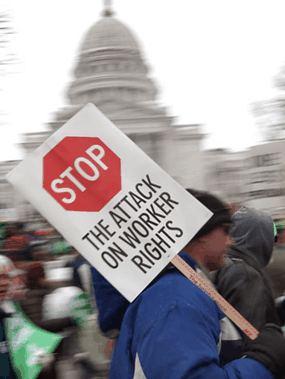
The current labor battle began in Wisconsin, where, after a dramatic standoff with state Democrats and pro-union demonstrators, Governor Scott Walker and the state legislature stripped public employees of their rights to collective bargaining. (A circuit court judge has since issued a temporary restraining order, stopping the measure from taking effect.) Much is at stake nationally in Wisconsin. If other states follow, unions will be forced to justify their continued existence year after year, making it impossible for them to represent their members in a stable and responsible fashion. Walker and his supporters have attacked what the United States and the other nations of the Governing Body of the International Labor Organization have called a fundamental human right: the right to associate freely and have an independent voice at work.

What happened in Wisconsin was, to some extent, foreseeable: American workers have suffered a steady decline in labor policy. We have allowed worker rights to erode in the private sector without recognizing the consequences, let alone protesting. Now we see the same thing happening baldly and suddenly in the public sector. The 100,000 people who hit the streets of Madison may provide the shock needed to see this problem clearly and to act.

More here.

Religion may become extinct in nine nations

Jason Palmer at the BBC:

_51778296_51778294 A study using census data from nine countries shows that religion there is set for extinction, say researchers.

The study found a steady rise in those claiming no religious affiliation.

The team's mathematical model attempts to account for the interplay between the number of religious respondents and the social motives behind being one.

The result, reported at the American Physical Society meeting in Dallas, US, indicates that religion will all but die out altogether in those countries.

The team took census data stretching back as far as a century from countries in which the census queried religious affiliation: Australia, Austria, Canada, the Czech Republic, Finland, Ireland, the Netherlands, New Zealand and Switzerland.

Their means of analysing the data invokes what is known as nonlinear dynamics – a mathematical approach that has been used to explain a wide range of physical phenomena in which a number of factors play a part.

More here. [Thanks to Omar Ali.]

Wednesday, March 23, 2011

The Ontology of Moral Realism

Richard Carrier over at his blog:

Moral realism is the view that there are moral statements that are meaningful and true, and true independent of your opinion or culture. I am a moral realist. That means I must be able to ontologically ground the existence of moral facts, and in things other than popular opinions or merely cultural facts. When I say they “exist” I have to explain what I mean by that: in what sense, and in what way, do they “exist,” particularly as I am a first-order physicalist (I believe everything that exists is solely and entirely caused by physical things and events: see Defining the Supernatural), so I must be able to reduce moral facts to physical facts in some way.

Bear-Scariness Realism

To get from A to B on this I have to drive by several destinations in the middle. Take, for instance, the scariness of an enraged bear: a bear is scary to a person (because of the horrible harm it can do) but not scary to Superman, even though it's the very same bear, and thus none of its intrinsic properties have changed. Thus the bear's scariness is relative, but still real. It is not a product of anyone's opinions, it is not a cultural construct, but a physical fact about bears and people. Thus the scariness of an enraged bear is not a property of the bear alone but a property of the entire bear-person system. And it is a physical property (it reduces entirely to the physical facts about bears and people and what the one can physically do to the other). Thus physical systems can have properties that their parts alone do not, yet that are entirely reducible to those parts and their physical arrangement (see Sense and Goodness without God, III.5.4.3 and III.5.5, pp. 128-34).

This scariness is also not simply subjective. Our emotional experience of fear is subjective, but the ability of the bear to harm us is an objective fact of the world. We can say “the bear does not scare me” if, for example, we don’t feel fear. But our emotion would then be misinforming us about the physical fact that the bear can seriously harm us (and therefore, in that sense, is objectively scary), regardless of what we feel. It would then be right to say “the bear ought to scare me,” and therefore the bear actually is scary and in this case we just don’t recognize this fact (we are, in other words, ignorant of the physical facts) or we recognize it (and thus acknowledge the bear is indeed scary) but do not feel the physiological indicators that usually attend that recognition.

Sean Carroll responds:

Carrier goes to great lengths to explain that these moral facts are not simply “out there” in the same sense that the laws of physics arguably are, but rather that they express relationships between the desires of particular humans and external reality. (The useful analogy is: “bears are scary” is a true fact if you are talking about you or me, but not if you are talking about Superman.)

I don’t buy it. Not to be tiresome, but I have to keep insisting that you can’t squeeze blood from a turnip. You can’t use logic to derive moral commandments solely from facts about the world, even if those facts include human desires. Of course, you can derive moral commandments if you sneak in some moral premise; all I’m trying to say here is that we should be upfront about what those moral premises are, and not try to hide them underneath a pile of unobjectionable-sounding statements.

Who Would Dare?

NYC108211_jpg_470x472_q85 Roberto Bolaño in the NYRB blog:

The books that I remember best are the ones I stole in Mexico City, between the ages of sixteen and nineteen, and the ones I bought in Chile when I was twenty, during the first few months of the coup. In Mexico there was an incredible bookstore. It was called the Glass Bookstore and it was on the Alameda. Its walls, even the ceiling, were glass. Glass and iron beams. From the outside, it seemed an impossible place to steal from. And yet prudence was overcome by the temptation to try and after a while I made the attempt.

The first book to fall into my hands was a small volume by [the nineteenth century erotic poet] Pierre Louÿs, with pages as thin as Bible paper, I can’t remember now whether it was Aphrodite or Songs of Bilitis. I know that I was sixteen and that for a while Louÿs became my guide. Then I stole books by Max Beerbohm (The Happy Hypocrite), Champfleury, Samuel Pepys, the Goncourt brothers, Alphonse Daudet, and Rulfo and Areola, Mexican writers who at the time were still more or less practicing, and whom I might therefore meet some morning on Avenida Niño Perdido, a teeming street that my maps of Mexico City hide from me today, as if Niño Perdido could only have existed in my imagination, or as if the street, with its underground stores and street performers had really been lost, just as I got lost at the age of sixteen.

From the mists of that era, from those stealthy assaults, I remember many books of poetry. Books by Amado Nervo, Alfonso Reyes, Renato Leduc, Gilberto Owen, Heruta and Tablada, and by American poets, like General William Booth Enters Into Heaven, by the great Vachel Lindsay. But it was a novel that saved me from hell and plummeted me straight back down again. The novel was The Fall, by Camus, and everything that has to do with it I remember as if frozen in a ghostly light, the still light of evening, although I read it, devoured it, by the light of those exceptional Mexico City mornings that shine—or shone—with a red and green radiance ringed by noise, on a bench in the Alameda, with no money and the whole day ahead of me, in fact my whole life ahead of me. After Camus, everything changed.

Libya – the Case for Intervention: A Discussion

Over at Crooked Timber, Conor Foley makes the case for intervention. The ensuing discussion (and follow up post) are well worth the read:

There are lots of good arguments against the current military intervention in Libya and Michael Walzer sets some of them out in Dissent.

Arguments against ‘humanitarian intervention’ can usually be grouped under three headings: the pragmatic – what is our endgame; the pacific – people will be killed; and the ideological objections – which come from the right and left. Both of the latter have merits, although they self-evidently cannot both be true. They can be roughly summarized as ‘Why should western troops be asked to die for a cause that does not affect our ‘national interests’ and can we believe western governments when they say that they are in fact acting for altruistic motives?’

I find the latter of the three arguments the least interesting because they inevitably descend into a search for the hidden ‘real reasons’ for military interventions. While there is a place for such discussion, I think that the first two are more immediately compelling and would suggest that the case for or against a ‘humanitarian intervention’ rests on answering two broad questions: has the level of violence reached such a threshold that the use of counter-force is morally justifiable and is it a practical, strategic option that will actually make things better for the people concerned?