
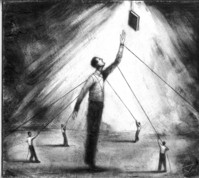
A Universal Library

Jk7_thumb3 Peter Singer in Project Syndicate:

[A] digital universal library would be even better than any earlier thinker could have imagined, because every work would be available to everyone, everywhere, at all times. And the library could include not only books and articles, but also paintings, music, films, and every other form of creative expression that can be captured in digital form.

But Google’s plan had a catch. Most of the works held by those research libraries are still in copyright. Google said that it would scan the entire book, irrespective of its copyright status, but that users searching for something in copyrighted books would be shown only a snippet. This, it argued, was “fair use” – and thus permitted under copyright laws in the same way that one may quote a sentence or two from a book for the purpose of a review or discussion.

Publishers and authors disagreed, and some sued Google for breach of copyright, eventually agreeing to settle their claim in exchange for a share of Google’s revenue. Last month, in a Manhattan court, Judge Denny Chin rejected that proposed settlement, in part because it would have given Google a de facto monopoly over the digital versions of so-called “orphan” books – that is, books that are still in copyright, but no longer in print, and whose copyright ownership is difficult to determine.

Chin held that the United States Congress, not a court, was the appropriate body to decide who should be entrusted with guardianship over orphan books, and on what terms. He was surely right, at least in so far as we are considering matters within US jurisdiction. These are large and important issues that affect not only authors, publishers, and Google, but anyone with an interest in the diffusion and availability of knowledge and culture. So, while Chin’s decision is a temporary setback on the way to a universal library, it provides an opportunity to reconsider how the dream can best be realized.

The central issue is this: how can we make books and articles – not just snippets, but entire works – available to everyone, while preserving the rights of the works’ creators?
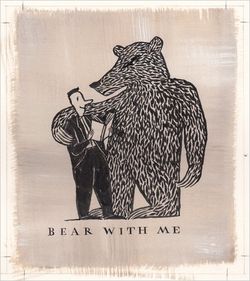

The Pun’s Story

From The New York Times:

Orourke-popup King Charles I’s court jester, Archy Armstrong, lost his job by saying grace — “Great praise be given to God and little laud to the Devil” — at dinner with the archbishop of Canterbury, William Laud. The Newspeak of “1984” was meant to preclude, among other things, puns. “Its vocabulary was so constructed,” George Orwell wrote, “as to give exact and often very subtle expression to every meaning that a Party member could properly wish to express, while excluding all other meanings.” And although the pun seems always to have had its comic uses, it is also a formal rhetorical device. The pun can be employed seriously, as when Lady Macbeth goes to smear the blood of murdered Duncan on some innocent servants: “I’ll gild the faces of the grooms withal, / For it must seem their guilt.” The problem with Pollack’s historical survey of puns is that it misses the greatest puns in history. He ignores many of the best practitioners of the idiom — Jesus and Sir Charles Napier, to name two. Jesus said to his disciple Peter, “Upon this rock I will build my church.” That was not only a pun on Peter’s name, which means rock, but also a pun on the character of Peter, who, in the garden of Gethsemane, would deny Jesus thrice before cockcrow. Napier led an unauthorized conquest of the Indian emirate of Sind and is supposed to have sent Queen Victoria a one-word dispatch: “Peccavi.” (Latin for “I have sinned.”)

Pollack mentions Abbott and Costello only in passing, without description or transcription of their “Who’s on first?” exchange. He also gives short shrift to the Marx Brothers, even though the “contract scene” in “A Night at the Opera” contains perhaps the 20th century’s most famous pun.

Groucho: “That’s in every contract. That’s, that’s what they call a ‘sanity clause.’ ”

Chico: “You can’t fool me. There ain’t no Sanity Claus.”

More here.

Saturday Poem

Two Poems by Michio Mado

Distant Place

In the evening
I look up at the sky
over the eaves
along with mosquitoes,
stars
hang
in the spider web

ah
in such a distant place where
stars can be mixed
with mosquitoes
we live

cohabiting with
mosquitoes
spiders
and other
countless
living things

On Facing Death

——————
Dear God,

I thank you
for letting me,
a scrawny spoon,
scoop from the ocean just once
The ocean
was beautiful
Carefully holding
this drop of
glorious sunset
I will come
to make an offering
to you

from Masters of Modern Japanese Poetry
The Morris-Lee Publishing Group,
Rosemont, New Jersey, © 1999
translation by Takaka Lento, 1999

Friday, April 15, 2011

The Trouble With Teens

From Discover:

Partykids Teenagers are a puzzle, and not just to their parents. When kids pass from childhood to adolescence their mortality rate doubles, despite the fact that teenagers are stronger and faster than children as well as more resistant to disease. Parents and scientists alike abound with explanations. It is tempting to put it down to plain stupidity: Teenagers have not yet learned how to make good choices. But that is simply not true. Psychologists have found that teenagers are about as adept as adults at recognizing the risks of dangerous behavior. Something else is at work.

Scientists are finally figuring out what that “something” is. Our brains have networks of neurons that weigh the costs and benefits of potential actions. Together these networks calculate how valuable things are and how far we’ll go to get them, making judgments in hundredths of a second, far from our conscious awareness. Recent research reveals that teen brains go awry because they weigh those consequences in peculiar ways. Some of the most telling insight into the adolescent mind comes not from humans but from rats. Around seven weeks after birth, rats hit puberty and begin to act a lot like human teens. They start spending less time with their parents and more with other adolescent rats; they become more curious about new experiences and increasingly explore their world. Teenage rats also develop new desires. It’s not just that they get interested in sex but also that their landscape of pleasure goes through an upheaval.

More here.

Friday Poem

On Cowee Ridge

John Gordon Boyd
died on the birthday
of three remarkable, and remarkably different, writers:
Heinrich Heine, Kenneth Patchen, Ross McDonald
John, too, was just as remarkable, blessed with an inherent “graciousness”
and with extraordinary eyes & ears…
I think of two texts
on the grievous occasion of his death:
“Religion does not help me.
The faith that others give to what is unseen,
I give to what I can touch, and look at.
My Gods dwell in temples
made with hands.”
— Oscar Wilde, in De Profundis
and two lines in Rainier Maria Rilke,
John’s favorite poet,
that say it all…
Was tun Sie, Gott,
Wenn ich bin stürbe?
“What will you do,
God, when I am dead?”
…………………….
……………………..
by Jonathan Williams
from Jubilant Thicket: New & Selected Poems.
Copper Canyon Press © 2005