
Enjoying the content on 3QD? Help keep us going by donating now.
Category: Recommended Reading
Life after near-death: a new perspective on living, dying, and the afterlife
From PeterAttia.com:
 Sebastian Junger is an award-winning journalist, bestselling author, and previous guest on The Drive. In this episode, Sebastian returns to discuss his latest book, In My Time of Dying: How I Came Face to Face with the Idea of an Afterlife. This episode delves into Sebastian’s profound near-death experience and how it became the catalyst for his exploration of mortality, the afterlife, and the mysteries of the universe. They discuss the secular meaning of what it means to be sacred, the intersection of physics and philosophy, and how our beliefs shape our approach to life and death. He also shares how this experience has profoundly changed him, giving him a renewed perspective on life—one filled with awe, gratitude, deeper emotional awareness, and a more engaged approach to living.
More here.
Enjoying the content on 3QD? Help keep us going by donating now.
The Secret, Magical Life Of Lithium
Jacob Baynham at Noema:
 Scientists generally consider it uncool to anthropomorphize, but as a nonscientist, I can say that if lithium were a friend, it would be the sort of friend who is humble and unassuming and yet also seemingly everywhere all at once doing really fabulous and important things. Lithium, in my imagination, is the envy of the other elements.
“I’m such a fan of lithium,” the astronomer Brian Fields told me over the phone recently. “It’s the third simplest element. And yet it’s always got surprises for us.” Fields teaches astronomy and physics at the University of Illinois Urbana-Champaign. He specializes in a field called galactic chemical evolution, which seeks to explain the origin of elements in the universe. “Lithium has one of the most complex stories,” Fields said. “The oxygen you’re breathing, the carbon in your DNA, the iron in your blood — that came later, out of stars. But lithium comes straight out of the Big Bang.”
more here.
Enjoying the content on 3QD? Help keep us going by donating now.
The surprising cause of fasting’s regenerative powers
Max Kozlov in Nature:
 Breaking a fast carries more health benefits than the fasting itself, a study in mice shows1. After mice had abstained from food, stem cells surged to repair damage in their intestines — but only when the mice were tucking into their chow again, the study found. But this activation of stem cells came at a price: mice were more likely to develop precancerous polyps in their intestines if they incurred a cancer-causing genetic change during the post-fasting period than if they hadn’t fasted at all. These results, published in Nature on 21 August, show that “regeneration isn’t cost-free”, says Emmanuelle Passegué, a stem-cell biologist at Columbia University Irving Medical Center in New York City, who wasn’t involved in the study. “There is a dark side that is important to consider.”
Fast way to health
Researchers have been investigating the potential health benefits of fasting for decades, and there is evidence that the practice can help to delay certain diseases and lengthen lifespan in rodents. But the underlying biological mechanisms behind these benefits have been a mystery. In 2018, Ömer Yilmaz, a stem-cell biologist at the Massachusetts Institute of Technology in Cambridge, and his colleagues found that stem cells are likely to be implicated. During fasting, these cells begin burning fats rather than carbohydrates as an energy source, leading to a boost in their ability to repair damage to the intestines in mice2.
More here.
Enjoying the content on 3QD? Help keep us going by donating now.
Another Life: On Yoko Ono
Cynthia Zarin at The Paris Review:
 A myth about Yoko Ono is that she came from nowhere and became a destroyer of worlds. The truth is otherwise. Yoko Ono—now ninety-one—was born in 1933, in Tokyo. Her father was a successful banker and a gifted classical pianist; her mother an art collector and philanthropist. Ono attended a progressive nursery school where the emphasis was on music: the children were taught perfect pitch and encouraged to listen to everyday sounds and translate them into musical notes. In 1943, she and her brother were evacuated to the countryside. Basic provisions were scarce. For hours, they lay on their backs looking at the sky. They said to each other: “Imagine good things to eat. Imagine the war is over.” She returned to Tokyo in 1945. She was president of her high school drama club; in a photo taken at the time, her hair is bobbed and she is wearing what looks like a cashmere sweater set. At Gakushuin University, she was the first female student to major in philosophy. Her family relocated to Scarsdale, in Westchester County; she enrolled in Sarah Lawrence College, where she studied music. After three years, she dropped out and moved to New York, supporting herself by teaching traditional crafts at the Japan Society. In 1960, she rents a loft downtown, at 112 Chambers Street, and begins to host musical performances.
more here.
Enjoying the content on 3QD? Help keep us going by donating now.
How To Read Genesis
James Butler and Malin Hay at the London Review of Books:
Enjoying the content on 3QD? Help keep us going by donating now.
Sunday, August 25, 2024
Hettie Jones (1934 – 2024) Poet
Enjoying the content on 3QD? Help keep us going by donating now.
Harold Meltzer (1966 – 2024) Composer
Enjoying the content on 3QD? Help keep us going by donating now.
Alain Delon (1935 – 2024) Actor
Enjoying the content on 3QD? Help keep us going by donating now.
The World’s Stockyard
Fernando Rugitsky in Phenomenal World:
A recent visitor to the Amazon rainforest was surprised by the animal that was most conspicuous: instead of exotic jaguars, the region was populated by “the humpbacked, floppy-eared, glossy white Nelore cow, the ultimate conqueror of the frontier.” As the Brazilian economy was transformed into the world’s main provider of beef in the last two decades, the rainforest that houses 10 percent of the world’s animal species has been set alight to open the way for millions of grazing cows. Current estimates suggest that there are more than twice as many cows as people in the Brazilian part of the Amazon—around 63 and 28 million, respectively.
When President Luís Inácio Lula da Silva started his first term in office in 2003, Brazilian exports of frozen beef ranked third in the world by volume, representing around 11 percent of the total. By the end of his second term in 2010, Brazil ranked first, accounting for 23 percent of all frozen beef exported worldwide. In quantity, these exports increased from 317 to 781 thousand tonnes. Over the following decade, Brazilian beef supremacy deepened: in 2022 Brazil was the origin of 32 percent of all frozen beef traded internationally, exporting almost twice as much as India, the second largest exporter. The rise of Brazil as the stockyard of the world was tightly connected to the rise of China as an economic superpower: Chinese imports of frozen beef surged between 2002 and 2022 from eleven thousand to over two million tonnes.
A yet more dramatic story can be told about soya.
More here.
Enjoying the content on 3QD? Help keep us going by donating now.
Freudulence
Jamieson Webster in LA Review of Books:
IT’S WELL-WORN KNOWLEDGE that Freud was pessimistic. Add to pessimism, elitism. Freud thought a more truthful relation to one’s true motives was only possible to the select few who were willing to interrogate themselves at all costs. In fact, he was so grandiosely pessimistic that he counted his theories as one of the great blows to mankind along with Copernicus and Darwin: we are not the center of the universe, we are not some unique species set apart from the rest of life on earth, and we are not masters in our own house. Freud’s message is often watered down to mean that there are processes in the mind that we don’t know about, like the way computer software runs in the background, or that there are parts of ourselves that are hidden and only need to be carefully revealed. These gloss the extremity of his actual message that we fundamentally cannot know ourselves—but for the tip of an iceberg.
How does our lack of self-knowledge tip the scales of history? It is important that we know what we don’t know, and what we can’t know. There is no better curb to human hubris. Actions we take might be more ethical if undertaken with a strong sense of our human limitations. As we begin to reckon with the failures of Western democracy, especially regarding the rationality of politics and the fitness of political leaders, could we have a better sense of how little shared knowledge there is?
This is a timely moment for Patrick Weil’s The Madman in the White House: Sigmund Freud, Ambassador Bullitt, and the Lost Psychobiography of Woodrow Wilson (2023), which provides a reassessment of the much-disputed book that Freud and American ambassador William C. Bullitt wrote about Woodrow Wilson, speculating about the president’s mental health.
More here.
Enjoying the content on 3QD? Help keep us going by donating now.
To Be Continued
Leo Robson in Sidecar:
Is there a ‘Seventh Generation’ of Chinese film-makers? It has not materialised in any formal sense, and the term is not in use. As a mode of classification, the idea of succession, one cohort following another – with no gaps in between – encompasses more than a century of cinema. But its ubiquity, at least among Western festival organisers and cinephiles, goes back forty years, to the emergence of the directors who were identified as the Fifth Generation though were, more significantly for descriptive purposes, the first to appear since the end of the Cultural Revolution and, with it, the reopening of the Beijing Film Academy. The graduating class of 1982 announced itself almost immediately, with Tian Zhuangzhuang’s September, Zhang Junzhao’s One and Eight, and – above all – Chen Kaige’s Yellow Earth, about a soldier’s relationship with a teenage girl set on Loess Plateau in Shanxi Province and shot by Zhang Yimou, who emerged as a director with the Mo Yan adaptation Red Sorghum (1988), which won the Golden Bear at Berlin. During the next five years, Zhang received a Silver Lion at Venice for Raise the Red Lantern, then a Golden Lion for The Story of Qiu Ju, while Chen shared the Palme d’Or – with Campion’s The Piano – for Farewell, My Concubine.
These films, a rejection of the socialist-realist habits that had dominated earlier practice, were dramatic and pictorial, not dialogue-driven, and usually historical and rural in setting, literary in source. What came next, reflecting differences of social attitude as well as aesthetic inclination, was altogether harder-bitten, more self-conscious and self-consciously abrasive, carnal, lo-fi, ad hoc. Films like Wang Xiaoshuai’s The Days, Zhang Yuan’s Beijing Bastards, Lou Ye’s Weekend Lover, and Guan Hu’s Dirty, set in the capital in the modern day or recent past, and typically concerned with members of the post-Tiananmen generation working as artists, musicians, or petty criminals, began to appear less than a decade after the first films of the Fifth Generation, and coincided with the height of its international renown.
More here.
Enjoying the content on 3QD? Help keep us going by donating now.
Democratic Disenchantment
Samuel Bagg in Boston Review:
In late 2018 a massive protest movement shook French society. Named for the yellow vests, or gilets jaunes, worn by demonstrators, the movement was initially sparked by opposition to a fuel tax hike, but its demands soon expanded. Among them were reforms to enable more direct popular input into political decisions.
Within weeks, President Emmanuel Macron rescinded the fuel tax increase. He soon offered ambitious democracy initiatives of his own: first, a “Great Debate” involving more than 10,000 local meetings and 2 million online comments, and second, a Citizens’ Convention on Climate (CCC), which asked 150 randomly selected citizens to propose solutions to the climate crisis, with the promise that their proposals would be put directly to a referendum.
Each side in this drama claimed the mantle of democracy. Defenders of the fuel tax pointed out that it was implemented by representatives who had been duly elected by the people of France; the gilets jaunes, they complained, were attempting to circumvent this legitimate process. Meanwhile, protesters criticized modern representative government, charging that it favors wealthy elites and insisting that genuine popular rule requires direct input via tools such as initiatives and referendums. And Macron’s own proposals aimed at transforming adversarial confrontation into respectful deliberation—reflecting an ideal of democracy as a process of reason-giving, collaborative discussion, and mutual learning.
These three visions—representative democracy, direct democracy, and deliberative democracy—represent intuitive and popular ways of thinking about what democracy means. Each has clear virtues, highlighting certain decision-making tools—elections, referenda, and citizen’s assemblies—that can help to ensure public power serves genuine public interests. By placing so much emphasis on the search for the right procedures, however, all three visions ultimately sell democracy short.
More here.
Enjoying the content on 3QD? Help keep us going by donating now.
5 vibe-shifting cartoons about the DNC

Edwidge Danticat’s essays spin webs of fresh ideas
Becca Rothfeld in The Washington Post:
 “
“This anecdote is a fitting beginning for a collection about the many ways that Haiti has been distorted by its translation into the idioms of global power. The original Haiti — the one that existed before France colonized the country in 1697, before the subsequent centuries of economic exploitation, before a series of devastating hurricanes exacerbated by climate change — is no longer accessible. “I am from a place that constantly evokes nostalgia in the people who have seen, lived, and loved it ‘before,’” writes Danticat, who emigrated to America when she was 12. Years later, when the writer and her children were driving through a flooded street full of floating trash in the capital city, Port-au-Prince, she suppressed her desire to shout, “The land might never be pristine again.”
More here.
Enjoying the content on 3QD? Help keep us going by donating now.
Sunday Poem
The QPP
The quietly pacifist peaceful
always die
to make room for men
who shout. Who tell lies to
children, and crush the corners
of old men’s dreams.
And now I find your name,
scrawled large in someone’s
blood, on this survival
list.
by Alice Walker
from Her Blue Body Everything We Know
Harvest Books, 1996
Friday, August 23, 2024
Real-time crime centers are transforming policing – a criminologist explains how these advanced surveillance systems work
Kimberly Przeszlowski in The Conversation:
 In 2021, a driver in Albuquerque, New Mexico, ran a red light, striking and killing a 7-year-old and injuring his father. The suspect fled the scene and eventually escaped to Mexico. Using camera footage and cellphone data, the Albuquerque Police Department’s real-time crime center played a crucial role in identifying, apprehending and charging the person at fault. The driver was ultimately sentenced to 27 years in prison, providing a measure of justice to the grieving family.
Real-time crime centers are specialized units within police departments that use the latest technology to monitor public spaces and record incidents. The New York City Police Department was the first to institute a real-time crime center in 2005.
Real-time crime centers often focus on video surveillance, using closed-circuit television systems, license plate scanners, body cameras worn by officers and drone cameras. The centers sometimes also include gunshot detection and computer-aided dispatch systems, live or static facial recognition, cellphone tracking and geolocation data, and access to probation, parole and arrestee information. Police departments are adding the latest innovations, such as video analytics driven by deep learning artificial intelligence, to identify objects and assess subjects’ behavior.
More here.
Enjoying the content on 3QD? Help keep us going by donating now.
What science can and can’t tell us about cheating ageing
Jan H. J. Hoeijmakers in Nature:
 We are born; we grow up; we become an adult and perhaps reproduce. Then we might increasingly develop ailments or chronic diseases, before we decline and eventually — inevitably — die. These are the facts of life, at least hitherto, however much many of us might wish for them to be otherwise.
Perhaps things could be different. Progress in ageing research has opened up the prospect that ageing and death might be deferred, possibly even for hundreds of years, according to some people. Is that wishful thinking? The timely, illuminating book Why We Die by 2009 chemistry Nobel co-laureate Venki Ramakrishnan explains the science — and, importantly, separates fact from fiction.
Over the past century or so, better hygiene, improved living conditions and health-care innovations, such as antibiotics and vaccines, have seen human life expectancy more than double. But the maximal lifespan has hit a ceiling at about 120 years.
More here.
Enjoying the content on 3QD? Help keep us going by donating now.
Fish Do Not Aspire to Wetness: Misunderstanding Liberalism
Stephen Holmes at The Ideas Letter:
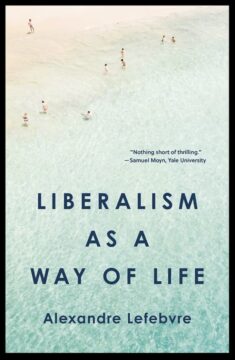 Today’s disheartening resurgence of authoritarianism, xenophobia, race-baiting, brazen sexism and religious zealotry, not to mention homicidal rampages in the name of ethnic identity, makes rallying to the defense of a beleaguered liberalism into an intellectual and moral imperative. Even Alexander Lefebvre, a delightfully entertaining Professor of Politics and Philosophy at the University of Sidney, acknowledges in an aside that “liberal institutions and values are threatened worldwide.” But his stylishly chatty and evangelizing new book aims to defend liberalism against a threat less grimly consequential than those making newspaper headlines. The danger to which he draws our attention is more bookish and professorial than blood-dimmed and existential. In making his eloquent case for liberalism, he says little about the malignant movements of the far right thriving on political confusion and division in the United States and the European Union. Instead, he concentrates his hostile fire on a fashionable but unjustifiably cramped interpretation of the teachings of his philosophical hero, John Rawls.
The mission he sets himself is to present Rawls’ thought in a new light and thereby overturn “the reigning orthodoxy of how to do political philosophy within the Anglophone academy.”
More here.
Enjoying the content on 3QD? Help keep us going by donating now.
Joscha Bach: “We Are All Software”
Enjoying the content on 3QD? Help keep us going by donating now.