our monstrous new selves

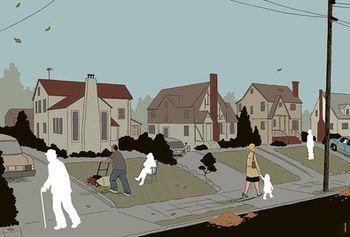
Greenberg_ftr Selves change. Not just in the course of our little lives, in ways that we therapists try to effect, but in the course of human history. The idea of what it means to be a human being, of what we should expect of ourselves, of what constitutes the good life and why it is good and how we ought to achieve it—this is transformed by time and circumstance, in a way that can be seen only in retrospect, and even then through a glass darkened by the prejudices of whatever kind of self is looking back. Hard as it is to spot our origins by peering into our collective past, it is even harder to glimpse ourselves as we live through epochal change, as our very understanding of who we are is transformed before our eyes. Hardest of all is to know what, if anything, to do about it.

Nicholas Carr, in The Shallows, and William Powers, with Hamlet’s BlackBerry, have undertaken to tell us exactly that: who we are becoming now that we swim in an endless stream of digital data, what ails this new self and how its pathologies should be treated. Their books are in part confessional accounts of their discovery that something has gone wrong in their lives. For Powers, revelation comes when he leans too far over the transom of his motorboat and falls into the waters off Cape Cod. Clambering back aboard, he realizes that his cellphone went into the drink with him and is ruined. He’s immediately aware of the hassle and headache he’s in for—replacing the phone, restoring his contacts, being out of touch, mourning the loss of his photos. But then, on his way back to his mooring,

I notice something funny. It’s not anything I can see or hear. It’s an inner sensation, a subtle awareness. I’m completely unreachable…. Nobody anywhere on the planet can reach me right now, nor can I reach them…. Just minutes ago, I was embarrassed and angry at myself for drowning my phone. Now that it’s gone and connecting is no longer an option, I like what’s happening.

more from Gary Greenberg at The Nation here.

actual human presence

May

It will come as little surprise to anyone acquainted with the paintings of Raoul Middleman that earlier in his career he had writing aspirations, too — and not just aspirations, for they were acted upon in raucous short stories that often delved into the steamier side of Baltimore. This is the city where he grew up, taught for many years at the prestigious Maryland Institute College of Art, and continues to make his home. But it is also, in his writings and paintings alike, a city of the imagination, transported beyond its present bricks and mortar to the planet of Joyce’s Dublin and Durrell’s Alexandria, Atget’s Paris and Kirchner’s Berlin. These are cities mapped by longings not landmarks. For many years he has kept a studio of mythic magni- tude in the neighborhood of the famed Copycat building, amidst the raw, mean streets that serve as location for The Wire. Middleman is at once a supremely painterly painter and a writerly painter. His illustrious, fecund career provides a service to aesthetics by dispelling the prissy formalist notion that somehow to tell a story in paint, to illustrate a type, to animate a com- position with scenario, is incompatible with whatever it is that provides visual art with its essence. Middleman’s vital, brimful- of-life riposte to such a reductive way of thinking reconnects narrative painting to centuries of endeavor in countless genres, many of which latter he himself has attacked in his greed for imagery. In virtually any Middleman painting, an event has just happened and there is more to come. Subjects are never passive. The universe is in flux.

more from David Cohen at artcritical here.

living dangerously in Sri Lanka

LWTC0405

On the morning of January 8, 2009, Lasantha Wickrematunge was driving to work in a suburb of the Sri Lankan capital of Colombo when his Toyota Corolla was blocked by four motorcycles. The masked riders smashed the car’s windows and dragged Lasantha into the street, where one of the assailants punched a hole in his skull with a captive bolt pistol, the kind used to slaughter livestock. According to eyewitnesses, the motorcyclists then sped off in the direction of a nearby military checkpoint, leaving Lasantha dead in the middle of a crowded intersection. Lasantha was the editor of The Sunday Leader, an English-language weekly newspaper that he founded with his older brother Lal in 1994. Known for their muckraking investigations of corrupt politicians, the Wickrematunges were accustomed to harassment and violence: Lasantha had been shot at, beaten up, and had his home shelled by antitank ammunition; the government briefly shut the Leader down in 2000 for flouting censorship laws; in 2005, and again in 2007, arsonists burned down its printing press; and before his assassination, Lasantha received death threats for criticizing the government’s war against the Liberation Tigers of Tamil Eelam (LTTE), a Tamil separatist group that had been in revolt against the predominantly Sinhalese government since 1983.

more from Michael Hardy at The American Scholar here.

Friday Poem(s)

The Sufi's Garland

And when I learned, sitting among the shoes and sheets Sufis garland

and shards and sheer that, the mind of man, that the
mind of man too is a solo act, a solo uncontainable act, I lost
my fears, my fears of losing, of losing my mind . . . and
thought freely.

And when I learned that being true must not, must not be a way
to ensure they speak good of you, speak good of you when
you are gone, then I, I lost my fears of not, of not
being able to buy their words worth . . . and spoke freely.
………………………….. –Shabad Shradanjali to Tagore's Gitanjali

Both of these verses are excerpts from a book that came my way. In The Sufi's Garland, which the author, Manav Sachdeva Maasoom, has written as a tribute to Emily Dickinson, Antonio Porchia and Rabindranath Tagore, Maasoom offers a wealth of smart sufi beauty.

Among Maasoom's verses you'll find thoughts as jarringly succinct as this:

I went outside to see
if God's voice
was disturbing anybody

In a world in which it seems God's voice is disturbing few this simply put statement can be read, among other things, as an indictment. But God's voice in the sufi-speak we find in this fine book is not the voice of a quasi-human overseer. This god's voice is beyond God. The voice of the god in The Sufi's Garland is the god that speaks when the God of sects is dumbfounded.

The God of sects would turn this verse of Mansoom's on its head:

seek first to love
then to understand

Speaking through the mouths of every confused or manipulative mullah, priest, or preacher, the God of sects demands that we first understand their singular take on God so that (they insist) we may love. Believe first, they say. In his two lines Mansoom sets us straight.

And, as if to underscore, Mansoom later writes:

When in Iran I prayed to Mohammed
Rasool and PEACE be upon him
one asked me straight—Are you Muslim?
and I told him, with a date
and water, breaking my fast
I don't think Brahma would've minded

But among the visions of god in this book, there are also snapshots of god:

the sheer elegance
……… of the seagulls
…………. gliding
……………… startling the Hudson
freshness
…………….. of the summer's
…….. first …………….. navels

~~

Dear Flower

your faint feistiness to survive gives me strength.
tomorrow foreshadows a tenderness in my kernel that is
yours' to keep. I do not know if the joy waltzing in my eyes
that lights up our hearts' lamps each time I visit is a light I
see in you because my heart is but noir. I do not know if
the joy and sweet in you is the same for each bee

Like everything else in the world the book is not perfect, but there's enough near-perfection, astute perception and wise reflection to be found in The Sufi's Garland to make it a worthwhile garland to have written, to read and to wear.


The Sufi’s Garland
by Manav Sachdeva Maasoom
Published by: ROMAN Books
Publication date: 25th March 2011
Price: $24.95 (Hardcover)
104 pp, 6-1/8 x 9-1/4″
ISBN: 978-93-80040-02-8

The bad mother complex

From The Boston Globe:

Mom One night, my 6-year-old wandered into my room and found me buried in a stack of magazine proofs, scanning line after line of text and marking errors with a red pen. He asked what I was doing. When I explained that mama was “making the magazine” — fixing mistakes, moving words, and eventually entering the changes into computer files that would then go to a printing press in Vermont — Owen wondered out loud how grown-ups could be in charge when they had so little common sense. “Here’s what you do,” he started. “You take a giant piece of tape and tape all these pages together on one side. Then you flip it over and tape them on the other side. And see? Your magazine is all done. Now we can play Swampfire!” It was the kind of moment I had fantasized about as a newspaper reporter, when hourlong commutes to Boston defined my existence and visions of work-family balance were just that — visions. Now here I was, with pajamas and a laptop, working in the family-friendly universe of quarterly magazines. And here was my firstborn, peeking in to entertain me with his shiny curls and a seminar on print production.

But I didn’t feel entertained or balanced. I felt guilty and stressed. Stressed because, contrary to Owen’s critique, I was working at maximum efficiency, plowing through the many pages I knew I had left to go. And guilty because — say it with me, moms — I would not play Swampfire that night. On talk shows, in online support groups, and in our most private thoughts, it seems impossible to utter the word “mother” without uttering the words “bad mother.” These days, a mommy blogger can make an entire career (so to speak) trafficking in guilt, wearing her failures like badges of honor: “I let my infant watch five hours of TV!” “My toddler dunked his head in the toilet!” Whether you’re a blue-suit executive, a bank teller, or Dr. Phil, we all know — or think we know — about family, work, conflict, and guilt.

More here.

The Worst Case: What If the Water Ran Dry in the Japanese Reactors?

From Science:

Japan What if cooling in one or more of the reactors at the Fukushima nuclear plant were lost? Richard Lester, chair of the department of nuclear science and engineering at the Massachusetts Institute of Technology (MIT) in Cambridge, emphasizes the “very, very” unlikely possibility of that scenario. But if it were to occur, the inherent heat of the radionuclides would cause the fuel in the reactors to melt. Here's what would happen next. In the event of a meltdown, the fuel could melt through and flow out of the primary pressure vessel, falling into the so-called core capture chamber which sits below the reactor for this very purpose. That vessel has water that would hopefully cool the molten fuel down, eventually ending the crisis. If this didn't happen, however, a steam explosion could blow out the primary containment vessel, spewing massive quantities of radioactive aerosols as well as particulates. With towns evacuated at a perimeter of 30 kilometers, the lethality of that release “would depend on the winds,” says Lester.

How would this compare to the disaster at Chernobyl? As noted in the New Scientist:

At Chernobyl the pressure vessel was breached and the reactor had no containment. There, the core itself burned fiercely, largely because it was made of graphite – which was used as the moderator… once the reactor exploded the graphite made the situation worse, because it burned so readily. The fires carried radioactive material from the reactor core high into the atmosphere, where it spread far and wide. This could not happen at Fukushima Daiichi, as it does not use graphite as the moderator.

More here.

Thursday, March 17, 2011

Lolita

Lydia Kiesling in The Millions:

Lolita1 Lolita has caused so many people to wring their hands and besiege librarians on behalf of those delicate blossoms, the children. To be sure, it is a very disgusting book. The rape of Lolita: “a last throb, a last dab of color, stinging red, smarting pink, a sigh, a wincing child,” after which the fiend Humbert buys “four books of comics, a box of candy, a box of sanitary pads, two cokes, a manicure set,” and so on.

And then, “At the hotel we had separate rooms, but in the middle of the night she came sobbing into mine, and we made it up very gently. You see, she had absolutely nowhere else to go.”

This is viscerally horrible. And yet this book, with its veritable panoply of horrors, is maybe the most bracing and perfect work of art I know. Nabokov said “for me a work of fiction exists only insofar as it affords me what I shall bluntly call aesthetic bliss.” By that arresting measure, Lolita is a triumph, the ne plus ultra of the novel form.

More here.

Revealed: US spy operation that manipulates social media

Nick Fielding and Ian Cobain in The Guardian:

ScreenHunter_03 Mar. 18 09.34 The US military is developing software that will let it secretly manipulate social media sites such as Facebook and Twitter by using fake online personas to influence internet conversations and spread pro-American propaganda.

A Californian corporation has been awarded a contract with United States Central Command (Centcom), which oversees US armed operations in the Middle East and Central Asia, to develop what is described as an “online persona management service” that will allow one US serviceman or woman to control up to 10 separate identities based all over the world.

The project has been likened by web experts to China's attempts to control and restrict free speech on the internet. Critics are likely to complain that it will allow the US military to create a false consensus in online conversations, crowd out unwelcome opinions and smother commentaries or reports that do not correspond with its own objectives.

The discovery that the US military is developing false online personalities – known to users of social media as “sock puppets” – could also encourage other governments, private companies and non-government organisations to do the same.

The Centcom contract stipulates that each fake online persona must have a convincing background, history and supporting details, and that up to 50 US-based controllers should be able to operate false identities from their workstations “without fear of being discovered by sophisticated adversaries”.

More here.

the problem of beauty

TLS_Miller3a_735118a

Many of us find ourselves behaving strangely at fortieth birthday parties, of course: the illusion of maturity, the last chance to misbehave. Then again, Greer’s always slightly sibylline prose was done few favours by the subeditors on the Sun’s back desk. So I can only try to paraphrase what she seemed to be saying: namely, that these pictures were not unwholesome, because, while they were effective at generating cheerfulness, they were not capable of stimulating desire. Greer’s “handyman” was quoted in support of the thesis; Kant was not, although the Sun’s “News in Briefs” feature often attributes highbrow quotations to the topless models on display. But there is an urgent question at issue here, even if the beauty of the Page Three girl is not that celebrated by the taste cultures discussed above. If it is true, for example – as a tabloid paper might suggest, a tasteful number of pages away from its “good” nudes – that our teenage children are learning their first lessons about the opposite sex from hard-core pornography, then beauty and desire are being sundered in ways that no Western aesthetician could have predicted – though Eastern aestheticians have always tended to a rather different view. Or maybe they aren’t, especially if the opposite sex is taking the same lessons. Changing times make the formulation of timeless truths a tricky and perhaps a pointless task.

more from Keith Miller at the TLS here.

what’s a guitar?

ID_PI_GOLBE_GUITA_AP_001

And though any instrument-as-object can express this estrangement, there’s something about a silent guitar — especially one that’s beautiful, or precious, or two-dimensional — that particularly aches. When a guitar becomes a symbol, the very thing that makes it a guitar, its immediacy, disappears. For “immediacy” is why a guitar is a folk instrument, i.e. the instrument of folks. The guitar is lightweight, cheap, easy to play. Anyone — and I would like to stress anyone — with two hands and the inclination can spend an afternoon learning three major chords (A D E is a good combo or D A G) and be then well equipped to instantly rock scores of songs from “Back in Black” to “You Are My Sunshine.” (Like the old ‘70s fanzine said: “This is a chord, this is another, this is a third. Now form a band.”) This is not so with the piano, nor the drums, the flute, the fiddle. Flung over the heart or across the back, the guitar is good for anywhere and any occasion. The guitar is a folk instrument because it is an easy extension of our bodies, and therefore an easy expression of our humanity. The guitar — and all its predecessors and incarnations: the bouzouki, the saz, the oud, the guitarrón — represents the parts of us that are spontaneous, angry, lazy, joyous, raw, unsophisticated and unadorned. The only other instrument that surpasses the guitar in capturing this immediacy is the voice. Which is the final reason why the guitar is not just a folk instrument but the folk instrument — it’s an easy companion to singing.

more from Stefany Anne Golberg at The Smart Set here.

Listening to Bacteria

Natalie Angier in The Smithsonian:

Bacteria-Bonnie-Bassler-631 Bassler, 48, has been fabulously successful in her career, winning laurels like a MacArthur Foundation “genius” award, membership in the National Academy of Sciences, a coveted position with the Howard Hughes Medical Institute and the presidency of the American Society for Microbiology. And all that can be traced to her deep appreciation for the power of communication. Messaging is the medium in which Bassler shines. Bassler is at the forefront of the fast-growing field of “quorum sensing,” the study of how microbes communicate with each other as they go about building the vast interlocking infrastructure of life on which we macrobes depend.

In recent years she and other microbiologists have discovered that bacteria are not the dull solipsists of long-standing reputation, content to merely suck in food, double in size, divide down the middle and repeat ad infinitum, attending to nothing but their obtuse, unicellular selves. Instead, bacteria turn out to be the original newshounds, glued to their cellphones and Internet chat lines. They converse in a complex chemical language, using molecules to alert one another to who’s out there, in what numbers and how best to behave given the present company. Bacteria survey their ranks, they count heads, and if the throng is sufficiently large and like-minded—if there is a quorum—they act. Through chemical signaling, tiny bacterial cells can band together and perform the work of giants. They can compost an elephant, fertilize an oak forest or light up the oceans in the eerie teal glow of bioluminescence. Some bacterial collusions are far less charming and do real harm. Molecular communication allows 600 different species of bacteria to organize themselves into the slimy dental plaque that leads to tooth decay, for example, and it likely enables the nasty pathogens that cause streptococcal pneumonia or bubonic plague to time the release of their toxins for maximum impact on their human hosts.

More here.

New findings on the developments of the earthquake disaster

From PhysOrg:

Quake The earthquake disaster on 11 March 2011 was an event of the century not only for Japan. With a magnitude of Mw = 8.9, it was one of the strongest earthquakes ever recorded worldwide. Particularly interesting is that here, two days before, a strong foreshock with a magnitude Mw = 7.2 took place almost exactly at the breaking point of the tsunami-earthquake. The geophysicist Joachim Saul from the GFZ German Research Centre for Geosciences (Helmholtz Association) created an animation which shows the sequence of quakes since March 9.

It shows the earthquake activity in the region of Honshu, Japan, measured at the GFZ since 8 March 2011. After a seismically quiet 8th March, the morning (coordinated universal time UTC) of the March 9 began with an earthquake of magnitude 7.2 off the Japanese east coast, followed by a series of smaller aftershocks. The morning of March 11 sees the earthquake disaster that triggered the devastating tsunami. This earthquake is followed by many almost severe aftershocks, two of which almost reach the magnitude 8. In the following time period the activity slowly subsides, and is dominated today (March 16) by relatively small magnitude 5 quakes, though several earthquakes of magnitude 6 are being registered on a daily basis. The activity of aftershocks focuses mainly on the area of the March 11 earthquake. Based on the distribution of the aftershocks, the length of the fraction of the main quake can be estimated at about 400 km. Overall, 428 earthquakes in the region of Honshu were registered at the GFZ since March 9.

More here.

Jamal Mahjoub interviews Ahdaf Soueif

In Guernica:

Soueif2-300 Soueif has written about Egypt for decades. Arguably the foremost Arab author writing in English today, her work has won her critical acclaim and a wide audience around the world. Edward Said described her as “one of the most extraordinary chroniclers of sexual politics now writing.” Her first novel, In the Eye of the Sun (1991), described as a masterpiece by the Sunday Telegraph’s Anthony Thwaite, rapidly became a modern classic. It recounts the liberation of Asya, a young Egyptian woman trapped in an unhappy marriage, who gains the confidence needed to break free while studying in England. The novel intersperses the story with vignettes describing current political events in Egypt. It is this combination of the actual and the fictitious which gives her work its solid grounding, setting the lives of her characters within a framework of historical developments. Soueif’s second novel, The Map of Love, consolidated her success. Shortlisted for the prestigious Booker Prize in 1999, the book has been translated into sixteen languages, including Arabic, and has sold over half a million copies in English alone. The Map of Love switches between past and present, describing events in the nineteenth century with as much clarity as it does the contemporary world, both in Egypt and New York.

In recent years Soueif’s fiction has come under pressure from the author’s increasing role as a political commentator. A collection of essays, Mezzaterra, published in 2004 underlined this new trajectory. In 2007, she launched PalFest, a literary festival aimed at breaking the deadlock in the Middle East and providing a cultural platform for dialogue between Palestine and the West. Adopting as its motto Said’s remark championing “the power of culture over the culture of power,” PalFest engages with Palestinian writers and cultural centers in promoting a dialogue between East and West, taking well-known writers like Michael Palin, Henning Mankell, Roddy Doyle, or Claire Messud, to experience the situation on the ground first-hand.

More here.

Owsley Stanley, Artisan of Acid, Is Dead at 76

Margalit Fox in the New York Times:

ScreenHunter_02 Mar. 17 10.21 Owsley Stanley, the prodigiously gifted applied chemist to the stars, who made LSD in quantity for the Grateful Dead, the Beatles, Jimi Hendrix, Ken Kesey and other avatars of the psychedelic ’60s, died on Sunday in a car accident in Australia. He was 76 and lived in the bush near Cairns, in the Australian state of Queensland.

His car swerved off a highway and down an embankment before hitting trees near Mareeba, a town in Queensland, The Associated Press reported. Mr. Stanley’s wife, Sheilah, was injured in the accident.

Mr. Stanley, the Dead’s former financial backer, pharmaceutical supplier and sound engineer, was in recent decades a reclusive, almost mythically enigmatic figure. He moved to Australia in the 1980s, as he explained in his rare interviews, so he might survive what he believed to be a coming Ice Age that would annihilate the Northern Hemisphere.

Once renowned as an artisan of acid, Mr. Stanley turned out LSD said to be purer and finer than any other. He was also among the first individuals (in many accounts, the very first) to mass-produce the drug; its resulting wide availability provided the chemical underpinnings of an era of love, music, grooviness and much else. Conservatively tallied, Mr. Stanley’s career output was more than a million doses, in some estimates more than five million.

More here.

Wednesday, March 16, 2011

Multiversism

Cover00

And once you become willing to take on the philosophical baggage of a multifoliate universe (and aren’t bothered by your countless identical twins), some of the deepest and most vexing problems about physics become easy to understand. All those nonsensical-seeming quantum-mechanical laws—that a particle can be in two places at once, that two objects can have a spooky connection that appears to transcend the laws governing space and time—instantly become explicable the moment you view our universe as one among many. And from Greene’s point of view, the 10⁵⁰⁰ different cosmoses described by string theory have ceased to be an unwanted artifact of the theory’s equations, instead becoming a factual description of universes that actually exist. Each of these universes is a bubble cosmos with its own cosmological constants, and as he says, “with some 10⁵⁰⁰ possibilities awaiting exploration, the consensus is that our universe has a home somewhere in the landscape.” Which is to say, string theory can no longer be accused of describing a landscape of fictional universes; our universe is just one in a collection of cosmoses as real as our own, even if we’re unable to see them. Multiversism is a radical, ambitious, and frustrating argument that relies on many lines of evidence and modes of thought—cosmological reasoning about the nature of the big bang, quantum-mechanical reasoning about the nature of matter on the smallest scale, information-theoretic reasoning about the nature of black holes—and it can be bewildering. Furthermore, Greene argues for nine distinct varieties of multiverse, each of which approaches the issue from a slightly different direction. And since the majority of his readers are untutored in the mathematical formalism that physicists use to understand the underpinnings of a scientific theory, Greene must use the much less precise tools of metaphor and simile to do the intellectual heavy lifting.

more from Charles Seife at Bookforum here.

fish and fandom

Stanley-fish-1

Academics: beware of loving what you write about. Fandom can tempt intellectuals to take uncharacteristic risks with their primary sources. Even Stanley Fish, who as the author of Is There a Text In This Class? knows better than anyone how important the division of insider and outsider is for keeping amateurs at bay. In 1993, Fish-the-fan, enamoured of the American television series The Fugitive, joined the faithful at a convention in Hollywood to rerun, adore and discuss the episodes, to listen to actors and directors of the programme talk about their experience. There’s probably an internally understood hierarchy of TV series obsessives, but I don’t know where Fugitive-heads come in relation to Trekkies, Python freaks or Dynasty divas. On the other hand, and at the same time, Fish-the-intellectual wanted to write a book about The Fugitive as it ‘celebrated and anatomised the ethic of mid-20th-century liberalism’, and, without doing a Christopher Ricks, who unnecessarily upgraded Bob Dylan’s songs to Great Poetry rather than the more-than-adequate great lyrics that they are, also wanted to claim that there was enough serious and educated thought behind the creation of the series to merit his academic attention. It is central to his essay that the people who conceived, pitched and wrote The Fugitive were not simply writing popular fiction in a winning formula but, in setting up the drama series and conceiving each episode, had the conscious intention to explore the same ideas as Fish does in writing about it.

more from Jenny Diski at the LRB here.

The Strangest Spice

Peppercorns Jon Fasman in More Intelligent Life:

There are many drawbacks to becoming a food writer—money and fatness spring to mind. But they all pale in comparison to the problem of translation. When food delights it does not delight in words; it delights in a way that exceeds, or slips past, or twists around words. People who write about music have this same problem, which is why both fields seem to turn out so many gossipy profiles: you can’t describe a transcendent song or dish, but you can easily describe the marital or financial peccadilloes of the person who created them. A meal is usually memorable for reasons ancillary to the food—the company, or the setting—but even when the food itself is memorable, memory calcifies it. It is a rare taste that breaks through the film of words.

All of this is by way of saying that about six years ago I sat down with three others for the full ten-course parade at Per Se, complete with wine pairings. I remember the austere but elegant restaurant, the way that around course five the meal tipped from Lucullan into some sort of strange performance art, but I can recall only one taste from the fifty or so dishes we tried that night: a single shortbread cookie, around the size of a domino, flavoured with Sichuan pepper and served as a companion to some sort of warm-spice ice-cream (cinnamon, I think, though it could have been anise or nutmeg).

That was not my first taste of the spice: its more familiar habitat, as its name suggests, is in the cuisine of south-western China. New York’s Grand Sichuan restaurants have made their reputation largely through liberal use of Sichuan peppercorns and dried chillies. And Peter Chang—a prodigiously gifted and famously itinerant genius of Sichuanese cuisine—has been the subject of Mash notes from more exalted food writers than I (such as Todd Kliman and Calvin Trillin), largely for his expert use of the spice.

Richard Dawkins & AC Grayling Discuss Evidence for the Supernatural

A podcast over at the Pod Delusion:

Richard Dawkins and AC Grayling discuss whether there can ever be evidence for the supernatural in an unmoderated, unrehearsed armchair discussion. The event was sponsored by the British Humanist Association, and organised as a part of Oxford Think Week by the Oxford Atheists, Secularists and Humanists (OxASH) in conjunction with Oxford Humanists, Oxford Skeptics in the Pub and Oxford Sea of Faith.