Whitey’s generation

From The Boston Globe:

Whiteysgeneration__1310154100_4284 What was life like for the tough boys of '30s and '40s Boston? It turns out they were the most closely studied troublemakers in history.

It’s the late 1920s in Boston, and thousands of boys are being born all over the city. Soon, as the Great Depression sends their neighborhoods through the wringer, some of them will start ditching school and smoking cigarettes, hanging around rail yards, stoops, and alleyways after dark. They’ll sneak into movie theaters downtown and get caught stealing candy from drugstores. As they grow older, they will cause real problems, running away from home and joining gangs and stealing cars. Before they can say “I didn’t do it,” they’ll have landed themselves in a juvenile detention center. Some of the boys will eventually quit the life and go straight. Others will keep getting into hot water.

One of them, an Irish kid from Southie with blond hair and blue eyes, will become the single most famous criminal in Boston history. As a highly effective and reputedly ruthless gangster, he will rise precipitously in the ranks of the city’s underworld before disappearing off the face of the earth and spending 16 years as a fugitive from the FBI. By the time he is apprehended at his hideout in Santa Monica, Calif., at age 81, it will be hard to imagine James “Whitey” Bulger as anything but a singular figure, much less one anonymous little street tough among many.

More here.
Mozart may have lived longer if he had spent more time in the sun

From PhysOrg:

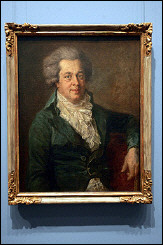
Mozart According to a new report published in Medical Problems of Performing Artists, Austrian composer Wolfgang Amadeus Mozart may have lived longer had he spent more time in the sun and allowed his body to produce more vitamin D. Mozart died in 1791 at the age of 35, and since his passing, many researchers have speculated as what caused his early death. He was buried three days after his death and no autopsy was ever performed. Previous literature had noted chronic kidney disease, strep throat and pink eye as a few conditions he battled toward the end of his life. Between 1762 and 1783, Mozart suffered numerous infections, all of which seemed to occur between mid-October and mid-May. It was this information that sparked William Grant, a retired NASA atmospheric physicist, and Dr. Stefan Pilz to believe that maybe there was an underlying reason for Mozart’s frequent infection. Their new hypothesis suggests that Mozart was vitamin D deficient. Vitamin D is a nutrient that is essential for bone health. It could be found back then in oily fish such as salmon. However, it is known as the sunshine vitamin because the body is able to produce the nutrient when the skin is exposed to the ultraviolet B rays from the sun.

Mozart, who lived in a high-latitude home in Austria, lacked exposure to the sun as the area does not provide the opportunity for sufficient exposure for six months out of the year, or the winter months. He was also known to work during the night and sleep during the day so his sun exposure was minimal. In recent years, vitamin D deficiency has been linked to many different medical conditions and greater risks for influenza, pneumonia, certain cancers, autoimmune diseases, cardiovascular disease, musculoskeletal pain and more. Given that Mozart’s infections seemed to occur at the same time when sun exposure and his vitamin D level would have been at its lowest, it could definitely provide an explanation.

More here.

Wednesday, July 13, 2011

The Fallacy of Difference, in Science and Art

Buildings Julia Galef over at Rationally Speaking:

It’s not often that you find something that’s a fallacy both logically and creatively — that is, a fallacy to which both researchers and artists are susceptible. Perhaps you’re tempted to tell me I’m committing a category mistake, that artistic fields like fiction and architecture aren’t the sort of thing to which the word “fallacy” could even meaningfully be applied. An understandable objection! But let me explain myself.

I first encountered the term “fallacy of difference” in David Hackett Fischer’s excellent book, Historians’ Fallacies, in which he defines it as “a tendency to conceptualize a group in terms of its special characteristics to the exclusion of its generic characteristics.” So for instance, India’s caste system is a special characteristic of its society, and therefore scholars have been tempted to explain aspects of Indian civilization in terms of its caste system rather than in terms of its other, more generic features. The Puritans provide another case in point: “Only a small part of Puritan theology was Puritan in a special sense,” Fischer comments. “Much of it was Anglican, and more was Protestant, and most was Christian. And yet Puritanism is often identified and understood in terms of what was specially or uniquely Puritan.”

Here’s a less scholarly example from my own experience. I’ve heard several non-monogamous people complain that when they confide to a friend that they’re having relationship troubles, or that they broke up with their partner, their friends instantly blame their non-monogamy. But while non-monogamy certainly does make a relationship unusual, it’s hardly the only characteristic relevant to understanding how a relationship works, or why it doesn’t. Non-monogamous relationships are subject to the same misunderstandings, personality clashes, insecurities, careless injuries, and other common tensions that tend to plague intimate relationships. But the non-monogamy stands out, so people tend to focus on that one special characteristic, and ignore the many generic characteristics that can cause any kind of relationship to founder.

So the fallacy of difference is a fallacy of science (broadly understood as the process of investigating the world empirically) but how is it also a fallacy of art?

A Series of Tubes

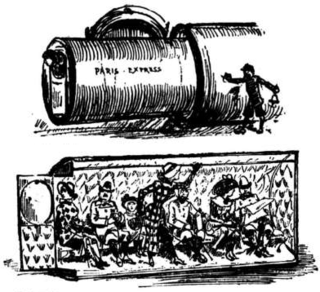
Albert_Robida_-_The_Twentieth_Century_-_Pneumatic_Tube_Train Jennifer Ouellette over at Cocktail Party Physics:

Imagine, if you will, a secret community dwelling beneath the streets of New York City, its inhabitants never allowed to travel to the surface or to interact in any way with the dreaded “Topsiders.” That’s the premise of an award-winning 1999 YA novel by Neal Shusterman called Downsiders, exploring what happens when a 14-year-old Downsider named Talon defies the prohibition and ends up falling in love with a Topsider named Lindsay. Together, they uncover the mysterious origins of the Downsiders: a forgotten inventor named Alfred Ely Beach who created the array of tunnels over a century ago.

This is an instance where science fiction bumps up briefly against science fact, because Shusterman’s inspiration for his subterranean world is based on an actual person. Alfred Ely Beach is best known for his invention of New York City’s first concept for a subway: the Beach Pneumatic Transit, which would move people rapidly from one place to another in “cars” propelled along long tubes by compressed air. Beach was also the publisher of Scientific American back in 1845, when he purchased it (at the ripe old age of 20) with a fellow investor, so it seems a fitting topic for my inaugural post on that magazine’s fledgling blog network. ( According to Wikipedia, inventor Rufus Porter actually founded the magazine, but sold it to Beach after a mere 10 months.)

Tunnels and pneumatic transportation systems are a staple of classic science fiction, starting with Jules Verne ’s Paris in the 20th Century (1863), in which the author envisions tube trains stretching across the ocean. In 1882, Albert Robida described not only tube trains, but pneumatic postal delivery systems in his novel, The Twentieth Century . Those authors were quite prescient: versions of such systems were actually built, and some still exist today.

Free Will Is as Real as Baseball


Sean Carroll enters the fray, over at Cosmic Variance:

In some ways, asking whether free will exists is a lot like asking whether time really exists. In both cases, it’s different from asking “do unicorns exist?” or “does dark matter exist?” In these examples, we are pretty clear on what the concepts are supposed to denote, and what it would mean for them to actually exist; what’s left is a matter of collecting evidence and judging its value. I take it that this is not what we mean when we ask about the existence of free will.

It’s possible to deny the existence of something while using it all the time. Julian Barbour doesn’t believe time is real, but he is perfectly capable of showing up to a meeting on time. Likewise, people who question the existence of free will don’t have any trouble making choices. (John Searle has joked that people who deny free will, when ordering at a restaurant, should say “just bring me whatever the laws of nature have determined I will get.”) Whatever it is we are asking, it’s not simply a matter of evidence.

When people make use of a concept and simultaneously deny its existence, what they typically mean is that the concept in question is nowhere to be found in some “fundamental” description of reality. Julian Barbour thinks that if we just understood the laws of physics better, “time” would disappear from our vocabulary. Likewise, discussions about the existence of free will often center on whether we really need to include such freedom as an irreducible component of reality, without which our understanding would be fundamentally incomplete.

The African Lions: An Authoritarian Challenge to Development Theory

Addis_Abeba-07122011 Michelle Sieff in World Politics Review:

Since 1995, Africa has experienced high rates of economic growth, averaging 5-6 percent annually. Media coverage usually focuses on countries like Nigeria, Ghana and Kenya — high-growth countries where political and civil liberties are relatively well-protected. But if Asia had its “tigers,” Africa has its “lions,” countries such as the East African nations of Rwanda, Ethiopia and Uganda that are successfully combining political repression and economic development.

Stories from Rwanda, Ethiopia and Uganda rarely make it into mainstream Western publications. Those that do usually highlight the ongoing repression of journalists and opposition politicians by the governments of Rwandan President Paul Kagame, Ethiopian President Melas Zenawi and Ugandan President Yoweri Museveni. In the Western imagination, these three men are the faces of tyranny on the African continent.

There is no question that these countries' governments repress political and civil rights. Freedom House currently classifies Rwanda and Ethiopia as “not free” and Uganda as only “partly free.” None are described as “electoral democracies.” The Economist Intelligence Unit, in its 2010 Democracy Index (.pdf), described Rwanda and Ethiopia as “authoritarian regimes” and Uganda as a “hybrid regime,” as opposed to the higher rankings of “full” or “flawed” democracy.

Like countless others throughout history, these governments justify the restriction of political and civil liberties in the name of national security, though the specific threats to security differ. In Rwanda, opposition politicians and journalists are prosecuted and convicted for speech that is deemed to constitute “divisionism” and “genocide ideology” — crimes under Rwandan law. In Ethiopia, opposition supporters are intimidated as part of the government's battle against terrorism and separatist movements. In Uganda, laws against “sedition” and “sectarianism” have repeatedly been used to crack down on journalists who criticize the government.

no black boy scouts

Roberson-448

At a poetry reading and talk that Ed Roberson gave at Northwestern on November 14, 2007, he pointed out that he is a Black poet who writes nature poems. Roberson didn’t say, though he certainly could have, that his view of nature breaks as well as critiques the historical conventions of nature poetry, which is the picturesque view that enables the poet to believe there is a sanctuary outside of human reality. In contrast to much nature poetry written in this vein, particularly as the subject was initially formulated in English Romantic poetry, Roberson’s work does not view landscapes as sublime or transcendent, or as embodying proof of God’s existence. He has consciously broken with a radical literary and artistic tradition that includes William Wordsworth, William Blake, and Vincent van Gogh, but that is now both dated and diluted. While Roberson’s statement at Northwestern might not initially seem sweeping or even unusual, it gains in resonance once you place it in the historical context of what happened in American poetry after 1960, when Grove Press published the groundbreaking anthology The New American Poetry 1945–1960, edited by Donald Allen. The only Black poet in Allen’s anthology was LeRoi Jones. (In 1967, Jones changed his name to Imamu Ameer Baraka, and later to Amiri Baraka.) It is within the violent decade of 1960–1970, and what happened both in America and in American poetry, that Roberson’s self-definition must first be seen.

more from John Yau at Poetry here.

The ‘Dramatic Picture’ of Richard Feynman

Freeman Dyson in the New York Review of Books:

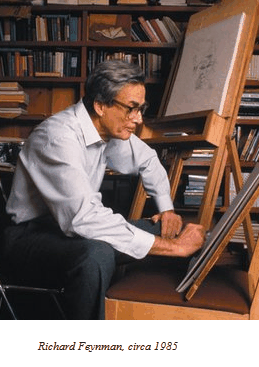
ScreenHunter_04 Jul. 13 14.02 In the last hundred years, since radio and television created the modern worldwide mass-market entertainment industry, there have been two scientific superstars, Albert Einstein and Stephen Hawking. Lesser lights such as Carl Sagan and Neil Tyson and Richard Dawkins have a big public following, but they are not in the same class as Einstein and Hawking. Sagan, Tyson, and Dawkins have fans who understand their message and are excited by their science. Einstein and Hawking have fans who understand almost nothing about science and are excited by their personalities.

On the whole, the public shows good taste in its choice of idols. Einstein and Hawking earned their status as superstars, not only by their scientific discoveries but by their outstanding human qualities. Both of them fit easily into the role of icon, responding to public adoration with modesty and good humor and with provocative statements calculated to command attention. Both of them devoted their lives to an uncompromising struggle to penetrate the deepest mysteries of nature, and both still had time left over to care about the practical worries of ordinary people. The public rightly judged them to be genuine heroes, friends of humanity as well as scientific wizards.

Two new books now raise the question of whether Richard Feynman is rising to the status of superstar. The two books are very different in style and in substance.

More here.

Wednesday Poem

Maudslay Park

The riverbank and its reflection move
downstream together, one stirred by wind
but steady in its tangle of boughs and patches
of fading light, one jangled by current,
trembling like the strings of a struck harp.

Or rather, neither moves; only the flat
scales of the river jostle and tilt their way
seaward forever, slowing, reluctant
there at the shallows, dividing and shearing
into coils that stream away around rock snouts.

The riverbank rises; candlestick trees
lit by late sun shelter the last cold birds.
Its reflection dives into another blue
with steel in it, cobalt and mercury;
there the boughs are made and unmade without end.

Above us, beyond the pocket our breath inhabits,
light gives way: unimaginable black
as far as thought will go, and farther.
Beneath us, dark millstones drag the continents
gritty, agonized inches through drowned bones.

Standing beside this shore, we are all moving—
we, the trees, the solid metallic river—
all particles twirling, rebounding, thinnest cloud
peppered by a rain of electric skydust
that needles through the planet with one stitch.

But at this moment, caught in a web of motion
we play at stillness, imagine ourselves
imagining the sun, the riverbank
and its reflection, behind us the cries
of gulls and children, the voices of friends.

by Rhina P. Espaillat
from The Able Muse, Autumn 1999

THE Q&A: HANIF KUREISHI, AUTHOR

JP O'Malley in More Intelligent Life:

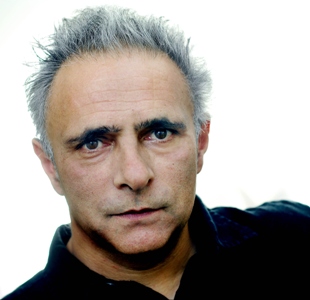
Hanif%20Kureishi%20-%20credit%20Sarah%20Lee Mr Kureishi's favoured themes of race, class, sexuality and religion all inform the pieces compiled in “Collected Essays”, released by Faber & Faber in Britain earlier this year. Dating from 1980, these essays (most of them previously published and unrevised, unfortunately) tackle politics, cultural changes and the role of the writer and reveal Mr Kureishi's knack for argument. They show his ability to be both provocative and convincing.

Mr Kureishi spoke to More Intelligent Life about these essays, his thoughts on David Cameron and why it’s racist to not attack a religion.

What does a good essay do for the reader?
An essay isn’t a work of non-fiction, it isn’t journalism as such. It’s written to inspire, provoke and ultimately to give pleasure to the reader. Essays differ from fiction, in that you don’t distribute yourself amongst your characters. There is one single full-on point of view.

You say you don’t read many novels anymore. Why?
I write more as I get older, and I’m more committed to writing. I’ve got three kids now. I also read stuff that seems to me to be more serious, I suppose. I’m interested in psychiatry, psychology, psychoanalysis, philosophy and politics—I’d much rather read about that than a novel, although I am a big fan of fiction and storytelling.

More here.

Are Antidepressants Just Placebos With Side Effects?

John Horgan in Scientific American:

07-12-prozacI have first-hand experience of the devastation of depression, in myself and those close to me. Although I have been tempted to try antidepressants, I've never done so. Of course, like everyone reading this column, I know many people who have been treated with antidepressants—not surprisingly, because according to a 2005 survey, one in 10 Americans are now under such treatment. Some people I know have greatly benefited from their treatment. Others never find adequate relief, or they experience annoying side effects—such as mania, insomnia, emotional flatness or loss of libido—so they keep trying different drugs, often in combination with psychotherapy. One chronically depressed friend has tried, unsuccessfully, to stop taking his medications, but he experienced a surge of depression worse than the one that led him to seek treatment. He accepts that he will probably need to take antidepressants for the rest of his life.

We all, to greater or lesser degrees, have this kind of personal perspective on antidepressants. But what does research on these drugs tell us about their efficacy? The long-smoldering debate over this question has flared up again recently, with two medical heavyweights staking out opposite positions.

More here.

Harvard and Class

Misha Glouberman in The Paris Review:

BLOG_gate-harvard I grew up in Montreal and went to an upper-middle-class Jewish day school where kids had parents who maybe owned a carpet store or maybe were dentists. And then I went to Harvard for college. And it was pretty weird. When I applied, I thought it would be great because I would get to meet lots of smart people. Those were the kinds of people I liked to be friends with, and I thought there would be more of them there. That was the main reason I thought it would be a fun place to be. I don’t think I was super ambitious or professional minded or even a very good student. The thing I figured out soon after I applied was that, on Gilligan’s Island, it wasn’t the Professor who went to Harvard, it was Mr. Howell, the rich man. That was something of a revelation. It’s funny, because what a lot of people talk about when they talk about going to Harvard is being really intimidated by the place when they arrive. I wasn’t at all intimidated by the place when I arrived—but I was really intimidated after graduating.

I arrived at Harvard from Montreal, which is a pretty fucking hip place to be an eighteen-year-old. I’d been going to bars for a while, and I was in a political theater company that did shows in lofts with homeless people and South American activists. And we went to pubs and got old gay men to buy us drinks. It was a pretty cool, fun, and exciting life for a kid in Montreal. It was a very vibrant place, and young people were really part of the life of the city. Then when I went to Harvard, the place was full of these nominally smart, interesting people, all of whom at the age of eighteen seemed perfectly happy to live in dormitories and be on a meal plan and live a fully institutional life. And that was completely maddening! This was the opposite of everything I’d hoped for from the environment I’d be in.

More here.

Case Closed for Dino Killer?

From Science:

Dino What happened to the dinosaurs? For more than 100 million years, they ruled the world. Then, suddenly—poof—about 65 million years ago, they were gone. At least that's the way it looks to most scientists, who blame an asteroid hitting Earth for the ancient beasts' dramatic demise. Some researchers are still skeptical about the asteroid hypothesis, but a new fossil discovery in Montana may lend it new impact.

Back in 1980, when the late Nobel laureate physicist Luis Alvarez and his son, geologist Walter Alvarez, first tried to pin dinosaur extinction on an errant asteroid, they faced a major credibility gap. At the time, there was little firm evidence for such a catastrophic event. But then they and other researchers found an overabundance of iridium in geological formations at the 65-million-year transition line between the Cretaceous and Tertiary periods, known as the K-T boundary. Iridium is common in asteroids but rare in Earth's crust. Still, the Alverezes' hypothesis faced another hurdle: No dinosaur fossils had been found any higher than 3 meters below the K-T boundary, a gap which equates to about 100,000 years. Most researchers concluded that the dinosaurs went extinct before the asteroid impact and that they died off gradually. Alternative hypotheses for their demise included an increase in Earth's volcanic activity around the same time which threw ash into the atmosphere, diminished available sunlight, and affected the growth of plants that herbivorous dinosaurs ate, or a draining away of the shallow inland seas that dinosaurs relied upon for their vegetation-rich habitats.

More here.

Tuesday, July 12, 2011

The Monster Ate Vegetables

Stefany Anne Golberg in Lapham's Quarterly:

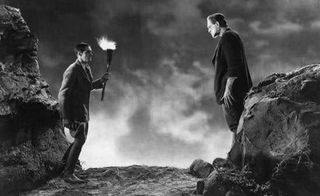
Frankenstein-thumb-490x300-2344 Mary Shelley was nineteen when she wrote Frankenstein. We wonder how a teenager could come up with this uncanny tale of a young student who, becoming obsessed with the mysterious science of galvanism, drops out of school and transforms himself into a “Modern Prometheus,” a god who gives life to an artificial creature, composed of the stuff of man but larger than man, and far more dangerous. Perhaps the clue to Shelley’s creation lies in youth itself. Only the young can really give us our monsters. Only the young see shadows where there is sunshine, hear the march of drums when the rest of us hear a song we used to dance to. Only the young can see pure evil, because only the young believe in the power of purity. Only the young really know why monsters are so terrifying, and what they show us about ourselves.

It’s surprising that Mary Shelley would make her horrible Monster a vegetarian. Surprising, because we think we know our monsters well. We’ve looked at Frankenstein’s monster a million times. But we never really listened to what he had to say. It shouldn't be surprising that Frankenstein’s monster is a vegetarian, because we've always known that vegetarians are monsters. Mary Shelley understood this. “Devil,” “fiend,” “insect,” Frankenstein calls his creation, but for Shelley he was Adam—purity before the Fall, goodness, gentleness, freedom, and also loneliness, failure, devastation. For all these reasons, Shelley made her Monster a vegetarian.

More here.

Cy Twombly’s favorite letter

Our own Morgan Meis in The Smart Set:

226317_10150256446747848_538727847_8828588_5597314_n In the early 1950s, Cy Twombly worked for the army as a cryptologist. That fact seems hugely significant since Twombly was one of the more elusive artists of his generation. That is what the conventional wisdom says, anyway. In this case, the conventional wisdom is probably correct.

Cy Twombly's art first acquired its distinctively elusive characteristics when he started using letters and words in his paintings. In a number of his paintings can be found the letter “e.” Twombly painted his “e”s in a cursive style most of the time, drawn with a freehand nonchalance. The “e”s in Twombly's paintings often look like something you would find in the notebook of a young person first learning to write in cursive. This person is drawing the same letter over and over again in loops in the attempt to get the form of the letter right. Maybe they have learned how to make one word and they are copying that word over and over again with varying success.

Letters, in general, are meant to make up words and words are meant to make up sentences and sentences are meant to convey meaning. Breaking sentences back down into individual words and words back down into individual letters has the opposite effect. Meaning is reduced, taken apart, decomposed. Still, the letters and the words contain a lingering residue of the meaning they are meant to lead toward even if they never get there. In Twombly's paintings, the individual “e”s looping off one another across the canvas contain a lot of promise. There is something tantalizing about the fact that they might mean something after all.

Cy Twombly seems to have enjoyed his stand-alone “e”s for just that reason. He liked to meditate on them as such. He liked the potential for meaning permanently forestalled. He must have liked the way, also, that his letter-and-word-scrawled canvases were a jolt to expectations.

More here.

Reading retreats: Paradise for book lovers

From Salon:

Read So why not plan a vacation devoted exclusively to reading? Twice annually, Bill Gates schedules a week-long “reading retreat” during which he does nothing but pore over the books and papers he's set aside during the year. He's not alone: The idea seems particularly popular in the UK, where you can sign up at London's School of Life to receive a customized book list (they have “bibliotherapists” on staff to compile one based on a telephone consultation) and lodging in one of several modern country houses. The website promises “the perfect combination of great books and great architecture.”

Those who prefer a more social experience can enroll in book-club-style retreats in which an assortment of guests all read the same book during the day and discuss it over the evening meal. Deb Snow, an English teacher currently running a guest house in rural Bulgaria, hosts a reading week with a pre-set list of books and meals provided. Reading Retreats in Rural Italy has a grander setting — the 14th-century Castello di Galeazza in Emilia-Romagna — but the terms are more informal and spartan. Clark Lawrence, who has been running these retreats for 15 years, explains, “Staying here is very similar to staying at a friend's house. People have to share the two bathrooms. We cook meals and eat together.”

More here.

When Fatty Feasts Are Driven by Automatic Pilot

From The New York Times:

WELL-blog480 “Bet you can’t eat just one” (as the old potato-chip commercials had it) is, of course, a bet most of us end up losing. But why? Is it simple lack of willpower that makes fatty snacks irresistible, or are deeper biological forces at work? Some intriguing new research suggests the latter. Scientists in California and Italy reported last week that in rats given fatty foods, the body immediately began to release natural marijuanalike chemicals in the gut that kept them craving more.

The findings are among several recent studies that add new complexity to the obesity debate, suggesting that certain foods set off powerful chemical reactions in the body and the brain. Yes, it’s still true that people gain weight because they eat more calories than they burn. But those compulsions may stem from biological systems over which the individual has no control. “I do think some people come into the world, and they are more responsive to food,” said Susan Carnell, a research associate at the Columbia University Institute of Human Nutrition. “I think there are many different routes to obesity.” In the recent rat studies, by a team from the University of California, Irvine, and the Italian Institute of Technology in Genoa, the goal was to measure how taste alone affects the body’s response to food. Among rats given liquid diets high in fat, sugar or protein, the ones who got the fatty liquid had a striking reaction: As soon as it hit their taste buds, their digestive systems began producing endocannabinoids, chemicals similar to those produced by marijuana use.

More here.

Shelley in Egypt: How a British Poem Inspired the Arab Spring

Austin Allen in Book Think:

Egyptshelley “Poets are the unacknowledged legislators of the world,” Percy Shelley wrote in 1821. Not surprisingly, this claim has earned some snickers from people who think of poets as barely able to legislate their own grooming habits. Fellow writers have made fun of it, too: in the twentieth century Auden shot back, “‘The unacknowledged legislators of the world’ describes the secret police, not the poets.”

But Shelley was speaking metaphorically, of course, and also fairly broadly; his general point was that language is the decisive force in human affairs. Culture, religion, and politics derive from narrative, myth, and rhetoric—and all of these things derive from “poetry,” that is, memorable figurative language.

Even if you interpret Shelley’s words in the narrowest sense possible—“Verse writers are the secret movers and shakers of global politics”—you’ll find that Shelley himself, more than almost anyone else, has proven them true. Don’t believe me? Look up his poem “The Masque of Anarchy,” which, although now largely forgotten, has sparked some of the most sweeping historical changes of the past two centuries.

“Masque” was written in response to the Peterloo Massacre of 1819, in which British troops attacked a defenseless crowd of citizen protesters. The poem urges the “Men of England” to rise up—and stand still—against tyranny:

Let a vast assembly be,

And with great solemnity

Declare with measured words that ye

Are, as God has made ye, free.

Stand ye calm and resolute,

Like a forest close and mute,

With folded arms and looks which are

Weapons of unvanquished war,

And let Panic, who outspeeds

The career of armed steeds

Pass a disregarded shade

Through your phalanx undismayed.

More here.