Why Does Al-Qaeda Have a Problem With Norway?

While it is still not clear who is responsible for the attacks in Norway, this article seems a lot more interesting now than it did last week when it was published.

Thomas Hegghammer and Dominic Tierney in The Atlantic:

23oslo_337-custom1 Why did al-Qaeda attack us on 9/11? Quite simple, said George Bush in 2001: “They hate our freedoms.” Not so, responded Osama Bin Laden: “Let him tell us why we did not strike Sweden.” Although Sweden may be off-limits for jihadists, the same cannot be said for Sweden's neighbor, Norway.

Last Thursday, three men were arrested in Norway and Germany for allegedly plotting a terrorist attack involving peroxide explosives. Those arrested were all Muslim immigrants to Norway, originally from China, Iraq, and Uzbekistan. Authorities claim that the suspects had links to al-Qaeda in Pakistan, and that one of them visited Waziristan in 2008. If this is true, an al-Qaeda cell had set up shop in the suburbs of Oslo.

Why on Earth would Norway be a target for attack? The country is famed as an international peace negotiator, the home of the Nobel Peace Prize, and the distributor of more foreign aid per capita than any other country. It's an all-round international good guy — so long as we aren't talking about whaling.

To be sure, no confirmed details have emerged so far about the suspects' motives or their objectives. However, leaks from the investigation suggest that Norway was indeed the target and not a logistics base for an attack elsewhere.

There are several theories about why Norway would be on al-Qaeda's hit-list — but they raise more questions than answers.

More here.
The Saddest Movie in the World

Richard Chin in Smithsonian:

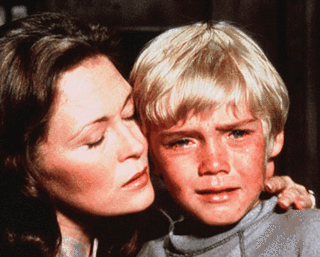
ScreenHunter_08 Jul. 22 23.41 In 1979, director Franco Zeffirelli remade a 1931 Oscar-winning film called The Champ, about a washed-up boxer trying to mount a comeback in the ring. Zeffirelli’s version got tepid reviews. The Rotten Tomatoes website gives it only a 38 percent approval rating. But The Champ did succeed in launching the acting career of 9-year-old Ricky Schroder, who was cast as the son of the boxer. At the movie’s climax, the boxer, played by Jon Voight, dies in front of his young son. “Champ, wake up!” sobs an inconsolable T.J., played by Schroder. The performance would win him a Golden Globe Award.

It would also make a lasting contribution to science. The final scene of The Champ has become a must-see in psychology laboratories around the world when scientists want to make people sad.

The Champ has been used in experiments to see if depressed people are more likely to cry than non-depressed people (they aren’t). It has helped determine whether people are more likely to spend money when they are sad (they are) and whether older people are more sensitive to grief than younger people (older people did report more sadness when they watched the scene). Dutch scientists used the scene when they studied the effect of sadness on people with binge eating disorders (sadness didn’t increase eating).

More here.

Lighting Darkened Corners

N. S. Morris in the Los Angeles Review of Books:

Tumblr_lonr1pdV7o1qhwx0o Spreading through American living rooms last winter, as live broadcasts streamed from Cairo’s Tahrir Square, was an overdue recognition that Arabs and others in the Middle East were not so different after all, not inhibited by their culture and religion, for instance, from wanting modern political and economic systems. A young, university educated woman articulated in eloquent English her plans for reform. An older man, a shopkeeper, was ready to die to change a system he knew in his gut was wrong. Those who have spent time in the region could not help but feel relief, not only at the bursting-forth of new momentum for change, but at the shift in perceptions here at home. Then came the pop video “Voice of Freedom” by Mostafa Fahmy, showing families in the streets singing of their hopes for the future. The week Hosni Mubarak left office, “Voice of Freedom” reached 1.5 million YouTube hits.

This many could relate to. Protesters were not shouting for Allah to kill Jews and Westerners. They were demanding decency and dignity. Ordinary people rallied against violent intimidation and structural discrimination, for better jobs and an end to money-grabbing cronyism among elites. In Tunisia and Egypt, in Bahrain, Iran, Libya, Yemen and Syria, movements of various sizes and varying agendas began to form. Each country came into focus as distinct. Once these folks began inhabiting the west’s laptop screens, we grew anxious to get to know them better. We craved — and still crave — more back story.

How timely, then, is the anthology Tablet & Pen: Literary Landscapes from the Modern Middle East. Edited by Reza Aslan, author of No god but God and Beyond Fundamentalism, the collection came out late last fall just before protests in Tunisia started the season of change.

More here.

Excuse me, I’m having a Macbeth moment

Catherine Quayle at the PBS website:

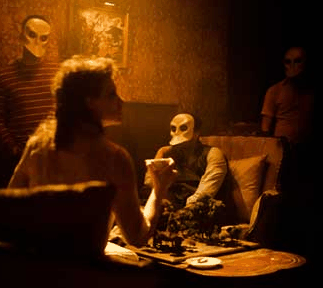
ScreenHunter_07 Jul. 22 22.56 …at the “McKittrick Hotel” in Manhattan, where the U.K. theater group Punchdrunk is nightly haunting five floors with its performance piece, “Sleep No More.”

Based — rather loosely — on “Macbeth,” the performance is an interactive, immersive experience in which the audience roams freely around the space, which is at times hotel, family home, ruined garden, psych ward, cemetery, while actors run in and out, performing wordless scenes, dancing, kissing, undressing, killing each other and then disappearing into the smoky gloom. It is deliberately disorienting, a full-scale demonstration of the term dreamlike, with one space sometimes leading into another via snakelike passageways so you are never sure which direction you are facing and from which you came, the light and temperature changing, the floor giving way to dirt or gravel or straw as you move from one unexpected setting to another. There is a labyrinth of tree branches lit by a hazy moon. A room filled with antique bathtubs, another with children’s beds. On one of the higher floors, we suddenly stepped into a cobblestone street lined with storefronts.

You could easily spend two hours there being only vaguely aware that this experience has anything to do with “Macbeth.” It wants as much or more to be a noir detective story in which we are all recruited to the case, though nothing will be solved, and we know this. But there is something deeply familiar about it. The scenes out of sequence. The known settings, disarranged. The fragments of meaning, the fleeting sense of something important happening, but the more you pursue it, the more it eludes. The pervasive, unexplained anxiety, the forest (literally!) closing in.

More here.

in prison

Berger_377x267

The landmark I’ve found is that of prison. Nothing less. Across the planet we are living in a prison. The word we, when printed or pronounced on screens, has become suspect, for it’s continually used by those with power in the demagogic claim that they are also speaking for those who are denied power. Let’s talk of ourselves as they. They are living in a prison. What kind of prison? How is it constructed? Where is it situated? Or am I only using the word as a figure of speech? No, it’s not a metaphor, the imprisonment is real, but to describe it one has to think historically. Michel Foucault has graphically shown how the penitentiary was a late eighteenth-, early nineteenth-century invention closely linked to industrial production, its factories and its utilitarian philosphy. Earlier, there were jails that were extensions of the cage and the dungeon. What distinguished the pentitentiary is the number of prisoners it can pack in—and the fact that all of them are under continuous surveillance thanks to the model of the Pantopticon, as conceived by Jeremy Bentham, who introduced the principle of accountancy into ethics.

more from John Berger at Guernica here.

the contemporary old master

Benefits-supervisor-lucia-008

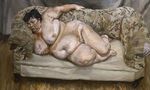
He haunted the National Gallery at night, hawk-like and surprisingly slight, with his heavy, unlaced boots and knotted scarves. A warder used to say that Freud was coming to be with his people, the family of old masters. But I remember him at Tate Modern as well, darting back and forth between Matisse and Picasso in that famous stand-off show in 2002, the rest of us wondering which way he would jump. It turns out he thought Picasso emotionally dishonest and Matisse infinitely greater because he painted the life of forms, which, he told the writer Martin Gayford, “is what art is all about”. Lucian Freud was frequently described as a contemporary old master, a Rembrandt for our times. But his work was in fact a radical breach of tradition. He painted people, but not quite (or not often) portraits. He painted from the life, but his life paintings were clearly not moments in the lives of those he painted – models, magnates, office workers, whippets, his many lovers, his many daughters – so much as scenes of their physical presence in his studio.

more from Laura Cumming at The Guardian here.

Eurozone Defense

Image

Is there an actual crisis of the euro? Ever since the Greek government’s surprise upward revision of its budget deficit to 12.7 percent of GDP last winter, the focus has been on Greece’s ability to service its Olympian debt. Of chief concern was the rollover of $25 billion euros worth of Greek bonds coming due this spring. The yield on Greek sovereign credit default swaps shot up; by April, Greece had rolled over $15 billion worth of its paper at successively higher and higher rates of interest, until the costs became prohibitive. European finance ministers were thrust into the role of lenders of last resort. The perennially indecisive character of European politics, which makes it nearly impossible for European policymakers to hold one another to account, allowed the Greek situation to get out of hand. For months it seemed the most that European leaders could manage was a muddle of bluffs, half-measures, and mixed-messages. Upcoming regional elections had the Germans dithering at the rank unfairness of paying for the Greeks to retire at 55 when they retire at 67. And before long, what had begun as a bad debt problem in Greece had degenerated into a broad liquidity crisis for the Eurozone.

more from Jule Treneer at n+1 here.

Friday Poem

The Song of Wandering Aengus

I went out to the hazel wood,

Because a fire was in my head,
And cut and peeled a hazel wand,
And hooked a berry to a thread;
And when white moths were on the wing,
And moth-like stars were flickering out,
I dropped the berry in a stream
And caught a little silver trout.
When I had laid it on the floor
I went to blow the fire a-flame,
But something rustled on the floor,
And some one called me by my name:
It had become a glimmering girl
With apple blossom in her hair
Who called me by my name and ran
And faded through the brightening air.
Though I am old with wandering
Through hollow lands and hilly lands,
I will find out where she has gone,
And kiss her lips and take her hands;
And walk among long dappled grass,
And pluck till time and times are done
The silver apples of the moon,
The golden apples of the sun.

by W.B. Yeats
from An Anthology of Modern Verse
Ed. A. Methuen. London: Methuen & Co., 1921

Nom de Plume: A (Secret) History of Pseudonyms

From The Christian Science Monitor:

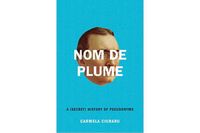
Nom We often think of writing as a form of self-expression, but how much do words truly reveal about their authors? This question is at the heart of Carmela Ciuraru’s Nom de Plume: A (Secret) History of Pseudonyms, a fascinating investigation of why writers use pen names. The book begins with a meditation on the power of naming. “Names are loaded, full of pitfalls and possibilities, and can prove obstacles to writing…” Ciuraru explains. “A change of name, much like a change of scenery, provides a chance to begin again.” With skilled research and palpable empathy, Ciuraru chronicles the lives of secretive storytellers – those who wished to communicate without being known. In our tell-all age, such shyness might seem strange, but there was a time when pseudonyms were common.

Many literary giants have disguised their identities – including George Eliot, Lewis Carroll, and O’Henry – and Nom de Plume gives us insight into the men and women behind the masks. Through well-chosen quotes, Ciuraru lets the authors speak for themselves. By sampling extensively from letters and diaries, she shows the vast gulf that can exist between an author’s identity and his or her persona on the page. Here is an example. A profile of Alice Sheldon – who wrote science fiction under a male pseudonym – includes Sheldon’s pathetic confession that “I’m fond of a hundred people who no more know ‘me’ than the landscape of Antarctica.” These kinds of quotes flesh out the historical figures Ciuraru describes and help readers understand their motivations.

More here.

How Technology Makes Us Better Social Beings

From Smithsonian:

Social-media-Keith-Hampton-631 “There has been a great deal of speculation about the impact of social networking site use on people’s social lives, and much of it has centered on the possibility that these sites are hurting users’ relationships and pushing them away from participating in the world,” Hampton said in a recent press release. He surveyed 2,255 American adults this past fall and published his results in a study last month. “We’ve found the exact opposite—that people who use sites like Facebook actually have more close relationships and are more likely to be involved in civic and political activities.” Hampton’s study paints one of the fullest portraits of today’s social networking site user. His data shows that 47 percent of adults, averaging 38 years old, use at least one site. Every day, 15 percent of Facebook users update their status and 22 percent comment on another’s post. In the 18- to 22-year-old demographic, 13 percent post status updates several times a day. At those frequencies, “user” seems fitting. Social networking starts to sound like an addiction, but Hampton’s results suggest perhaps it is a good addiction to have. After all, he found that people who use Facebook multiple times a day are 43 percent more likely than other Internet users to feel that most people can be trusted. They have about 9 percent more close relationships and are 43 percent more likely to have said they would vote.

The Wall Street Journal recently profiled the Wilsons, a New York City-based family of five that collectively maintains nine blogs and tweets incessantly. (Dad, Fred Wilson, is a venture capitalist whose firm, Union Square Ventures, invested in Tumblr, Foursquare and Etsy.) “They are a very connected family—connected in terms of technology,” says writer Katherine Rosman on WSJ.com. “But what makes it super interesting is that they are also a very close-knit family and very traditional in many ways. [They have] family dinner five nights a week.” The Wilsons have managed to seamlessly integrate social media into their everyday lives, and Rosman believes that while what they are doing may seem extreme now, it could be the norm soon. “With the nature of how we all consume media, being on the internet all the time doesn’t mean being stuck in your room. I think they are out and about doing their thing, but they’re online,” she says.

More here.

Thursday, July 21, 2011

A Paean to the Paan

8561.ll-paan Pushpesh Pant in Open The Magazine:

Father loved his paan so much that at times Mother teased him that he loved the leaf more than he loved her. He would just smile and wink at us children and put another gilori (triangle of prepared paan) of his beloved magahi, plucked out of a silver pandibiya (paan box) in his mouth. He would never let any other variety ruin his delicate palate. Mother was not the only one who thought he carried this fuss too far. Didn’t other paan leaves have seductions of their own—the meetha patta, saunfia, kalkatia, kapoori, saanchi, jagannathi and mahoba?

Nothing could persuade Father to change his ways. He made do with magahi (a betel leaf from Magadh, Bihar) that he received via VPP in that pre-courier era from his trusted supplier, Chaurasiaji in Banaras. The kattha (brown paste applied to the leaf) he used was just the cream at the top, and he slaked chuna not in water, but in milk. The supari (betel nut) had to be dakhani—cooked in kattha and bone-hard. Not addicted to tobacco, he relished a few grains of muski daana produced by M/S Ittada Khan, Muttada Khan—perfumers from Kannoj. These were seeds of green cardamom dipped in tobacco water, then draped in chandi ka varq (silver foil) and then aromatised with a few strands of saffron. The name suggests the presence of a trace of aphrodisiac musk as well. The miniature bottles the stuff came in even looked like ittar (perfume) containers.

All this knowledge came much later. What mattered in the years before one’s loss of innocence was to ensure that one was rewarded with a grain of the forbidden delight after a long spell of tedious good conduct. Mother, of course, didn’t approve.

This was the beginning of my unending affair with this leaf of myriad delights; little did one know that paan is not native to this land and was imported from south-east Asia and called naag vallari, literally the ‘snake vine’. The name is an apt one, as the creeper does resemble the hood of a cobra.

R.I.P. Lucian Freud, 1922 – 2011

22freud2-articleInline William Grimes in The New York Times:

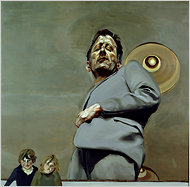
Lucian Freud, whose stark and revealing paintings of friends and intimates, splayed nude in his studio, recast the art of portraiture and offered a new approach to figurative art, died on Wednesday night at his home in London. He was 88.

He died following a brief illness, said William Acquavella of Acquavella Galleries, Mr. Freud’s dealer.

Mr. Freud, a grandson of Sigmund Freud and a brother of the British television personality Clement Freud, was already an important figure in the small London art world when, in the immediate postwar years, he embarked on a series of portraits that established him as a potent new voice in figurative art.

In paintings like “Girl With Roses” (1947-48) and “Girl With a White Dog” (1951-52), he put the pictorial language of traditional European painting in the service of an anti-romantic, confrontational style of portraiture that stripped bare the sitter’s social facade. Ordinary people — many of them his friends and intimates — stared wide-eyed from the canvas, vulnerable to the artist’s ruthless inspection.

From the late 1950s, when he began using a stiffer brush and moving paint in great swaths around the canvas, Mr. Freud’s nudes took on a new fleshiness and mass. His subjects, pushed to the limit in exhausting extended sessions, day after day, dropped their defenses and opened up. The faces showed fatigue, distress, torpor.

Superbad

7644 Jacob Silverman in Tablet:

Pity the comic-book fan who, with plucky optimism, skips to the movie theater to see one of this summer’s superhero flicks, only to leave two-and-a-half hours later with a CGI-induced hangover. Green Lantern was a travesty—you could feel the producers looming just off-camera, pleading with whatever fallen deities they pray to that this overdone stew of a movie would earn enough money to enable a franchise. Thor had moments of levity, and its star, Chris Hemsworth, appears to know his way around a Shake Weight, but the title character and his brother Loki seemed more like cosseted brats than Norse immortals locked in fratricidal conflict. Captain America, which will be released this Friday, is directed by Joe Johnston, a man who would probably rather forget the aughts (when he brought us Jurassic Park III, Hidalgo, and The Wolfman), and stars an actor, Chris Evans, whose best performance—by far—was a 10-minute cameo as an imbecilic action star in Scott Pilgrim vs. The World. Need we even bother?

There are plenty of other examples of terrible recent superhero films. There are some exceptions, of course, but most of the last decade—an era when Hollywood has supposedly rededicated itself to producing quality superhero movies featuring iconic characters—has been a wash.

What happened? Popular entertainment, after all, need not shy away from complexity or genuine moral conflict; the recent revival of Batman as the Dark Knight proved that well. Rather, the problem is one common to most superhero movies: Too often, filmmakers treat comic books as a brand rather than as source material, emptying them of all the intricacies and ironic reversals that made the beloved characters beloved in the first place. Put simply, contemporary superhero movies suck because they’ve forgotten their Jewish roots.

Extending our Senses

Image A conversation between David Rotheberg and Laurie Anderson, in n+1:

David Rothenberg: That is a humpback whale singing there, recorded in Hawaii. They do it during mating season. They swim from Alaska all the way down to Hawaii, and they don’t eat—they just sing and mate and give birth. Only the males are singing, scientists have figured out, and they assume it is to attract the attention of female whales, but in the thirty years people have been studying this, they never have seen a female whale show any interest in this song.

Laurie Anderson: Maybe they are interested but just don’t express it.

DR: Exactly—they are not going to show this to us humans.

LA: Isn’t there sort of a cyclical way those work, sort of like pop songs?

DR: That is the amazing thing; humpback whales change their song as a group from year to year, from month to month. From week to week you can hear a difference. And why do they want to change it if they all want to sound the same? No other animal does anything quite like that. People are thinking, “Well, it is like pop music?”

LA: When you are playing with whales, can you just describe how that works?

DR: Yes. I play clarinet, but I don’t jump in the water with the clarinet because it would get all wet and be kind of hard to play. So I’m on a boat, playing into a microphone; the sound goes into an underwater speaker and is broadcast into the world of these whales. I am wearing headphones listening to an underwater microphone, so I am playing along with this other environment. A lot of times I try this and nothing happens, the whales don’t seem to care. But in the best moments they do seem to interact. Sometimes they really do seem to respond to what I’m doing, which isn’t surprising when you have an animal that wants to change its song and maybe is interested in new sounds.

Murdoch’s minions have nothing on the journalists of 1897

Paul Collins in Slate:

ScreenHunter_06 Jul. 21 17.54 It was 1 a.m. on a hot July night when detectives marched into the offices of the New York World. “Where's the head?” they demanded.

In the summer of 1897, that question meant just one thing in Manhattan newsrooms, and it wasn't a request to meet the managing editor. The head everyone sought was of William Guldensuppe, a masseur who had disappeared in late June from his Hell's Kitchen apartment. He'd reappeared scattered in pieces along the Lower East Side, the Bronx, and Brooklyn. What was still missing, though, was his head—which, rumor had it, a jealous lover had hidden inside a block of plaster.

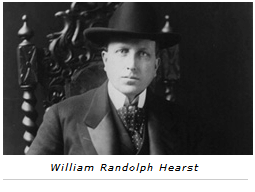
To William Randolph Hearst, the crime was perfect opportunity to trumpet his newly launched New York Evening Journal. Hearst offered a whopping $1,000 reward to solve the crime, and even formed a “Murder Squad” of reporters who were ready to resort to flashing badges and pistols to make citizen's arrests. Yet his stunts were merely improvements on the carnivalesque populism of rival publisher Joseph Pulitzer. Featuring celebrity news and scandal, Pulitzer's New York World had also created the world's first color comic section, and the popularity of strips like “The Yellow Kid” inspired competitors to scoff that the World and Journal were selling comic-strip journalism—”Yellow Journalism,” they called it.

Not to be upstaged by Hearst's Journal, the World stole evidence from the Guldensuppe murder scene by shaving off a piece of a floorboard, testing it, and proclaiming BLOOD IN THE HOUSE OF MYSTERY. They also hired divers to search the East River for Guldensuppe's head. But after a World diving crew was spotted surreptitiously drawing a slimy white mass out of the river, the delicate matter of legality arose. The New York Herald believed the World had the scoop of the day—literally scooping William Guldensuppe's head off the bottom of the East River—and that Pulitzer's henchmen were now concealing the ghastly thing in their editorial offices. In a burst of righteous indignation, the Herald called in the police.

More here.

God, Music and Food for Thought

Anjum Altaf in The South Asian Idea:

Sitar_vias_img In a discussion of the arts, it was mentioned that middle-class families in India encouraged children to learn classical music because it was a mark of high culture; it made one special in one’s esteem and in that of others. It was then asked why classical music was not healthy in Pakistan given that much the same considerations should be applicable across the border. It is my sense that the question was less an expression of belief and more an opening for a discussion and I am going to exploit that to speculate on some topics of interest.

The one-word, and not altogether flippant, answer to the question is God. Hindu deities (Krishna and Saraswati, to mention just two) not only approve of but delight in music. Whether Allah approves or disapproves is still in doubt with no resolution in sight while the camp of disapprovers continues to add adherents.

That would be sufficient; but simple answers rarely do justice to the fascinating complexities of reality. Many conjectures beg to be addressed and many tales clamor to be told.

Ustad Jhandey Khan was the guru of Begum Akhtar and the mentor of Naushad. His story, found in a fading magazine from the 1960s, was the centerpiece of a lament about the conflicted state of music in Pakistan. Ustad Jhandey Khan loved his music and would weep all night after practicing certain ragas. Then something would happen; he would unstring his instruments and pronounce that henceforth there would be no more profanity in his house. Life would lose all meaning; after a while he would quietly go back to the music. The point of the article was that music would never flourish in Pakistan till this conflict between the yearning of the soul and the voices in the head was resolved.

More here.

God didn’t make man; man made gods

J. Anderson Thomson and Claire Aukofer in the Los Angeles Times:

63282129 In recent years scientists specializing in the mind have begun to unravel religion's “DNA.” They have produced robust theories, backed by empirical evidence (including “imaging” studies of the brain at work), that support the conclusion that it was humans who created God, not the other way around. And the better we understand the science, the closer we can come to “no heaven … no hell … and no religion too.”

Like our physiological DNA, the psychological mechanisms behind faith evolved over the eons through natural selection. They helped our ancestors work effectively in small groups and survive and reproduce, traits developed long before recorded history, from foundations deep in our mammalian, primate and African hunter-gatherer past.

For example, we are born with a powerful need for attachment, identified as long ago as the 1940s by psychiatrist John Bowlby and expanded on by psychologist Mary Ainsworth. Individual survival was enhanced by protectors, beginning with our mothers. Attachment is reinforced physiologically through brain chemistry, and we evolved and retain neural networks completely dedicated to it. We easily expand that inborn need for protectors to authority figures of any sort, including religious leaders and, more saliently, gods. God becomes a super parent, able to protect us and care for us even when our more corporeal support systems disappear, through death or distance.

Scientists have so far identified about 20 hard-wired, evolved “adaptations” as the building blocks of religion.

More here.

“An Anatomy of Addiction”: Sigmund Freud, cokehead

From Salon:

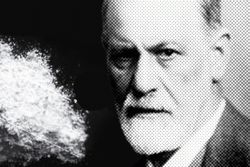
Freud Nicholas Meyer's bestselling 1974 novel, “The Seven Percent Solution,” isn't mentioned once in “An Anatomy of Addiction: Sigmund Freud, William Halsted and the Miracle Drug Cocaine” by Howard Markel, but any of Markel's readers who have also read Meyer's highly entertaining Sherlock Holmes pastiche will think of it often all the same. The novel “reveals” that Holmes' “Great Hiatus” (the three years between his false death at Reichenbach Falls and his reappearance in “The Adventure of the Empty House”) was actually a period of recovery from cocaine addiction after his treatment by the great Viennese therapist Sigmund Freud. The founder of psychoanalysis brought exceptional insight to bear in providing this cure; he once abused cocaine himself.

Markel's provocative book is a dual addiction biography of Freud and his contemporary, William Halsted, arguably the greatest surgeon of his time, a founding professor at Johns Hopkins Hospital and deviser of at least a half-dozen revolutionary surgical techniques and procedures still employed today, such as the use of rubber gloves. Both were unquestionably great men, but they also wrestled with dangerous drug habits that imperiled their work. Both sought to conceal or downplay their drug use and, as a result, information on that use and how, if at all, they managed to stop it is pretty sparse on the ground. If Meyer's novel is the story of a doctor investigating the psyche of a great detective, then “An Anatomy of Addiction” is the work of a doctor — Markel is an M.D. and director for the Center of the History of Medicine at the University of Michigan — who plays detective to understand the secret lives of two medical giants.

More here.