Human Evolution: No Easy Fix

Px878_thumb3 Ariel Fernandez in Project Syndicate:

Humans are undeniably complex, and proud of it. No case, we believe, needs to be made for our biological superiority. Our biological functions are exquisitely regulated and resilient to external variations, owing to complicated webs of interactions. Unlike other species, we seem to be endowed with willpower and intellect, hence we are capable of modifying the environment to buffer the effects of our decreasing fitness.

Be that as it may, we may be doomed as a species precisely because of the way in which our complexity arose. Paraphrasing the science writer Philip Ball, nature seems to have activated a time bomb, and our complexity is only a short-term fix.

To grasp the nature of the problem, we need to examine how humans are made at the molecular level, and contrast our constitution with that of other species that we often call “rudimentary,” such as unicellular organisms. This analysis leads us to examine proteins – our cellular building blocks and the executors of biological functions – across vastly different species. Proteins with common ancestry belonging to different species, termed “orthologs,” offer solid ground for comparison.

It has been generally recognized that the basic “fold,” or shape, of a protein must be conserved across species, because there is a tight correspondence between structure and function. Proteins that retain the same function across very different species – generally the case with orthologs – are expected to keep the same fold.

But the sequence of amino acids that make up the protein chains in these orthologs can vary significantly. Sometimes the extent of sequence identity between two orthologs can be as low as 25-30%, and yet their folds remain strikingly similar, attesting to the robustness of function to evolutionary change.

Derrick Bell, 1930-2011

07bell-articleLarge Fred Bernstein in the NYT:

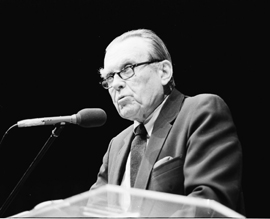
Professor Bell, soft-spoken and erudite, was “not confrontational by nature,” he wrote. But he attacked both conservative and liberal beliefs. In 1992, he told The New York Times that black Americans were more subjugated than at any time since slavery. And he wrote that in light of the often violent struggle that resulted from the Supreme Court’s 1954 desegregation decision, Brown v. Board of Education, things might have worked out better if the court had instead ordered that both races be provided with truly equivalent schools.

He was a pioneer of critical race theory — a body of legal scholarship that explored how racism is embedded in laws and legal institutions, even many of those intended to redress past injustices. His 1973 book, “Race, Racism and American Law,” became a staple in law schools and is now in its sixth edition.

Mr. Bell “set the agenda in many ways for scholarship on race in the academy, not just the legal academy,” said Lani Guinier, the first black woman hired to join the Harvard Law School’s tenured faculty, in an interview on Wednesday.

At a rally while a student at Harvard Law School, Barack Obama compared Professor Bell to the civil rights hero Rosa Parks.

Professor Bell’s core beliefs included what he called “the interest convergence dilemma” — the idea that whites would not support efforts to improve the position of blacks unless it was in their interest. Asked how the status of blacks could be improved, he said he generally supported civil rights litigation, but cautioned that even favorable rulings would probably yield disappointing results and that it was best to be prepared for that.

In from the Cold

Valles_36.5_milosz Alissa Valles in Boston Review:

Fellowship of Poets examines the idea of poetry as a moral force in history, embodied in relationships both hierarchical—between poet and reader, teacher and student—and fraternal. For these particular poets, who met when Miłosz was in his 60s and Brodsky in his 30s, the friendship seems to have run a precarious course between mentorship and rivalry, and some of Grudzinska Gross’s most penetrating—and wittiest—insights pertain to how the two negotiated the balance of power between them.

Against the Western habit of placing Eastern European poets on the same page politically (for the simple reason that this is where anthologies place them), there is a revelatory account of Miłosz and Brodsky’s tête-à-tête at a literary conference in Lisbon in 1988, one of the few occasions when the two were publicly at odds. Miłosz accused Brodsky of supporting the principle of divide et impera—“divide and rule”—in denying the reality of Central Europe as a region unified by its subjugation to Moscow. Brodsky protested rather unconvincingly, disarmed by Miłosz’s repeated insistence that this was a disagreement between friends. Grudzinska Gross gives a valuable and subtle commentary on the shades of irony at play in Brodsky’s own use of the word “imperium,” claiming that he learned the stance of the empire’s cynical observer from Alexander Pushkin, Russia’s most famous Romantic poet. Like Pushkin, Brodsky tended to make the figure of the tyrant, rather than the fact of empire, the object of his scorn, continuing to take pride in the grand scale of the Soviet Union and its history while adopting an ostensibly apolitical attitude. “Freedom,” he writes in a poem that carries that title, “is when you forget the spelling of the tyrant’s name.” It is difficult to imagine Miłosz, or any Pole before Zagajewski, writing that line.

The American edition’s cozy subtitle, “Fellowship of Poets,” evokes the self-congratulatory backslapping atmosphere Miłosz and Brodsky moved in during their post-Nobel years. The Polish edition has a different subtitle, “Magnetic Poles,” which would have made for an unfortunate pun in English but neatly combines the book’s two important lines of inquiry: the basis for Miłosz and Brodsky’s mutual sympathy and fascination, and the ways in which they were (and remain, at least in the living word) polar opposites.

Thursday, October 6, 2011

In gray there is multiplicity

In-gray-460

In gray there is multiplicity. It’s the last line of this book. Lisa Pearson, who edited It Is Almost That, tells us a million things before we get to this stunning line. And when I read it (and underlined it with my Sharpie), I thought, “That’s the beginning of the book” (which it was for me, because I turned it around and began reading it differently). What I liked so much about this ending (and the explanation that immediately preceded it) is that I was tactically allowed, as a reader, to have my own experience of this book, and was told here rather than up-front exactly what went into the assembling of this creation—which is a collection of 26 image+text pieces by a slightly larger number of female artists. Some of the pieces here are collaborations, and one is in fact by a group. It’s a lot of territory, and in Lisa Pearson we’ve got an adept and unobtrusive tour guide. And guide us, she did do.

more from Eileen Myles at Poetry here.

hitchens the believer

20111006_3466981(1)_w

There are some who represent Hitchens as a contrarian or provocateur, without convictions. They are wrong. What sort of provocateur would write that “Bin Ladenism” is more dangerous than German Wilhelmine imperialism, the Nazi-Fascist axis and international communism? Such a patently absurd claim could only be made by one who deeply believes it to be true. Leave aside the grotesque disproportion in lumping the Kaiser’s Germany in with mid-20th-century totalitarianism. What is wholly fantastical is putting Osama Bin Laden’s gang in the same category as Nazi Germany and the Soviet Union – two extremely powerful states with vast industrial and military resources, the first coming close to conquering all of Europe, the second annexing Europe’s eastern half and the Baltic states while imposing itself throughout central Asia. In passing over these undeniable facts, Hitchens is not playing the role of intellectual gadfly. He is showing himself to be a believer who – like Trotsky – blanks out reality when it fails to accord with his faith. That Hitchens has the mind of a believer has not been sufficiently appreciated.

more from John Gray at the New Statesman here.

prince on dylan

Monk_jpg_470x840_q85

I think Dylan’s paintings are good paintings. They’re workmanlike and they do their job. They’re not trying to be something they’re not. I’m not sure he’s even aware that there’s a style that can sit beside Arthur Dove, Charles Burchfield, John Marin, Charles Sheeler. The amount of paint is measured. And the color is always within a defined degree of browns, beiges, and yellows. There’s never any interruption in the way the surface is painted, and this is why I think they’re special. That’s hard to do. When you’re painting a whole scene, whether it’s a portrait or a boat going up the canal or a view outside your hotel window and you’re trying to get the trees to fuse into a path a man is walking on … it takes something that’s instinctive instead of learned. I looked at his painting of a Chinese farmer herding a big-horned cow and marveled at the breadth of the horns and the way the horns melted into the figure of the farmer. “Man,” I said, “that’s some strange cow.” That’s what I thought about D.H. Lawrence’s paintings. Different subject matter, but the same struggle to represent. Same amount of paint. Same palette. Same use of line to accent the contours of what’s real. If you don’t know D.H. Lawrence’s paintings, you should. It’s kind of hard to see them—a few are in an out-of-the-way hotel in New Mexico and a few are in Texas, but most of them are lost and any reproductions of them are pretty dull and underimagined.

more from Richard Prince at the NYRB here.

The devil drives

Boyd_210657h

I t is March 8, 1858, and John Hanning Speke is on an island in Lake Tanganyika trying vainly to hire a dhow from an Arab slaver, the better to explore the waters around him. That night, while he camps, a small beetle crawls into his ear and begins “to dig violently at my tympanum”. In terrible agony, Speke sticks a penknife blade in his ear and “applied the point . . . to [the beetle’s] back, which did more harm than good; for though a few thrusts quieted him, the point also wounded my ear so badly that suppuration took place and all the facial glands extending from that point down to the point of the shoulder became contorted . . . . It was the most painful thing I ever remember to have endured”. On July 22, 1870, Dr David Livingstone, arrives at Bambarre, a slave-trading depot, barely able to walk, his feet are so heavily ulcerated. The ulcers “eat through everything – muscle, tendon and bone, and often lame permanently, if they do not kill”. And on January 7, 1862, James Grant’s “right leg, above the knee had become stiff, swollen and alarmingly inflamed. He could neither walk nor leave his hut. The intense pain was only eased by his making incisions to release the fluid. Yet fresh abscesses would form within days”.

more from William Boyd at the TLS here.

Can Europe Be Saved?

1317761868790 Henry Farrell and John Quiggin in Daily Beast:

Europe is on the brink of disaster—again. The possibility of a Greek default sent the markets roiling on Tuesday. And despite more than $2 trillion doled out to troubled nations such as Greece and Portugal, Europe’s leaders are once again meeting behind closed doors, trying to find a way to stanch the bleeding.

It won’t work, and the window of opportunity is closing fast. At their core, Europe’s problems are political, not economic. And until the continent’s richer nations find the political will to help their poorer counterparts, the situation will remain dire.

If this was just an economic problem, the solution would simple. In the short-term, Europe needs to shore up investor confidence, and the European Central Bank could do that by announcing that its top priority is preserving the euro, not price stability. This would allow the ECB to increase the money supply and ease the strain on struggling economies such as Greece and Portugal. In the meantime, the wealthier nations could put together a once-off restructuring of, say, Greek debt, and a recapitalization of the country’s national banks.

These two steps would dilute or even wipe out shareholder equity in many banks, and impose heavy losses on debtors. Those losses are unfortunate, but they are essential to recovery. The reality is that all lenders bore some responsibility for creating the economic bubble and all must pay their fair share to resolve the crisis.

The problem: Figuring out the politics.

Debating the Role of International Affairs & Political Science in the Public Sphere

55741e8acff5fae526ea706b573eae64

Over at the SSRC’s Transformations of the Public Sphere, Stephen Walt, Rogers Smith and Lisa Anderson discuss the role that scholars of international affairs should play in the public sphere. Walt:

Social scientists are far from omniscient, but the rigor of the scientific process and the core values of academia should give university-based scholars an especially valuable role within the broader public discourse on world affairs. At its best, academic scholarship privileges creativity, validity, accuracy, and rigor and places little explicit value on political expediency. The norms and procedures of the academic profession make it less likely that scholarly work will be tailored to fit pre-conceived political agendas. When this does occur, the self-correcting nature of academic research makes it more likely that politically motivated biases or other sources of error will be exposed. Although we know that scholarly communities do not always live up to this ideal picture, the existence of these basic norms gives the academic world some important advantages over think tanks, media pundits, and other knowledge-producing institutions.

Yet the precise role that academic scholars of international affairs should play is not easy to specify. Indeed, there appear to be two conflicting ways of thinking about this matter.

On the one hand, there is a widespread sense that academic research on global affairs is of declining practical value, either as a guide to policymakers or as part of broader public discourse about world affairs.

Smith:

Read more »

What Happens when a Leftist Philosopher Discovers God?

JuergenHabermas Peter Berger in The American Interest:

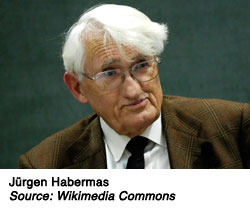
In phase one, lasting up to the early 1980s, he [Jurgen Habermas] still viewed religion as an “alienating reality”, a tool of domination for the powerful. In good Marxist tradition, he thought that religion would eventually disappear, as modern society comes to be based on “communicative rationality” and no longer needs the old irrational illusions. In phase two, roughly 1985-2000, this anti-religious animus is muted. Religion now is seen as unlikely to disappear, because many people (though presumably not Habermas) continue to need its consolations. The public sphere, however, must be exclusively dominated by rationality. Religion must be relegated to private life. One could say that in this phase, at least in the matter of religion, Habermas graduated from Marxism to the French ideal of laicite—the public life of the republic kept antiseptically clean of religious contamination.

Phase three is more interesting. As of the late 1990s Habermas’ view of religion is more benign. Religion is now seen as having a useful public function, quite apart from its private consolations. The “colonization” of society by “turbo-capitalism” (nice term—I don’t know if Habermas coined it) has created a cultural crisis and has undermined the solidarity without which democratic rationality cannot function. We are now moving into a “post-secular society”, which can make good use of the “moral intuition” that religion still supplies. Following in the footsteps of Ernst Bloch and other neo-Marxist philo-Godders, Habermas also credits Biblical religion, Judaism and Christianity, for having driven out magical thinking (here there is an echo of Max Weber’s idea of “ the disenchantment of the world”), and for having laid the foundations of individual autonomy and rights.

Wednesday, October 5, 2011

How Psychology Solved A WWII Shipwreck Mystery

Alix Spiegel at NPR:

Hmas-sydney_wide In November 1941, two ships crossed paths off the coast of Australia. One was the German raider HSK Kormoran. The other: an Australian warship called the HMAS Sydney. Guns were fired, the ships were damaged, and both sank to the bottom of the ocean.

The loss of the Sydney in World War II was a national tragedy for the Australians, particularly because none of the 645 men onboard survived. In the years that followed, there was intense interest in finding the wrecks, particularly the wreck of the Sydney. The idea was that doing this might give the families of the lost sailors some measure of peace, a sense of closure and certainty.

The problem was that the only witnesses to the battle and the sinking were about 300 German sailors who had abandoned their ship after it had been hit. They were eventually picked up by the Australian military.

After their capture, most of these Germans were interrogated and asked to identify where the ships had gone down. But the Germans seemed quite fuzzy on this point.

Bob Trotter, a former director of the Finding Sydney Foundation, a nonprofit group established to help find the Sydney, says their ignorance isn't all that surprising.

“Particularly in a wartime situation, the position of the ship is really kept in the bridge area,” Trotter says. “It would not be normal that the rest of the ship's company would be told.”

Still, in the course of their interrogations, about 70 Germans did come up with a location. But those locations, taken together, didn't make much sense — the positions were spread out, smeared over hundreds of miles. One survivor even placed the sinking almost halfway to Antarctica.

More here.

Resonance of destruction past, manufactured, and yet-to-come

Our own Morgan Meis in The Smart Set:

ScreenHunter_03 Sep. 01 12.49 Everybody is talking about ruins these days. That could be a bad sign. Detroit, in particular, seems to have captured the fancy of the ruin enthusiast. Detroit has experienced a 25 percent reduction in population over the last 10 years or so. Whole areas of the city have been abandoned. You can see entire neighborhoods in ruin, skyscrapers in ruin, a vastly depopulated downtown area. Camilo José Vergara, a photographer specializing in urban decay, once suggested in the mid-1990s that large sections of downtown Detroit be turned into a “skyscraper ruins park.” It would be a testimonial to a lost age, preserved in stone and metal and glass. Today, people sometimes travel to places like Detroit and other Rust Belt locations for the sole reason of gazing upon the ruins.

There have been the dissenters, too, the people who do not take or do not want to take aesthetic pleasure in industrial and urban ruins. The phrase “ruin porn” has made its way into popular parlance. Noreen Malone wrote a piece for The New Republic this year about our love of pictures of the abandoned streets and buildings of Detroit. She argued:

These indelible pictures present an un-nuanced and static vision of Detroit. They might serve to “raise awareness” of the Rust Belt’s blight, but raising awareness is only useful if it provokes a next step, a move toward trying to fix a problem. By presenting Detroit, and other hurting cities like it, as places beyond repair, they in fact quash any such instinct.

Malone is right about one thing: Vergara’s photographs do not suggest a next step.

More here.

Christopher Lasch and the Populist Imperative

9780802817693

A son of the Middle Border, born and raised in Nebraska before his parents moved to Chicago, Lasch, writes Eric Miller, “was a surveyor, taking the measure of the wilderness.” The wilderness was modern America. What Lasch discovered there were pathologies advertised as “progress,” promoted by elites for their own benefit with little regard for the common good. Miller, who teaches history at Geneva College, has written a biography of Lasch, with the evocative title Hope in a Scattering Time. A fine, thoughtful, and even moving book, its appearance could hardly be more opportune. In our own day, the politics of progress have passed the point of exhaustion. Were there any lingering doubts on that score, the vast disparity between the expectations raised by President Obama’s election and the dispiriting reality of the Obama Era has dispelled them once and for all. Only knaves and fools will look to Washington to devise solutions to the problems afflicting American society today. Indeed, further deference to established centers of power, on issues domestic or foreign, will surely perpetuate and even exacerbate those problems.

more from Andrew Bacevich at Anamnesis here.

reading antunes

Antonio-lobo-antunes-sitting

Almost all of Antunes’s books revolve around the Portuguese Colonial War—a crucial bit of Portuguese history that is little-known to Americans. Admittedly, this is one of the challenges of reading an Antunes book—a fate he shares with plenty of international authors—but I’d say that Antunes in particular deals with an obscure point of history. He benefits quite a bit from the omnipresence of smartphones capable of looking up cities, revolutionary groups, events. To paint broadly for a moment, the basic background to all of Antunes’s novels is this: “Prime Minister” Salazar has been in control of Portugal for some three decades, right up until Portugal’s colonies—namely Angola and Mozambique—rise up and fight for independence. Salazar—like every dictator and Republican president known to man—benefitted the wealthy and sent the lower-middle classes to fight in his war. He benefitted from being not quite as bad as neighboring Franco, but his secret police kept the people in check until he was overthrown in 1974, in the middle of the Colonial War. So you have people like Antunes stationed in Africa, trying to repress the natives on behalf of a dictator that only the wealthiest strata of society believed in, and who is suddenly deposed in the Carnation Revolution, a fairly bloodless uprising. At this point the war-broken soldiers come home to a country that’s moved on, that doesn’t really accept them back into the fold, so to speak.

more from Chad Post at The Quarterly Conversation here.

An Arab Poet Who Dares to Differ

Adonis With Adonis the front runner for the Nobel Prize in Literature again, I was reminded of this article by Adam Shatz in the New York Times almost a decade ago:

“I am among those who seek the ills of the Arabs in their own history, not outside of it,” he said. An outspoken champion of secular democracy and a ferocious critic of organized religion, Adonis has published many studies of Arab culture and history, notably the book “The Changing and the Fixed: A Study of Conformity and Originality in Arab Culture.” In that volume, banned in certain Arab countries as heresy, Adonis accused Islam's clerics of perpetuating what he calls past-ism — a stubborn tendency to cling to what is known and to fear the new. According to Adonis, even apparently secular forms of politics in the Arab world, notably Arab nationalism and Marxism, are religious in structure, presenting themselves as revelations — absolute truths that confirm received wisdom instead of fostering debate.

“We live in a culture that doesn't leave a space for questions,” he said, puffing on a cigarillo. “It knows all the answers in advance. Even God has nothing left to say!” He let out a high-pitched giggle, as he often does after saying something particularly ominous or apocalyptic. What the Arab world needs, more than anything, he said, is a “revolution of subjectivity” that would emancipate people from tradition. Until this inner revolution occurs, he warned, Arabs would know only a secondhand modernity, a dangerous brew of hollow consumerism, rigged elections and radical Islam. “There is no more culture in the Arab world,” he said. “It's finished. Culturally speaking, we are a part of Western culture, but only as consumers, not as creators.”

To American readers of Fouad Ajami and V. S. Naipaul, Adonis's criticisms of Arab society may have a familiar ring. But what sets him apart from these men is that he writes in Arabic for an Arab audience, and that he is equally critical of the West, particularly the United States. “What strikes me about the States,” he said, widening his arms as if he were conducting the Berlin Philharmonic, “is the richness of American society on the one hand and, on the other” — he brought his hands together as if he were measuring a grain of sand — “the smallness of its foreign policy.”

The Barb of Variety

9783406587139_large Horst Bredekamp on Josef H. Reichholf's The Origin of Beauty: Darwin's greatest Dilemma in Sign and Sight:

Well-meaning critics struggled to conceal their perplexity, behind which laid a thick wall of denial. The second part of “Descent of Man” published in 1871 contained Charles Darwin's treatise on “sexual selection”, which presented perhaps his greatest failure. Darwin was confronted with the problem of not believing that nature, which was literally exploding with variety and diversity, could be explained solely with the aid of “natural selection”. To resolve this conflict he came up with the theory of “sexual” selection, making the female eye the agent of evolution. “Female choice” as he called it, was in no only way solely obligated to follow a commitment to strength and guaranteed survival; the female interest essentially followed another principle, one that could be described as the desire for variation. This meant that Darwin was defining nature, to a certain extent, as a history of erotic form – or even art. In regarding the bodies of animals as self-produced images, he defined his second pillar of evolution as an astonishing pictorial theatre which arose out of the interplay of the female eye in the search for variation and the readiness of the male to mutate.

Fellow naturalists like Alfred R. Wallace were so dismissive of Darwin's theory because they could not accept the existence of a variational drive independent of the pressure to conform to the environment.

Evolutionary biology has never managed to shake off this discomfort, even if the theory of sexual selection continues to be picked up by outsiders and has been cautiously integrated into and developed by the mainstream. The misgivings were also culturally determined. Unlike Darwin's 1859 treatise “The Origin of Species by Means of Natural Selection, or the Preservation of Favoured Races in the Struggle for Life” which hit a nerve at a time when the struggle for survival was being unleashed under the conditions of burgeoning capitalism, his concept of sexual selection inadvertently struck at the neurotic core of the Victorian obsession with controlling drives. This provoked a resistance whose unacknowledged psychological roots made it virtually invincible.

Religion Makes People Happy, So Why is Church Attendance Declining?

Dsc_0037_NONAME Bruno S Frey and Jana Gallus make the case for religion as happiness insurance:

Modern happiness research leaves no doubt that religious people are happier than their contemporaries. And the causality runs from religion to happiness (though it might also be possible that religious people are less interested in material aspects and, therefore, less affluent).

* One of the studies supporting this assumption was provided by Headey et al. (2010). Based on data from the German Socio-Economic Panel, they find that individuals who turn to religion over time become, ceteris paribus, more satisfied, while those turning away from it suffer a loss in their quality of life.

* A comparison of multivariate estimates of happiness functions shows that, even when controlling for other influences, deism is highly positively correlated with life satisfaction across all countries (Frey and Stutzer 2002, Dolan et al. 2008, Frey 2010).

In the US, for example, 48% of those who describe themselves as “very happy” attend church service at least once a week; this compares to a share of merely 26% made up by those who never go to church (Pew Forum on Religion and Public Life 2007).

But the relevance of these results is not only restricted to the individual level. Focusing on whole countries as units of measurement, receding religiousness could be a predictor of a decline in life quality, all other factors held constant. Given the fact that life satisfaction eventually also influences productivity, it becomes clear why the topic should be policy relevant.