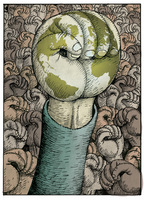
The Globalization of Protest

Pa3259c_thumb3Joseph E. Stiglitz in Project Syndicate:

In May, I went to the site of the Tunisian protests; in July, I talked to Spain’s indignados; from there, I went to meet the young Egyptian revolutionaries in Cairo’s Tahrir Square; and, a few weeks ago, I talked with Occupy Wall Street protesters in New York. There is a common theme, expressed by the OWS movement in a simple phrase: “We are the 99%.”

That slogan echoes the title of an article that I recently published, entitled “Of the 1%, for the 1%, and by the 1%,” describing the enormous increase in inequality in the United States: 1% of the population controls more than 40% of the wealth and receives more than 20% of the income. And those in this rarefied stratum often are rewarded so richly not because they have contributed more to society – bonuses and bailouts neatly gutted that justification for inequality – but because they are, to put it bluntly, successful (and sometimes corrupt) rent-seekers.

This is not to deny that some of the 1% have contributed a great deal. Indeed, the social benefits of many real innovations (as opposed to the novel financial “products” that ended up unleashing havoc on the world economy) typically far exceed what their innovators receive.

But, around the world, political influence and anti-competitive practices (often sustained through politics) have been central to the increase in economic inequality. And tax systems in which a billionaire like Warren Buffett pays less tax (as a percentage of his income) than his secretary, or in which speculators, who helped to bring down the global economy, are taxed at lower rates than those who work for their income, have reinforced the trend.

Research in recent years has shown how important and ingrained notions of fairness are. Spain’s protesters, and those in other countries, are right to be indignant: here is a system in which the bankers got bailed out, while those whom they preyed upon have been left to fend for themselves.
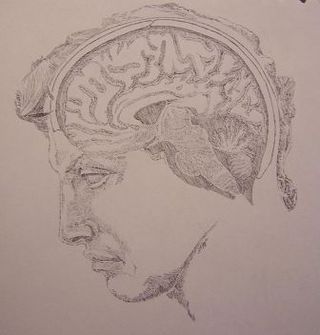

A Brief Guide to Embodied Cognition: Why You Are Not Your Brain

573px-DavidbrainSamuel McNerney over at a guest post at one of Scientific American's blogs:

Embodied cognition, the idea that the mind is not only connected to the body but that the body influences the mind, is one of the more counter-intuitive ideas in cognitive science. In sharp contrast is dualism, a theory of mind famously put forth by Rene Descartes in the 17th century when he claimed that “there is a great difference between mind and body, inasmuch as body is by nature always divisible, and the mind is entirely indivisible… the mind or soul of man is entirely different from the body.” In the proceeding centuries, the notion of the disembodied mind flourished. From it, western thought developed two basic ideas: reason is disembodied because the mind is disembodied and reason is transcendent and universal. However, as George Lakoff and Rafeal Núñez explain:

Cognitive science calls this entire philosophical worldview into serious question on empirical grounds… [the mind] arises from the nature of our brains, bodies, and bodily experiences. This is not just the innocuous and obvious claim that we need a body to reason; rather, it is the striking claim that the very structure of reason itself comes from the details of our embodiment… Thus, to understand reason we must understand the details of our visual system, our motor system, and the general mechanism of neural binding.

What exactly does this mean? It means that our cognition isn’t confined to our cortices. That is, our cognition is influenced, perhaps determined by, our experiences in the physical world. This is why we say that something is “over our heads” to express the idea that we do not understand; we are drawing upon the physical inability to not see something over our heads and the mental feeling of uncertainty. Or why we understand warmth with affection; as infants and children the subjective judgment of affection almost always corresponded with the sensation of warmth, thus giving way to metaphors such as “I’m warming up to her.”

Embodied cognition has a relatively short history. Its intellectual roots date back to early 20th century philosophers Martin Heidegger, Maurice Merleau-Ponty and John Dewey and it has only been studied empirically in the last few decades. One of the key figures to empirically study embodiment is University of California at Berkeley professor George Lakoff.

Lakoff was kind enough to field some questions over a recent phone conversation, where I learned about his interesting history first hand.

Consciousness: The Black Hole of Neuroscience

ConsciousnessMegan Erickson in Big Think:

The simplest description of a black hole is a region of space-time from which no light is reflected and nothing escapes. The simplest description of consciousness is a mind that absorbs many things and attends to a few of them. Neither of these concepts can be captured quantitatively. Together they suggest the appealing possibility that endlessness surrounds us and infinity is within.

But our inability to grasp the immaterial means we’re stuck making inferences, free-associating, if we want any insight into the unknown. Which is why we talk obscurely and metaphorically about “pinning down” perception and “hunting for dark matter” (possibly a sort of primordial black hole). The existence of black holes was first hypothesized a decade after Einstein laid the theoretical groundwork for them in the theory of relativity, and the phrase “black hole” was not coined until 1968.

Likewise, consciousness is still such an elusive concept that, in spite of the recent invention of functional imaging – which has allowed scientists to visualize the different areas of the brain – we may not understand it any better now than we ever have before. “We approach [consciousness] now perhaps differently than we have in the past with our new tools,” says neuroscientist Joy Hirsch.

“The questions [we ask] have become a little bit more sophisticated and we’ve become more sophisticated in how we ask the question,” she adds – but we're still far from being able to explain how the regions of the brain interact to produce thought, dreams, and self-awareness. “In terms of understanding, the awareness that comes from binding remote activities of the brain together, still remains what philosophers call, ‘The hard problem.'”

The Christian Right and the Rise of American Fascism

Chris Hedges in The Christian Left:

Dr. James Luther Adams, my ethics professor at Harvard Divinity School , told us that when we were his age, he was then close to 80, we would all be fighting the “Christian fascists.”

The warning, given to me 25 years ago, came at the moment Pat Robertson and other radio and televangelists began speaking about a new political religion that would direct its efforts at taking control of all institutions, including mainstream denominations and the government. Its stated goal was to use the United States to create a global, Christian empire. It was hard, at the time, to take such fantastic rhetoric seriously, especially given the buffoonish quality of those who expounded it. But Adams warned us against the blindness caused by intellectual snobbery. The Nazis, he said, were not going to return with swastikas and brown shirts. Their ideological inheritors had found a mask for fascism in the pages of the Bible.

He was not a man to use the word fascist lightly. He was in Germany in 1935 and 1936 and worked with the underground anti-Nazi church, known as The Confessing Church, led by Dietrich Bonhoeffer. Adams was eventually detained and interrogated by the Gestapo, who suggested he might want to consider returning to the United States . It was a suggestion he followed. He left on a night train with framed portraits of Adolph Hitler placed over the contents inside his suitcase to hide the rolls of home movie film he took of the so-called German Christian Church, which was pro-Nazi, and the few individuals who defied them, including the theologians Karl Barth and Albert Schweitzer.

More here. [Thanks to Jim Culleny.]

Tim Minchin: Mocking God in the heart of Texas

When Tim Minchin – actor, comedian, confirmed atheist – decided to take his comedy to America's Bible belt, we were concerned he might be burnt at the stake. Here, he describes what happened next…

Tim Minchin in The Observer:

ScreenHunter_11 Nov. 06 11.46Whenever a friend or fan finds out I've started touring the States, there is an inevitable raising of the eyebrows (or eyebrow, if they are blessed with that most enviable of talents). There are two reasons behind such browular elevations, the first of which is born of comedy snobbery: Brits and Aussies are very fond of saying that Americans “don't get irony”. This is absurd; if anything, they don't get absurdity, which the Brits and the Irish probably “get” better than anyone else. Apart from that, I have observed a surprising consistency in what makes people laugh, notwithstanding geography-specific subject matter, which I avoid. (The only other cultural-comic quirks I have observed are that the English really like camp men making thinly veiled bum-sex double entendres, and Australians love swearing. We think it's fucking hilarious.)

The second thing that concerns people about me touring the US is that they fear my penchant for jaunty-but-vehement criticism of religion will at best result in empty auditoriums, and at worst get me shot. But the perception that the country is packed wall-to-wall with Christian fundies is as specious as the irony myth. There is no doubt that many Americans have what seems to be a near-erotic relationship with the two-millennium-dead Middle-Eastern Jewish magician-preacher we call Jesus. But there are frickin' loads of people in America, and even if the percentage of the population that is not religious is only 10% (it's a much greater number, surely), then there are still 33 million potential ticket-buyers.

More here.

Deep Intellect: Inside the mind of the octopus

From Orion Magazine:

OctupusMEASURING THE MINDS OF OTHER creatures is a perplexing problem. One yardstick scientists use is brain size, since humans have big brains. But size doesn’t always match smarts. As is well known in electronics, anything can be miniaturized. Small brain size was the evidence once used to argue that birds were stupid—before some birds were proven intelligent enough to compose music, invent dance steps, ask questions, and do math. Octopuses have the largest brains of any invertebrate. Athena’s is the size of a walnut—as big as the brain of the famous African gray parrot, Alex, who learned to use more than one hundred spoken words meaningfully. That’s proportionally bigger than the brains of most of the largest dinosaurs.

Another measure of intelligence: you can count neurons. The common octopus has about 130 million of them in its brain. A human has 100 billion. But this is where things get weird. Three-fifths of an octopus’s neurons are not in the brain; they’re in its arms. “It is as if each arm has a mind of its own,” says Peter Godfrey-Smith, a diver, professor of philosophy at the Graduate Center of the City University of New York, and an admirer of octopuses. For example, researchers who cut off an octopus’s arm (which the octopus can regrow) discovered that not only does the arm crawl away on its own, but if the arm meets a food item, it seizes it—and tries to pass it to where the mouth would be if the arm were still connected to its body.

More here.

Death Comes to Pemberley

From The Telegraph:

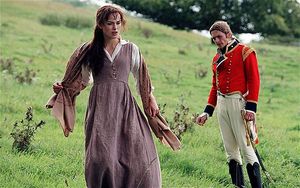
Pdjames1_2046755bQ What do you get if you cross a Jane Austen novel with a crime thriller? A The latest fiction from PD James- 'Death Comes to Pemberley'. Here the distinguished novelist explains why she decided to combine her two literary passions to produce a sequel which opens with a brutal murder at Pemberley.

A. Like many – probably most – novelists, I am happiest when plotting and planning or writing a new book, and the period in between, once the excitement of the publication is over, is usually spent considering what to write next. The prospect of becoming 90 was a time of important decision-making, since I had become increasingly aware that neither years nor creative energy last forever. After the publication of my latest Dalgliesh story, The Private Patient, in 2008, I decided that I could be self-indulgent and turn to an idea that had been in my mind for some time: to combine my two lifelong enthusiasms, namely for writing detective fiction and for the novels of Jane Austen, by setting my next book in Pemberley. My own feeling about sequels is ambivalent, largely because the greatest writing pleasure for me is in the creation of original characters, and I have never been tempted to take over another writer’s people or world, but I can well understand the attraction of continuing the story of Elizabeth and Darcy. Austen’s characters take such a hold on our imagination that the wish to know more of them is irresistible, and it is perhaps not surprising that there have been more than 70 sequels to Austen’s novels.

Pride and Prejudice, which was originally titled First Impressions, was written between October 1796 and August 1797. Austen’s father wrote to a London bookseller, Thomas Cadell, to ask if he had any interest in seeing the manuscript, but he declined by return of post. It was in 1811 and 1812 that Austen revised the novel, making it shorter, and it was published in 1813 under the title Pride and Prejudice. It is frustrating that the original manuscript has not been discovered as it would have been fascinating to see what portions were excised and which retained and possibly extended. In Death Comes to Pemberley, I have chosen the earlier date of 1797 for the marriages both of Elizabeth and her older sister Jane, and the book begins in 1803 when Elizabeth and Darcy have been happily together for six years and are preparing for the annual autumn ball which will take place the next evening. With their guests, which include Jane and her husband Bingley, they have been enjoying an informal family dinner followed by music and are preparing to retire for the night when Darcy sees from the window a chaise being driven at speed down the road from the wild woodlands. When the galloping horses have been pulled to a standstill, Lydia Wickham, Elizabeth’s youngest sister, almost falls from the chaise, hysterically screaming that her husband has been murdered. Darcy organises a search party and, with the discovery of a blood-smeared corpse in the woodlands, the peace both of the Darcys and of Pemberley is shattered as the family becomes involved in a murder investigation.

More here.

Saturday, November 5, 2011

Apartheid and the occupation of Palestine

John Dugard at Al Jazeera:

ScreenHunter_10 Nov. 06 11.30Israel discriminates against Palestinians in the West Bank and East Jerusalem in favour of half a million Israeli settlers. Its restrictions on freedom of movement, manifested in countless humiliating checkpoints, resemble the “pass laws” of apartheid. Its destruction of Palestinian homes resemble the destruction of homes belonging to blacks under apartheid's Group Areas Act. The confiscation of Palestinian farms under the pretext of building a security wall brings back similar memories. And so on. Indeed, Israel has gone beyond apartheid South Africa in constructing separate (and unequal) roads for Palestinians and settlers.

Apartheid's security police practiced torture on a large scale. So do the Israeli security forces. There were many political prisoners on Robben Island but there are more Palestinian political prisoners in Israeli jails.

Apartheid South Africa seized the land of blacks for whites. Israel has seized the land of Palestinians for half a million settlers and for the purposes of constructing a security wall within Palestinian territory – both of which are contrary to international law.

Most South Africans who visit the West Bank are struck by the similarities between apartheid and Israel's practices there. There is sufficient evidence for the Russell Tribunal to conduct a legitimate enquiry into the question whether Israel violates the prohibition of apartheid found in the 1973 Apartheid Convention and the Rome Statute.

More here.

Johns Hopkins’s ‘Eureka! Rare Books in the History of Scientific Discovery’

Kris Coronado in the Washington Post:

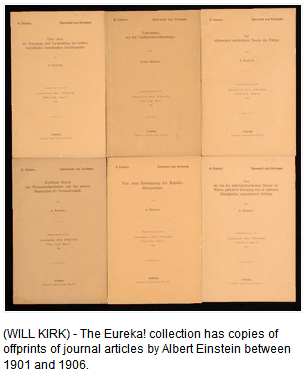
ScreenHunter_09 Nov. 06 11.22“There are books in this room of which there are only a dozen copies that survived in the world,” says Havens, curator of rare books and manuscripts at Johns Hopkins University’s Sheridan Libraries, as he gestures to the 55 pieces on display in one room.

Hopkins’s George Peabody Library — a rare-books collection within the university’s Sheridan Libraries — is debuting “Eureka! Rare Books in the History of Scientific Discovery,” a collection of more than 300 works bequeathed to the university last fall, after the November 2009 death of Hopkins alumnus Elliott Hinkes, a Los Angeles oncologist and rare-book collector.

These artifacts are quite impressive in themselves. Yet what makes them all the more intriguing is their collective illustration of pivotal moments in scientific history: discoveries that forever altered our perspective of the world.

More here.

MTV blows its street cred

A network that once professed a social conscience pushes its usual trash as a genuine youth movement grows.

Stephen Deusner in Salon:

Mtv-ows1-460x307MTV is eager to cover Occupy Wall Street; it just doesn’t know how, at least not in any substantial or meaningful way. MTV News’ “True Life: I’m Occupying Wall Street” debuts today, following a protester named Bryan who works on the sanitation team and fights to keep the city from evicting the occupiers. And as part of its O Music Awards — which have noting to do with Oprah — MTV plans to bestow former Rage Against the Machine guitarist Tom Morello with a special award for Best #Occupy Wall Street Performance, for his strolling rendition of “This Fabled City.”

This is how MTV covers OWS – with a reality-esque documentary and an awards show. Which is fitting, since that’s about the only thing the network does anymore. It reveals a network that is clueless about the principles that inspired the movement and — perhaps even worse — exploitive in the most blatantly corporate sense of the word. Its first response to an important and possibly defining moment was to retrofit OWS to a format that’s easily as old as many of the demonstrators themselves. How long before we see JWoww and The Situation carrying picket signs? Could there be a “Teen Mom” at the protests?

Ever since the synthy strains of “Video Killed the Radio Star” introduced the network in 1981 — it’s been easy sport to bash the channel for its vapidity and youthmongering. MTV is like “Saturday Night Live” — you can’t kill it or embarrass it, no matter how bad it gets.

More here.

On Homesickness

From The Paris Review:

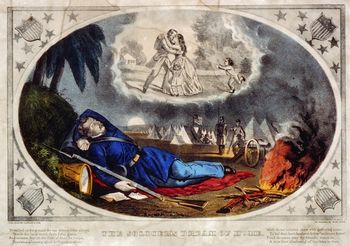
HomesicknessThe word homesickness didn’t come into use until the 1750s. Before that, the feeling was known as “nostalgia,” a medical condition. It was first identified in 1688 by Johannes Hofer, a Swiss scholar, who warned that the condition had not been sufficiently observed or described and could have dire consequences. By Hofer’s description, the nostalgic individual so exhausted himself thinking of home that he couldn’t attend to other ideas or bodily needs. While nostalgia was embraced as a Victorian virtue, a testament to civility and the domestic order, extreme onsets could kill a person. And so they did during the Civil War. By two years in, two thousand soldiers had been diagnosed with nostalgia, and in the year 1865, twenty-four white Union soldiers and sixteen black ones died from it. Meantime one hundred thousand Confederates deserted, presumably motivated by memories of mom’s hushpuppies. The war just about ended what little romanticization of homesickness had survived in the wilds of early America. A sentiment that caused desertion and death could no longer pass as a force for social good. Instead it had far greater utility as a patronizing justification of racism. Some in favor of slavery began to claim that slaves loved their home more than anyone; that being the case, how cruel to then tear them from the plantation.

An immigrant seeking a fortune couldn’t afford any semblance of I can’t cut it. Nor could a pioneer moving westward, or a Yankee trudging to California with a pan in his hand.

More here.

PG Wodehouse: a life in letters

From Guardian:

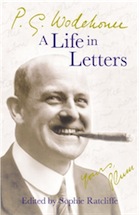
PG-Wodehouse-A-Life-in-LetteIn 1928, the American magazine Liberty published what was to become one of PG Wodehouse's best-loved stories: “Lord Emsworth and the Girl Friend”. All the usual Wodehousean suspects are here – the fierce aunt, the overbearing gardener, the uncomfortably stiff collar – and the plot hangs on a characteristically slight thread. Even so, this tale of friendship between a tremulous peer and a 12-year-old East Ender named Gladys has tremendous power. Emsworth is a character known for his benign indifference. Absent-minded, cowed by those around him, he lives for his prize pig in a world of his own. But when Gladys has a bad afternoon at the Castle, we see a whole different side to the oft-oppressed peer. “Something happened, and the whole aspect of the situation changed.” “It was, in itself, quite a trivial thing, but it had an astoundingly stimulating effect on Lord Emsworth's morale. What happened was that Gladys, seeking further protection, slipped at this moment a small hot hand into his.” Contained but viscerally alive, there is a poignant reserve about this “mute vote of confidence” – the pace and rhythm of the sentences are as subtle as the emotions they convey. It is, Kipling argued, “one of the most perfect short stories ever written”.

Countless readers of Wodehouse have testified to the way his novels have their own “stimulating effect” on morale, providing not just comic, but almost medicinal effects: the exiled Kaiser Wilhelm, after his defeat in the first world war, consoled himself by reading Wodehouse to his “mystified” staff; the late Queen Mother allegedly read “The Master” on a nightly basis, to set aside the “strains of the day”; more recently, news reports tell of the imprisoned Burmese comedian Zargana finding comfort in Wodehouse during solitary confinement. “Books are my best friends”, he confided. “I liked the PG Wodehouse best. Joy in the Morning – Jeeves, Wooster and the fearsome Aunt Agatha. It's difficult to understand, but I've read it three times at least. And I used it as a pillow too.”

More here.

Saturday Poem

All People Are Pregnant

All people are pregnant, said Diotima,
their bodies are pregnant, their souls are pregnant,
oh how they want to give birth with all their might.
Beauty is childbirth. Birth is beautiful.

So Diotima said to Socrates. Socrates said
the same thing at Agathon’s party, and it was heard
by young Aristodemus, and he passed it on
to Apollodorus, who told his own friends.

Little Plato was playing with beetles in the garden.
Where did all these beetles come from, he wondered,
did they emerge suddenly from an immense, flawless beetle
in the sky? That we are unable to see?

At night, his mommy carried him inside and put him to sleep.
At Agathon’s place a party of pederasts began,
and because no one could stand to drink any more they began to argue:
let us talk of love. Let us talk of beauty.

by Hasso Krull
from Neli korda neli
Publisher: Eesti Keele Sihtasutus, Tallinn, 2009

© Translation: 2010, Brandon Lussier
Publisher: PIW, 2010

the war on error

3db351fa-e57d-11e0-852e-00144feabdc0

Christopher Hitchens is living in what Philip Gould, the New Labour pollster and author of The Unfinished Revolution, described in a recent, and poignant, BBC interview as the “death zone”. He, like Gould, is terminally ill. We all live under a death sentence, however long it may be suspended, but it concentrates the mind if you are told that the end is much nearer than you would have wished – terrifyingly near. “I had immense plans for the next decade,” Hitchens said wistfully when he was diagnosed with inoperable oesophageal cancer last autumn. There is, inevitably, an air of last things about this collection of essays, reviews and columns written over the past decade or so, a sense of leave-taking, and you read Arguably knowing that this great provocateur and polemicist will soon be silenced. Since being told a year ago that he had as little as another year to live, Hitchens’ articles have been written with “full consciousness that they might be my very last”. This is, he writes in the introduction, “Sobering in one way and exhilarating in another … it has given me a more vivid idea of what makes life worth living, and defending.” The epigraph to Arguably is a resonant line from Henry James’s The Ambassadors: “Live all you can. It’s a mistake not to.”

more from Jason Cowley at the FT here. (PS many filthy rich people read 3QD regularly. Don’t ask how we know. We just know. Today is Filthy-Rich-People-Give-$500-Day in our fundraiser. You know who you are. You are filthy rich and you care about intelligent writing. No shame in that. Today is your day.)

something really personal

65685520

“Writers,” Joan Didion observed in 1968, “are always selling somebody out.” It’s one of those classic Didion statements, epigrammatic yet personal, a line that unpacks itself the more we consider what it implies. Didion may have been referring to journalism when she wrote that in the preface to “Slouching Towards Bethlehem,” but she was also, as directly as can be imagined, addressing herself. “My only advantage as a reporter is that I am so physically small, so temperamentally unobtrusive, and so neurotically inarticulate that people tend to forget that my presence runs counter to their best interests. And it always does,” she acknowledged earlier in the same paragraph, and it is this clarity, this edge of laser-sharp engagement, that sets her apart. For nearly 50 years now, her work has been defined by what she calls “triangulation,” which is a way of explaining how she asserts herself in a piece of writing — to tell a reader where she is. This question of presence, of triangulation, has come up on a Thursday afternoon in Didion’s comfortably cluttered Upper East Side living room because she is discussing her new book, “Blue Nights” (Alfred A. Knopf: 188 pp., $25), which, she is saying, she almost didn’t write. “There came a time,” she recalls, her voice a low murmur, “when I decided I would simply repay the money I had gotten from Knopf. I told Lynn Nesbit that this was my plan, that I was going to tell Sonny I couldn’t do it, and we would repay him. And Lynn said, ‘Why don’t you wait on that awhile?'”

more from David L. Ulin at the LA Times here.