Thomas Meaney in The Nation:
More here.

Thomas Meaney in The Nation:
More here.
Brian Handwerk in National Geographic:

As usual, more than a half dozen genuine Nobel laureates were onstage at Harvard's Sanders Theater to hand out the coveted prizes.
Wasabi Alarm: The famous sushi condiment has become a lifesaver thanks to the work of Makoto Imai, of Japan's Shiga University of Medical Science, and colleagues. The team won the 2011 Ig Nobel chemistry prize for developing a “wasabi alarm” that discharges an airborne spray made from the spicy horseradish. The spray is potent enough to wake a soundly sleeping person in the event of an emergency.
“People with hearing difficulties may fail to wake up with noise or flashing lights, and another mode of communication may be necessary to save their lives,” Imai said. “The wasabi alarm is not a smell but a stinging sensation to the upper airways.”
Airborne wasabi concentrations of up to 20 parts per million are strong enough to awaken sleepers via stinging noses and watery eyes, Imai reported, but not so strong that the effect hinders peoples' ability to evacuate efficiently.
More here.
[Thanks to Ali Zaidi.]
Qualandar Bux Memon and Ali Mohsni in New Internationalist:
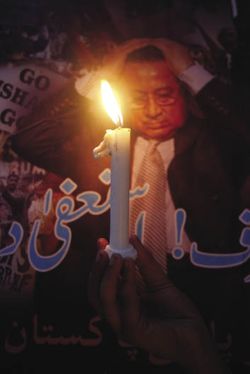
Moreover, these organizations are intrinsically opposed to the ‘personalization of politics’ of the traditional parties. For example, the Pakistan People’s Party can only be led by a member of the Bhutto family – the party’s recent leadership succession was decided by the will of the late Benazir Bhutto, with members having no say. Similarly, the Pakistan Muslim League, the main opposition party, who are currently in power in the Punjab province, is headed by one industrial family. Its current leader is Nawaz Sharif and the party belongs to his family. Such hierarchical, feudal structures contrast sharply with the political parties of the Left, which hold annual or bi-annual conventions to elect office bearers.
Gender and caste are also seen as important and members of minorities or groups that face discrimination are encouraged to take leadership positions.
More here.
Jessica Grose in Slate:
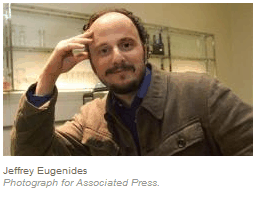
Slate spoke to Eugenides about whether or not Leonard is based on David Foster Wallace (an issue of some dispute), his own post-collegiate malaise, and his daily writing routine.
Slate: What made you decide to use your alma mater, Brown, as a setting?
Jeffrey Eugenides: I was going to set it at a different college. At a fictionalized college. Then I started writing it, and it seemed too much trouble for what it was worth. I knew Brown better.
More here.
Paul Rosenberg in Al Jazeera:

This philosophy prized individual critical inquiry, as well as institutions-formal and informal-which enabled individual efforts to be joined together into a far more powerful whole. This outlook was crucially important to the creation of a new nation on a new hemisphere, confident enough to establish itself on a new political foundation with some ancient roots, but fashioned with its own original design. Mere imitation of the past was rejected as a guiding principal. So, too, was blind reliance on the fantasy of individual political genius. Instead, the spirit and process of critical inquiry was crucial to how the new nation was conceived.
The basic architecture of “separation of powers”, for example, was intended to prevent the accumulation of all power into the hands of any unaccountable group or faction – and thus to put a premium on the process of advancing ideas that could pass the muster of critical examination by the widest possible range of parties involved. Similarly, steps were taken to insulating of government from dogmatic religious influence. Religious tests for public office were banned in the Constitution itself, and separation of church and state was formalised in the First Amendment's guarantee of religious freedom, which similarly guaranteed freedom of speech, freedom of assembly and freedom of the press – all intimately connected to the individual and collective exercise of critical reason.
And yet, despite all this, there was always an anti-Enlightenment, anti-intellectual side of America as well. And that side has always created needless deficits in critical thinking, hampering America's ability to fully realize its promise.
More here.
Matt Taibbi in Rolling Stone:
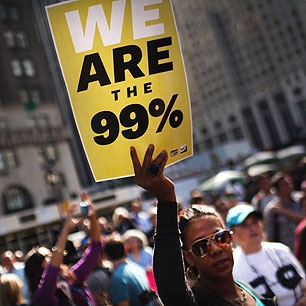
Why? Because after a decade of unparalleled thievery and corruption, with tens of millions entering the ranks of the hungry thanks to artificially inflated commodity prices, and millions more displaced from their homes by corruption in the mortgage markets, the headline from the first week of protests against the financial-services sector was an old cop macing a quartet of college girls.
That, to me, speaks volumes about the primary challenge of opposing the 50-headed hydra of Wall Street corruption, which is that it's extremely difficult to explain the crimes of the modern financial elite in a simple visual. The essence of this particular sort of oligarchic power is its complexity and day-to-day invisibility: Its worst crimes, from bribery and insider trading and market manipulation, to backroom dominance of government and the usurping of the regulatory structure from within, simply can't be seen by the public or put on TV. There just isn't going to be an iconic “Running Girl” photo with Goldman Sachs, Citigroup or Bank of America – just 62 million Americans with zero or negative net worth, scratching their heads and wondering where the hell all their money went and why their votes seem to count less and less each and every year.
No matter what, I'll be supporting Occupy Wall Street. And I think the movement's basic strategy – to build numbers and stay in the fight, rather than tying itself to any particular set of principles – makes a lot of sense early on. But the time is rapidly approaching when the movement is going to have to offer concrete solutions to the problems posed by Wall Street. To do that, it will need a short but powerful list of demands. There are thousands one could make, but I'd suggest focusing on five…
More here.

Migration is said to be good for host cultures. Geographers, demographers and business people believe it is, especially in the US, where one migrant group after another – Jews, Poles, Italians, Irish – has auditioned for a role in the great musical of American identity. The competition has been bitter, especially between newcomers and predecessors, and the typecasting has been crude, yet sooner or later every minority earns its place in the chorus. Nonetheless there’s a growing sense in some parts of the US that enough is enough, the stage is full to capacity and the show can no longer go on as it has. The source of this impatience is illegal immigration from Mexico, which is no longer seen primarily as a supply of service employees, farm labour and building workers, but as a threat to an indebted nation still embroiled in distant wars, with land borders to north and south that it can’t patrol as effectively as it would like and unemployment hovering at around 9 per cent. The US already has more than 11 million unauthorised migrants. About six and a half million are from Mexico and another two million from other parts of Latin America. Every year, many thousands more are crossing from Mexico without permission, to swell their ranks. Roughly 500,000 Hispanics – 8 per cent of the population of the state – are living in Arizona without authorisation. Arizona has become an operational front in yet another desert conflict.
The battle against illegal migration is a domestic version of America’s interventions overseas, with many of the same trappings: big manpower commitments, militarisation, pursuit, detection, rendition, loss of life. The Mexican border was already the focus of attention before 9/11; it is now a fixation that shows no signs of abating even as Obama draws down the numbers abroad. Despite war-weariness at home, war has remained the model for curbing illegal immigration; territorial integrity and the preservation of national identity are the goals.
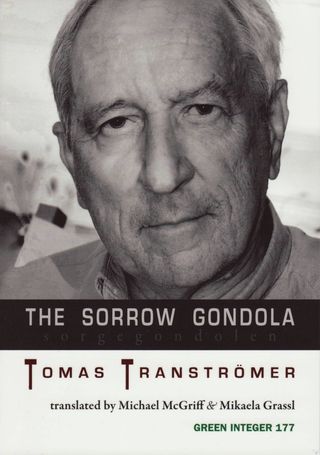
The great subject of the poetry of Tomas Tranströmer—sometimes it seems as though it is his only subject—is liminality. He is a poet almost helplessly drawn to enter and inhabit those in-between states that form the borderlines between waking and sleeping, the conscious and the unconscious, ecstasy and terror, the public self and the interior self. Again and again his poems allude to border checkpoints, boundaries, crossroads: they teeter upon thresholds of every sort—be they the brink of sleep or the brink of death, a door about to open or a door about to close. These thresholds are often ensorcelated places, where a stone can miraculously pass through a window and leave it undamaged, where the dreams of a sleeping couple (in Robin Robertson’s translation of the lines) “will meet as colours meet / and bleed into each other / in the dampened pages of a child’s painting-book.” Indeed, in his finest individual collection, called Sanningsbarriaren in its original Swedish and The Truth-Barrier in most English translations, he concocts a neologism which perfectly encapsulates his lifelong fixation with the liminal. Yet this inhabitant of borderlands and denizen of thresholds is also deeply suspicious of binaries and dichotomies, of Manichaeism in any form.
In Tranströmer’s universe, conditions are too much in flux, too subject to sudden and radical change, to ever permit dualistic thinking: every emotion can without warning turn into its opposite, every perception of what Whitehead called “the withness of the body” can turn into an out-of-the body experience. In one of his best-known poems, “The Open Window,” composed in the aftermath of the Cuban Missile Crisis, we first glimpse the speaker shaving to the lulling purr of his electric razor, but suddenly the razor becomes a helicopter, and the speaker is looking down from its cockpit to the distant earth below. “‘Keep your eyes open!’” says the helicopter pilot in Robert Bly’s translation of the poem, “‘You’re seeing all this for the last time.’” How does ones one return to reality and sanity after experiencing a vision as apocalyptic as this?
Few people who set out to change the world actually succeed. Frank Kameny was one of those few. You most likely have never heard of him. But for gay Americans, he’s a Founding Father of the historic movement that pulled us out of the closet and into greater acceptance in the United States. What made Kameny a hero was that he demanded equity and fairness when it was literally him against the world. He was 86 and lived in Washington.
I can’t remember the first time I met Kameny. But I’ll never forget the impression he left on me. Feisty. Determined. What impressed me most about Kameny, though, was his unapologetic pragmatism. While he was “stubborn and impatient,” as D.C. Council Member David Catania (I-At Large) told The Post, Kameny understood that he, and eventually the movement that grew around him, had to make big leaps to get society as a whole to take the incremental steps need to move toward equality for gay men, lesbians, bisexual and transgendered Americans. And what leaps he made.
Chingwa Ne Maruva
My belly wakes me again
Ndomuka nafour dze makuseni
Ndoenda kumsika
The life of a vendor
Selling rape and tomatoes
And tomatoes and rape ’cause every day is rape
And stolen dignity
Ask me for my ID and vending licence
Is that not violence?
Do I need a licence to live
Is life theirs to give?
Chingwa ne maruva
Bread and roses, mama
Chingwa ne maruva
Bread and roses, mama
He smashes the tomatoes
Uses baton sticks for avocados
All he knows is how to break
’Cause he breaks for the law’s sake
It’s a neverending process of cleaning
Cleansing
Like a frenzy
Mai vake vanotengesa maveggie
But she sells them in a council place
So she should be legal and safe
So smash tomotaoes
Crush avocados
Destroy the table
Destroy what’s illegal
Smash tomatoes
Crush avocados
Destroy the table
Destroy what’s illegal
Chingwa ne maruva
Bread and roses, mama
Chingwa ne maruva
Bread and roses, mama
Here come the forces of good
Those who wage war on food
I thought ours was the land and the fruits
Now crushed by these blind boots
Saying my food is dirty
No, my food is dignity
It sends my children to school you see
Chinobhadara mabills angu ne renti
From now on handichatengese maveggie
You’ll see me in the streets demanding two things
Love and dignity
‘Cause I’m a mother gone wild
Today my fruits were destroyed by my own child
by Comrade Fatso
from House of Hunger, © 2008
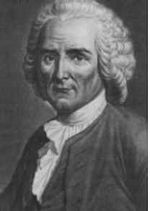
Leo Strauss’s Rousseau chapter in Natural Right and History is perhaps the most neglected aspect of the book.1 This is surprising because Strauss himself paid Rousseau the considerable compliment of taking him seriously. At a time when Rousseau was dismissed as either a crank outside the philosophical canon or as a dangerous obscurantist responsible for the radical politics of the French Revolution, Strauss helped to revive a serious interest in his philosophical thought.2 The Rousseau chapter is titled “The Crisis of Modern Natural Right” and begins: “The first crisis of modernity occurred in the thought of Jean-Jacques Rousseau” (252). The crisis initiated by Rousseau, ironically, took the form of a return to antiquity. Rousseau, Strauss tells us, attacked modernity in the name of two classical ideas: virtue and the city, on the one hand, and nature, on the other. Rousseau appealed to the polis and the ancient conception of the citizen (as opposed to the modern state and its characteristic inhabitant, the bourgeois) and at the same time he appealed to the classical conception of natural right, however attenuated, as the standard by which society should be judged. Strauss notes that later thinkers – Kant, Fichte, Hegel – may have “clarified” Rousseau’s vision, but “one must wonder whether they preserved [its] breadth” (252).
more from at Steven B. Smith at The Art of Theory here.
Once upon a time, when provinces still existed, an ambitious young provincial would now and again attempt to take the capital by storm: Midwesterners arriving in New York; Balzacian youths plotting their onslaught on the metropolis (‘à nous deux, maintenant!’); eloquent Irishmen getting a reputation in London; and Scandinavians – Ibsen, Georg Brandes, Strindberg, Munch – descending on Berlin to find a culture missing in the bigoted countryside. So also Henrik Pontoppidan’s hero, an unhappy clergyman’s son who flees the windswept coasts of Jutland for a capital city which is itself narrow-minded and provincial in comparison with the bustling centres of Europe. Denmark has just lost a war, and an important territory, to Prussia: one in ‘a long row of national humiliations’ in ‘a doomed country that, in the course of one man’s life, had fallen into ruin, wasted away to a pale and flabby limb on Europe’s body swelling with power’. Denmark itself is to Europe as Jutland is to Copenhagen; and we must never underestimate the degree to which that ‘national misery’, which is secretly a part of every national history and identity, is also part and parcel of the personal or psychic identity of its inhabitants.
more from Frederic Jameson at the LRB here.
There is remarkably little good poetry about very small children. Maybe it’s the lack of sleep that does it; for the first few months it’s hard to remember to put out the bins, let alone write poems. Perhaps the first writer to make a serious attempt to evoke the world of earliest childhood was the Latin poet Statius, a contemporary of the Roman emperor Domitian (ad 81–96). In one of his most remarkable poems, Statius describes taking a newborn baby boy in his arms, “as he demanded the novel air with trembling wails”. Bit by bit, he learned to interpret the child’s inarticulate complaints and to soothe his “hidden wounds” (vulnera caeca). Later still, once the baby had learned to crawl, Statius would pick him up and kiss him, until bit by bit, cradled in the poet’s arms, he would drop off to sleep. Statius’s name was the toddler’s first word, and Statius’s face served as “his first plaything”. How many other poets, in any language, have described the experience of having their face yanked around by a fascinated baby? It comes, then, as a rude shock to discover that the baby was not Statius’s son, but his slave. “He was not of my stock, nor did he carry my name or features; I was not his father . . . . I was not one to love some chatterbox plaything bought from an Egyptian slave-ship – no, he was mine, my own.” This little boy was a verna, “house-reared”, the child of two of Statius’s own household slaves.
more from Peter Thonemann at the TLS here.
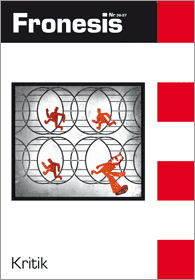
Leila Brännström: In our societies, critical thinking is often seen as an ideal. Critical thinking and a critical perspective is, for example, seen as an important skill at all levels of education. The question is, however, what critical thinking and a critical perspective means. How is critical thinking related to the capacity to conduct critique of ideology? Ideology in the sense of conceptions which hold a hegemonic position in society, which are “engraved” into institutions, and which are upheld by people both in institutionalised contexts and in everyday life.
Anders Johansson: Unfortunately the critical ability – both of ideology and literature – is rather limited today. There is a certain type of commentary, thinking and writing which is both perceived and sees itself as critical thinking, without actually being either critical or thinking (literary critique in which the feelings of the reviewer is understood as the truth, academic research which is only restating an existing doxa, predictable moves in media debates which only confirm current positions).
Critical thinking is by definition dialectical: to critique an object is to split it, to show that what appears to be whole and self-identical is always compound and contradictory. But critical thinking isn't only about seeing an object from a subjective yet critical perspective, but also vice versa: to separate the objective in oneself as well as the subjective in the object, to highlight how the one is always mediated by the other. In other words: on the one hand to realise that my preferences are not just mine, but a product of all possible more or less common circumstances and structures, and on the other hand to trust one's subjective judgement because the “thing-in-itself” is not accessible in any other way.
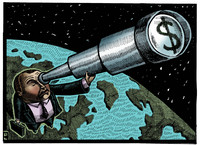
The latest economic data suggests that recession is returning to most advanced economies, with financial markets now reaching levels of stress unseen since the collapse of Lehman Brothers in 2008. The risks of an economic and financial crisis even worse than the previous one – now involving not just the private sector, but also near-insolvent sovereigns – are significant. So, what can be done to minimize the fallout of another economic contraction and prevent a deeper depression and financial meltdown?
First, we must accept that austerity measures, necessary to avoid a fiscal train wreck, have recessionary effects on output. So, if countries in the eurozone’s periphery are forced to undertake fiscal austerity, countries able to provide short-term stimulus should do so and postpone their own austerity efforts. These countries include the United States, the United Kingdom, Germany, the core of the eurozone, and Japan. Infrastructure banks that finance needed public infrastructure should be created as well.
Second, while monetary policy has limited impact when the problems are excessive debt and insolvency rather than illiquidity, credit easing, rather than just quantitative easing, can be helpful. The European Central Bank should reverse its mistaken decision to hike interest rates. More monetary and credit easing is also required for the US Federal Reserve, the Bank of Japan, the Bank of England, and the Swiss National Bank. Inflation will soon be the last problem that central banks will fear, as renewed slack in goods, labor, real estate, and commodity markets feeds disinflationary pressures.
Joshua Hammer in Smithsonian Magazine:

On New Year’s Day 2011, a bomb exploded in the birthplace of the Coptic faith, Alexandria, in front of al-Qiddissin church, the largest of the city’s 60 Coptic churches, as worshipers were leaving midnight Mass. Twenty-one died. “We all rushed into the street and saw the carnage,” said Father Makkar Fawzi, the church’s priest for 24 years. “Those who had gone downstairs ahead of the rest were killed.” Alexandria “has become a focal point of the [Islamic fundamentalists], a breeding ground of violence,” says Youssef Sidhom, the editor of Watani (Homeland), a Coptic newspaper in Cairo.
Since the New Year’s Day bombing, sectarian attacks against Egypt’s Copts have escalated. Forty Egyptians died in 22 incidents in the first half of this year; 15 died in all of 2010. Human rights groups say the breakdown of law and order in the first months after Mubarak’s ouster is partly to blame. Another factor has been the emergence of the ultraconservative Salafist Muslim sect, which had been suppressed during the Mubarak dictatorship. Salafists have called for jihad against the West and the creation of a pure Islamic state in Egypt.
More here.
Benjamin Pauker in Foreign Policy:

Nouriel Roubini: I stopped by. My view of it is that it is a symptom of the economic malaise that we're facing not just in the United States, but all over the world. It started with the Arab Spring, and of course, poverty, unemployment, corruption, inequality eventually leads to people becoming restless. But now, you have middle-class people in Israel saying we cannot afford homes; you have middle-class students in Chile saying we don't have education; you have riots in London; people smashing Mercedes and BMWs of fat cats in Berlin and Frankfurt; you have an anti-corruption movement in India. It takes a lot of different manifestations, but we live in a world with a lot of economic insecurity, of worries about the future, of inequality, poverty, of concerns about jobs. And [Occupy Wall Street] is the manifestation in the U.S.
In 2009, [President Barack] Obama told the bankers, “I'm the only one who's standing between you and the pitchforks.” The bankers got the bailouts; they were supposed to extend credit, extend mortgages. They did pretty much nothing, and they went back to the same actions as before: making money through trading. At this point, I think people are fed up with it. Rightly or wrongly, there's a huge amount of anger.
More here.