Occupy vs Tea Party: What Their Twitter Networks Reveal

Occupy_larger-thumb-600x429-147397Peter Aldhous in New Scientist:

According to some political commentators, Occupy Wall Street is the left's answer to the Tea Party – driven by a similar anger towards elites. But the social networks of people tweeting about the two movements suggest that they have rather different dynamics.

Those tweeting about the Tea Party emerge as a tight-knit “in crowd”, following one another's tweets. By contrast, the network of people tweeting about Occupy consists of a looser series of clusters, in which the output of a few key people is being vigorously retweeted.

The Occupy network also has many casual unconnected tweeters, shown to the bottom right of the diagram below. Whether Occupy takes off as a coherent movement may depend on its success in bringing these potential recruits into the fold.

This view of how the two movements are impacting the Twitterverse comes from Marc Smith of the Social Media Research Foundation in Belmont, California. “These are very differently organised groups,” he says. “Occupy is much more diffuse and diverse.”

Smith has analysed tweets containing “occupywallstreet” or “teaparty”, drawing connections between the Twitter users involved if one follows one other (shown in grey), or if they retweeted, replied or mentioned one another (shown in blue).

The Occupy network above visualises almost 1400 tweets posted in less than 30 minutes on 15 November. The size of each user depends on their number of followers. The clusters, with users shown in different colours, are defined by an algorithm that looks for “islands” after subtracting the influence of people who “bridge” different parts of the network.

Occupy's clusters look like a series of firework explosions, as supporters retweet the posts of a few key individuals and organisations.

Social Networks Matter: Friends Increase the Size of Your Brain

The-Social-NetworkEric Michael Johnson in Scientific American:

In the 1990s the British evolutionary anthropologist Robin Dunbar championed an idea known as the Social Brain Hypothesis. He found that mammals who lived in the largest social groups often had the largest neocortex to brain ratio. Since the neocortex — composed chiefly of gray matter that forms the outermost “rind” of our cantaloupe-sized stuff of thought — is associated with sensory perception and abstract reasoning, Dunbar hypothesized that the demands of group living resulted in a selection pressure that promoted the expansion of neocortical growth.

In 2009 I co-authored a study in the Journal of Human Evolution with colleagues Evan MacLean, Nancy Barrickman, and Christine Wall of Duke University that found no relationship between relative brain size and group size in lemurs (a clade of strepsirrhine primates that last shared a common ancestor with the haplorhine monkeys and apes about 75 million years ago). However, where it comes to these more recently evolved haplorhines, the data is remarkably consistent with Dunbar’s interpretation (see Figure 1 below).

Primates, and humans in particular, are such good social cooperators because we can empathize with others and coordinate our activities to build consensus. It is what also makes us so remarkably deceitful, allowing us to manipulate other members of our group by intentionally making them think we will behave one way when our actual plans are quite different. A successful primate is therefore one who can keep track of these subtle details in behavior and anticipate their potential outcome.

But therein lies a chicken-and-egg problem. How do we know whether it’s the social networks that have promoted an increase in neocortical growth or whether that same expansion of gray matter simply allowed these social networks to expand? A new study published in the November 4th edition of Science addressed this question by housing monkeys in different sized groups to find out if their neocortical gray matter increased as the number of individuals grew.

An Adventure in the Nth Dimension

Brian Hayes in American Scientist:

SphereThe area enclosed by a circle is πr2. The volume inside a sphere is 4/3πr3. These are formulas I learned too early in life. Having committed them to memory as a schoolboy, I ceased to ask questions about their origin or meaning. In particular, it never occurred to me to wonder how the two formulas are related, or whether they could be extended beyond the familiar world of two- and three-dimensional objects to the geometry of higher-dimensional spaces. What’s the volume bounded by a four-dimensional sphere? Is there some master formula that gives the measure of a round object in n dimensions?

Some 50 years after my first exposure to the formulas for area and volume, I have finally had occasion to look into these broader questions. Finding the master formula for n-dimensional volumes was easy; a few minutes with Google and Wikipedia was all it took. But I’ve had many a brow-furrowing moment since then trying to make sense of what the formula is telling me. The relation between volume and dimension is not at all what I expected; indeed, it’s one of the zaniest things I’ve ever come upon in mathematics. I’m appalled to realize that I have passed so much of my life in ignorance of this curious phenomenon. I write about it here in case anyone else also missed school on the day the class learned n-dimensional geometry.

More here.

Has a Harvard Professor Mapped Out the Next Step for Occupy Wall Street?

Lawrence Lessig's call for state-based activism on behalf of a Constitutional Convention could provide the uprooted movement with a political project for winter.

Alesh Houdek in The Atlantic:

ScreenHunter_05 Nov. 17 13.28The banking system that's brought us the current crisis remains in power, barely chastened. “Why?” ask the Occupy Wall Street protesters.

Lawrence Lessig has an answer. In his new book, Republic, Lost: How Money Corrupts Congress — and a Plan to Stop It, he spends 20 pages reviewing the the 30 years of deregulation that led up to the financial crisis and outlining our present circumstances. In fact, this book, published just before Occupy Wall Street began, is perfectly positioned to become the movement's handbook. While few protesters will need convincing that the government is corrupted by money, the book lays out the case in a such a comprehensive and persuasive manner — and proposes such specific and radical solutions — that it seems tailor-made for the Occupy movement. And it's ambitious proposal for state-based activism on behalf of a Constitutional Convention could provide the movement with a next organizing step as it nears its two-month anniversary Thursday — and faces such questions as how to ride out the winter and how to respond to police crackdowns.

Lessig, director of the Edmond J. Safra Foundation Center for Ethics at Harvard University and a professor at Harvard Law School, spent 10 years fighting to reform the nation's copyright laws. The effort produced a half-dozen books, led to the creation of the Creative Commons licensing system and a case before the Supreme Court, which ultimately failed. Rather than dissuading him, Lessig concluded four years ago that this failure perfectly situated him to take on an infinitely harder challenge — the reform of Congress itself. The shift in focus led him to leave Stanford University and relocate his family to the east coast to teach at Harvard in 2008, where he began the research and activity that gave rise to his latest book.

More here.

Female Comedians, Breaking the Taste-Taboo Ceiling

From The New York Times:

Sarah-silverman-5_20110817195141In a Rolling Stone interview from 1979, Johnny Carson, host of “Tonight” and the most important gatekeeper in comedy for decades, gave his take on female comics. “The ones that try sometimes are a little aggressive for my taste,” he said. “I’ll take it from a guy, but from women, sometimes, it just doesn’t fit too well.” That attitude is certainly durable — see Christopher Hitchens’s uncharacteristically dumb 2007 column for Vanity Fair, “Why Women Aren’t Funny” — but it no longer holds sway. Comics like Joan Rivers, Roseanne Barr and Sandra Bernhard were trailblazers, but if you had to pinpoint one joke as a breakthrough for this new generation of female comedians, it might be this one: “I was raped by a doctor, which is so bittersweet for a Jewish girl.” When I saw Sarah Silverman deliver that signature one-liner in a downtown theater almost a decade ago, the audience exploded with laughter followed by groans. Then came the anxious chuckles whose subtext seemed to be: I can’t believe I laughed at that joke.

Jump-comedy-2-popupBlond and bubbly, Ms. Schumer is always light, even when saying dark things. Her performance is also more mannered, with gestural and verbal tics that make her stupendously realized onstage character more obviously a creation. (“Right?” often sets up the punch line, while “um” fills the time as the laughter dies down.) Her flamboyance has a distancing effect, yet she slyly baits the audience. She begins one of her most dependable jokes by triumphantly announcing that she slept with her “high school crush.” While this could come off like a boast, her sugary delivery makes it sound like a heartwarming dream come true, albeit over a decade late. Then Ms. Schumer gooses the crowd — “right?” she shouts, earning applause. Pause: “But now he expects me to go to his graduation.” The line between good and bad taste moves so quickly these days that a provocateur must be nimble, constantly looking to raise the ante. So at two recent performances Ms. Schumer added a second punch line, delivered with a catty sigh: “Like I know what I’m going to be doing in three years.”

More here.

for the love of cinema, hit him hard

StoryBigImageWNGERCWDhishum-Dhishum_big

SOMEWHERE IN THE SUN-DAPPLED greenery of the Shomali plains, an hour’s drive out of Kabul, Salim Shaheen stands ankle deep in mud, urging on two men in a shallow stream who are locked in a grim clench. “Fight you guys, fight,” he urges, in a voice that is almost painfully hoarse, but carries further than a megaphone. The blows rain down as Shaheen builds up to a crescendo. “I implore you, for the love of cinema, hit him hard, hard, hit him like an Afghan, man, not a sissy foreigner.” Finally, with a thumping punch to the jaw, the actor flips his costar into the water with a dramatic and almighty splash that soaks most of the production team huddled around them, and nearly wets the camera. The crew and the watching crowd break into applause, and Shaheen wades into the water to exclaim over and examine the punched face. “See how beautiful it looks, behenji,” he yells out to me on the other side of the stream in that ill-used voice, “swelling up for real. Not like in Mumbai where they only pretend to hit each other. Watch how we make films in Afghanistan.” This last line is something of a recurring theme in conversations with Salim Shaheen, one of Afghanistan’s leading heroes, directors and producers. Portly, bombastic and with enough energy to run a small power station, Shaheen seems at first glance an unlikely candidate for Afghanistan’s poster boy. But for an entire generation of Afghans who watched his blood-soaked, action-packed movies, he is the quintessential dhishum-dhishum hero; the hyperbolic, gun-toting, fist-smashing, song-singing hero who gets the girl and pulps the villain—all in the best traditions of masala Hindi movies from the 1970s and 1980s.

more from Taran N Khan at The Caravan here.

Study shows left side of brain more active in immoral thinking

From PhysOrg:

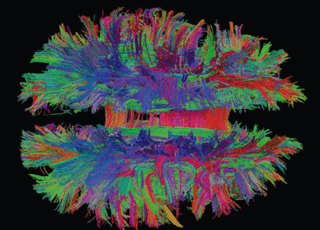
BrainBecause the brain is so complex, researchers are forced to devise all manner of different types of tests in trying to understand not just how it works, but which parts of it do what. To that end, a diverse group of scientists from several universities across the U.S. got together to work on the problem of which parts of the brain, if any specifically, are involved in analyzing and making moral judgments. To find out, or at least learn more, they devised three experiments meant to test the busyness of the brain, measured by blood flow, to certain regions, when presented with immoral situations. They have published the results of what they found in the journal Frontiers in Evolutionary Neuroscience.

The idea behind all three experiments was to present volunteers with material that is generally believed to be immoral while watching blood flow patterns in their brains using fMRI, as compared to what happens when moral or neutral material is viewed. In the first study, volunteers were told that they would be engaging in a memory test. They were then shown a series of statements, followed by another series of statements after that. During the second series they were asked to press a button to indicate if the statement they were being shown had been among those shown in the first series. The statements shown were divided into four classes: pathogen related (non-sexually gross stuff), incestuous acts, nonsexual immoral acts and neutral acts. In the second study, volunteers were shown three types of statements in random order: 50 examples describing acts that most people think of as immoral, 50 statements that most think of as pro-moral (morally good) and 50 statements that most people think of as neutral. And finally, in the third study, volunteers were shown three types of pictures in random order: immoral, non-moral (negative without morality), and neutral. After analyzing and normalizing the data, the researchers found that the left hemisphere of the brain showed increased blood flow in response to immoral stimuli throughout all three studies, while the right did not.

More here.

island troubles

Sutherland_223375k

Stevenson, as has been said, was disarmingly candid about the material he borrowed for Treasure Island. One name, however, is missing from the extensive catalogue of self-confessed “plagiarisms”. That one missing name was brought to public attention by Robert Leighton (1858–1934). Later in life a respected novelist and literary editor of the Daily Mail, Leighton was, in 1881, an assistant editor to James Henderson on Young Folks. Writing in the Academy in March 1900, Leighton recalled that early in 1881 – sometime, allegedly, before late August – James Henderson had offered to consider a story from Stevenson and, “as indicating the kind of story he desired for Young Folks, he gave to Stevenson copies of the paper containing a serial by Charles E. Pearce, entitled Billy Bo’swain”. Pearce’s novel, as Leighton notes, had a chart and buried treasure: “its whole plan and construct were similar”. Leighton’s version wholly contradicts the received view that the story originated, entirely, at Braemar, within the family, with the famous map drawn up at Lloyd’s easel, and no thought of the London market. From what he knew, Leighton maintained that “I have always believed that Stevenson wrote Treasure Island with an eye on Young Folks”. It was conceived not as family entertainment, but as a product to be sold in the literary marketplace. Leighton’s bombshell was thrown after Stevenson’s death and after “My First Book” had recorded a radically more romantic account of Treasure Island’s genesis.

more from John Sutherland at the TLS here.

mengele’s skull

Keenan_weizman_front

Modern human rights forensics began in Argentina with the victims, and in Brazil with the perpetrator. And it began with the same question asked of the bones: “Who are you?” Like testimony, forensics has political, ethical, and aesthetic manifestations. The emergence of a forensics aesthetics—marked for us most clearly by Helmer’s video presentation in São Paulo—signals a shift in emphasis from the living to the dead, from subject to object, in the aftermath of atrocity and the pursuit of human rights. But just as the survivors of the camps required the space of the trial itself to emerge as witnesses, and in a real sense emerged as such in the very act of speaking, so too things do not simply come with their agency already fully operational. A forum, which in this case was a scientific-aesthetic space, and all the techniques of presentation (of making-evident) that come with it, is required for facts to be debated. If things have begun to speak in the context of war-crimes investigation and human rights, it is not simply that we have acquired better listening skills, or that the forums of discussion have been liberally enlarged. The very entry of bones and other things into these forums has changed the meanings and the practices of discussion themselves. In fact, the entry of non-humans into the field of human rights has transformed it.

more from Thomas Keenan and Eyal Weizman at Cabinet here.

Wednesday, November 16, 2011

The Naked Derivative Exposures of Banks to Sovereigns

Euro_logo_plus_characterLisa Pollack on the Euro crisis in the FT's Alphaville (image from Wikimedia commons):

As spreads of all colours blow out due to the perpetually unresolved sovereign crisis in Europe, FT Alphaville has been wondering what non-fundamental factors are driving these moves. The bond market is in some places broken and in other places potentially being driven by regulation.

To the extent that the market for credit default swaps influences the bond market, we ponder the technicals of these derivatives that reference it. Here we look at the role played by trades directly between banks and sovereigns.

The sovereign CDS feedback loop

Previously we had concluded that the counterparty risk management (i.e. “CVA” desks) at banks serve to push CDS spreads ever wider as spread-widening is taken to mean increased riskiness of a sovereign (as a counterparty to a trade with a bank), leading to buying pressure on sovereign CDS as the bank hedges itself against the sovereign, leading to spreads widening out further and so on. Basel III, when it kicks in, is only going to bake this in further as volatility serves as an input to the CVA recipe too.

So are sovereigns big counterparties to banks? If so, are banks in-the-money or out-of-the-money to them?

Nature is the 99%, too

The economy is built on the idea of relentless growth, which is an environmental and health disaster for all but the 1%.

Chip Ward at Al Jazeera:

ScreenHunter_04 Nov. 16 15.38What if rising sea levels are yet another measure of inequality? What if the degradation of our planet's life-support systems – its atmosphere, oceans and biosphere – goes hand in hand with the accumulation of wealth, power and control by that corrupt and greedy 1 per cent we are hearing about from Zuccotti Park? What if the assault on America's middle class and the assault on the environment are one and the same?

It's not hard for me to understand how environmental quality and economic inequality came to be joined at the hip. In all my years as a grassroots organiser dealing with the tragic impact of degraded environments on public health, it was always the same: Someone got rich and someone got sick.

In the struggles that I was involved in to curb polluters and safeguard public health, those who wanted curbs, accountability and precautions were always outspent several times over by those who wanted no restrictions on their effluents.

We dug into our own pockets for postage money, they had expense accounts. We made flyers to slip under the windshield wipers of parked cars, they bought ads on television. We took time off from jobs to visit legislators, only to discover that they had gone to lunch with fulltime lobbyists.

More here.

Salman Khan: The New Andrew Carnegie?

Annie Murphy Paul in Time:

Aaauntitled-1Khan is the former hedge fund manager who set out to tutor his young cousin in math with a homemade video he posted online. From that modest beginning has grown the Khan Academy, a free online library of more than 2,700 videos offering instruction in everything from algebra to computer science to art history. Running the nonprofit academy is now Khan’s full-time job, and he plans to expand the enterprise further, adding more subject areas, more faculty members (until now, all the videos have been narrated by Khan himself) and translating the tutorials into the world’s most widely used languages.

Much attention has been paid to the use of Khan Academy videos in classrooms. Hundreds of schools across the U.S. have integrated his lessons into their curricula, often using them to “flip” the classroom: students watch the videos at home in the evening, then work on problem sets — what would once have been homework — in class, where there are teachers to help and peers to interact with. The approach is promising, and it may well change the way American students are taught.

The real revolution represented by Khan Academy, however, has gone mostly unremarked upon. The new availability of sophisticated knowledge, produced by a trusted source and presented in an accessible fashion, promises to usher in a new golden age of the autodidact: the self-taught man or woman. Not just the Khan Academy, but also the nation’s top colleges and universities are giving away learning online. Khan’s alma mater, MIT, has made more than 2,000 of its courses available gratis on the Internet. Harvard, Yale, Berkeley, Johns Hopkins and Carnegie Mellon are among the other elite institutions offering such free education.

More here.

Want to be a Kindle millionaire?

From The Independent:

AmandahockingThis week, an unknown American author called Amanda Hocking joins an elite literary club alongside just 11 others – including Stieg Larsson, James Patterson and Nora Roberts – by racking up her millionth Kindle sale. Unknown is of course a relative term in this case – no one can shift that many books by remaining anonymous – but Hocking is unusual because she has sold all her books on Kindle. Entirely self-published, her first physical book doesn't reach traditional bookshops until January 2012.

A 27-year-old Star Wars fan from Minnesota, Hocking writes so-called “paranormal romances” for young adults, and is being hailed as the new Stephenie Meyer. Since March 2010, she has uploaded no fewer than 10 books onto Kindle, all of them about vampires and trolls and zombies, all playing out like sagas that mandatorily require multiple sequels. Why trolls? “They kind of freaked me out at first,” she admits, “but I didn't want to write about fairies. I don't really like fairies.” It was when she discovered, during her research, that they could sometimes be attractive, that she had her lightbulb moment. “They're not so common, and I thought, no one else is doing this. Let's go for it.” Each book takes between two and four weeks to write, and she sells them for between 99 cents and $2.99. In the past 18 months, she has grossed approximately $2 million.

More here.

Q and A with Alan Alda on Marie Curie

From Smithsonian:

Alan-Alda-Marie-Curie-Radiance-631What got you interested in Marie Curie?

What got me interested was that this part of her life is such a dramatic story. But what kept me interested and what kept me going for the four years I’ve been working on the play was her amazing ability not to let anything stop her. The more I learn, the more I realize what she had to struggle against, and she has become my hero because of that. For most of my life, I couldn’t say I had any heroes—I never really came across somebody like this who was so remarkable in her ability to keep going no matter what. It really had an effect on me.

How did you decide to write a play about her life?

I started out thinking it would be interesting to have a reading of her letters at the World Science Festival in New York, which I help put on every year. Then, I found out that the letters were radioactive—they are all collected in a library in Paris and you have to sign a waiver that you realize you’re handling radioactive material. I just wasn’t brave enough to do it. So [in 2008] I put together a nice one-act play about Einstein. But I became so interested in researching Curie that I really wanted to write about her in a full-length play.

What part of her life does the play focus on?

You could write three or four plays or movies about different parts of her life, but Radiance focuses on the time between the Nobel Prizes, 1903 to 1911. When she won her first Nobel Prize, they not only didn’t want to give it to her, but once they relented and decided to award her the prize along with Pierre Curie and Henri Becquerel, they wouldn’t let her get up on stage to receive it. She had to sit in the audience while Pierre got up to receive it for the both of them. It’s hard to believe.

More here.

Man On A Mission: Grow The World’s Hottest Chili Pepper

Eliza Barclay at NPR:

ScreenHunter_03 Nov. 16 10.48Look out, heat fiends. A chili pepper so outrageously hot that it makes 2 in 3 people who eat it throw up is about to hit online stores.

“Your heart will race, you'll sweat. You might shake, you might throw up. But once it gets into your blood stream and gets into your brain the capsaicin releases the same endorphins that narcotics do. So you get a euphoric feeling.”

That's how Ed Currie of Rock Hill, S.C., described the effects of the chili he grew to reporter Marshall Terry of NPR member station WFAE. Currie, an amateur chili expert who works at a bank by day, aspires to break the Guinness World Record for the world's hottest chili.

Currie's prized HP22B pepper is just the latest achievement in the increasingly competitive world of fire and spice — from hot sauces to raw chilis.

Demonstrating his fearlessness as a reporter, Terry not only visited Currie's home to check out his 1,400 chile plants, he also tried the HP22B himself. The results are not so pretty, but you can see them in a video they made…

More here. [Thanks to Samina Raza. Robin, get a hold of some of these.]

Wednesday Poem

Despair
.
So much gloom and doubt in our poetry –
flowers wilting on the table,
the self regarding itself in a watery mirror.
Dead leaves cover the ground,
the wind moans in the chimney,
and the tendrils of the yew tree inch toward the coffin.
I wonder what the ancient Chinese poets
would make of all this,
the shadows and empty cupboards?
Today, with the sun blazing in the trees,
my thoughts turn to the great
tenth-century celebrators of experience,
Wa-Hoo, whose delight in the smallest things
could hardly be restrained,
and to his joyous counterpart in the western provinces,
Ye-Hah.

.

by Billy Collins
from Ballistics

the crackdown

Image

Last night, in what seems to be part of a coordinated crackdown on occupations across the country, Zuccotti Park was raided. Thousands of us who had subscribed to the text alert system, or who got emails or phone calls or panicked Twitter messages, went to Wall Street. But we could not get near the camp. Two blocks south of Liberty Plaza on Broadway, blocked by a police barricade that circled the whole area, I found myself part of a small crowd straining to see what was happening. In the distance, Zuccotti Park was lit like a sports field, glaring eerily, and I could make out a loud speaker, blasting announcements and threats. Sounds of people chanting and screaming floated towards us. While we paced the street, seething and sorrowful, tents were trampled, people’s possessions piled up, and occupiers arrested. Later I would come across a camper I had met earlier in the day sobbing on the sidewalk. A few blocks west, maybe thirty minutes after I arrived, the police line broke so two huge dump trucks could pass through. So that was it: we, and everything we had made and were trying to make, were trash. The authorities must be ashamed, because they so badly did not want anyone to see what happened last night. First they attacked the senses, flooding the park with bright light and using sound cannons. Then they corralled the press into pens, arrested reporters, and shut down airspace over lower Manhattan, so that no news stations could broadcast from above.

more from Astra Taylor at n+1 here.