
Category: Recommended Reading
Homeward Bound: The Rise of Multigenerational and One-Person Households
From The New York Times:
It’s not funny, I know, but it’s not the punch line, either. That comes when the two sociologists I have in mind — Katherine S. Newman of Johns Hopkins University, the author of “The Accordion Family,” and Eric Klinenberg of New York University, the author of “Going Solo” — conclude their fascinating studies with a nod each to the bartender. Except by then they’re no longer in a bar; they’re in Sweden. We’ll get to that. First let’s look at those so-called accordion families, which Newman evaluates both as a transnational phenomenon and in the nuanced particulars of individual households. Like Klinenberg, she devotes a good portion of her book to personal interviews, but where Klinenberg goes deep in his emphasis on the United States, Newman goes wide. At the extreme end of her analysis is a country like Italy, where 37 percent of 30-year-old men live with their parents, and have never lived anywhere else. Less striking but certainly notable is a parallel trend in the United States, where a higher proportion of adult children now live with parents than at any time since the 1950s. Newman states her thesis plainly: “Global competition is the most profound structural force affecting the residential location of young adults in the developed world (or the underdeveloped world, for that matter)” — but one is impressed by her refusal to turn thesis into dogma.
More here.
Words from the dictionary of American Regional English
From Smithsonian:

…Some DARE words hint at long-lost social occasions. At a “waistline party,” mentioned in African-American circles, the price of admission corresponded to a reveler’s girth; at a “toe social,” a mid-20th- century term, women draped in sheets were picked as partners on the basis of their feet. (Presumably they then danced together uninhibitedly, or “fooped.”) We can hear echoes of how men and women spoke to, or about, each other. In the 1950s, a man from the Ozarks might say his pregnant wife was “teemin’” or “with squirrel”—but not if she was around to hear him.
Picture: Almost a whole page of the Dictionary of American Regional English is dedicated to “wampus,” a Southern term for a variety of real creatures, such as a wild horse, and imagined ones, such as swamp wampuses and whistling wampuses.
More here.
Saturday Poem
Toba 1
.
I have nothing to write about
My flesh is bared to the sun
My wife is beautiful
My children are healthy
Let me tell you the truth
I am not a poet
I just pretend to be one
I was created, and left here
Look, the sun cascades among the boulders
making the sea look darker
Other than this quiet at the height of the day
I have nothing I want to tell you about
even if you are bleeding in your country
Ah, this everlasting radiance!
by Shuntaro Tanikawa
from Tabi (Journey)
publisher: Kyuryudo, Tokyo, 1968
translation: Takako Lento, 2011
Original Japanese after the jump
Friday, March 2, 2012
Six ways that Congress could fix copyright, now
Matthew Lasar in Ars Technica:

The fight against copyright maximalism has largely been negative. To offer something more positive, Public Knowledge (PK for short) has released an Internet Blueprint—six bills that the group says could “help make the internet a better place for everyone” and that “Congress could pass today.”
We're not expecting Congress to pass them today (or tomorrow), but they're at least an intriguing start point for debate. Here's a quick version each.
Shorten copyright terms
The current copyright protection time window is quite large: life of the creator plus a whopping 70 years (or 95 years total for corporate authorship). It's hard to believe that when the Republic was young, copyright lasted 14 years, renewable by another 14.
“Continually expanding the term of copyright comes at a cost,” the new Blueprint contends. “By giving an author a monopoly on an expression, it prevents other people from building on that expression to create new works.”
The Public Knowledge reform proposal isn't particularly radical, though—it would reduce most copyright terms to life of the author plus 50 years, or “a flat 50 years if the author was an employee.”
More here.
What is to be wished for in the way of life in community?
Marilynne Robinson in Guernica:

Of course we have not realized anything approaching this ideal. The meaning of it is much disputed—does it mean equality of opportunity or equality of outcome? Frankly, if we were to achieve either we might find that it resembled the other nearly enough to make the question moot. In any case, our failures, real and perceived, sometimes manifest as an anger with the project itself, and this distracts attention from the fact that we have made a very interesting experiment, full of implication, in putting aside traditional definitions and expectations and finding that when they are not supported culturally, which is to say artificially, they tend to fade away. We can learn from our own history that the nature of our species, and our nature as individuals, is an open question.
More here.
A speech-jamming gun capable of stopping speakers in mid-sentence
From MIT's Technology Review:
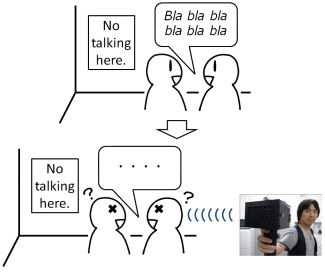
Kurihara and Tsukada have simply built a handheld device consisting of a microphone and a speaker that does just that: it records a person's voice and replays it to them with a delay of about 0.2 seconds. The microphone and speaker are directional so the device can be aimed at a speaker from a distance, like a gun.
In tests, Kurihara and Tsukada say their speech jamming gun works well: “The system can disturb remote people's speech without any physical discomfort.”
Their tests also identify some curious phenomena. They say the gun is more effective when the delay varies in time and more effective against speech that involves reading aloud than against spontaneous monologue. Sadly, they report that it has no effect on meaningless sound sequences such as “aaaaarghhh”.
More here.
Portraits of the Artist: The Work of Carl Köhler
Emily Colette Wilkinson in The Millions:

But this, perhaps, is changing. Thanks to the efforts of his son, Henry, Köhler’s work has made its way outside of Sweden for the first time. If you live in New York, you might have seen “Beyond the Words: The Author Portraits of Carl Köhler” at the Brooklyn Central Library this past winter and spring, or the write-up in The New York Times’ blog Paper Cuts. The show was also briefly at the Martin Luther King Jr. Library, in Washington, D.C., in July and August. Now, this exhibit is on its way to Canada: Its next stop is the Robarts Library at the University of Toronto (January-March 2010). After that, the show’s on to the University of British Columbia’s Irving K. Barber Learning Centre in Vancouver (April-June/July 2010). With any luck, these shows will not be the last.
While Köhler’s figure drawings from his time in Paris in the 1950′s are remarkable, as are his abstract figural paintings, it is what he called his “authorportraits,” his paintings of European and American writers, intellectuals, and popular artists that I am most taken with—as much for their content as for their formal diversity. These portraits comprise an astonishing variety of media and styles, a variety that reflects the variety of Köhler’s subjects, who included James Joyce, Günter Grass, Joyce Carol Oats, Michael Jackson, Simone de Beauvoir, and Fyodor Dostoyevsky, among many others.
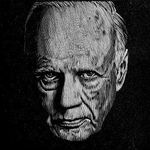
More here. [Photo shows portrait of Franz Kafka.]
Writing Karachi
Bina Shah, H. M. Naqvi, Maniza Naqvi, and Mohammed Hanif:
Beautiful bookshelves – in pictures
From Guardian:

Equilibrium
Colombia-born Alejandro Gomez Stubbs, the designer of Equilibrium, says 'The concept was to design a piece that contrasted stylish modern design with playfulness and animation'
More here.
Friday Poem
June 16
It's Bloomsday in Dublin
and wherever Ulysses works
as an advertizing man
with an unfaithful wife
as I sit here listening
to a lecture on Flannery
O'Conner, Frank O'Conner
and Frank, I think of going
to Dublin with you and buying
a toy wedding ring at
Woolworth's and the phrase
'mock funeral' comes
to me I don't know what it
means though I remember being
the groom at a mock wedding
with a girl named Ann in 1956
I was eight and so was she
and all the other children
were in the procession it was
the first hot night in June and
yes she said yes I will yes
by David Lehman
Fetus donates stem cells to heal mother’s heart
From New Scientist:

“The study is the first to show conclusively that fetal cells contained in the placenta assist in cardiac tissue repair,” says Jakub Tolar, director of stem-cell therapies at the University of Minnesota in Minneapolis.
More here. (Congratulations to dear friend Hina on her groundbreaking work.)
Santorum’s Arrested Development

Santorum says that 62 percent of people who go to college lose their “faith commitment” there. (Odd, isn’t it, how even people who believe in the old values have to flop back on social-science talk—“faith commitment” for plain religion?) Some have questioned those statistics, which come from a 2007 report that found even greater decline among those who don’t attend college. I do not know how one measures such things, but I think it inevitable that questioning of childhood beliefs should take place at various stages of adolescence. This does not happen in junior year or senior year on campus. It is part of a long process called growing up. At some point, late or early, children disengage themselves from the stories crafted for them. Their loss of belief in the tooth fairy is only slightly behind their loss of teeth. There is a slow motion race to disappear between Santa Claus and the Easter Bunny. The Stork undergoes, for some, a lengthier demise—and “the birds and the bees” do not long outlast it. Others, I hope, soon disabuse themselves of belief in their parents’ infallibility. Certain religious myths are discarded without necessarily losing faith. That I do not believe in Noah’s Ark does not mean that I must stop believing in God—though certain home schooling parents force that connection on their kids.
more from Garry Wills at the NYRB here.
the moviegoer
Percy’s medical career was cut short in 1942, when he contracted tuberculosis six months into an internship at Bellevue Hospital. He spent the next two years recovering in a sanatorium in the Adirondacks, observant and restless as ever but largely confined to bed. While both his brothers and his best friend were serving their country honorably, he was flat on his back, dramatically detached from action of any kind. Percy had always been somewhat reserved — unsurprising for a boy who had sustained such huge losses so early. In the hospital, cut off from friends and family and any feeling of connection to world events, he turned further inward, and, as always, found escape in books. Rather than medical texts, though, Percy picked up Kierkegaard and Dostoyevsky, and then Camus, Sartre, Thomas Mann, Kafka, and Tolstoy. The answers he was seeking, he realized, were not necessarily to be found in science, and the questions he was forming were new as well. As he would later explain in an essay titled “From Facts to Fiction” in his collection Signposts in a Strange Land, What began to interest me was not so much a different question as a larger question, not the physiological and pathological processes within man’s body but the problem of man himself, the nature and destiny of man; specifically and more immediately, the predicament of man in a modern technological society.
more from Lisa Peet at The Millions here.
Thursday, March 1, 2012
Nuclear Weapons on a Highway Near You
Adam Weinstein in Mother Jones:

That's the way the Office of Secure Transportation (OST) wants it. At a cost of $250 million a year, nearly 600 couriers employed by this secretive agency within the US Department of Energy use some of the nation's busiest roads to move America's radioactive material wherever it needs to go—from a variety of labs, reactors and military bases, to the nation's Pantex bomb-assembly plant in Amarillo, Texas, to the Savannah River facility. Most of the shipments are bombs or weapon components; some are radioactive metals for research or fuel for Navy ships and submarines. The shipments are on the move about once a week.
The OST's operations are an open secret, and much about them can be gleaned from unclassified sources in the public domain. Yet hiding nukes in plain sight, and rolling them through major metropolises like Atlanta, Denver, and LA, raises a slew of security and environmental concerns, from theft to terrorist attack to radioactive spills. “Any time you put nuclear weapons and materials on the highway, you create security risks,” says Tom Clements, a nuclear security watchdog for the nonprofit environmental group Friends of the Earth.
More here.
Israelis flock to see film produced by arch-foe, Iran
Daniella Cheslow in First Post:
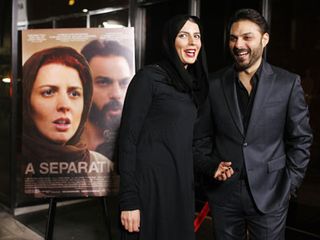
A Separation, a domestic drama directed by Iranian Asghar Farhadi, bested an Israeli rival and three others to win the award for best foreign film.
Israelis were rooting hard for their own Oscar contender, Joseph Cedar’s Footnote, a Talmudic scholar saga. But their interest in A Separation was piqued by the rare glimpse it offered into the living rooms of a country they regard as a threat to their very survival.
“It’s very well acted, exceptionally well-written and very moving,” said Yair Raveh, film critic for Israel’s leading entertainment magazine, Pnai Plus. “Ultimately you don’t think about nuclear bombs or dictators threatening world peace. You see them driving cars and going to movies and they look exactly like us.”
Israel, like the West, accuses Iran of using its nuclear programme as a cover to build bombs, and is afraid they would be turned against the Jewish state. Tehran insists it is producing energy, not weapons.
A Separation takes viewers far away from the nuclear showdown, chronicling the drama of an Iranian woman who wants to divorce her husband because he refuses to move abroad with her, preferring to stay behind to tend to his ailing father.
More here.
Hamza Tzortzis and Pervez Hoodbhoy Debate Religion & Rationality
Pervez Hoodbhoy explains the background of these videos in an email thus:
Tzortzis (Greek, lives in London) converted to Islam and is now hugely popular among young people brimming with faith…The man is a real entertainer. I had no idea who he was…some students at LUMS [Paksitan's Lahore University of Management Sciences] asked me to debate him. I agreed. The Islamic society here flew him in at a few hours notice.
Unfortunately, the debate ended badly. This was the only challenge Tzortzis received at a Pakistani university.
The second video is Pervez commenting on what happens at the end of the first video.
Cato of the Antipodes
John Cotter in Open Letters Monthly:
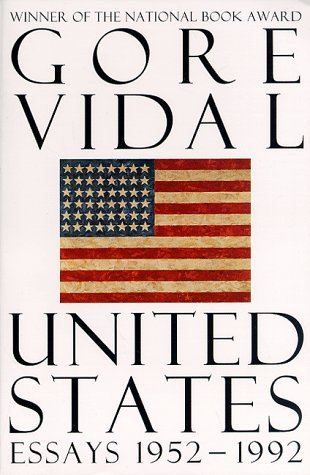
Atypically for a critic of the 20th century, Gore Vidal does not subordinate his perceptions to any school or ideology. This is why he can be trusted. For models, he looks to the worldly, progressive belletrists of the late 19th and early 20th century: Henry James, William Dean Howells, Henry Adams. Note the absence of their immediate predecessors: Hawthorne, Melville, Emerson. Vidal is not a romantic—his mind is empirical. Though he reads with a sympathetic eye, his judgments are sonorous with authority.
Though he often writes of politics, he is a critic and a satirist rather than a pundit, and much of even this work comes by way of book reviewing. “I start from the premise that the creator is ‘right,’” he notes, in the introduction to his second collection of essays, Reflections Upon a Sinking Ship. “I try to inhabit his work, to enjoy it, to be—very simply—had by the artist. Only later does one attempt to answer the question: to what extent has the maker of the world accomplished what he set out to do?” Mark that try. Vidal is a natural skeptic, and one of the pleasures of his criticism is the extent to which he refuses to be had by certain writers, try as they might. He claims to feel no pinch of sadism, and though his dismissive aperçus are rightly famous (on John Barth: “This isn’t bad, except as prose”; on Theodore Roosevelt: “Give a sissy a gun and he will kill everything in sight”), I don’t want to go on quoting them here, because they fill up space all too often in newspaper profiles and what Martin Amis calls the “shithead factfile” that precedes interviews. Isolated, these blow-gun darts of observation shock and amuse, yes, but they also diminish the author, show him only as a drawing-room wit and not the serious reader and thinker that, on more thorough perusal, he reveals himself to be.
More here.
3QD Arts & Literature Prize 2012: Voting Round Is Now Open

The period for nominating entries for the 3QD Arts & Literature Prize is over.
To browse the full list of the nominees and then vote, go here.
Good luck to all! The voting round closes on Tuesday, March 6, 2012, at 11:59 pm NYC time.
3 Quarks Daily 2012 Arts & Literature Prize: Vote Here
Dear Reader,
Thanks very much for participating in our contest. For details of the prize you can look at the announcement here, and to read the nominated posts you can go here for a complete list with links.
If you are new to 3 Quarks Daily, we welcome you and invite you to look around the site after you vote. Learn more about who we are and what we do here, and do check out the full site here. Bookmark us and come back regularly, or sign up for the RSS feed. If you have a blog or website, and like what you see here, we would very much appreciate being added to your blogroll. Please don’t forget!
Results of the voting round (the top twenty most voted for posts) will be posted on the main page on March 7, 2012. Winners of the contest will be announced on March 19, 2012.
Now go ahead and submit your vote below!
PLEASE BE AWARE: We have multiple ways of detecting fraud such as multiple votes being cast by the same person. We will disqualify anyone attempting to cheat.
Cheers,
Abbas