Uncovering Da Vinci’s rule of the trees

From PhysOrg:

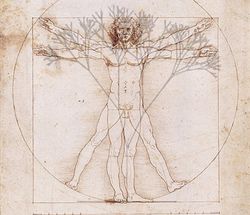
DavinciDa Vinci wrote in his notebook that “all the branches of a tree at every stage of its height when put together are equal in thickness to the trunk.” In other words, if a tree’s branches were folded upward and squeezed together, the tree would look like one big trunk with the same thickness from top to bottom. To investigate why this rule may exist, physicist Christophe Eloy, from the University of Provence in France, designed trees with intricate branching patterns on a computer. “I designed the lightest tree structure to resist wind while still maintaining the strength of the trunk,” said Eloy.

Trees are fractal in nature, meaning that patterns created by the large structures, such as the main branches, repeat themselves in smaller structures, such as smaller branches. Eloy started with a fractal tree skeleton, in which smaller copies of the main branches are repeatedly added together to create the virtual tree. Each new branch takes after its “mother” branch, mimicking the fractal nature of real trees. At this stage, the model tree served merely as a framework for later determining the most effective branch thickness. Once the skeleton was completed, Eloy put it to the test in a virtual wind tunnel. After applying various wind forces needed to break the branches, Eloy determined the diameters for each branch that limited the chance of snapping. Accounting for every part from the smallest twig to the trunk, the simulation seemed to produce Leonardo's rule.

More here.

Mark Twain in Love

From Smithsonian:

Mark-Twain-Laura-Wright-631On an empyreal spring evening in 1858, with the oleander in bloom upriver and early jasmine scenting the wind, the steersman for the Mississippi steamboat Pennsylvania, a bookish 22-year-old named Sam Clemens, guided the massive packet into the docks under the winking gaslights of New Orleans. As the Pennsylvania berthed, Clemens glanced to his side and recognized the adjacent craft, the John J. Roe. Perhaps recalling his many happy assignments steering the Roe, the young apprentice pilot leapt spontaneously onto the freighter’s deck. He was amiably shaking the hands of his former mates when he froze, transfixed by the sight of a slight figure in a white frock and braids: a girl not yet on the cusp of womanhood who would forever after haunt his dreams and shape his literature. Mark Twain’s description, written years later, of the girl as she emerged from the jumble of deckhands, leaves no doubt as to the spell she cast on him. “Now, out of their midst, floating upon my enchanted vision, came that slip of a girl of whom I have spoken…a frank and simple and winsome child who had never been away from home in her life before.” She had, the author continued, “brought with her to these distant regions the freshness and the fragrance of her own prairies.”

The winsome child’s name was Laura Wright. She was only 14, perhaps not quite, on that antebellum May evening, enjoying a river excursion in the care of her uncle, William C. Youngblood, who sometimes piloted the Roe. Her family hailed from Warsaw, Missouri, an inland hamlet some 200 miles west of St. Louis. She surely could never have imagined the import of that excursion. In this centenary year of Mark Twain’s death, it may seem that literary detectives have long since ransacked nearly every aspect of his life and works. Yet Laura Wright remains among the final enigmas associated with him. Only one faded photograph of her is known to exist.

More here.

Sam Harris interviews Daniel Kahneman

Sam Harris in his blog:

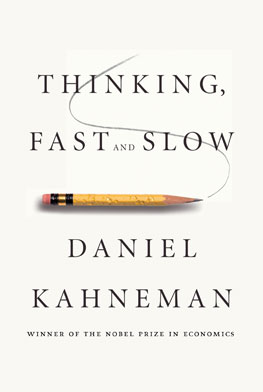
Kahneman_Jacketsmall_Here is what Steven Pinker, my previous interview subject, recently wrote about him:

Daniel Kahneman is among the most influential psychologists in history and certainly the most important psychologist alive today. He has a gift for uncovering remarkable features of the human mind, many of which have become textbook classics and part of the conventional wisdom. His work has reshaped social psychology, cognitive science, the study of reason and of happiness, and behavioral economics, a field that he and his collaborator Amos Tversky helped to launch. The appearance of Thinking, Fast and Slow is a major event.

Kahneman was kind enough to take time out of a very busy book tour to answer a few of my questions.

Much of your work focuses on the limitations of human intuition. Do you have any advice about when people should be especially hesitant to trust their intuitions?

When the stakes are high. We have no reason to expect the quality of intuition to improve with the importance of the problem. Perhaps the contrary: High-stake problems are likely to involve powerful emotions and strong impulses to action. If there is no time to reflect, then intuitively guided action may be better than freezing or paralysis, especially for the experienced decision maker. If there is time to reflect, slowing down is likely to be a good idea. The effort invested in “getting it right” should be commensurate with the importance of the decision.

Are there times when reasoning is suspect and we are wise to rely on our snap judgments?

As Gary Klein has emphasized (Sources of Power is one of my favorite books), true experts—those who have had sufficient practice to detect the regularities of their environment—may do better when they follow their intuition than when they engage in complex analysis. Tim Wilson and his collaborators have demonstrated that people who choose between two decorative objects do better by following their impulse than by protracted analysis of pros and cons. The critical test in that experiment is how much they will like the chosen object after living with it for a while. Affective forecasting based on current feelings appears to be more accurate than systematic analysis that eliminates those feelings.

More here.

What is a “Straw Vulcan”?

From TV Tropes:

SpockVulcanA straw man used to show that emotion is better than logic.

It starts by having characters who think “logically” try to solve a problem. And they can't. Either they can't find any answer, or they're caught in some kind of standoff, or they're even stuck in a Logic Bomb-type loop. Once this is established, someone who uses good old human emotion comes up with a solution that the logical thinker can't. This provides An Aesop that emotion is superior and that the logical thinker shouldn't trust logic so much.

This is, of course, a broken Aesop. Fiction often gets the concept of logic wrong in a number of ways.

The most common mistake is to assume that logic and emotion are somehow naturally opposed and that employing one means you can't have the other. Excluding emotion doesn't make your reasoning logical, however, and it certainly doesn't cause your answer to be automatically true. Likewise, an emotional response doesn't preclude logical thinking — although it may prevent you from thinking in the first place — and if an emotional plan is successful, that doesn't make logic somehow wrong.

Because the author is more concerned with setting up their strawman than in handling logic correctly, they will often misuse and distort the concept to create contrived examples where what they're calling “logic” doesn't work. Common situations include:

  • The Straw Vulcan will only accept a guaranteed success. A plan that only has a chance of success is not “logical”, even if the chance is the highest possible. This is actually a well-known error in logic, called the Perfect Solution Fallacy.
  • The story assumes a “logical” plan is one where every step makes the goal visibly closer, and accepting a short-term disadvantage for a long-term advantage is not “logical”. There's nothing inherently illogical in accepting a short-term set-back if it makes the long-term success more likely.
  • The Straw Vulcan will be completely unable or unwilling to plan for unexpected and even illogical behavior from other parties.

More here.

Thomas Friedman’s metaphorical pile-ups, hollow analyses, and factual inaccuracies

Belén Fernández in Guernica:

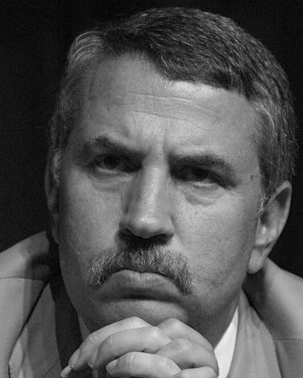
ScreenHunter_02 Dec. 01 10.45Friedman’s writing is characterized by a reduction of complex international phenomena to simplistic rhetoric and theorems that rarely withstand the test of reality. His vacuous but much-publicized “First Law of Petropolitics”—which Friedman devises by plotting a handful of historical incidents on a napkin and which states that the price of oil is inversely related to the pace of freedom—does not even withstand the test of the very Freedom House reports that Friedman invokes as evidence in support of the alleged law. The tendency toward rampant reductionism has become such a Friedman trademark that one finds oneself wondering whether he is not intentionally parodying himself when he introduces “A Theory of Everything” to explain anti-American sentiment in the world and states his hope “that people will write in with comments or catcalls so I can continue to refine [the theory], turn it into a quick book and pay my daughter’s college tuition.”

In the case of Friedman’s musings on the Arab/Muslim world, the reduction process produces decontextualized and often patronizing or blatantly racist generalizations, such as that suicide bombing in Israel indicates a “collective madness” on the part of the Palestinians, whom Friedman has determined it is permissible to refer to collectively as “Ahmed.” Criticism of Israeli crimes is largely restricted to the issue of settlement-building; generalizations about the United States meanwhile often arrive in the form of observations along the lines of: “Is this a great country or what?” This does not mean, however, that the United States is not in perennial danger of descending into decisive non-greatness if it does not abide by Friedman’s diktats on oil dependence and other matters, such as the need to expand U.S. embassy libraries across the globe because “you’d be amazed at how many young people abroad had their first contact with America through an embassy library.”

More here.

Wednesday, November 30, 2011

Addition Is Useless, Multiplication Is King

Sanjoy Mahajan in Freakonomics:
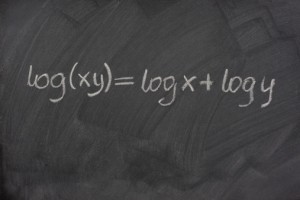
Logs-300x200TIME magazine has been running a series called “Brilliant: The science of smart” by Annie Murphy Paul. The latest column, “Why Guessing Is Undervalued,” quoted several results from research on learning estimation, a topic near to my heart. One result surprised me particularly:

…good estimators possess a clear mental number line — one in which numbers are evenly spaced, or linear, rather than a logarithmic one in which numbers crowd closer together as they get bigger. Most schoolchildren start out with the latter understanding, shedding it as they grow more experienced with numbers.

I do agree that children start out with a logarithmic understanding. I first learned this idea from a wonderful episode of WNYC’s Radio Lab on “Innate numbers” (Nov. 30, 2009). The producers had asked Stanislas Dehaene to discuss his research on innate number perception.

One of his studies involved an Indian tribe in the Amazon. This tribe does not have words for numbers beyond five, and does not have formal teaching of arithmetic. But the members have a sophisticated understanding of numbers. They were given the following problem: on a line with one object at one end, and nine objects at the other end, they were asked, “How many objects would you place directly in the middle of the line?”

What number would you choose?

Twenty years ago I would have chosen five, for five is the average of one and nine: It is larger than one by four, and smaller than nine also by four. Thus, it is halfway on a linear (or additive) number line. Almost all Western students also choose five. However, the members of the Indian tribe chose three. That choice also makes sense, but in a different way: Three is larger than one by a factor of 3, and smaller than nine also by a factor of 3. Thus, three is halfway between one and nine on a multiplicative or logarithmic number line.

Dehaene concludes, and I agree, that our innate perception of numbers is logarithmic (or multiplicative); and that we learn our linear (or additive) scale through our culture.

More here. [Thanks to Annie Murphy Paul.]

The Worst Book Ever Written

Gabe Habash at the Publishers Weekly blog PWxyz:

1qb4hBefore you get all riled up about how we’ve previously called two other books (How to Avoid Huge Ships and Dildo Cay) the Worst Book Ever, you should know that sometimes PWxyz makes mistakes. Please forgive us our mis-pronouncement and come, walk with us down the hallowed halls of literary infamy, for we have a whopper of a book to show you.

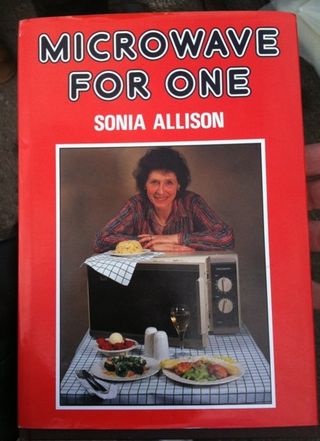
In 1987, The Book Services Ltd published a slim, 144-page cookbook called Microwave for One. The book is by Sonia Allison, who has quite a few publications under her belt. But she’s best known for her masterpiece of tragedy, a book whose title and cover is so rife with sadness that one almost has the urge to brush the invisible tears from Ms. Allison’s face as she leans over her microwave and her food spread.

Very little is known about the contents of the book, except for the few that have been lucky enough to chance upon a copy. Let’s turn to these Amazon customer reviews for some insight.

After the divorce” by Benjamin L. Hamilton

After the divorce my diet consisted primarily of uncooked ramen and whiskey. Occasionally I wondered aloud if I’d ever have another home cooked meal again.

Then I discovered “Microwave for One” and everything changed.

My favorite chapters were:

Chapter 1: Plugging in your Microwave and You

Chapter 4: How to Wait 3 Minutes

Chapter 11 [BONUS CHAPTER]: Eating with Cats

In closing, I give this book 2 thumbs up (and a paw!). Thanks Sonia Allison!

More here. [Thanks to Charles J. Shields.]

the iron lady

Cn_image.size.thatcher

Not long after she resigned as prime minister, in 1990, Margaret Thatcher began to write her memoirs. I met her at a dinner party and asked her what she would call them. The famous blue eyes flashed at me: “Undefeated!” she declared. This expressed a sober arithmetical fact. Uniquely at that time in British politics, Margaret Thatcher had won three general elections in a row as party leader and had never lost any. Before she had the chance to contest her fourth, she was deposed by members of Parliament from her own party in a coup. Yet, even in that contest, the pure numbers were on her side. In 1990, when the Conservative Party staged a challenge to her leadership, she won more legislators’ votes than her main rival, but not enough to avoid a second ballot. Her Cabinet colleagues convinced her that she would be humiliated in the runoff, and she resigned.

more from Charles Moore at Vanity Fair here.

A Jew in the Northwest

Hood98_portland_oregon_mount_hood_12-16-98_med

I was standing, like a good Northwesterner, in the produce section of my locally owned organic-food supermarket—this was a couple of years ago, not long after I had moved to Portland from the New York City area—when I heard a voice in my ear. “Excuse me,” it said. “You’re a Jew, aren’t you?” My sphincter clenched. There were two ways this could go, and neither one was good. Either the guy I could now sense hovering at my elbow was a Lubavitcher, doing outreach among his fallen brethren (drawing them near, in the term of art), or he was a Jew for Jesus, hoping to tell me about the Lord. In the first case, I would sling the brushback pitch that I had learned to keep at hand for such occasions, amply familiar from life in New York. Ma ha’avodah hazose lachem? I would say: What is this worship to you?—the words of the Wicked Son in the Passover story. (“To you,” the Haggadah explains, “and not to him. By excluding himself from the community, he has negated the essential.”) In the second case, I would probably just start screaming and ripping up his pamphlets, as I did to a guy in the subway once. Christian missionaries tend to transform me into a kind of Semitic Incredible Hulk, a ball of ethno-historical rage. (A third possibility, that I’d been teleported back to Poland, circa 1941, and was about to be invited into a cattle car, I discounted as unlikely.)

more from William Deresiewicz at The American Scholar here.

fighting the agreeable ooze

Dwight-macdonald-1

If one were to point out that the wider authority of literary criticism is barely discernible today, one could hardly be accused of courting a controversy or kicking up a fuss. There certainly is a coterie of Americans for whom literature and its criticism is a matter of urgency or livelihood or both, but the notion of the literary critic as a cultural gatekeeper, whose judgments shape tastes and move units, sounds either fanciful or anachronistic, depending on whether you believe that such a creature ever really existed. Our culture is now so big and so varied, the population so diverse and so fragmented, that the very idea of anything or anyone having “wider authority” sounds silly, if not absurd. Masscult and Midcult: Essays Against the American Grain, a selection of Dwight Macdonald’s work from the 1950s and ’60s, includes the kinds of big, critical pronouncements that today would be met with eye rolls of annoyance or, more likely, blank stares of indifference. Macdonald started out as a journalist, and he wrote literary criticism that was as politically informed as it was aesthetically attuned. His voice was cantankerous and opinionated; he provided readers with the larger context as well as the close read. And he wrote much of this biting, caustic criticism for The New Yorker, where he was a staff writer for more than a decade.

more from Jennifer Szalai at The Nation here.

Henry Morton Stanley’s Unbreakable Will

From Smithsonian:

Is willpower a mood that comes and goes? A temperament you’re born with (or not)? A skill you learn? In Willpower: Rediscovering the Greatest Human Strength, Florida State University psychologist Roy F. Baumeister and New York Times journalist John Tierney say willpower is a resource that can be renewed or depleted, protected or wasted. This adaptation from their book views Henry Morton Stanley’s iron determination in the light of social science.

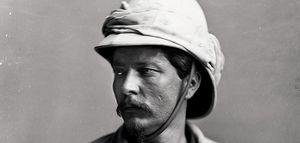
Stanley-1872-631In 1887, Henry Morton Stanley went up the Congo River and inadvertently started a disastrous experiment. This was long after his first journey into Africa, as a journalist for an American newspaper in 1871, when he’d become famous by finding a Scottish missionary and reporting the first words of their encounter: “Dr. Livingstone, I presume?” Now, at age 46, Stanley was leading his third African expedition. As he headed into an uncharted expanse of rain forest, he left part of the expedition behind to await further supplies. The leaders of this Rear Column, who came from some of the most prominent families in Britain, proceeded to become an international disgrace. Those men allowed Africans under their command to perish needlessly from disease and poisonous food. They kidnapped and bought young African women. The British commander of the fort savagely beat and maimed Africans, sometimes ordering men to be shot or flogged almost to death for trivial offenses. While the Rear Column was going berserk, Stanley and the forward portion of the expedition spent months struggling to find a way through the dense Ituri rain forest. They suffered through torrential rains. They were weakened by hunger, crippled by festering sores, incapacitated by malaria and dysentery. They were attacked by natives with poisoned arrows and spears. Of those who started with Stanley on this trek into “darkest Africa,” as he called that sunless expanse of jungle, fewer than one in three emerged with him. Yet Stanley persevered. His European companions marveled at his “strength of will.” Africans called him Bula Matari, Breaker of Rocks. “For myself,” he wrote in an 1890 letter to The Times, “I lay no claim to any exceptional fineness of nature; but I say, beginning life as a rough, ill-educated, impatient man, I have found my schooling in these very African experiences which are now said by some to be in themselves detrimental to European character.

More here.

Bam! How comics teach science

From MSNBC:

ComicCan you really learn relativity from a comic book? The Japanese have been using manga for decades to teach complex subjects, and now Americans are doing it too. No Starch Press, a San Francisco publishing house, puts out a whole line of manga-style books on math and science, picked up from the original Japanese and translated for the American market. Yes, there's a “Manga Guide to Relativity,” as well as calculus, linear algebra, biochemistry and other head-banging subjects. The plot lines may sound sappy to grown-ups. Usually they involve a cute schoolgirl or schoolboy who's challenged by an equally cute teacher to master a seemingly impenetrable subject. But Bill Pollock, the founder and president of No Starch Press, says the books get the job done, especially for students who are at a crucial age for math and science education. “We're not out to publish the best manga ever,” Pollock told me. “The manga is a vehicle.”

Educational comics are nothing new, of course: Classics Illustrated, for example, was delivering comic-book versions of English lit and science class back in the '50s. (I still get the heebie-jeebies when I recall the Classics Illustrated version of “Jane Eyre” that sat in the comic-book box at Grandma's house.) More recently, cartoonist Larry Gonick has been using the comic-book format to explain subjects ranging from chemistry to physics to sex. This year, one of the items on my holiday book list is “Feynman,” a graphic-novel biography of the bongo-playing physicist. But manga books come from a different cultural tradition — the same tradition that spawned Pokemon, Hello Kitty and other Japanese imports that American kids have grown up with. In Japan, there's a manga subgenre (“gakushu manga”) that is completely focused on education. These books, which range around 200 pages in length, are the ones that have been adapted into English-language “manga guides.”

More here.

The Crises of Democratic Capitalism

3050102Wolfgang Streeck in New Left Review:

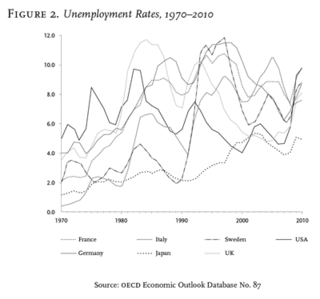
The collapse of the American financial system that occurred in 2008 has since turned into an economic and political crisis of global dimensions. How should this world-shaking event be conceptualized? Mainstream economics has tended to conceive society as governed by a general tendency toward equilibrium, where crises and change are no more than temporary deviations from the steady state of a normally well-integrated system. A sociologist, however, is under no such compunction. Rather than construe our present affliction as a one-off disturbance to a fundamental condition of stability, I will consider the ‘Great Recession’ and the subsequent near-collapse of public finances as a manifestation of a basic underlying tension in the political-economic configuration of advanced-capitalist societies; a tension which makes disequilibrium and instability the rule rather than the exception, and which has found expression in a historical succession of disturbances within the socio-economic order. More specifically, I will argue that the present crisis can only be fully understood in terms of the ongoing, inherently conflictual transformation of the social formation we call ‘democratic capitalism’.

Democratic capitalism was fully established only after the Second World War and then only in the ‘Western’ parts of the world, North America and Western Europe. There it functioned extraordinarily well for the next two decades—so well, in fact, that this period of uninterrupted economic growth still dominates our ideas and expectations of what modern capitalism is, or could and should be. This is in spite of the fact that, in the light of the turbulence that followed, the quarter century immediately after the war should be recognizable as truly exceptional. Indeed I suggest that it is not the trente glorieuses but the series of crises which followed that represents the normal condition of democratic capitalism—a condition ruled by an endemic conflict between capitalist markets and democratic politics, which forcefully reasserted itself when high economic growth came to an end in the 1970s. In what follows I will first discuss the nature of that conflict and then turn to the sequence of political-economic disturbances that it produced, which both preceded and shaped the present global crisis.

Walk-Through-Wall Effect Might Be Possible With Humanmade Object

Sn-tunneling-thumb-200xauto-11637Nathan Collins in Science Now:

If you've ever tried the experiment, you know you can't walk through a wall. But subatomic particles can pull off similar feats through a weird process called quantum tunneling. Now, a team of physicists says that it might just be possible to observe such tunneling with a larger, humanmade object, though others say the proposal faces major challenges.

If successful, the experiment would be a striking advance toward fashioning mechanical systems that behave quantum mechanically. In 2010, physicists took a key first step in that direction by coaxing a tiny object into states of motion that can be described only by quantum mechanics. Tunneling would be an even bigger achievement.

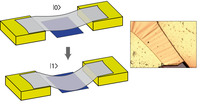
So how does quantum tunneling work? Imagine that an electron, for example, is a marble sitting in one of two depressions separated by a small hill, which represent the effects of a sculpted electric field. To cross the hill from one depression to the other, the marble needs to roll with enough energy. If it has too little energy, then classical physics predicts it can never reach the top of the hill and cross over it.

Tiny particles such as electrons, however, can still make it across even if they don't have enough energy to climb the hill. Quantum physics describes such particles as extended waves of probability—and it turns out that there is a probability that one of them will “tunnel” through the hill and suddenly materialize in the other depression, even though the electron can't occupy the high ground between the two low spots.

It sounds unlikely, but scientists and engineers have amply demonstrated quantum tunneling in semiconductors in which electrons tunnel through nonconducting layers of material.

Slavoj Zizek and Harum Scarum

Hamid Dabashi in Al Jazeera:

In Gene Nelson's “Harum Scarum” (1965), featuring Elvis Presley as the Hollywood heartthrob Johnny Tyronne, we meet the action movie star travelling through the Orient while promoting his new film, “Sands of the Desert”. Upon arrival, however, Elvis Presley/Johnny Tyronne is kidnapped by a gang of assassins led by a temptress “Oriental” named Aishah, who wish to hire him to carry out an assassination. Emboldened by proper “Western virtues”, Elvis will do no such thing and manages to sing and dance his way out of the way of the conniving “Orientals”.

In an interview with Al Jazeera, Slavoj Zizek, the Slovenian philosopher, made a rather abrupt staccato observation – a hit-and-run strike worthy of an action hero – very much reminiscent of the fate of Elvis Presley and his Oriental sojourn:

“I think today the world is asking for a real alternative. Would you like to live in a world where the only alternative is either anglo-saxon neoliberalism or Chinese-Singaporean capitalism with Asian values? I claim if we do nothing we will gradually approach a kind of a new type of authoritarian society. Here I see the world historical importance of what is happening today in China. Until now there was one good argument for capitalism: sooner or later it brought a demand for democracy … What I'm afraid of is, with this capitalism with Asian values, we get a capitalism much more efficient and dynamic than our western capitalism. But I don't share the hope of my liberal friends – give them ten years [and there will be] another Tiananmen Square demonstration – no, the marriage between capitalism and democracy is over.”

What precisely are these “Asian values,” when uttered by an Eastern European, we Asians of one sort or another may wonder? Did capitalism really have to travel all the way to China and Singapore (as Elvis did to the Orient) to lose all its proper Western virtues (and what exactly might they be) and become corrupted (or indeed carry its destructive forces to its logical conclusions)? So, are we to believe, when it flourishes in “the West”, capitalism flowers in democracy and when it assumes “Asian values” it divorces that virtue and becomes a promiscuous monster?

Elvis Presley indeed. Let us rescue capitalism from that treacherous Aishah and her Asian values and have it go back to his Western virtues.

What Zizek is warning the world against is capitalism with its newly acquired “Asian values”, as distinct from what he calls “our [his] Western capitalism”, he insists, obviously adorned with “Western virtues” – which promiscuity has already resulted in decoupling the happily-ever-after marriage of capitalism and democracy.

Tuesday, November 29, 2011

Richard Rhodes explores Hedy Lamarr’s other career

Sam Kean in Slate:

111117_BOOK_hedy_lamarr_jpg_CROP_article250-mediumImagine that, on Sept. 12, 2001, an outraged Angelina Jolie had pulled out a pad of paper and some drafting tools and, all on her own, designed a sophisticated new missile system to attack al-Qaida. Now imagine that the design proved so innovative that it transcended weapons technology, and sparked a revolution in communications technology over the next half-century.

Believe it or not, this essentially happened to Hedy Lamarr. Often proclaimed “the most beautiful woman in the world,” the 26-year-old Lamarr was thriving in Hollywood when, in mid-September 1940, Nazi U-boats hunted down and sank a cruise ship trying to evacuate 90 British schoolchildren to Canada. Seventy-seven drowned in the bleak north Atlantic. Lamarr, a Jewish immigrant from Nazi-occupied Austria, was horrified. She decided to fight back, but instead of the usual celebrity posturing, she sat down at a drafting table at home and sketched out a revolutionary radio guidance system for anti-submarine torpedoes.

This unlikely tale is the subject of Richard Rhodes’ new book, Hedy’s Folly. Compared to his other works, like the magisterial (and quite hefty) The Making of the Atomic Bomb, this book breezes by in 272 chatty pages. Rhodes succeeds in the most vital thing—capturing the spirit of a willful woman who wanted recognition for more than her pretty face—but he skims over the deeper questions that Lamarr’s life story raises about the nature of creative genius.

More here.

Occupation as Fairness

Cohen_36.6_flagJoshua Cohen and Seth Resler in The Boston Review:

Seth Resler: John Rawls’s magnum opus is A Theory of Justice, published in 1971. Let’s talk about what the theory actually is. It has its own name, which is “justice as fairness,” and there are two principles involved. Tell me about them.

Joshua Cohen: A Theory of Justice defends two principles of justice. The first principle is an expression of what we conventionally refer to in the United States as liberal ideas about liberty. The idea is that everyone is entitled to equal fundamental liberties including political liberty, freedom to participate in the political process, religious liberty, freedom of speech and association, freedoms associated with the rule of law—including protection of bodily integrity. Rawls says that principle has priority. That’s the first principle of the theory. We’ll call it the Liberty Principle.

The second principle has two parts, and because it has two parts it is a little more complicated than the first one. The first part of the second principle provides a way to think about equality of opportunity. The idea is that where you end up shouldn’t depend on where you start out, that your birth should not fix your fate. A little more precisely, it says that if you take two people who are equally motivated and equally able, their chances in life should not depend on differences in their social backgrounds. Your chances in life shouldn’t depend on your class background, your family background, the neighborhood you grow up in; they should depend on what you’re able to do and what you’re motivated to do. So, equally able and equally motivated, you have equal chances. That is Equality of Fair Opportunity.

The Debated Truth About the Crackdown on Occupy

Brandon-Watts-lies-injure-007Naomi Wolf in The Guardian:

US citizens of all political persuasions are still reeling from images of unparallelled police brutality in a coordinated crackdown against peaceful OWS protesters in cities across the nation this past week. An elderly woman was pepper-sprayed in the face; the scene of unresisting, supine students at UC Davis being pepper-sprayed by phalanxes of riot police went viral online; images proliferated of young women – targeted seemingly for their gender – screaming, dragged by the hair by police in riot gear; and the pictures of a young man, stunned and bleeding profusely from the head, emerged in the record of the middle-of-the-night clearing of Zuccotti Park.

But just when Americans thought we had the picture – was this crazy police and mayoral overkill, on a municipal level, in many different cities? – the picture darkened. The National Union of Journalists and the Committee to Protect Journalists issued a Freedom of Information Act request to investigate possible federal involvement with law enforcement practices that appeared to target journalists. The New York Times reported that “New York cops have arrested, punched, whacked, shoved to the ground and tossed a barrier at reporters and photographers” covering protests. Reporters were asked by NYPD to raise their hands to prove they had credentials: when many dutifully did so, they were taken, upon threat of arrest, away from the story they were covering, and penned far from the site in which the news was unfolding. Other reporters wearing press passes were arrested and roughed up by cops, after being – falsely – informed by police that “It is illegal to take pictures on the sidewalk.”

Corey Robin responds:

On Friday, Naomi Wolf made the attention-grabbing accusation in the Guardian that federal officials were involved in, indeed ordered, the violent crackdowns against Occupy Wall Street protesters that we’ve been seeing across the country these past few weeks.

Congressional overseers, with the blessing of the White House, told the DHS [Department of Homeland Security] to authorise mayors to order their police forces – pumped up with millions of dollars of hardware and training from the DHS – to make war on peaceful citizens.

The next day, Joshua Holland debunked Wolf’s claims on Alternet.

I don’t have anything to add to Holland’s excellent critique. Wolf gets her facts wrong, and he shows it.

To my mind, though, the problem is bigger than that: The reason Wolf gets her facts wrong is that she’s got her theory wrong. And though many were quick to jump off her conspiracy bandwagon once Holland pointed out its flaws, I suspect that one of the reasons they were so quick to jump on it in the first place is that they subscribe to her theory.

Why Marriage is a Declining Option for Modern Women

Kate-bolick-007Kate Bolick in The Observer:

For thousands of years, marriage had been a primarily economic and political contract between two people, negotiated and policed by their families, church and community. It took more than one person to make a farm or business thrive, and so a potential mate's skills, resources, thrift and industriousness were valued as highly as personality and attractiveness. This held true for all classes. In the American colonies, wealthy merchants entrusted business matters to their landlocked wives while off at sea, just as sailors, vulnerable to the unpredictability of seasonal employment, relied on their wives' steady income as domestics in elite households. Two-income families were the norm.

Not until the 18th century did labour begin to be divided along a sharp line: wage-earning for the men and unpaid maintenance of household and children for the women. Coontz notes that as recently as the late 17th century, women's contributions to the family economy were openly recognised, and advice books urged husbands and wives to share domestic tasks. But as labour became separated, so did our spheres of experience – the marketplace versus the home – one founded on reason and action, the other on compassion and comfort. Not until the postwar gains of the 1950s, however, were a majority of American families able to actually afford living off a single breadwinner.

All of this was intriguing, for sure – but even more surprising to Coontz was the realisation that those alarmed reporters and audiences might be on to something. Coontz still didn't think that marriage was falling apart, but she came to see that it was undergoing a transformation far more radical than anyone could have predicted, and that our current attitudes and arrangements are without precedent. “Today we are experiencing a historical revolution every bit as wrenching, far-reaching, and irreversible as the Industrial Revolution,” she wrote.

Last summer I called Coontz to talk to her about this revolution. “We are without a doubt in the midst of an extraordinary sea change,” she told me. “The transformation is momentous – immensely liberating and immensely scary. When it comes to what people actually want and expect from marriage and relationships, and how they organise their sexual and romantic lives, all the old ways have broken down.”