Adam Ehrlich Sachs’s Fables of Inheritance

Matthew James Seidel at The Millions:
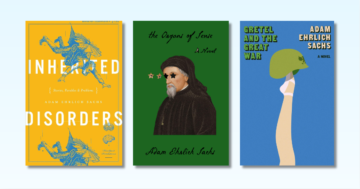
Difficult relationships between fathers and sons have been fodder for writers for millennia. Sometimes these relationships are simply power struggles, as in so many Greek myths, such as the conflicts first between Uranus and his son Cronus and later Cronus and his son Zeus. Or their conflicts are representative of social strife, as in Ivan Turgenev’s Fathers and Sons. And other times, like in many of Franz Kafka’s most famous works, they’re about, well, Kafka. But no one writing today has explored the mercurial nature of the father-son relationship with more humor and fresh insight than Adam Ehrlich Sachs. Now, with the publication of his third book, Gretel and the Great War, Sachs is broadening his canvas to put this core dynamic in the context of social upheaval, obsession, and, above all, legacy.

For those unfamiliar with Sachs, reading his three books in chronological order offers an opportunity to see a writer honing his voice and developing a unique style. But perhaps the best way to appreciate Sachs, particularly his growth as a storyteller, is to examine the three literary father figures who have each had an increasingly significant influence on his works, beginning with Kafka.

more here.

Enjoying the content on 3QD? Help keep us going by donating now.
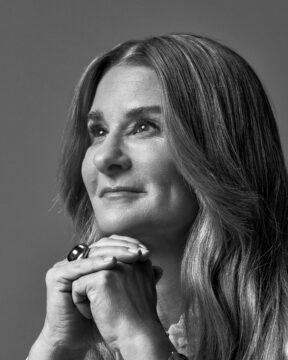
Melinda French Gates Is Going It Alone

Belinda Luscombe in Time Magazine:

The early days of the pandemic were a complicated time for a lot of couples.

But it’s fair to say that in the sprawling, Pacific lodge-style home of Melinda and Bill Gates, the complexity was particularly acute. The foundation the couple co-led had been running a flu study in their hometown of Seattle, which had detected early cases of COVID-19 in the region. There were video calls with infectious-disease specialists they funded, world leaders, epidemiologists, journalists, and public-health officials. Two of their three children were home from school full time. Plus, the couple was secretly separated, trading off who lived at the family house and who was elsewhere while they tried to figure out if they could stay married.

“It was a super intense time for us as a foundation,” says Melinda French Gates, sitting in her industrial-chic office in Kirkland, Wash., three days after exiting the world-changing organization that bore her name for almost 25 years. “The other thing I would say, though, is, unusually, it gave us the privacy to do what needed to be done in private. You know, I separated first before I made the full decision about a divorce. And to be able to do that in private while I’m still trying to take care of the kids, while still making certain decisions about how you’re going to disentangle your life—thank God.”

More here.

Enjoying the content on 3QD? Help keep us going by donating now.

Stem cells reverse woman’s diabetes — a world first

Smriti Mallapaty in Nature:

A 25-year-old woman with type 1 diabetes started producing her own insulin less than three months after receiving a transplant of reprogrammed stem cells1. She is the first person with the disease to be treated using cells that were extracted from her own body. “I can eat sugar now,” said the woman, who lives in Tianjin, on a call with Nature. It has been more than a year since the transplant, and, she says, “I enjoy eating everything — especially hotpot.” The woman asked to remain anonymous to protect her privacy.
James Shapiro, a transplant surgeon and researcher at the University of Alberta in Edmonton, Canada, says the results of the surgery are stunning. “They’ve completely reversed diabetes in the patient, who was requiring substantial amounts of insulin beforehand.” The study, published in Cell today, follows results from a separate group in Shanghai, China, who reported in April that they had successfully transplanted insulin-producing islets into the liver of a 59-year-old man with type 2 diabetes2. The islets were also derived from reprogrammed stem cells taken from the man’s own body and he has since stopped taking insulin.

More here.

Enjoying the content on 3QD? Help keep us going by donating now.

George Grant And Conservative Social Democracy

George Dunn at Compact Magazine:

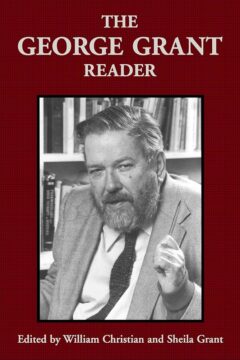
George Parkin Grant, who died in 1988 at the age of 69, was world-famous in Canada—at least, that was the jest frequently made at the philosopher’s expense. The joke reflected his status as a public intellectual who made frequent appearances on Canadian Broadcast Corporation radio programs but never attracted much attention south of the 49th parallel. There are many reasons for his obscurity outside his home country, but one cause was surely his intense Canadian nationalism, coupled with his outspoken criticism of the form of liberalism he saw embodied in the hegemon to the south.
Next year will mark the 60th anniversary of one of Grant’s most influential works, Lament for a Nation: The Defeat of Canadian Nationalism. In it, he rebuked Canada’s political establishment for bowing to pressure from the Kennedy administration to accept nuclear missiles on Canadian soil. This capitulation to Washington, he prophesied, heralded the demise of Canadian sovereignty and ensured its absorption into its southern neighbor as a “branch-plant satellite” of the emerging universal empire helmed by the United States. But the loss of Canadian sovereignty was only a local episode in a broader process that was erasing cultural particularity across the globe. Liberals trumpet diversity, but Grant argued that our global civilization would permit pluralism only in private pursuits.

more here. (h/t Cynthia Haven)

Enjoying the content on 3QD? Help keep us going by donating now.

Sunday, September 29, 2024

The value of our values

Alexander Prescott-Couch in Aeon:

In Human, All Too Human (1878), Friedrich Nietzsche wrote that ‘A lack of historical sense is the original failing of all philosophers.’ In accusing philosophy of lacking historical sense, Nietzsche was echoing broader trends in 19th-century thought. In comparison with the ‘philosophical’ 18th century, the 19th century is sometimes described as the ‘historical’ century, one in which investigation into more universal features of human reason gave way to increased focus on how particular historical trajectories influence language, culture and moral assumptions.

The 19th century is also what one might call the ‘philological century’. Philology is the critical study of written sources, including their linguistic features, history of reception and cultural context. Today, the term sounds outmoded, evoking dusty, learned tomes of fastidious source criticism. However, philology was a leading intellectual discipline in 19th-century Germany due to a flurry of methodological developments that revolutionised our understanding of ancient and sacred texts. New rigorous techniques of verifying sources were developed, merely speculative hypotheses were discouraged, more detailed comparative studies of language were conducted. While such methods were scholarly, sometimes bordering on scholastic, their application had significant cultural impact, spilling out of scholarly journals into broader public consciousness.

More here.

Enjoying the content on 3QD? Help keep us going by donating now.

Singularity

Benjamin Kunkel in Sidecar:

The great Marxist critic Fredric Jameson, who died on Sunday at 90, cast a cold eye on death. Death in our society derives its glamour and pathos from representing the extinction of an allegedly unique, not just solitary but singular individual, once upon a time ideal-typically a ‘genius’ or ‘hero’ and today more often a celebrity. And Jameson would have none of this. What I mean will take a moment to explain.

Generally speaking, this determinedly utopian thinker adhered to the ban on graven images of utopia enunciated by Adorno, and refrained in his analysis of various classical and sci-fi utopias from speculation of his own about the lineaments of an ideal society. But his reticence was not absolute, and, in a handful of places within his massive body of writing, Jameson presents the deprecation of personal mortality as a feature of Utopia (his majuscule). One striking instance lies in his essay, in The Seeds of Time (1994), on Andrei Platonov and the Soviet novelist’s utopian picaresque Chevengur. The thought of Utopia, Jameson says, ‘obliges us to confront the most terrifying dimension of our humanity, at least for the individualism of modern, bourgeois people, and that is our species being, our insertion in the great chain of the generations, which we know as death. Utopia is inseparable from death in that its serenity gazes calmly and implacably away from the accidents of individual existence and the inevitability of its giving way: in this sense it might even be said that Utopia solves the problem of death, by inventing a new way of looking at individual death, as a matter of limited concern, beyond all stoicism.’

More here.

Enjoying the content on 3QD? Help keep us going by donating now.

What Was Bidenomics?

Andrew Yamakawa Elrod in Phenomenal World:

The Biden administration first embraced the slogan of “modern supply-side economics” six months before anyone uttered the phrase “Inflation Reduction Act.” Speaking before the World Economic Forum in January 2022, Treasury Secretary Janet Yellen explained that what distinguished the Biden administration’s “modern supply-side economics” from the Reagan-era variety was its program to raise labor-force participation and productivity through government spending and increased taxation of capital—to create a “supply-side expansion…that distributes expanding national income more equally.” “Three aspects of the Biden agenda” would address “longer-term structural problems, particularly inequality”: reform of key social-service industries such as elder and childcare, increased public expenditure on education, and corporate taxes. All that remained, Yellen declared, was passage of “the Build Back Better legislation that remains under consideration in Congress.”

Six months later, congressional reality parlayed “modern supply-side economics” into something else entirely. Speaking in Detroit in September 2022, Yellen outlined three different pillars that defined the administration’s “modern supply-side” approach. In place of increasing labor-force participation through paid-leave requirements, child-care price caps, public pre-K classes, and nursing-home reform, there was “resilience to global shocks.” Where there had been community-college funding to raise labor productivity, there were now business subsidies for “expanding productive capacity.” Rather than raising corporate taxes, there was now “economic fairness.” The meaning of “modern supply-side economics,” Yellen explained, was about “reducing economic and national security risks” posed by “countries like China.”

How did this transformation occur?

More here.

Enjoying the content on 3QD? Help keep us going by donating now.

Sunday Poem

Lighten

Most people live in almost total darkness… people,
millions of people whom you will never see,
who don’t know you, never will know you,
people who may try to kill you in the morning
live in a darkness which — if
you have that funny terrible thing which
every artist can recognize, and no artist can define
— you are responsible to those people to lighten,
and it does not matter what happens to you.

James Baldwin
from Poetic Outlaws

Enjoying the content on 3QD? Help keep us going by donating now.

Zig and Zag: The surprising origins and politics of equality

Samuel Moyn in The Nation:

In the chilling speech he gives at the end of the film Margin Call, Jeremy Irons says that no one should say they believe in equality, because no one really thinks it exists: The very idea camouflages the endurance of hierarchy in an essentially unchanging form. “It’s certainly no different today than it’s ever been,” he explains to an underling. “There have always been and there always will be the same percentage of winners and losers….

Yeah, there may be more of us than there’s ever been, but the percentages? They stay exactly the same.”

For many others, the response to the 2008 financial crisis was very different from Irons’s cynical response. The crisis led to more consciousness and criticism of inequality than had been seen in the past 50 years. Starting with Occupy Wall Street in 2011, large numbers of Americans concerned about the ascendancy of the “1 percent” eventually consolidated around Bernie Sanders’s presidential campaigns in 2016 and 2020. During these years, the French economist Thomas Piketty provided the reading public with evidence that vindicated the movement: In Capital in the Twenty-First Century, published in English in 2014, he confirmed that economic inequality had been rising across the North Atlantic world. Piketty also showed that the situation was simultaneously worse and better than the way Irons had characterized it in Margin Call: Capitalism’s inherent dynamics generally increased inequality, he argued, but political mobilizations could bring about its reduction.

More here.

Enjoying the content on 3QD? Help keep us going by donating now.

Zadie Smith is ruthless about getting rid of books

Sophia Nguyen in The Washington Post:

Zadie Smith did not understand why anyone would be interested in her bookshelves.

“I think the problem is, I feel like interiors and books are used as a kind of social and political capital, meant to express something about you. But I just don’t have time,” she said. “I’m aware, when I go to certain writers’ studies, they’re beautiful and everything is perfect. That kind of energy, I can only put into writing.”

Smith; her husband, the poet and novelist Nick Laird; and their children moved to north London in 2020, and much of their library has yet to be unpacked. “Every box you open, it’s like — ah, well, here we are, a pile of books for babies. And I don’t have babies anymore.” Generally, aside from the art books and graphic novels and other volumes still in storage, she is unsparing about the books that circulate in the house, which arrive by the dozens in the mail. “The annoying thing is that some of my favorite new books, I read them and then I put them out again. There’s been a lot of good debuts recently, but they come and go.”

More here.

Enjoying the content on 3QD? Help keep us going by donating now.

Friday, September 27, 2024

The Double-Agent War Hero Who Helped Japan Attack Pearl Harbor

Francis P Sempa in the Asian Review of Books:

Frederick Rutland

Tokyo-based American author Ronald Drabkin has written a riveting, fast-paced account of a Beverly Hills-based spy who engaged in intelligence collection for Japan and provided the Japanese Navy with naval aviation technical expertise before Japan’s attack on American ships, planes and forces at Pearl Harbor. Frederick Rutland was a British naval hero in the First World War, worked for the Japanese Navy in the years between the wars, and had connections to American intelligence agencies in the lead-up to Pearl Harbor. Months before the attack at Pearl Harbor, Rutland offered his services to the United States and Britain when he sensed that a surprise Japanese attack was in the offing. After Pearl Harbor was attacked, Rutland was interned in a British prison and later on the remote Isle of Man as an enemy spy. A few years after the war, then living in Wales, Rutland either committed suicide or was murdered; Drabkin isn’t sure which.

More here.

Enjoying the content on 3QD? Help keep us going by donating now.

Is Spacetime Unraveling?

Peter Woit at Not Even Wrong:

One lesson of the development of our best fundamental theory is that the new ideas that went into it were much the same ideas that mathematicians had been discovering as they worked at things from an independent direction. Our currently fundamental classical notion of spacetime is based on Riemannian geometry, which mathematicians first discovered decades before physicists found out the significance for physics of this geometry. If the new idea is that the concept of a “space” needs to be replaced by something deeper, mathematicians have by now a long history of investigating more and more sophisticated ways of thinking about what a “space” is. That theorists are on the road to a better replacement for “space” would be more plausible if they were going down one of the directions mathematicians have found fruitful, but I don’t see that happening at all.

To get more specific, the basic mathematical constructions that go into the Standard Model (connections, curvature, spinors, the Dirac operator, quantization) involve some of the deepest and most powerful concepts in modern mathematics. Progress should more likely come from a deeper understanding of these than from throwing them all out and starting with crude arguments about holograms, tensor networks, or some such.

More here.

Enjoying the content on 3QD? Help keep us going by donating now.

Want to End Poverty? Focus on One Thing.

Rajiv Shah in the New York Times:

The data shows that trying to make modest improvements on all issues is not working. It is only diffusing already thin resources.

As world leaders gather this week for the United Nations General Assembly they should reimagine their approach. In today’s digital world, nothing matters more to individual well-being than energy: Access to electricity determines fundamental aspects of individuals’ lives, like whether they are healthy or have a job.

Instead of treating electrification as one of many goals, it’s time to see it is essential to all of them. And that means the world needs to focus investment and effort on getting reliable, clean electricity to the nearly 700 million people who don’t have any — and the 3.1 billion more who don’t have enough.

More here.

Enjoying the content on 3QD? Help keep us going by donating now.

How Hyperpop Became a Force

Emma Madden at Billboard:

Canonized by a team of Spotify editors, including Lizzy Szabo in the summer of 2019, ‘Hyperpop’ was a term taken from Szabo’s data science colleague Glenn McDonald, in an attempt to contextualize the growing traction surrounding an internet infected duo named 100 gecs, and the scene of like minded musicians who seemed to be forming around them. Artists operating under the Hyperpop rubric — from established stars like Charli XCX to Gen Z newcomers like osquinn and ericdoa — have concurrently played a hand in boosting it from a niche internet scene to a viral talking point, having received unexpected cosigns from the likes of YouTuber pewpiedie and and EDM superproducer Skrillex. Practitioners seek to accelerate and exaggerate pop music to the point of abrasion and absurdity. And while no formal genre conventions truly exist across its spectrum — much like Spotify’s playlist, Hyperpop is scene-led rather than genre-led — a prototypical song will usually sound like the meeting point between experimental sound design and EDM influenced pop from the 2010s.

Unlike punk, emo, grunge, psychobilly, this niche that’s been called “Hyperpop” for at least the past year and a half is keen to reach the mainstream, albeit through experimental means.

more here.

Enjoying the content on 3QD? Help keep us going by donating now.

Friday Poem

All the Carefully Measured Seconds

Back then I still believed it was possible
to prevent certain things, until that hot afternoon.
It was the middle of grain harvest, August of ’54,
when Fred climbed down from his stalled combine
and took off to Montrose to buy a part.
Later I realized that the part was a ruse of fate, like
something made up to get someone to a surprise party.
So many times I reran those last hours,
adding or subtracting a few seconds here or there.
Lingering a moment in the field, he could have
noticed the grain shiver as a cloud passed by,
he could have paused by the barn to admire the blue
and lavender flecks adorning the pigeon’s throats,
he could have stopped by the house to finger
the soft leaves of the African violets
on the sill, he could have slipped his arm
around Ella’s waist as she stood at the sink,
her hands in the dishwater.
But, he swatted the grain dust from his overalls
and climbed into his green Buick to keep
his appointment on Highway 38. Even then,
it was not too late. He could have floored
the car just this once, he could have let
the wind rush in, raising his sparse strands
of matted hair to dance in the breeze.

When I saw Fred’s car again, it looked as if
it had been punched by the fist of some god
though surely not the same one who keeps
the earth spinning, the sun and moon rising,
passion ascending to fuse new life,
the rose unfolding with tenderness,
the worm tilling the orchard floor,
all the carefully measured seconds
adding up exactly to us.

by Josephine Redlin
from
Ploughshares- Spring 1995

Enjoying the content on 3QD? Help keep us going by donating now.